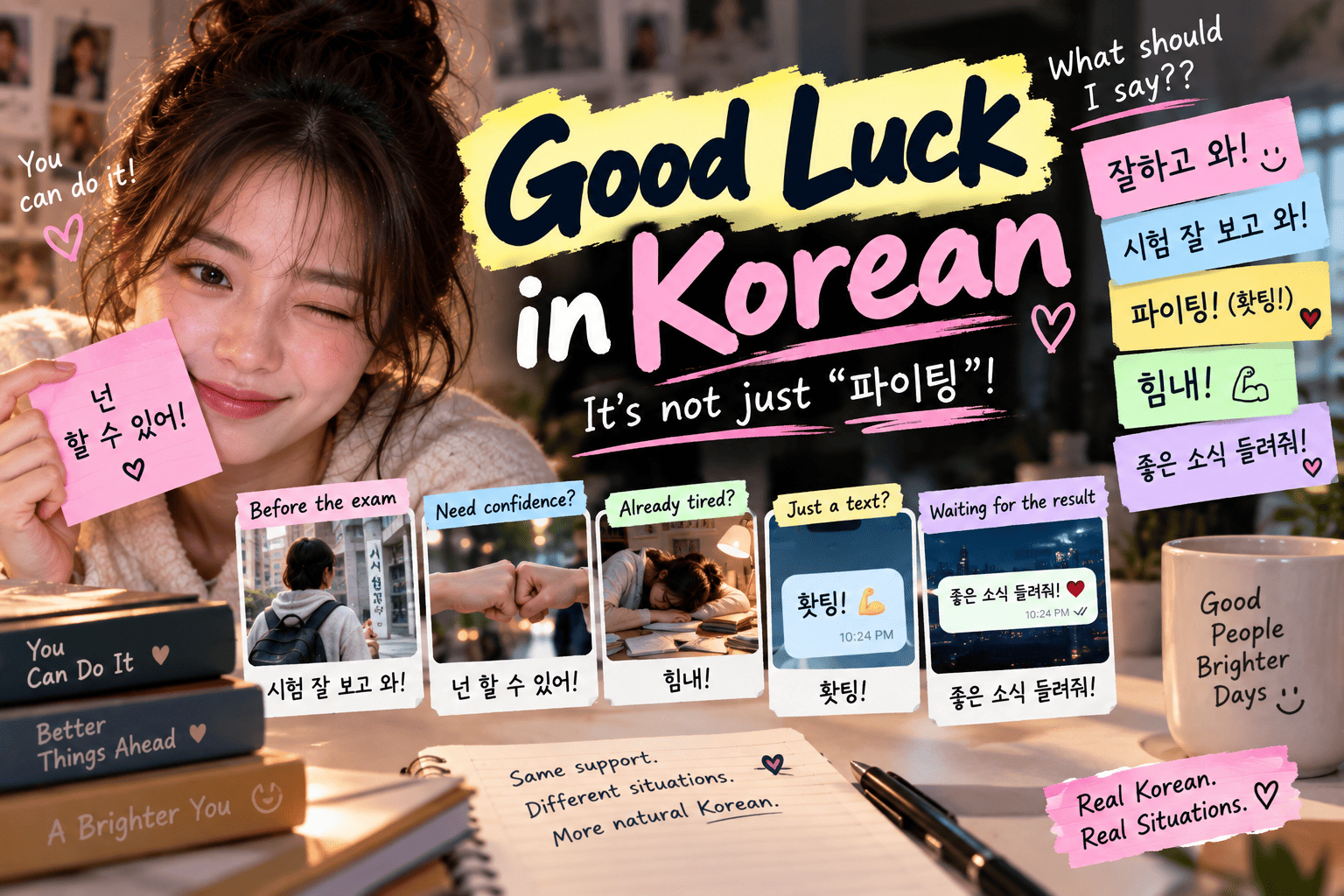
Good Luck in Korean: What Koreans Actually Say Before an Exam, Interview, or Tough Day
Before my girlfriend Sua takes an exam or goes to an interview, I rarely say anything that literally means “I wish you luck.”
I usually say something much simpler:
시험 잘 보고 와. (siheom jal bogo wa.)
“Do well on your exam.”
잘하고 와. (jalhago wa.)
“Go do well.”
And if she looks nervous, I might add, 잘할 수 있지? (jalhal su itji?) — “You can do it, right?”
When I am the one taking an exam, I remember people telling me something different:
좋은 소식 들려줘! (joeun sosik deullyeojwo!)
“Bring me good news!” 🍀
No one mentioned luck. Still, I knew exactly what they meant.
That is probably the most useful thing to know about good luck in Korean. The natural sentence often depends less on “luck” and more on what the person in front of you needs right now.
Sometimes Korean Does Not Talk About Luck at All
행운을 빌어. (haenguneul bireo.) really does mean “I wish you luck.” It is perfectly understandable Korean.
But in my own everyday speech, I am much more likely to talk about the thing the person is about to do.
An exam?
시험 잘 보고 와.
An interview?
면접 잘 보고 와. (myeonjeop jal bogo wa.)
A presentation?
발표 잘하고 와. (balpyo jalhago wa.)
Actually, this feels less like wishing for luck and more like giving someone a small push from behind before they walk through the door.
If Sua Is Nervous, My Words Change
There are days when the exam or interview itself is not really the problem. She is just nervous.
Then I am more likely to say:
잘할 수 있지?
“You can do it, right?”
or
넌 할 수 있어. (neon hal su isseo.)
“You can do it.” 💪
When I say 잘할 수 있지?, I am not actually checking whether she has the ability. I already want the answer to be yes.
It is encouragement wearing the shape of a question.
힘내 Is What Comes Out When Someone Is Already Tired
If someone has been studying for hours, having a rough day at work, or slowly running out of energy, I would probably not talk about luck at all.
I would say:
힘내. (himnae.)
And very often:
힘내. 넌 할 수 있어. (himnae. neon hal su isseo.)
“Hang in there. You can do it.”
The interesting part is that the situation can still be the same exam.
Someone walking confidently into the exam room might hear 잘하고 와. Someone who looks exhausted before getting there might hear 힘내.
Same exam. Different person in front of me.
Fighting in Korean Does Not Really Mean “Fight”
If you search fighting in Korean, you will quickly run into 파이팅 (paiting).
In Korean, it works as a cheer. Depending on the moment, English might translate it as “You’ve got this,” “Let’s go,” or “Good luck.”
Nobody is asking you to start a fight.
파이팅 is the standard spelling. In everyday messages, however, you will also see 화이팅 and shorter forms.
I Thought About It and Realized I Mostly Type 홧팅
This was something I had never really noticed until I thought about how I actually talk.
I do use 파이팅 with friends. But I do not say it out loud nearly as often as I expected.
In messages, though?
홧팅! (hwatting!) 📱
That comes very naturally.
I might send:
시험 잘 보고 와. 홧팅!
Face to face, I am more likely to say 잘하고 와 or 힘내.
Well, that is only my own habit. It is not a rule for every Korean speaker. But if you searched hwaiting meaning after seeing it in a text message, this difference between a dictionary form and the way people actually type is worth noticing.
“좋은 소식 들려줘” Has a Completely Different Feeling
Of all these expressions, 좋은 소식 들려줘 is the one I find most interesting.
Someone said it to me before an exam.
Literally, it is close to:
“Let me hear some good news.”
But emotionally, the sentence has already jumped past the test.
The stressful part is not even the focus anymore. The speaker is imagining me coming back later with something positive to tell them.
There is a little confidence hidden inside that sentence.
Not “Maybe you’ll get lucky.”
More like, “I’m waiting to hear that it went well.”
So What Would I Actually Say?
Okay, imagine four people.
One is walking into an exam room. I would probably say 잘 보고 와.
One is nervous and doubting herself. I might say 넌 할 수 있어.
One has been studying all night and looks exhausted. 힘내 feels warmer.
And one is a friend I am texting quickly before the test. That message might simply end with 홧팅!
That is why good luck in Korean does not feel like one vocabulary answer to me.


