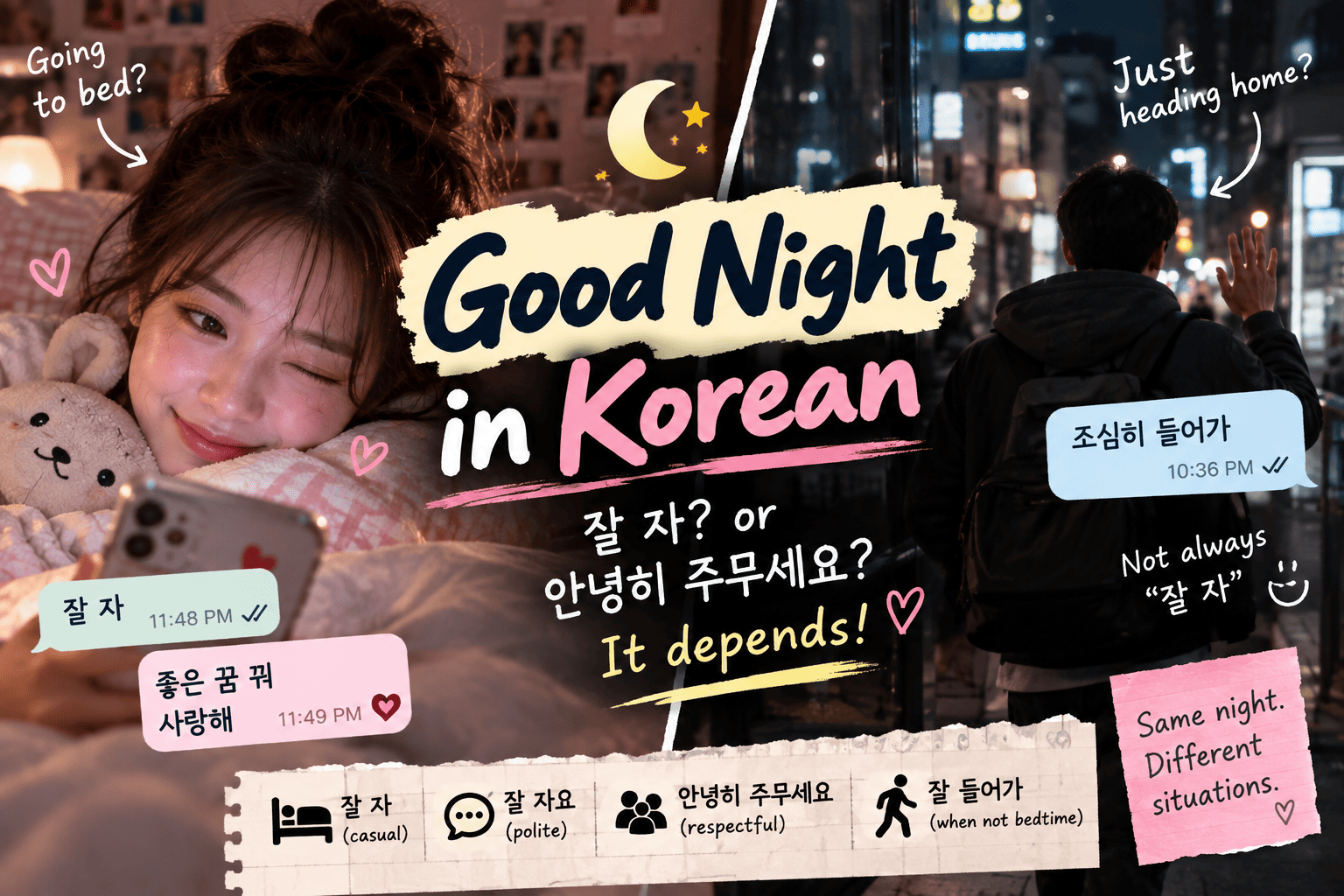
Good Night in Korean: 잘 자 vs 안녕히 주무세요—and What to Say When It’s Not Bedtime
A pillow and a subway exit can both appear late at night. Only one of them is really a bedtime scene.
Picture this: your partner texts, “I’m going to sleep.” You reply, 잘 자. (jal ja.) Later, a friend leaves a late dinner and heads for the subway. This time, 조심히 들어가. (josimhi deureoga.) — “Get home safely” — may fit much better. 🌙
English can use “good night” in both kinds of moments. Korean usually pays more attention to what happens next. That is the most useful idea to remember when learning good night in Korean.
The First Question Is Not “How Polite?”
Many beginner guides start with a simple ladder: 잘 자 is casual, 잘 자요 is polite, and 안녕히 주무세요 is respectful.
That is useful, but there is an earlier question:
Is the person actually going to bed?
If yes, a bedtime expression makes sense. If the person is simply leaving at night, Korean often chooses a going-home expression instead.
Actually, the clock matters less than the next action.
Jal Ja Meaning: A Real Bedtime Phrase
The basic jal ja meaning becomes easy once you look inside the phrase.
잘 (jal) means “well,” and 자 (ja) is a casual form of 자다 (jada), “to sleep.”
So 잘 자 is close to “Sleep well.” In natural English, “Good night” is often the easiest translation.
잘 자 (jal ja)
This is casual. It fits someone you already speak casually with, such as a close friend, sibling, or romantic partner.
잘 자. 내일 봐. (jal ja. naeil bwa.)
“Good night. See you tomorrow.”
잘 자요 (jal jayo)
잘 자요 keeps the same sleep idea but uses a polite ending.
It can work when you want some politeness without using the honorific verb 주무시다. The relationship still matters, so it is better not to treat 잘 자요 as a phrase that automatically works with everyone older than you.
Annyeonghi Jumuseyo Meaning: The Verb Changes Too
The important part of annyeonghi jumuseyo meaning is that this is not simply 잘 자 with extra politeness added at the end.
주무시다 (jumusida) is the honorific form of 자다 (jada), “to sleep.”
안녕히 주무세요. (annyeonghi jumuseyo.)
“Good night.” / “Sleep well.”
안녕히 (annyeonghi) carries the sense of being peaceful and well. Together, the expression becomes a respectful bedtime greeting.
This is an important detail for learners: Korean respect can change the verb itself, not only the sentence ending.
Same House, Same Night, Different Direction of Respect
Imagine a parent and an adult child getting ready to sleep.
The parent might say to the child:
잘 자. (jal ja.)
The child might answer:
안녕히 주무세요. (annyeonghi jumuseyo.)
The time is identical. The topic is identical. What changed is who is speaking to whom. 👀
That is more useful than memorizing a chart labeled casual, polite, and formal without understanding the relationship behind it.
But What If Nobody Is Going to Bed?
This is where English “good night” can mislead Korean learners.
Suppose you finish dinner with a friend late in the evening. Your friend is not going to sleep. They still have to take the subway home.
You might say:
잘 들어가. (jal deureoga.)
“Get home safely.”
조심히 들어가. (josimhi deureoga.)
“Take care on your way home.”
내일 봐. (naeil bwa.)
“See you tomorrow.”
None of these is a literal translation of “good night.” They simply match the real situation better.
Well, natural Korean often becomes easier once you stop translating the English phrase first.
What About a Good-Night Text to Someone You Like?
A bedtime message can carry much more warmth than its dictionary meaning.
잘 자~ (jal ja~)
잘 자, 사랑해. (jal ja, saranghae.)
“Good night, I love you.”
좋은 꿈 꿔. (joeun kkum kkwo.)
“Sweet dreams.” 💫
These can feel especially warm in a close relationship. A small ending, an affectionate word, or the tone of a message can change how the whole sentence feels.
But 잘 자 itself is not automatically romantic. The relationship creates that extra meaning.
Two Nighttime Exits: Bed or Door
Instead of remembering a long list, imagine that every nighttime conversation has two possible exits.
The person is heading to bed
With someone close:
잘 자.
With some politeness:
잘 자요.
With someone you speak to respectfully:
안녕히 주무세요.
'Real Korean Language & Everyday Korea' 카테고리의 다른 글
| Thank You in Korean: What Comes After 감사합니다? (0) | 2026.09.20 |
|---|---|
| Goodbye in Korean: Why the Last Thing You Say May Not Mean “Goodbye” (0) | 2026.09.20 |
| Hello in Korean: When Does 안녕하세요 Become 안녕? (0) | 2026.09.20 |
| Good Luck in Korean: What Koreans Actually Say Before an Exam, Interview, or Tough Day (0) | 2026.09.20 |
| Welcome in Korean: 어서 오세요 vs 환영합니다—and What to Say After “Thank You” (0) | 2026.09.19 |
| I Miss You in Korean: Bogo Sipeo Meaning and When It Sounds Romantic (0) | 2026.09.19 |
| I Don’t Know in Korean: Molla Meaning, 모르겠어요, and What to Say When You’re Not Sure (0) | 2026.09.19 |
| Good Job in Korean: 잘했어, 수고했어요, or 고생했어요? (0) | 2026.09.19 |


