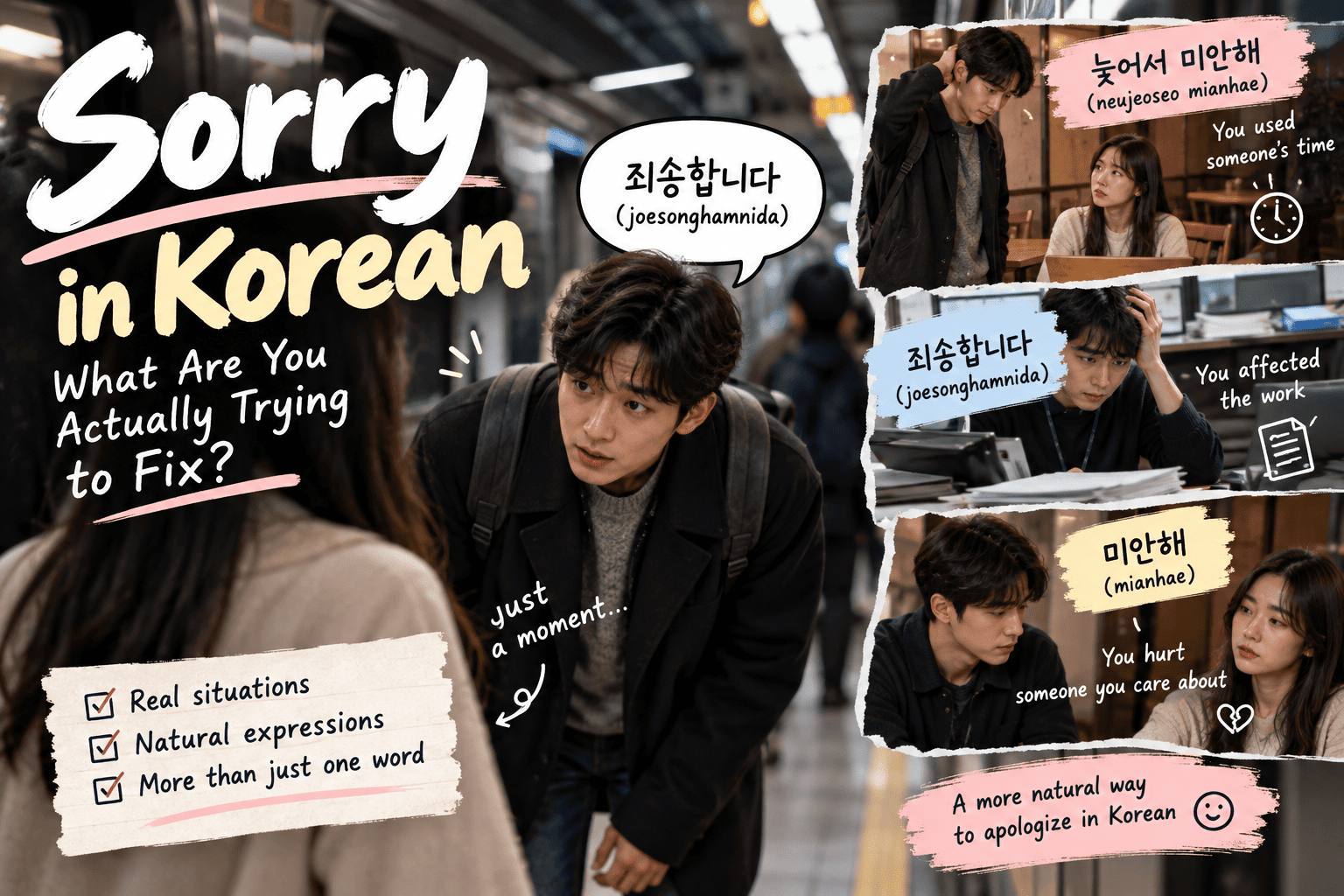
Sorry in Korean: What Are You Actually Trying to Fix?
You turn around too quickly on the subway and bump into someone.
죄송합니다 (joesonghamnida).
You move aside. They keep walking.
The whole apology lasts maybe three seconds.
Now imagine arriving twenty minutes late while your friend has been sitting alone at a café. Or realizing that something you missed at work has created extra work for somebody else.
English can begin all three moments with “Sorry.” Korean can too, in different forms. But the word itself is only part of what is happening.
Sometimes the mistake disappears as soon as you step out of the way. Sometimes there is still something left to fix. 🧩
The three-second sorry
For a beginner, 죄송합니다 (joesonghamnida) is one of the safest polite apologies to know.
With someone you are already close to, you may hear 미안해 (mianhae). 미안해요 (mianhaeyo) keeps the apology polite while sounding less formal than 죄송합니다 in many everyday situations.
You do not need seven apology levels running through your head every time something happens.
Someone is blocking your way because you accidentally stepped in front of them. You notice.
죄송합니다.
You move.
Done.
I have had ordinary moments like that too—brushing past someone, getting in the way, or realizing I was inconveniencing a stranger. There is usually no dramatic backstory. You notice the problem, apologize, and make space again.
A longer apology would not necessarily make that moment better.
An empty chair changes the size of the apology
Being late feels different.
I have been late when meeting my girlfriend, and I have had similar moments with friends. Nobody has to explain why the apology carries more weight than bumping shoulders with a stranger.
The other person has been sitting there.
Five minutes.
Ten.
Maybe longer.
When you finally arrive, 미안해 by itself may be enough in some relationships. In another moment, you might naturally say why you are sorry:
늦어서 미안해.
Neujeoseo mianhae.
“Sorry I’m late.”
The reason is now inside the apology instead of floating somewhere outside it.
You might explain what happened. You might not need a long explanation at all. That depends on the situation, the relationship, and how serious the delay actually was.
What you probably should not do is treat “Sorry” like a password that erases twenty minutes the second you say it. 🙂
Work has a different kind of mess
At work, the uncomfortable part is often very concrete.
A report needs to be corrected. A detail was missed. Something has to be checked again. In field work, one person’s preparation can affect the next person’s task.
I have worked with reports, measurement equipment, wiring, and field tasks where several pieces have to line up. I have also had moments where I needed to apologize because something had not gone as smoothly as it should have.
That kind of apology sounds strange if it ends with a beautiful 죄송합니다 and nothing else happens.
A simple example might be:
죄송합니다. 다시 확인해서 보내드리겠습니다.
Joesonghamnida. Dasi hwaginhaeseo bonaedeurigetseumnida.
“I’m sorry. I’ll check it again and send it back.”
The second sentence is not there to make the apology sound more impressive.
There is simply still a job sitting on the table.
Sometimes the useful sentence is about the next action
A missing item in a report may need to be added.
A wrong value may need to be checked.
A piece of equipment may need another look.
If another person is now waiting on you, telling them what you are going to do next can matter more than searching for a stronger version of “sorry.”
Well, that is one reason workplace apologies can feel very different from everyday ones. The conversation may be short, but the work continues after it.
A field mistake is not a bumped shoulder
Put two situations next to each other.
You brush against someone while walking.
Then imagine a field task where something you forgot makes another person stop and wait.
Both might begin with 죄송합니다.
After that, they separate.
In the first situation, stepping aside may finish the problem immediately.
In the second, somebody may still need information, a correction, another check, or a missing item.
I would not turn that into some special “Korean apology rule.” It is simply what happens when the mistake has consequences that continue after the apology.
The language follows the situation.
And then there are apologies you cannot repair with a file
Arguments are harder.
I have had moments with my girlfriend when something I said or did left me feeling that I needed to apologize. That is a very different feeling from realizing a report needs another edit.
You can reopen a document.
You can correct a number.
You cannot reopen a conversation and delete one sentence from five minutes ago.
So you might say:
미안해. 내가 말을 너무 심하게 했어.
Mianhae. Naega mareul neomu simhage haesseo.
“I’m sorry. I spoke too harshly.”
That is an example, not a transcript from one particular argument in my life.
The useful part is the shape of it. The apology names something real instead of asking 미안해 to carry the entire conversation alone.
And sometimes the other person is still upset afterward.
That can be uncomfortable, but it is also normal. Saying sorry does not create an obligation for somebody to feel better immediately.
Friends, cancelled plans, and the awkward message
Some apologies happen before you even see the other person.
You realize you cannot make it to a plan with a friend. Now you have to send the message.
미안해. 오늘 약속 못 갈 것 같아.
Mianhae. Oneul yaksok mot gal geot gata.
“I’m sorry. I don’t think I can make it today.”
Depending on what happened, you may add an explanation or suggest another day. Other times a short message is enough.
There is no benefit in padding every apology until it sounds like a customer-service email.
Actually, close relationships often make that especially obvious. People already know your normal voice. A strangely polished apology can sound more distant than a plain one.
What exactly got disturbed?
When I think about these situations together, I find it more useful to look at what the mistake touched.
Someone’s space
You bumped into them, blocked the way, or made a small physical mistake.
A quick 죄송합니다 and an immediate correction may be all the moment needs.
Someone’s time
You were late or made them wait.
The apology may need to acknowledge that delay.
The work itself
Something still has to be checked, corrected, resent, or finished.
Your next action becomes part of the conversation.
A relationship
You hurt somebody with something you said or did.
There may be nothing physical to fix at all, and the conversation might not end as neatly as you would like.
These are not four official categories of Korean apologies. They are simply a practical way to stop treating every 미안해 as though it were the same event.
Sometimes the apology is the wrong size
Imagine lightly bumping into somebody and saying:
정말 죄송합니다. 다시는 이런 일이 없도록 하겠습니다.
Jeongmal joesonghamnida. Dasineun ireon iri eopdorok hagetseumnida.
“I’m terribly sorry. I’ll make sure this never happens again.”
For a tiny accidental bump, that would be quite a lot. 😅
Now reverse it.
You caused a serious problem for someone and send:
미안.
Mian.
That can feel strangely small.
There is no perfect mathematical ratio between mistake and apology. People are different, relationships are different, and tone matters.
Still, we usually notice when the size is wildly off.
Before choosing the Korean word for sorry
Suppose something goes wrong tomorrow.
You may still need to decide between 죄송합니다, 미안해요, or 미안해. That choice matters.
But you can give yourself one extra second first.
Did I get in someone’s way?
Did I use their time?
Is there work left for me to correct?
Did I hurt someone I care about?
Then say what fits.
If there is something to fix, fix it.
If there is something worth explaining, explain it.
And if you simply bumped into someone on the subway?
죄송합니다.
Step aside.
Keep walking.


