One Question, Four Korean Answers: How 네, 예, 응, and 어 Feel Different in Real Conversation!
One Question, Four Korean Answers: How 네, 예, 응, and 어 Feel Different in Real Conversation
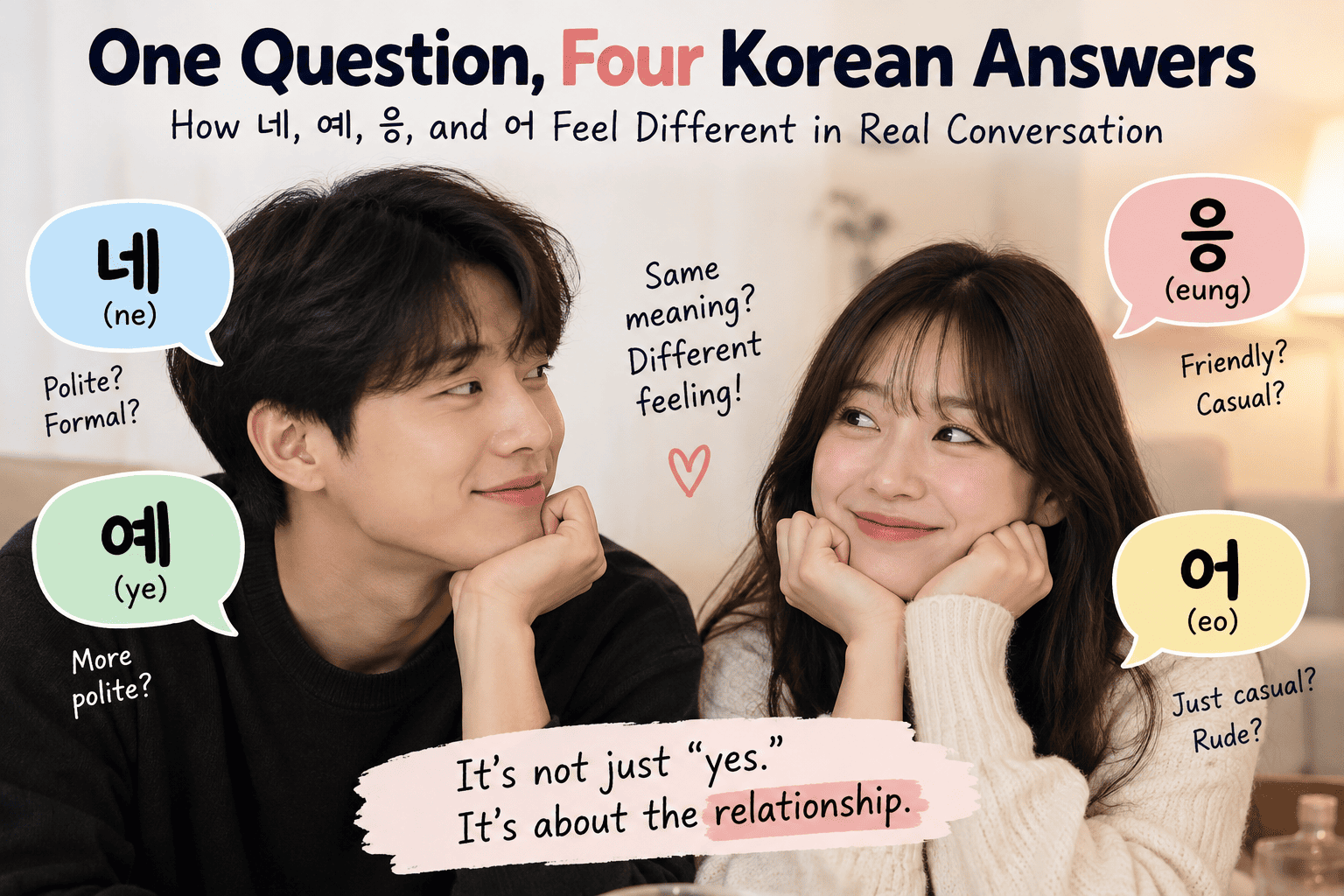
You learn your first Korean word for “yes”: 네 (ne).
Then real conversations become less simple. You hear 예 (ye). Friends answer each other with 응 (eung). Sometimes a Korean person responds with a short 어 (eo).
Now one English word seems to have four Korean answers.
It is tempting to solve the problem by memorizing four definitions: “네 means this, 예 means that, 응 feels friendly, and 어 feels more casual.” But Korean conversation does not divide itself that neatly.
A more useful question is not “Which Korean word means yes?”
It is “Who am I speaking to, and how do we normally speak to each other?”
That difference matters because 네, 예, 응, and 어 are not simply four interchangeable translations of “yes.” The relationship and speech level around them can change which answer feels natural.
Start With the Biggest Difference: Polite or Casual?
Before worrying about tiny differences between individual words, divide the four responses into two broad groups.
네 (ne) and 예 (ye) belong comfortably in polite conversation.
응 (eung) and 어 (eo) are associated with casual speech between people who can speak informally with each other.
This is more useful for a beginner than trying to memorize a personality for every word.
Imagine someone you have just met asks you a question politely. Answering with 네 is an easy, natural starting point. If your close friend asks you the equivalent question in casual Korean, 응 or 어 may fit the relationship much better.
The dictionary meaning may still be “yes.” The social fit is different.
The Same Answer Test: Change the Relationship, Not the Meaning
Let us keep the basic message the same: someone wants to know whether you are coming tomorrow.
Instead of studying 네, 예, 응, and 어 one by one, we can change the relationship and see what happens to the answer.
Round 1: Someone You Do Not Know Well
Imagine a person you recently met asks:
내일 오실 거예요? (naeil osil geoyeyo?)
Are you coming tomorrow?
A natural answer could be:
네, 갈게요. (ne, galgeyo.)
Yes, I’ll come.
You could also hear:
예, 갈게요. (ye, galgeyo.)
Yes, I’ll come.
Both 네 and 예 can function as polite affirmative responses. There is no need to invent a rule that says one of them is automatically polite while the other is automatically more polite.
The National Institute of Korean Language explains that both forms are acceptable when answering an elder or superior, or when giving an affirmative answer. Under the standard-language rule, 네 is treated as the primary form, while 예 is also allowed.
That matters for learners because you do not need to panic over whether 네 is “formal enough.” In an ordinary polite conversation, it is a normal response.
Round 2: A Close Friend
Now imagine your close friend asks:
내일 올 거야? (naeil ol geoya?)
Are you coming tomorrow?
A very natural casual answer could be:
응, 갈 거야. (eung, gal geoya.)
Yeah, I’m coming.
Or you might hear:
어, 갈 거야. (eo, gal geoya.)
Yeah, I’m coming.
The important difference is not that 응 and 어 contain a completely different type of “yes.” The conversation itself has moved into casual speech.
If the two friends normally use informal Korean with each other, the casual response fits the relationship.
Round 3: What If You Say 네 to a Close Friend?
This is where the difference between grammatically possible and socially expected becomes useful.
Suppose the same close friend asks:
내일 올 거야? (naeil ol geoya?)
And you suddenly answer:
네. (ne.)
The word itself has not become incorrect Korean.
But if you normally speak casually to each other, the sudden switch to a polite response can create an extra effect. Depending on the tone and relationship, it may sound deliberately formal, playful, stiff, or slightly distant.
That effect does not come from 네 secretly meaning “cold.” It comes from the fact that the speech style no longer matches what the two people normally use with each other.
Why 네 Can Feel Different With Someone Close
I notice this clearly in my own conversations with my girlfriend.
When she asks me something in everyday conversation, I naturally answer with 응 (eung) or 어 (eo). Neither of us normally needs to think about the grammar before responding. Those answers simply fit the way we speak to each other.
But if one of us suddenly replies with 네 (ne), the atmosphere can change for a moment.
Sometimes it sounds playful, almost as if we are pretending to be unusually polite with each other.
At other times, especially if the tone is serious, hearing 네 from her can give me a slight feeling of distance because it is different from our usual way of speaking.
For example:
오늘 같이 먹을래? (oneul gachi meogeullae?)
Do you want to eat together today?
A normal answer between us might be:
응. (eung.)
Yeah.
But:
네. (ne.)
Yes.
can feel intentionally formal in that same relationship.
This does not mean 네 is naturally cold or distant. I use 네 very naturally with people I do not know well and with people in more formal or senior relationships.
The contrast comes from what is normal between the two speakers.
That is an important lesson for Korean learners: sometimes the emotional effect of a word comes not from the word alone, but from a change in the relationship style surrounding it.
네 and 예: Do Not Create a Rule Korean Does Not Need
Learners sometimes encounter explanations such as:
네 = normal polite yes
예 = more formal or more respectful yes
That distinction may describe the preference of some speakers or some situations, but it should not be memorized as an absolute grammar rule.
The National Institute of Korean Language explicitly allows both 네 and 예 in the relevant affirmative-response function and treats them as synonymous in its learner dictionary.
For example, a manager might ask:
자료 확인했어요? (jaryo hwaginhaesseoyo?)
Did you check the document?
You could answer:
네, 확인했습니다. (ne, hwaginhaetseumnida.)
Yes, I checked it.
There is nothing inherently insufficiently polite about 네 here.
You may also hear:
예, 확인했습니다. (ye, hwaginhaetseumnida.)
Yes, I checked it.
For a learner, the practical point is simple: you do not need to treat 예 as an upgraded version of 네.
Listen to real speakers, notice the setting, and develop your preference gradually instead of forcing a rigid difference where Korean itself allows overlap.
응 and 어: Learn the Boundary Before the Tiny Nuance
The same caution applies to 응 (eung) and 어 (eo).
You may find explanations online that assign a fixed personality to each one: one is warmer, one is colder, one is softer, or one is more masculine.
Those shortcuts can become misleading very quickly.
Intonation matters. The sentence that follows matters. Personal speaking habits matter. Most importantly, the relationship between the speakers matters.
For a beginner, there is a more reliable lesson to learn first:
응 and 어 belong in casual conversational territory.
If you already speak informally with a close friend, sibling, partner, or another person with whom casual speech is established, hearing these responses is normal.
If you have just met someone and are still speaking politely, copying 응 or 어 simply because you heard them in a drama can create a mismatch.
You do not need to master every subtle difference on day one. First learn where casual responses belong. The finer details become much easier once you have enough real Korean conversations to hear differences in tone.
Why “Yes” Is Not the Full Meaning of 네
There is another reason why translating 네 only as “yes” can cause confusion.
Imagine someone at work calls your name:
현수 씨? (Hyeonsu ssi?)
Hyeonsu?
You respond:
네? (ne?)
Yes? / Did you call me?
You are not agreeing with a statement. There was nothing to agree with.
You are responding to someone who called you.
The National Institute of Korean Language’s learner dictionary specifically includes this function of 네: it can be used when answering the call of an elder or someone in a higher relationship.
It can also appear when you did not hear something clearly:
네? 다시 말씀해 주세요. (ne? dasi malsseumhae juseyo.)
Sorry? Please say that again.
Again, translating 네 mechanically as “yes” would miss what the speaker is doing.
This is why learning conversational Korean by English translation alone has limits. A short Korean response can perform a social action that English expresses differently.
Politeness Is About Relationships, Not Just Vocabulary
Korean learners often want a clean chart telling them exactly which word belongs to each type of person.
Real language is less mechanical.
The National Institute of Korean Language also notes that language etiquette cannot always be reduced to a fixed grammatical regulation. The relationship between speaker and listener and their normal language habits need to be considered.
This helps explain why the same 네 can feel completely ordinary with a manager but unexpectedly formal between two people who normally speak casually.
It also explains why you should be careful with rules such as:
“Always use this word with someone older.”
or:
“Never use that word with a friend.”
Age and social position can matter in Korean, but so can familiarity, established speech style, workplace culture, family habits, and the specific conversation.
A useful learner rule should help you enter a conversation safely without pretending that every Korean relationship follows one identical script.
A Two-Step Way to Choose Your Answer
If 네, 예, 응, and 어 still feel confusing, you do not need four complicated definitions.
Use two decisions.
Step 1: Are You Speaking Politely or Casually?
If you are already having a polite conversation, start in the 네 / 예 side of the system.
If you and the other person already speak casually to each other, 응 / 어 become natural possibilities.
This single distinction solves more real situations than memorizing a long list of supposed emotional differences.
Step 2: If You Are Unsure About the Relationship, Stay Polite
Imagine meeting another adult for the first time.
You are not sure about age, status, or how casually the person expects to speak.
You do not need to test the relationship by trying 응.
네 (ne) is a practical default response while the relationship is still unclear.
If the relationship later becomes close and the two of you agree, explicitly or naturally, to speak casually, your answers can change with it.
In other words, you do not need to predict the entire Korean social system before saying yes. You only need to recognize the speech style of the conversation you are already in.
Try the Choice Yourself
Instead of memorizing another vocabulary list, try choosing a response in each situation.
Situation 1: Your Manager Asks About a Task
이거 다 했어요? (igeo da haesseoyo?)
Did you finish this?
Which answer is the safest starting point?
네, 다 했습니다. (ne, da haetseumnida.)
Yes, I finished it.
The conversation is polite and work-related, so 네 fits easily.
예 could also be used. There is no need to switch to 예 because you believe 네 is not respectful enough.
Situation 2: Your Closest Friend Asks About Dinner
저녁 먹을래? (jeonyeok meogeullae?)
Do you want to have dinner?
A natural casual response could be:
응, 좋아. (eung, joa.)
Yeah, sounds good.
The important clue is not the topic of dinner. It is the casual relationship and the casual form of the question.
Situation 3: A New Acquaintance Asks If You Like Coffee
커피 좋아하세요? (keopi joahaseyo?)
Do you like coffee?
A safe answer is:
네, 좋아해요. (ne, joahaeyo.)
Yes, I do.
Using 응 simply because both words can translate to “yes” would ignore the polite speech level already established by the other person.
Situation 4: Your Partner Suddenly Answers 네
You ask casually:
오늘 같이 갈래? (oneul gachi gallae?)
Do you want to go together today?
Your partner normally answers with 응 or 어, but this time says:
네. (ne.)
Does 네 suddenly have a new dictionary meaning?
No.
What changed is the expected speech style. Depending on the tone, the switch might sound jokingly formal, deliberately distant, or simply unusual.
This is why relationship context tells you more than a four-word translation chart.
What a Beginner Actually Needs to Remember
You do not need to leave this article believing that 네, 예, 응, and 어 each have one fixed emotional personality.
That would replace one oversimplification with another.
Instead, remember the larger pattern.
네 (ne) is a reliable polite response and can also answer someone who calls you.
예 (ye) is also an accepted polite affirmative response; do not assume it is always a “higher” version of 네.
응 (eung) and 어 (eo) belong naturally in casual relationships, but their exact feeling can change with tone and individual speaking habits.
And when you are unsure which side of the relationship you are on, staying polite is usually a much safer starting point than guessing.
Choose the Relationship Before You Choose the Word
The most useful Korean “yes” is not the word with the neatest English translation.
It is the response that fits the conversation you are having.
With someone you have just met, 네 may feel completely ordinary. With a partner who normally hears 응 from you every day, the exact same 네 can suddenly sound unusually formal.
The word did not change.
The relationship around the word did.
So when choosing between 네, 예, 응, and 어, do not start by asking which one means “yes” most accurately.
Start by asking a simpler question:
How do this person and I normally speak to each other?
Once you can answer that, choosing the Korean response becomes much easier.