Cute in Korean, Who the Sentence Is Describing
Cute in Korean, Who the Sentence Is Describing
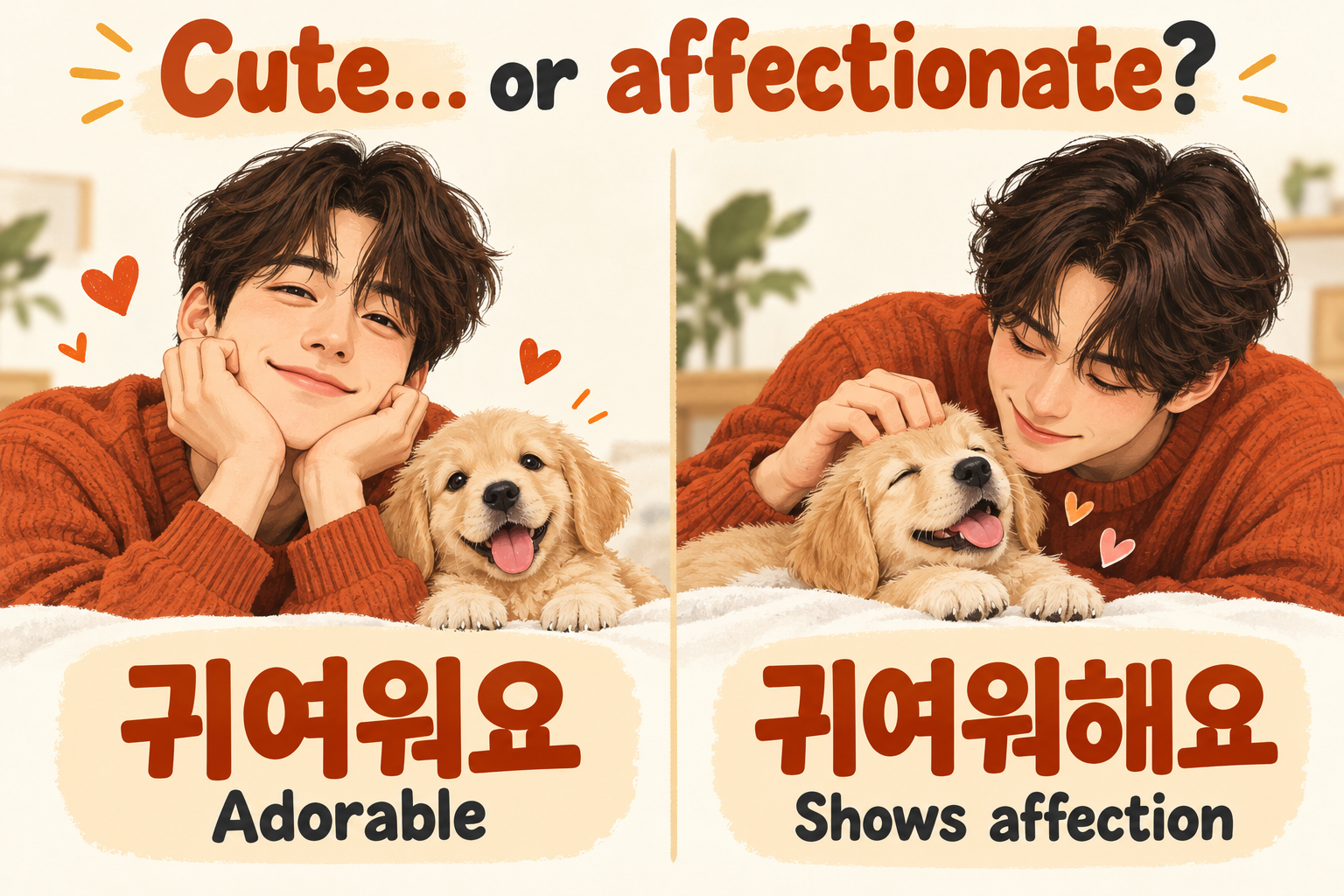
귀엽다 (gwiyeopda) means cute or adorable. To say it politely, use 귀여워요 (gwiyeowoyo). If the subject is clear from the conversation, that expression can stand alone.
A similar-looking verb, 귀여워하다, describes treating someone or an animal affectionately. Switching to this verb changes more than the ending: the person doing the action may no longer be the one being described as adorable.
How do you say cute in Korean in a sentence?
The National Institute of Korean Language’s learner dictionary lists the adjective’s forms. In these forms, the final ㅂ changes before -어요 and -은: 귀엽다 becomes 귀여워요 or 귀여운. Before -습니다, it stays: 귀엽습니다.
| Use | Form | Example |
|---|---|---|
| Casual comment | 귀여워 | 강아지가 귀여워. The puppy is cute. |
| Polite comment | 귀여워요 | 강아지가 귀여워요. |
| Formal polite comment | 귀엽습니다 | 강아지가 귀엽습니다. |
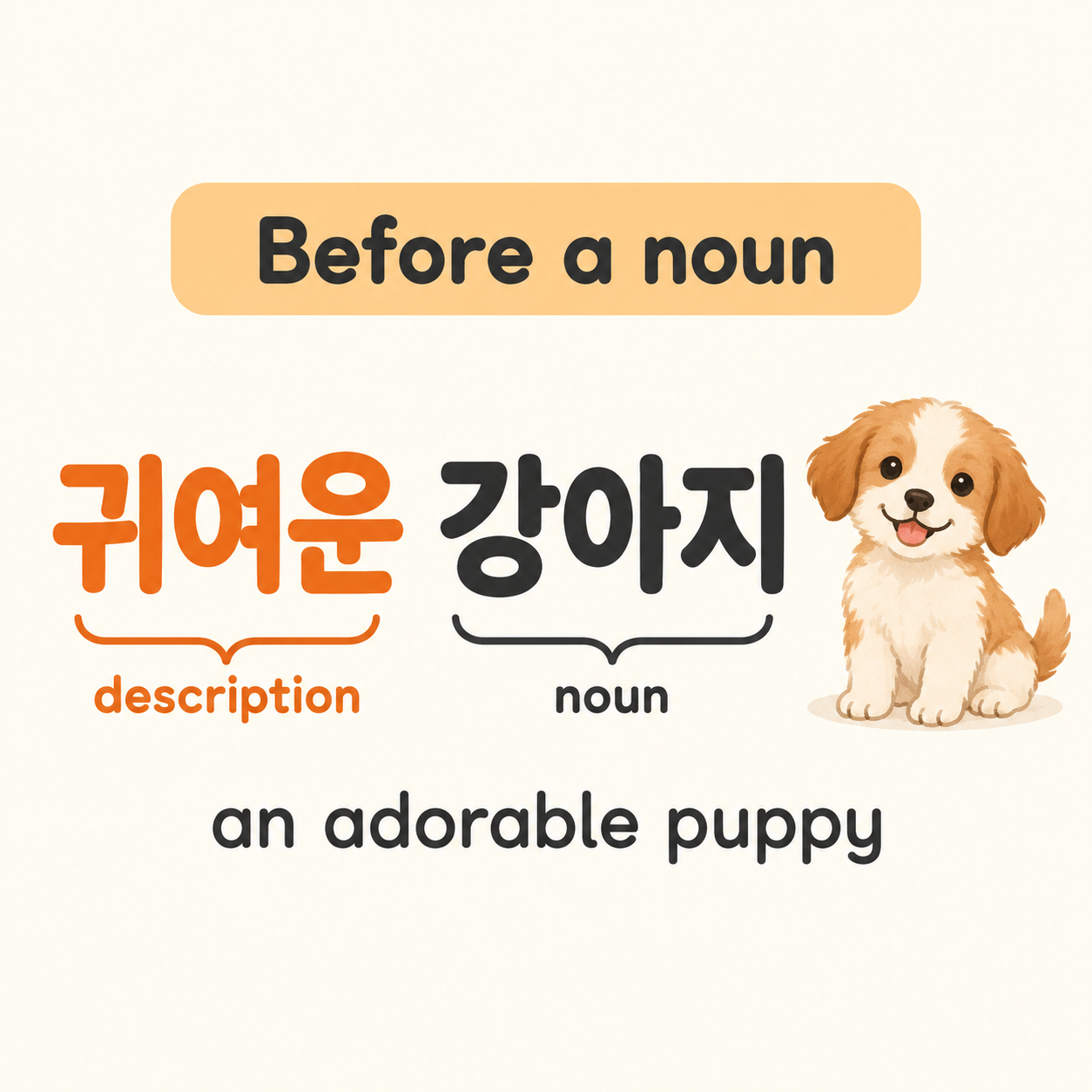
| Before a noun | 귀여운 | 귀여운 강아지 an adorable puppy |

Use the casual ending with someone you already speak casually to. In the last row, the description comes before 강아지, meaning puppy. The phrase names a puppy with that quality rather than making a complete comment about it.
The adjective can describe more than a face. The entry also gives examples involving speech, gestures and behavior.
Is Minsu adorable, or is he being affectionate?
Suppose you are translating these two lines about Minsu and a puppy:
- 민수가 귀여워요.
Minsu is adorable. - 민수가 강아지를 귀여워해요.
Minsu is affectionate toward the puppy.
In the first line, 민수가 identifies the person being described. In the second, the same name identifies the person acting affectionately. 강아지를 names the animal receiving that affection. The dictionary lists the verb and its object pattern separately from the adjective.
Translating the second line as Minsu is cute loses the puppy and changes Minsu’s role. Repair the translation by restoring the action and its recipient. The line tells you how he treats the puppy; it does not call Minsu adorable.
귀여워해요 is a form of that verb. It is not a more polite version of 귀여워요. Both examples end politely, but only the second reports someone directing affection toward another.

Does the related verb exclude adults from the adjective?
The verb entry describes affection toward a person younger than oneself or toward an animal. The adjective’s entry does not carry that same age restriction. A shared word shape is not a reason to copy every part of one definition into the other. Younger than oneself does not mean a child; two adults can differ in age.
In a June 10, 2025 answer, the institute says the dictionary does not prohibit using 귀엽다 toward seniors. It separately cautions that evaluating a senior’s appearance or character may be considered inappropriate. That social concern does not make the description a dictionary error.
Translate the action without reversing it
Now imagine two captions for a photo of Minsu with his younger sibling. One should say that the sibling is adorable. The other should say that Minsu treats the sibling affectionately. Here 동생 means younger sibling. A draft uses 동생이 귀여워요. for both captions. Which caption can keep it? Write a different Korean sentence for the other before opening the answer.
Check both captions
Keep 동생이 귀여워요 for the sibling’s description: The younger sibling is adorable. For Minsu’s action, use 민수가 동생을 귀여워해요: Minsu treats his younger sibling affectionately. Changing only the predicate of the first sentence would leave the sibling as the actor. The second caption needs 민수가 for the actor and 동생을 for the recipient as well as the verb.