Excuse Me in Korean: Getting Attention and Asking Your Question
Excuse Me in Korean: Getting Attention and Asking Your Question
Why One English Phrase Has Several Korean Expressions
Imagine that you are in a Korean restaurant and want to ask a server for another glass of water. You look around, catch the server's attention, and say something before making your request. What should you say? The answer depends on the situation, your relationship with the listener, and what you want to do next.
English speakers often use “excuse me” for several purposes: calling someone, politely interrupting, asking for directions, or requesting a moment of attention. Korean handles these situations with expressions such as 저기요, 실례합니다, and 잠시만요. They overlap in some situations, but they are not interchangeable in every conversation.
Learning excuse me in Korean starts with understanding the purpose of the expression rather than memorizing one English-to-Korean translation. You need to know whether you are calling someone from a distance, approaching a stranger, or asking someone to pause briefly. You also need a natural question to follow the opening expression.
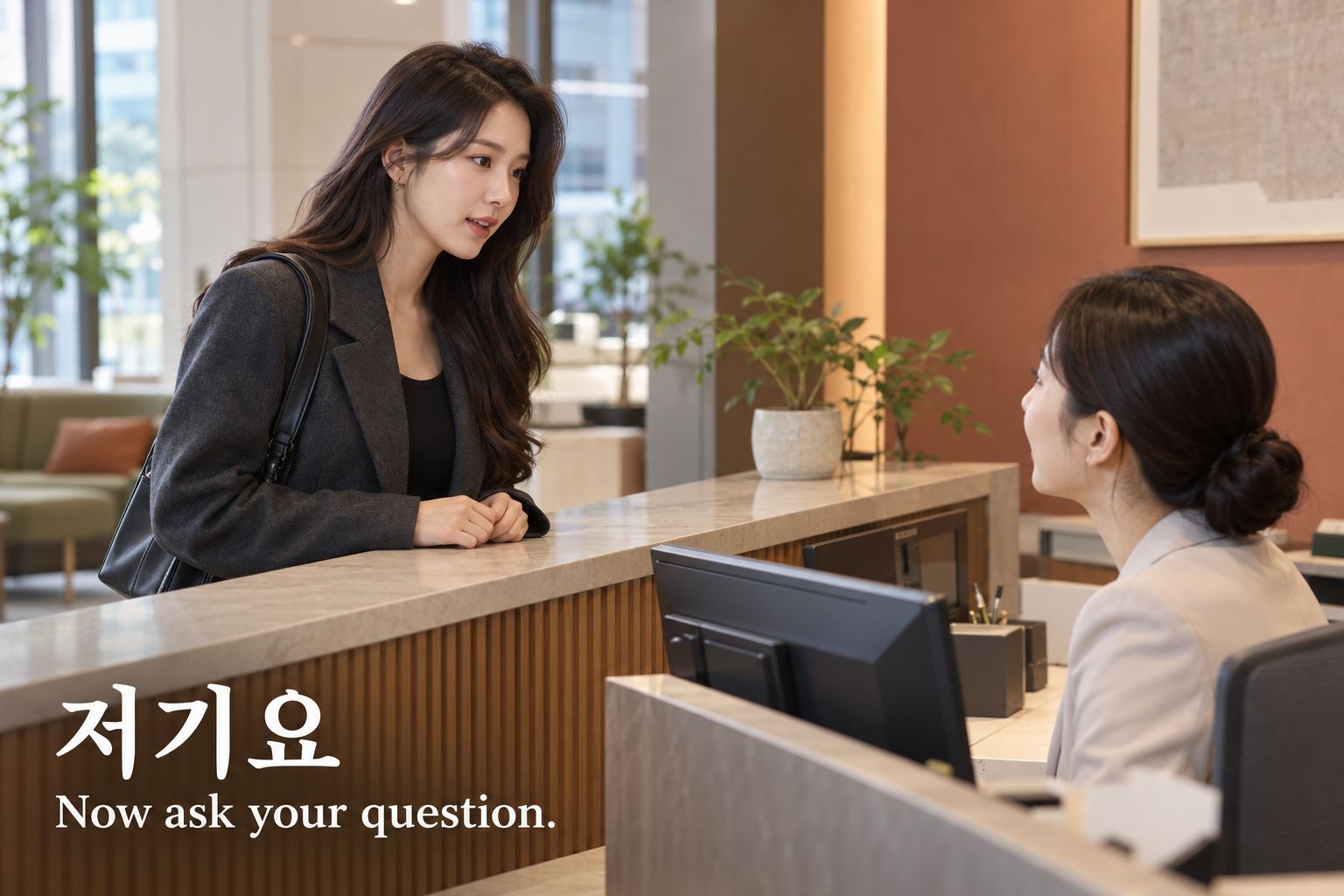
저기요: Getting Someone's Attention
저기요 (jeogiyo) is one of the most useful expressions when you want to get someone's attention. You may hear it in restaurants, shops, and other public places when someone wants to speak to a person who is not already part of their conversation.
For example, imagine that you are sitting at a restaurant and need to ask the server for something. You could say:
저기요, 물 좀 주세요.
“Excuse me, could I have some water?”
The expression 저기요 gets the other person's attention. The rest of the sentence makes the actual request. These two parts work together, but they have different functions.
Here are some other useful examples:
- 저기요, 이거 얼마예요? — Excuse me, how much is this?
- 저기요, 화장실이 어디예요? — Excuse me, where is the restroom?
- 저기요, 주문해도 될까요? — Excuse me, may I place an order?
Notice that the question changes while the opening expression stays the same. You can use 저기요 to attract attention and then ask about a price, location, or service.
Is 저기요 polite?
저기요 is a polite everyday expression, commonly used when addressing an unfamiliar person in an appropriate public situation. It is especially recognizable when calling a restaurant server or shop employee.
However, politeness also depends on how you continue the conversation. A respectful opening followed by a blunt or demanding sentence can still sound uncomfortable. Adding a suitable polite request, such as 주세요 or -아/어도 될까요?, helps make the complete sentence more considerate.
For example, 물 주세요 is understandable, but 물 좀 주세요 sounds softer as an everyday request. The adverb 좀 often softens a request rather than referring literally to a small quantity.
실례합니다: Politely Interrupting or Approaching Someone
실례합니다 (sillyehamnida) is useful when you want to approach someone politely or interrupt them with consideration. It acknowledges that you are entering their attention or taking a moment of their time.
It is particularly suitable when approaching an unfamiliar person, asking for directions, or beginning a question in a situation where you want to sound respectful.
For example:
실례합니다. 이 근처에 지하철역이 어디에 있어요?
“Excuse me. Where is the subway station around here?”
The first expression politely opens the interaction. The second sentence asks for the information you need.
Another useful expression is:
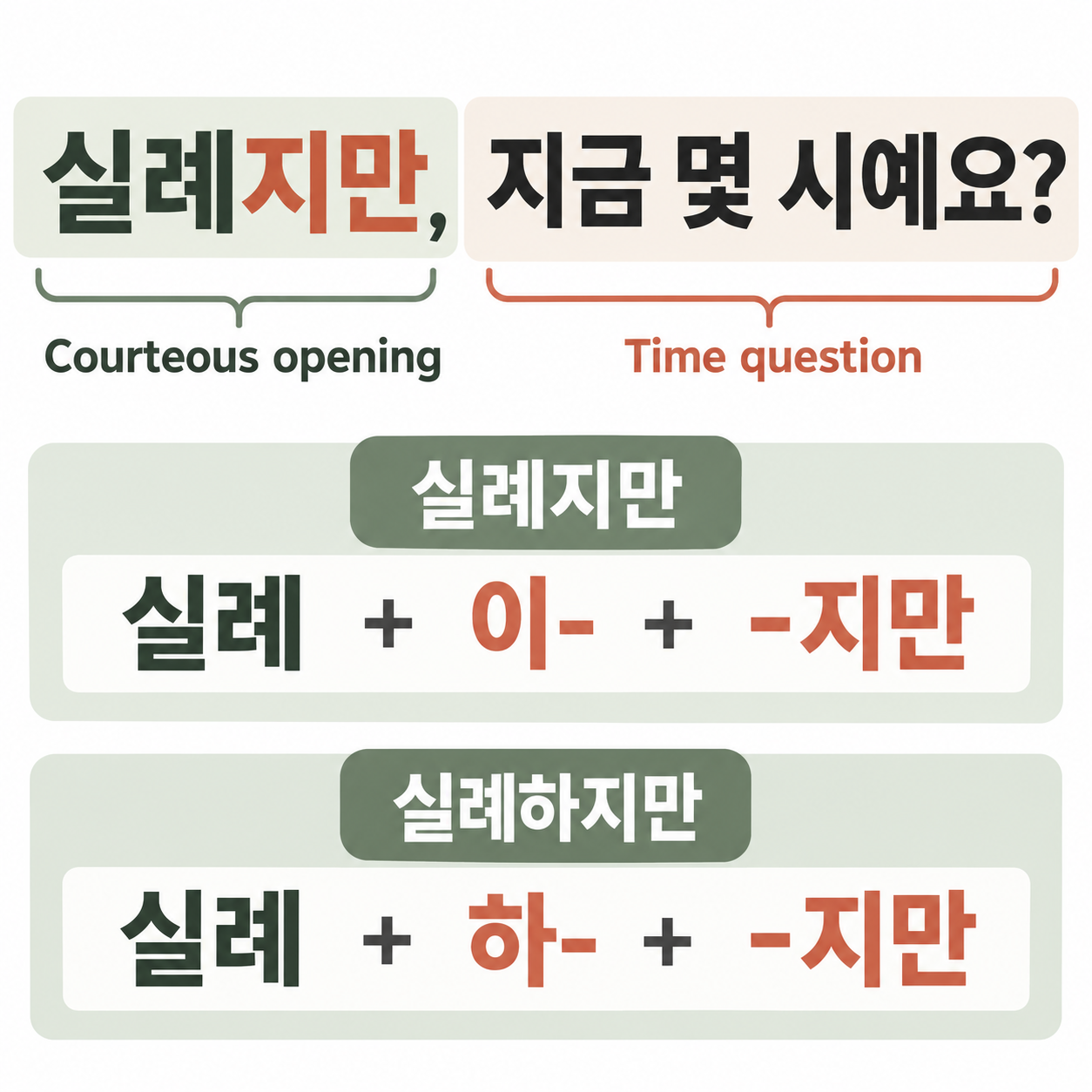
실례지만, 질문 하나 해도 될까요?
“Excuse me, may I ask you a question?”
실례지만 combines the idea of politely acknowledging an interruption with the next question. It can make the transition into a request sound more considerate.
실례합니다 and 저기요: What Is the Difference?
Both expressions can be used with strangers, but they place emphasis on slightly different things.
저기요 is commonly used to call someone's attention. 실례합니다 more explicitly acknowledges that you are approaching or interrupting the other person.
Compare these situations:
- At a restaurant, you want to call a server who is a short distance away: 저기요.
- You approach an unfamiliar person on the street to ask for directions: 실례합니다.
- You want to begin a polite question to someone who is occupied: 실례합니다 or 실례지만, depending on the sentence.
These are useful tendencies, not rigid rules. Both expressions may work in more than one situation, and the tone of the complete sentence matters.
잠시만요: Asking Someone to Wait for a Moment
잠시만요 (jamsimanyo) means “Just a moment, please” or “Please wait a moment.” Its main function is different from the previous expressions: it asks someone to pause or wait briefly.
For example, if someone is about to walk away and you need a moment to ask something, you might say:
잠시만요! 질문 하나만 할게요.
“Just a moment! I have one question.”
You can also hear it in situations where someone needs a little time before responding:
- 잠시만요, 확인해 볼게요. — Just a moment, I'll check.
- 잠시만 기다려 주세요. — Please wait a moment.
- 잠시만요, 아직 준비가 안 됐어요. — One moment, I'm not ready yet.
The important distinction is that 잠시만요 is not simply another way to call a stranger. It focuses on asking for a short pause. If your main intention is to attract a server's attention, 저기요 is usually a more direct choice.
“Excuse Me Korean” Is Not One Fixed Expression
When choosing an excuse me in Korean expression, identify what you want the other person to do first. Do you want them to notice you, allow you to interrupt, or wait briefly? The intended action helps determine which phrase sounds appropriate.
There is also a useful difference between an opening expression and the question that follows it. For example, 저기요 does not itself ask where something is. It attracts attention; the sentence after it supplies the actual question.
This distinction becomes especially important when you are asking for directions or information. A natural interaction usually has two parts:
- Get the person's attention politely.
- Ask a clear question using an appropriate sentence ending.
For a beginner, this is more useful than treating every English “excuse me” as the same Korean expression.
Choosing the Right Expression for the Situation
Once you know how to get someone's attention, the next step is choosing an expression that fits the relationship and the situation. Korean has several ways to approach someone, but they are not interchangeable.
저기요: Getting Someone's Attention
저기요 is a common expression for getting the attention of someone you do not necessarily know. You might use it to approach a stranger, call a shop employee, or begin a short question in a public place.
For example:
저기요, 이 버스는 시청에 가요?
“Excuse me, does this bus go to City Hall?”
Here, 저기요 helps open the interaction. The actual question comes afterward. It does not mean that 저기요 itself contains the question or tells the listener what information you need.
실례합니다: A More Considerate Approach
실례합니다 is useful when you want to approach someone politely, especially when interrupting them, asking for assistance, or entering an interaction with someone unfamiliar.
For example:
실례합니다, 사진 한 장 찍어 주실 수 있을까요?
“Excuse me, could you take a photo for me?”
The expression acknowledges that you are approaching someone and asking for their attention. It can sound more formal or considerate than a short 저기요, depending on the situation.
It is also useful when you need to interrupt someone who is occupied. However, you do not need to use it before every ordinary question. The relationship and the amount of interruption matter.
잠시만요: Asking Someone to Wait Briefly
잠시만요 has a different function. It asks someone to wait for a short time rather than simply calling their attention.
For example:
잠시만요, 가방을 확인할게요.
“Just a moment, I'll check my bag.”
You might use it when someone is waiting for you, when you need to find something, or when you want to pause an interaction briefly.
It is not always a direct translation of “Excuse me.” If your goal is to approach an unfamiliar person and ask a question, 실례합니다 or 저기요 may be more suitable.
여기요: Calling Someone in a Service Setting
여기요 can be used to call a person's attention in a restaurant or another service setting. It is particularly recognizable when a customer wants to call a server.
For example:
여기요, 물 좀 주세요.
“Excuse me, could I have some water?”
This is a practical expression, but it should not be treated as a universal way to address every unfamiliar person. In a restaurant, it can be understood as calling staff. When approaching a stranger on the street, 저기요 or 실례합니다 will usually communicate your intention more clearly.
Getting Attention Is Only the First Step: How to Ask the Question
A useful way to build a Korean request is to separate it into two parts:
- Get the person's attention.
- Ask the actual question or make your request.
For example:
저기요, 화장실이 어디예요?
“Excuse me, where is the restroom?”
저기요 opens the conversation. 화장실이 어디예요? asks for the location of the restroom. If you memorize only the opening expression, you still need the second part to communicate what you want to know.
Three Useful Question Patterns
1. Asking where something is
어디예요? means “Where is it?” or “Where is ...?”
- 지하철역이 어디예요? — Where is the subway station?
- 출구가 어디예요? — Where is the exit?
2. Asking whether something is possible
-(으)ㄹ 수 있어요? asks whether someone can do something or whether something is possible.
- 도와주실 수 있어요? — Could you help me?
- 영어로 설명해 주실 수 있어요? — Could you explain it in English?
3. Asking someone to do something politely
주세요 is commonly used to make a polite request for something.
- 물 좀 주세요. — Please give me some water.
- 메뉴판 좀 주세요. — Could I have the menu, please?
The adverb 좀 can soften a request in everyday conversation. It does not always mean “a little” in the literal sense. Its effect depends on the expression and context.
Three Conversations in Everyday Situations
Conversation 1: Asking a Friend a Question
Situation: Two friends are walking together. One wants to ask about a place they are trying to find. They normally speak casually.
A: 저기, 잠깐 물어봐도 돼?
“Hey, can I ask you something?”
B: 응, 뭐 궁금한데?
“Sure, what do you want to know?”
A: 여기서 지하철역까지 얼마나 걸려?
“How long does it take to get to the subway station from here?”
Why this sounds natural: Between close friends, 저기 is a casual way to get someone's attention. 잠깐 물어봐도 돼? asks permission to ask a question, and 얼마나 걸려? asks about the time required. A formal expression such as 실례합니다 would sound unnecessarily distant in this familiar situation.
Conversation 2: Asking a Stranger for Directions
Situation: A visitor is looking for a subway station and approaches someone they do not know.
A: 실례합니다. 이 근처에 지하철역이 어디에 있나요?
“Excuse me. Where is the subway station around here?”
B: 저쪽으로 쭉 가시면 왼쪽에 있어요.
“If you go straight that way, it will be on your left.”
A: 아, 그렇군요. 감사합니다.
“Oh, I see. Thank you.”
Why this sounds natural: 실례합니다 politely opens an interaction with an unfamiliar person. The question uses 어디에 있나요? to ask for a location, while 가시면 means “if you go,” combining honorific -시- with conditional -면. The final 감사합니다 closes the exchange courteously.
Conversation 3: Calling a Server at a Restaurant
Situation: Two people have finished their food and want to ask for the bill.
A: 저기요, 계산해 주세요.
“Excuse me, could we have the bill?”
B: 네, 바로 도와드리겠습니다.
“Certainly, I'll help you right away.”
A: 감사합니다.
“Thank you.”
Why this sounds natural: 저기요 calls the server's attention, and 계산해 주세요 communicates the actual request. The expression 계산하다 relates to settling the bill, while 주세요 makes the request polite. The server responds with 도와드리겠습니다, a courteous way to say they will assist.
Compare the Expressions Before You Use Them
| Expression (한국어) | Pronunciation | Speech Level | Best Situation | Natural Reply / Nuance |
|---|---|---|---|---|
| 저기요 | jeogiyo | Polite | Getting a stranger's or staff member's attention | Follow with your actual question |
| 실례합니다 | sillyehamnida | Formal / Polite | Approaching or interrupting an unfamiliar person | Allows you to begin a considerate request |
| 잠시만요 | jamsimanyo | Polite | Asking someone to wait briefly | 잠시만 기다려 주세요 — Please wait a moment |
| 여기요 | yeogiyo | Polite | Calling staff in a restaurant | 네, 무엇을 도와드릴까요? — Yes, how can I help? |
| 저기 | jeogi | Casual | Getting a friend's attention | 응, 왜? — Yes, what is it? |
| 말씀 좀 여쭤볼게요 | malsseum jom yeojjwobolgeyo | Polite / Respectful | Beginning a question with added courtesy | 네, 말씀하세요 — Yes, go ahead |
The expressions in this table do not all perform the same job. 저기요 and 여기요 are commonly used to get attention in particular settings. 실례합니다 helps open an interaction politely. 잠시만요 asks for a short pause, while 말씀 좀 여쭤볼게요 introduces a question in a considerate way.
Frequently Asked Questions
How do you say “Excuse me” in Korean?
저기요 and 실례합니다 are two useful expressions, but their functions are not identical. 저기요 commonly gets someone's attention, while 실례합니다 is useful when approaching or interrupting someone politely. The best choice depends on whom you are addressing and why you need their attention.
Should I use 저기요 or 여기요 in a restaurant?
Both can be heard when calling restaurant staff. 여기요 directly calls attention to someone at the restaurant, while 저기요 is also a familiar way to get someone's attention. Neither expression guarantees an immediate response, so wait for the staff member to acknowledge you before making your request.
Is 잠시만요 the same as 실례합니다?
No. 잠시만요 asks someone to wait for a short time, whereas 실례합니다 politely opens an interaction or acknowledges an interruption. You might say 실례합니다 before asking a stranger for directions, but 잠시만요 when you need someone to wait while you check something.