Gwenchana in Korean: "I'm Okay," "Are You Okay?" and That Comforting Little Word
Gwenchana in Korean: "I'm Okay," "Are You Okay?" and That Comforting Little Word
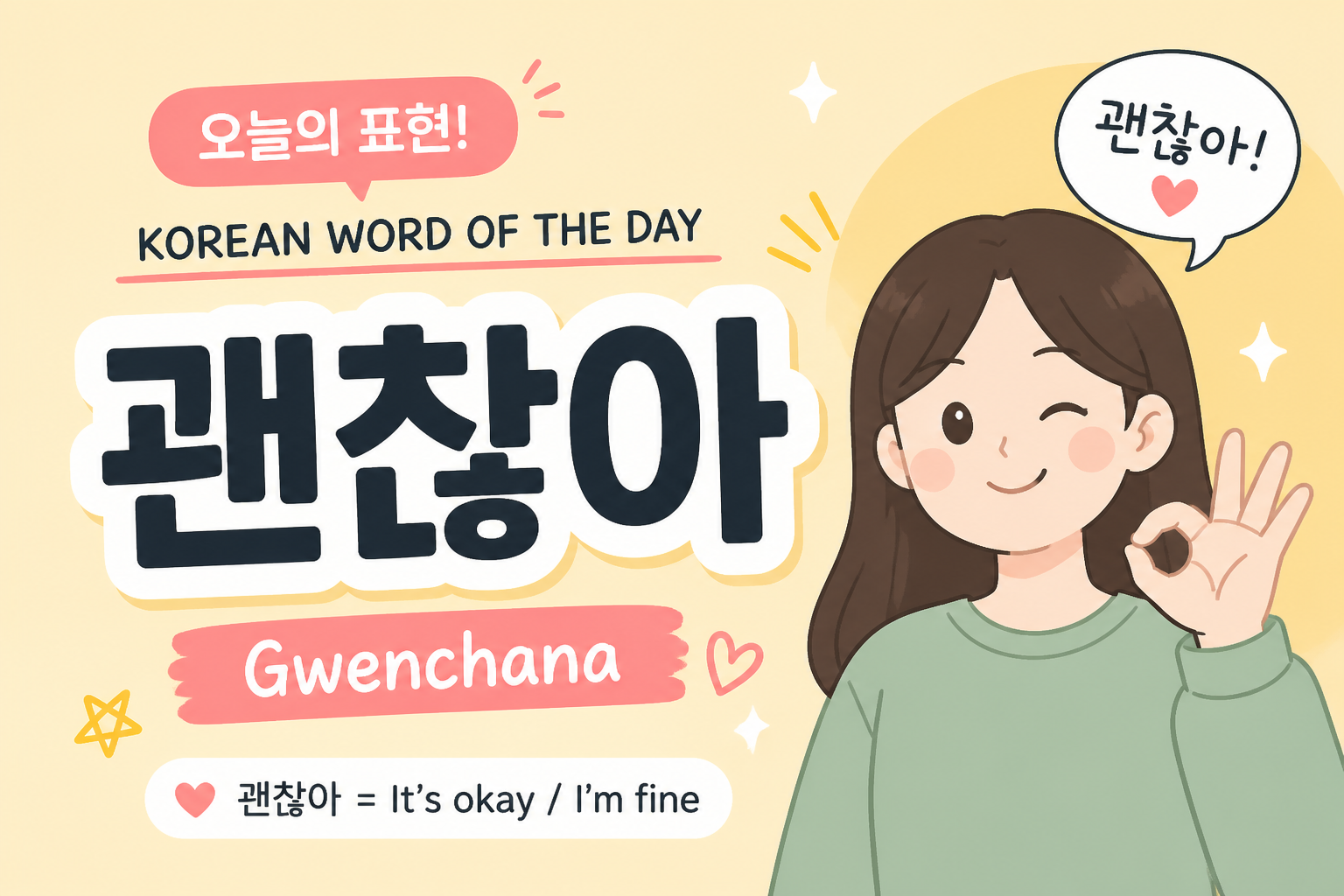
Have you ever tripped over a sidewalk curb in Seoul, scrambled back to your feet with red cheeks, and had a kind stranger immediately ask you something with a warm, concerned look? Or maybe you watched a tearful K-drama scene where a character softly brushes away tears and whispers, "Gwenchana..."
If there is one word that defines the gentle, resilient heartbeat of daily Korean life, it is 괜찮아 (gwenchana).
On the surface, English dictionaries translate gwenchana as "it's okay" or "I'm fine." But in reality, this single phrase is an emotional Swiss Army knife. Depending on your tone of voice and social relationship, it can mean:
- "I'm completely fine, don't worry about me."
- "Are you hurt? Are you doing alright?"
- "No thank you, I don't need any more coffee."
- "Don't sweat the small stuff, everything is going to work out."
Because this word carries so much social weight, using the wrong ending or misinterpreting the unspoken subtext can lead to awkward misunderstandings. Let’s break down how real Koreans use this comforting expression, from its linguistic roots to practical everyday conversations.
1. From Papago to Real Life: The Anatomy of 괜찮다
If you open Naver Dictionary or type "I'm okay" into Papago, the first word on your screen will be 괜찮다 (gwenchanta).
Here is rule number one: never walk up to someone and say "괜찮다!" as a greeting or standalone response.
괜찮다 is the unconjugated dictionary form. In real-life Korean, verbs and adjectives must be conjugated into polite or casual endings before they leave your mouth. Shouting dictionary forms makes you sound like a robotic voice synthesizer reading a vocabulary list!
Here is how the word transforms:
- Start with the dictionary base: 괜찮다 (gwen-chan-ta). Notice the double final consonant (받침) ㄶ. When followed by ㄷ, the silent ㅎ makes the ㄷ sound like an aspirated ㅌ (ta).
- Drop the dictionary suffix 다: you are left with the stem 괜찮-.
- To form everyday polite speech, attach the standard vowel ending -아요: 괜찮아요 (gwenchanayo). Here, the ㅎ remains soft, and the sound flows naturally as gwen-cha-na-yo.
The Two-Way Street: A Statement and a Question in One Word
Unlike English, which requires rearranging word order to make a question ("Are you okay?" vs "You are okay"), Korean relies entirely on your vocal intonation:
- Rising intonation (괜찮아요? ↗): "Are you okay?" or "Is that fine with you?"
- Falling intonation (괜찮아요. ↘): "I am okay." or "That works for me."
With just three syllables, you can hold an entire mini-conversation. A friend drops their phone:
- You: "괜찮아요?" (Is it okay?)
- Friend: "네, 괜찮아요!" (Yes, it's fine!)
2. Choosing Your Social Register: Casual, Polite, or Formal?
Korean society places immense value on social hierarchy, age, and mutual boundaries. The exact same feeling of "being fine" must be delivered through the correct speech level.
1) Casual Speech (반말) — With intimate friends, younger siblings, or peers
- "괜찮아." (Gwenchana)
Drop the 요, and you have the raw, intimate casual form. You use this when consoling a close friend going through a tough breakup, cheering up your younger sister, or replying to someone of the exact same age after agreeing to speak casually.
Social Etiquette Warning: Never say "괜찮아" to someone older than you, a boss, or someone you met 30 minutes ago, even if you are having a super friendly chat! Dropping honorifics without permission can sound dismissive, as if you are talking down to them.
2) Polite Everyday Speech (존댓말 / 해요체) — The universal sweet spot
- "괜찮아요." (Gwenchanayo)
This is the version you will use 90% of your time in Korea. You say this to restaurant servers, taxi drivers, coworkers, university seniors, and polite strangers. It conveys warmth, maturity, and respect.
If someone bumps into you on the bustling subway line 2 in Seoul and bows apologetically, a gentle "괜찮아요, 신경 쓰지 마세요" (It's okay, don't worry about it) instantly dissolves any tension.
3) Formal Speech (격식체 / 하십시오체) — Professional business and official settings
- "괜찮습니다." (Gwenchanseumnida)
Notice the 격식체 ending: -습니다. In Korean pronunciation rules, the letter ㅂ before ㄴ softens into an "m" sound, so it is pronounced gwen-chan-seum-ni-da.
You use this in formal corporate meetings, military service, news reporting, or when delivering official customer service. If your team leader asks if your project workload is manageable, replying with "네, 괜찮습니다!" projects competence, discipline, and professional readiness.
3. Real-Life Dialogues: How Korean Conversations Actually Flow
Let's look at three realistic multi-turn scenarios that demonstrate how native speakers navigate this word in daily life.
Scene 1: Comforting a friend who spilled an iced coffee (Casual / 반말)
Yuna accidentally knocks over her iced Americano on the cafe table.
- Yuna: "헐, 어떡해! 테이블 다 젖었어... 미안해 진짜!" (Oh no, what do I do! The whole table is soaked... I'm so sorry!)
- Minho: "야, 괜찮아 괜찮아. 커피 쏟은 것 가지고 뭘 그래. 휴지 가져올게." (Hey, it’s totally okay, relax. It's just a spilled coffee, no big deal. I'll grab some napkins.)
- Yuna: "고마워... 옷에는 안 튀었어? 진짜 다행이다." (Thanks... Did it splash on your clothes? What a relief.)
Subtext Breakdown: Notice that Minho repeats it twice: "괜찮아 괜찮아." Doubling the word is an everyday Korean speech habit that signals deep emotional comfort and de-escalates embarrassment.
Scene 2: Declining an extra refill at a dinner with colleagues (Polite / 존댓말)
At an office dinner, a senior coworker tries to pour another glass of soda.
- Manager Park: "지우 씨, 사이다 한 잔 더 따를까? 목마르지 않아?" (Jiwoo, shall I pour you another glass of cider? Aren't you thirsty?)
- Jiwoo: "아, 과장님! 저는 지금 충분해서 괜찮아요. 신경 써주셔서 감사합니다." (Ah, Manager! I'm completely fine for now, thank you so much for asking.)
- Manager Park: "그래? 그럼 천천히 마셔요." (Really? Then drink at your own pace.)
Cultural Nuance: In English, saying "I'm okay" to decline food can sound slightly ambiguous. In Korean, 괜찮아요 is the standard, universally polite way to say "No thank you, I'm satisfied."
Scene 3: A doctor examining an ankle sprain (Formal / 존칭)
A physical therapist inspects a patient's swollen ankle during a rehabilitation session.
- Doctor: "환자분, 여기 누를 때 통증이 느껴지시나요?" (Patient, do you feel any pain when I press here?)
- Patient: "아니요 선생님, 그쪽은 전혀 안 아프고 괜찮습니다." (No doctor, that side doesn't hurt at all and feels fine.)
- Doctor: "다행이네요. 인대 파열은 아니니 무리하지 마시고 쉬세요." (What a relief. It's not a torn ligament, so please rest and take it easy.)
Tone Insight: In a medical or clinical setting, using 괜찮습니다 creates clear, objective communication without casual ambiguity.
4. Texting Like a Local: KakaoTalk Dynamics and Slang
When Koreans text on KakaoTalk, writing the full three syllables can feel too slow. Here is how modern mobile texting actually looks:
1) The Consonant Shortcut: ㄱㅊ
Among close friends, teenagers and 20-somethings frequently type just the leading consonants:
- ㄱㅊ = 괜찮 (It's okay / All good)
- ㄱㅊ? = 괜찮아? (You good?)
Warning: Never text ㄱㅊ to someone older than you or in a company chatroom! It is the digital equivalent of replying "k" or "w/e" to your boss.
2) The Soothing Double Text: "괜차나여~"
To sound extra cute, warm, and approachable, Koreans often soften the spelling to mirror casual pronunciation:
- "괜차나여 ㅎㅎ" (Softened "It's all good, hehe")
- "난 완전 괜찮음!" (Noun-ending slang: "I am totally 100% fine!")
The trailing tilde (~) and double vowels soften the impact, reassuring the reader that you are genuinely happy and holding no grudge.
5. Quick Comparison Table: Choose the Perfect Expression
Here is your comprehensive cheat sheet for mastering every nuance of this essential word:
| 괜찮아 | gwen-chan-a | Casual (반말) | Intimately comforting peers, siblings, or close friends | "다행이다, 걱정했잖아" (Phew, I was worried!) |
| 괜찮아요 | gwen-chan-a-yo | Polite (해요체) | Standard everyday situations, strangers, coworkers | "다치신 데는 없으세요?" (Are you hurt anywhere?) |
| 괜찮습니다 | gwen-chan-seum-ni-da | Formal (하십시오체) | Business presentations, military, formal customer service | Confident and reassuring in professional environments |
| 괜찮으세요? | gwen-chan-eu-se-yo? | Honorific Question | Asking elders, superiors, or clients if they are okay | Adds the respectful infix -시- to elevate the other person |
| 괜찮기는요 | gwen-chan-ki-neun-yo | Modest Denial | Politely brushing off praise or excessive apologies | "별말씀을요, 당연한 일인데요" (Don't mention it!) |
6. Frequently Asked Questions (FAQ)
Q1. How do I politely reply when someone asks me "괜찮아요?"
If you are indeed fine, simply smile and say:
- "네, 괜찮아요. 감사합니다!" (Yes, I'm okay. Thank you!) If you are actually NOT okay and need assistance, you can honestly say:
- "아니요, 조금 어지러워요." (No, I'm feeling a little dizzy.) or "잠깐만 도와주실 수 있나요?" (Could you help me for a second?)
Q2. Can "괜찮아요" be used to express that someone's personality is good?
Yes, absolutely! In Korean, describing someone as a "괜찮은 사람" (a gwenchaneun saram) is a high compliment:
- "그 사람 진짜 괜찮은 사람이야." (He is genuinely a great, decent person.) It means the person is reliable, emotionally mature, and kind-hearted. It doesn't mean they are just "mediocre"—it means they are truly solid.
Q3. How do I decline food or drinks politely without sounding rude?
When an elder or host offers you more food and you are stuffed, waving your hands gently while saying:
- "아닙니다, 정말 배불러서 괜찮습니다. 잘 먹었습니다!" (No thank you, I am truly full and fine. I ate so well!) This communicates profound appreciation for their hospitality while clearly signaling that your stomach has reached its limit.