Hangul Alphabet, Read the Letters Inside a Syllable
Hangul Alphabet, Read the Letters Inside a Syllable

The Hangul alphabet has 24 basic letters, but printed Korean does not place every letter in a separate space. In 눈, three letters share one syllable block. Reading it means recognizing ㄴ, ㅜ, and the final ㄴ without turning them into three syllables.
Start with the letter groups below, then follow the changes from 나 to 노 and from 과 to 관.
The Korean alphabet letters in four groups
- Group: 14 basic consonants
Letters: ㄱ ㄴ ㄷ ㄹ ㅁ ㅂ ㅅ ㅇ ㅈ ㅊ ㅋ ㅌ ㅍ ㅎ - Group: 10 basic vowels
Letters: ㅏ ㅑ ㅓ ㅕ ㅗ ㅛ ㅜ ㅠ ㅡ ㅣ - Group: 5 additional consonants
Letters: ㄲ ㄸ ㅃ ㅆ ㅉ - Group: 11 additional vowels
Letters: ㅐ ㅒ ㅔ ㅖ ㅘ ㅙ ㅚ ㅝ ㅞ ㅟ ㅢ
A chart may show 24 basic letters or all 40 forms: 19 consonants and 21 vowels. The additional forms combine basic letters, as shown in the National Institute of Korean Language’s letter chart.
A written block has an initial consonant position and a vowel position, with an optional final consonant position underneath. Initial ㅇ fills the consonant position without adding a consonant sound, as in 아. That does not make ㅇ silent everywhere: at the bottom of a syllable, it represents the final ng sound.
How to read Hangul when the vowel changes position
Read the initial consonant first, then the vowel, then any final consonant. The vowel's shape determines where it fits. With ㅏ, the vowel sits to the right. With ㅗ or ㅜ, it sits below the initial consonant.
- Block: 나
Letters in reading order: ㄴ + ㅏ
Romanized reading: na - Block: 노
Letters in reading order: ㄴ + ㅗ
Romanized reading: no - Block: 누
Letters in reading order: ㄴ + ㅜ
Romanized reading: nu
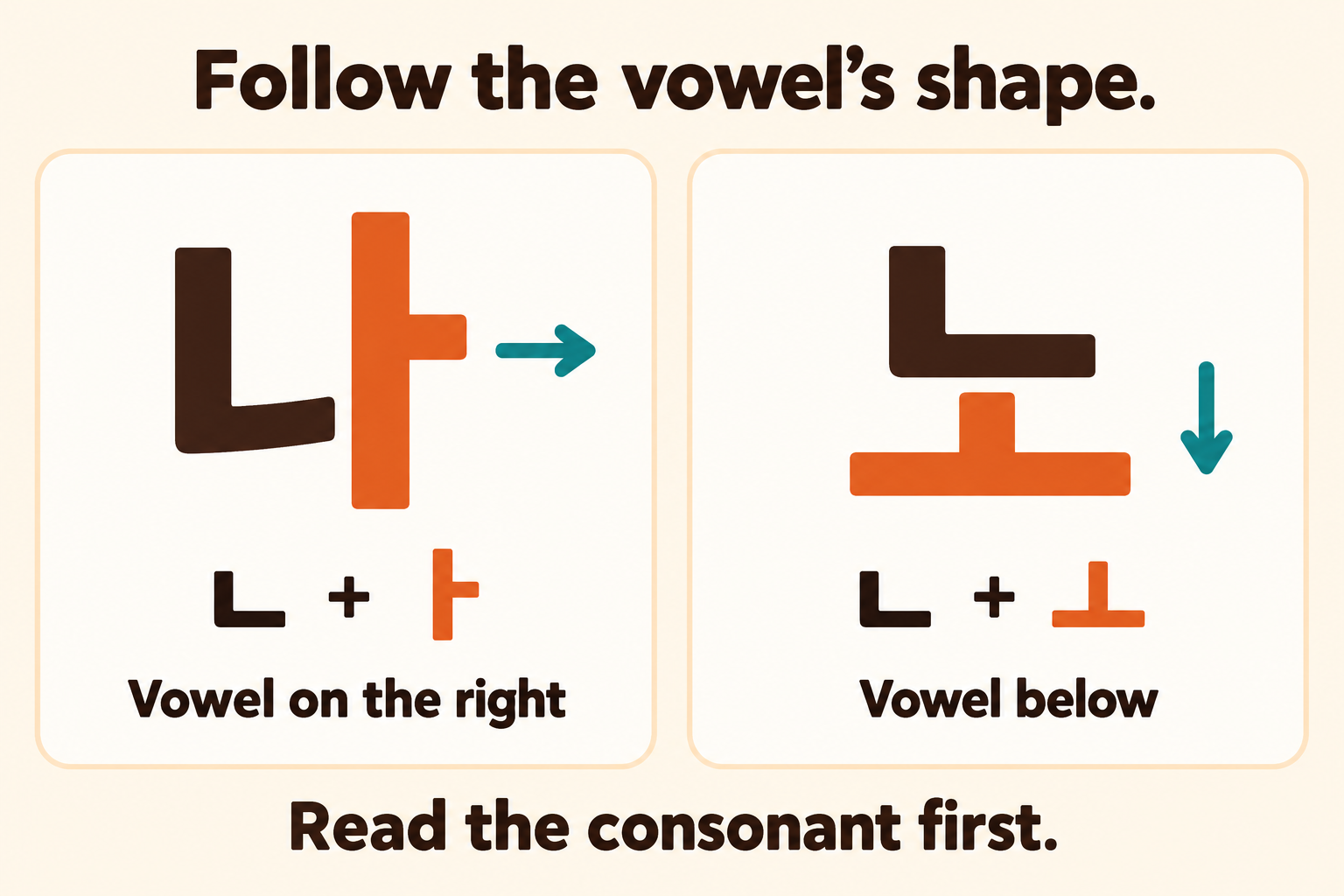
The initial ㄴ stays the same. What changes is the vowel, and therefore the arrangement of the block. Do not read 노 as if the lower letter came before ㄴ just because your eyes notice it first.
The Latin spellings here follow Revised Romanization. They identify the readings; they are not instructions to pronounce no exactly like the English word. In particular, Korean ㅗ and ㅜ are different vowels even if an English spelling feels familiar.
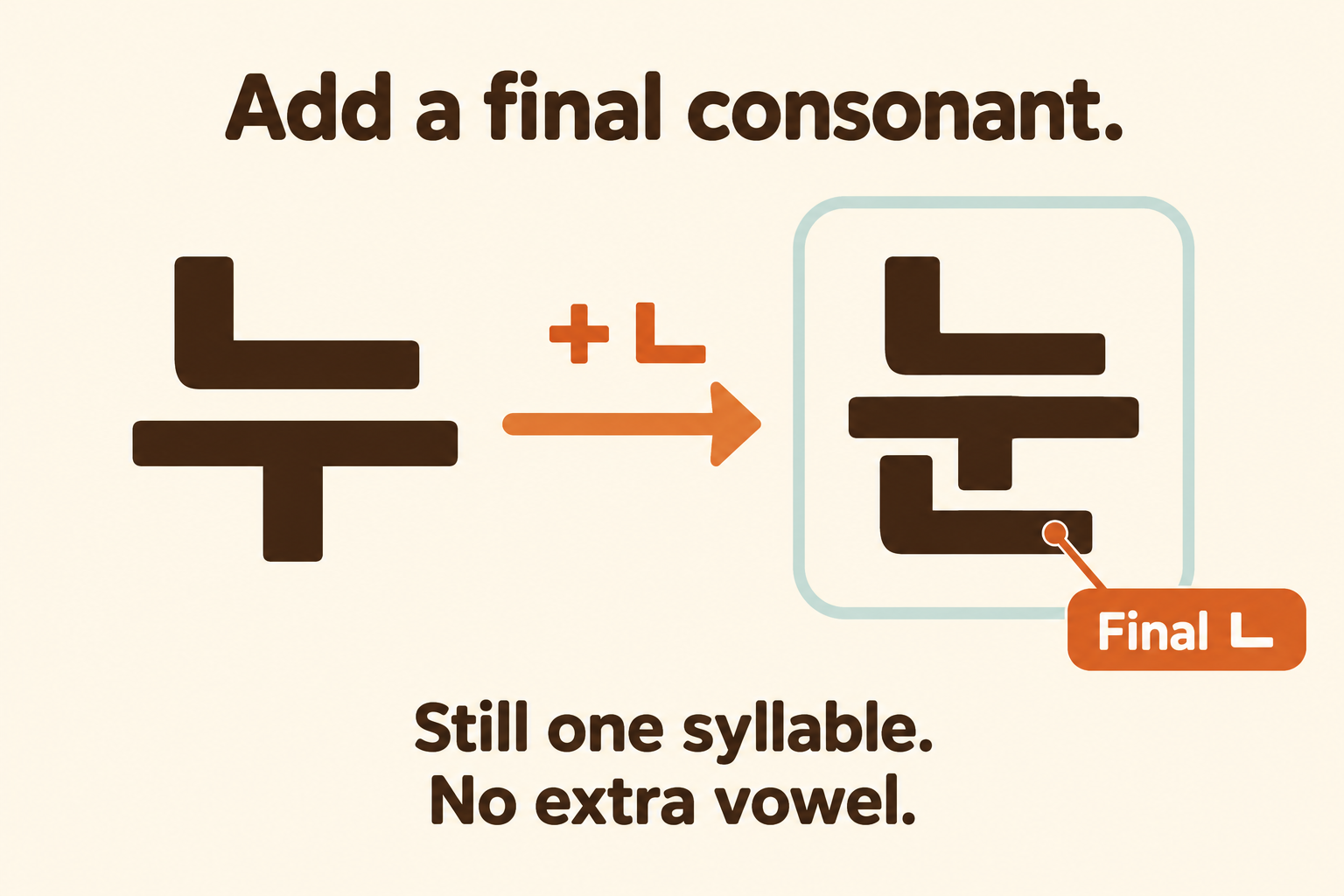
Now add a final ㄴ to each block.
- Before: 나, na
After: 난, nan
What the added letter does: Adds final n, not another na - Before: 노, no
After: 논, non
What the added letter does: Adds final n, not another no - Before: 누, nu
After: 눈, nun
What the added letter does: Adds final n, not another nu
There are now two ㄴ letters in each block, but they have different positions. The first begins the syllable; the last closes it. A bottom consonant does not automatically carry a vowel of its own.
One vowel can occupy more than one direction
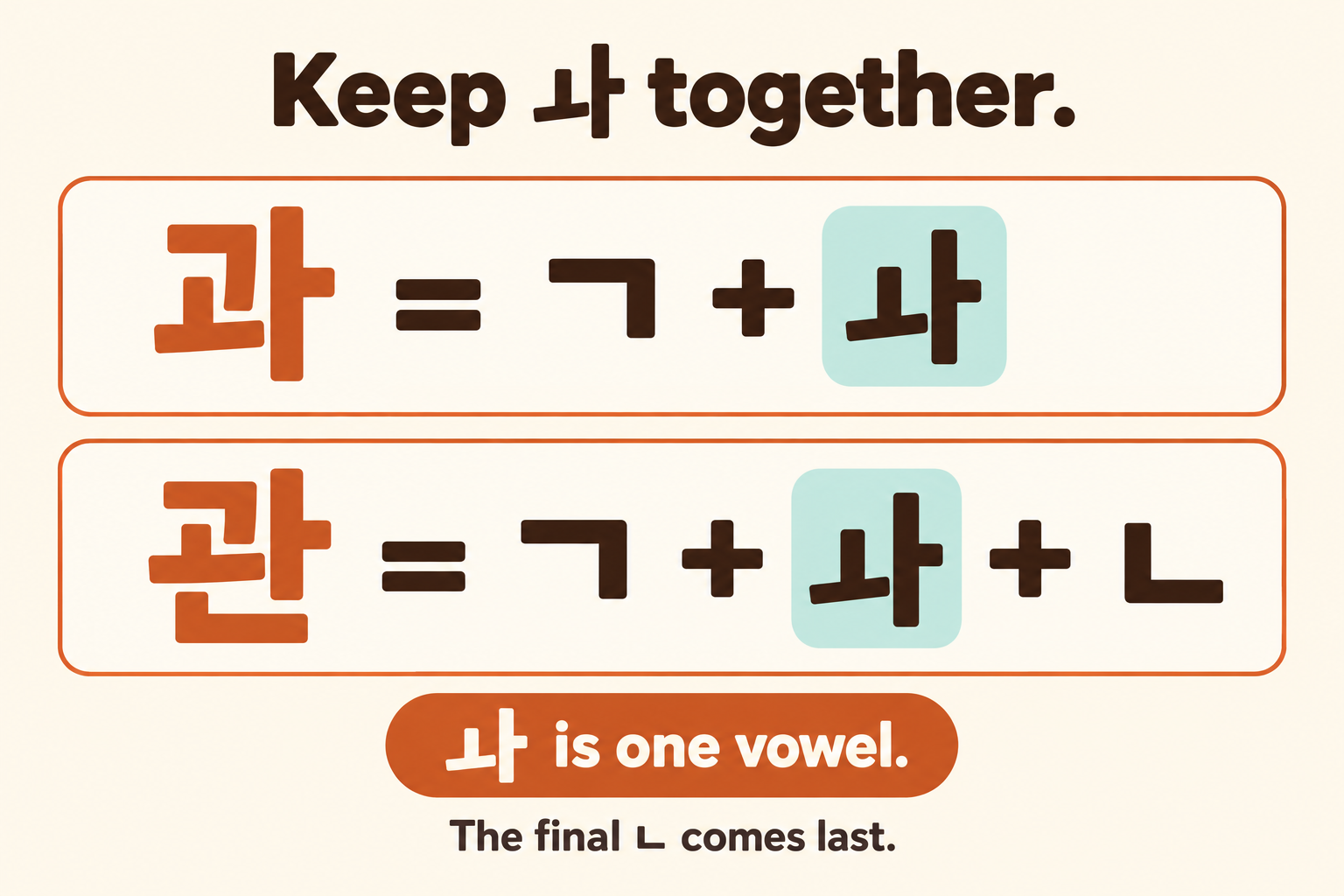
Not every vowel fits the simple right-or-below pattern. The vowel ㅘ combines the shapes ㅗ and ㅏ and is romanized wa. In 과, that vowel reaches below and to the right of ㄱ. It still fills one vowel position.
Compare these two constructions:
- 과 = ㄱ + ㅘ, read gwa.
- 관 = ㄱ + ㅘ + ㄴ, read gwan.
In 관, the lowest ㄴ is the final consonant. The horizontal part above it belongs to ㅘ; it is not another final consonant or a separate syllable. Splitting the visible shapes into “go-a-n” would create divisions that the written block does not contain.
To check an unfamiliar dense block, locate its whole vowel before assigning the remaining letters to consonant positions. Counting every visible component first can split a combined vowel in the wrong place.
Try a new block before checking the answer
Look at 광. How many written syllables are there? Identify the initial consonant, the whole vowel, and the final consonant. Is the bottom ㅇ silent?
Check your answer
광 is one written syllable: ㄱ + ㅘ + ㅇ. The vowel ㅘ stays together. The bottom ㅇ is the final consonant, so it has the ng sound rather than being silent. The romanized reading is gwang.
Recognizing the spelling is not the whole pronunciation lesson
The final-consonant position is called batchim. Other consonants and consonant clusters can appear there, and their pronunciation is not always their initial-position sound. Sounds can also change where syllables meet. The ㄴ examples above do not establish a rule that every written final is pronounced unchanged.
For further reading practice, the official EPS Hangeul workbook separates vowel and consonant work from final consonants and linking sounds. Start with its letter and syllable exercises; leave the later sound rules for a separate practice session.