Happy Birthday in Korean: Why 생일 Changes to 생신
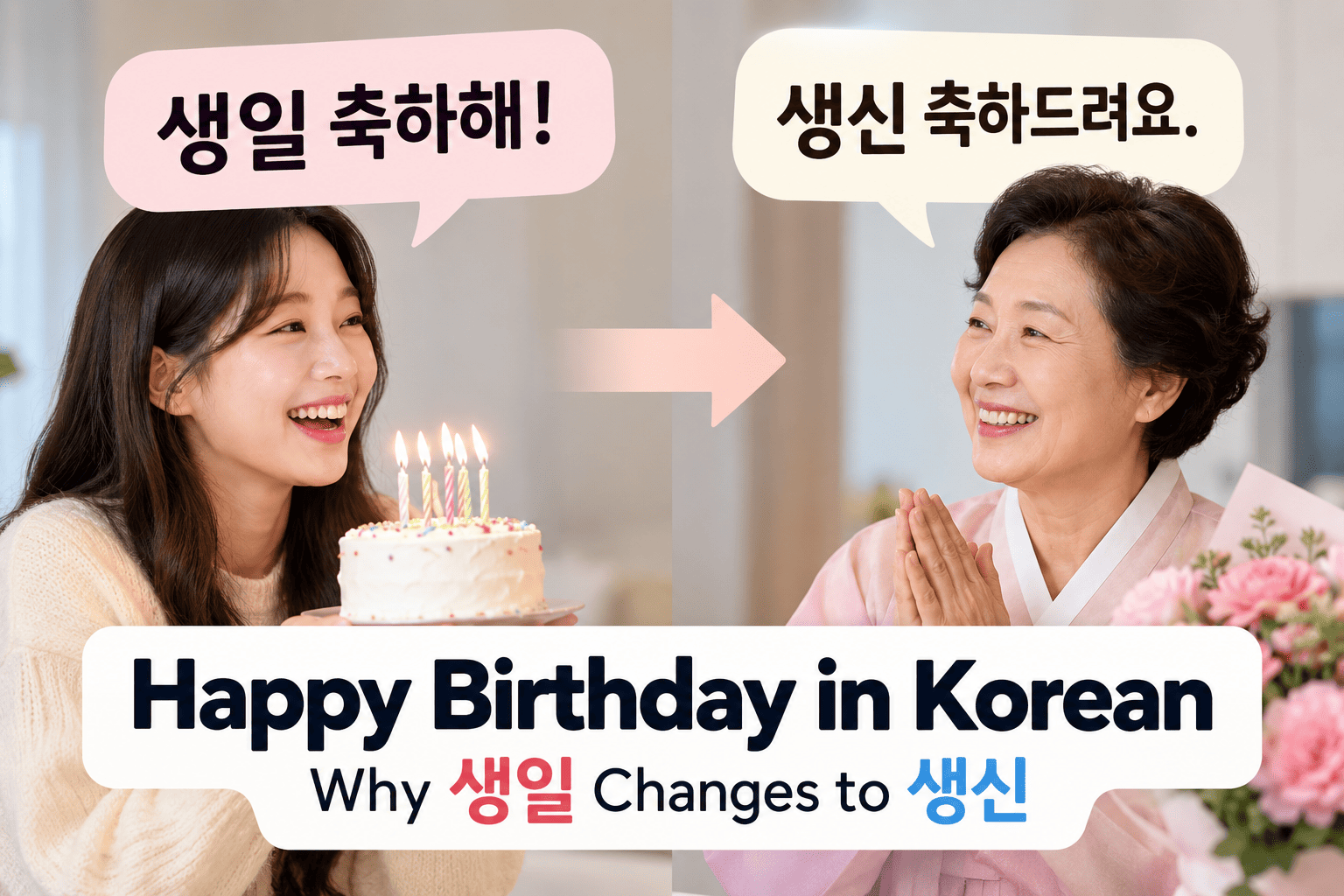
Happy Birthday in Korean: Why 생일 Changes to 생신
Two birthday cards can look quite different in Korean.
For a close friend:
생일 축하해! 🎂
For a parent or someone you speak to with respect:
생신 축하드려요.
The difference is bigger than the sentence ending. 생일 itself has changed to 생신. The verb changes too. That is where a Korean birthday greeting starts to show how honorific language really works.
How to say happy birthday in Korean
생일 축하해 is the familiar casual expression. It works well with close friends and people you normally speak to casually.
생일 축하해요 keeps 생일 and adds a polite ending. You might use it with someone you speak politely to without specifically treating their birthday as an honorific occasion.
When the person themselves is someone you want to honor, Korean has a more respectful choice.
생신 축하드려요.
For a more formal message:
생신 축하드립니다.
This is an important distinction. Polite speech and honorific speech can overlap, but they are not always expressed in exactly the same way.
Why does 생일 become 생신?
생일 is the ordinary word for birthday.
생신 is the honorific form of 생일.
So you might talk about a friend's birthday as:
친구 생일
For your mother's birthday you can say:
어머니 생신
The event is still a birthday. The Korean noun changes because the person connected to it is being spoken about respectfully.
This is one reason Korean honorifics cannot always be learned by changing only the final verb ending.
생신 is not tied to one exact age
There is no birthday when everyone suddenly has to stop using 생일 and start using 생신.
생신 is connected to respect rather than a fixed age number.
Parents and grandparents are common examples. Older relatives and other people you address respectfully may also be spoken about with 생신.
So memorizing a rule such as 생신 starts at 60 would give the wrong idea.
Why 축하드려요 instead of 축하해요?
This part makes the respectful greeting more interesting.
Compare:
생일 축하해요.
생신 축하드려요.
The first sentence is polite. The second one is built to show more respect toward the person receiving the greeting.
생일 becomes 생신.
축하하다 also becomes 축하드리다. The 드리다 form adds a courteous tone to the act of offering congratulations.
That is why 생신 축하드려요 is a more natural model when teaching a respectful birthday greeting for a parent or another person you honor.
생신 축하드립니다 carries the same respectful direction with a more formal ending.
Birthday messages for different relationships
For a close friend:
생일 축하해! 오늘 맛있는 거 많이 먹어! 🎉
Happy birthday! Eat lots of good food today!
For someone you normally speak to politely:
생일 축하해요! 좋은 하루 보내세요.
Happy birthday! Have a great day.
For a parent or an older person you speak to respectfully:
생신 축하드려요. 항상 건강하세요.
Happy birthday. Please stay healthy.
For a more formal message:
생신 진심으로 축하드립니다. 늘 건강하시길 바랍니다.
Wishing you a very happy birthday. I hope you always stay healthy.