Hul in Korean: The Slang for Shock, Disbelief, and Speechless Moments "헐~"
Hul in Korean: The Slang for Shock, Disbelief, and Speechless Moments
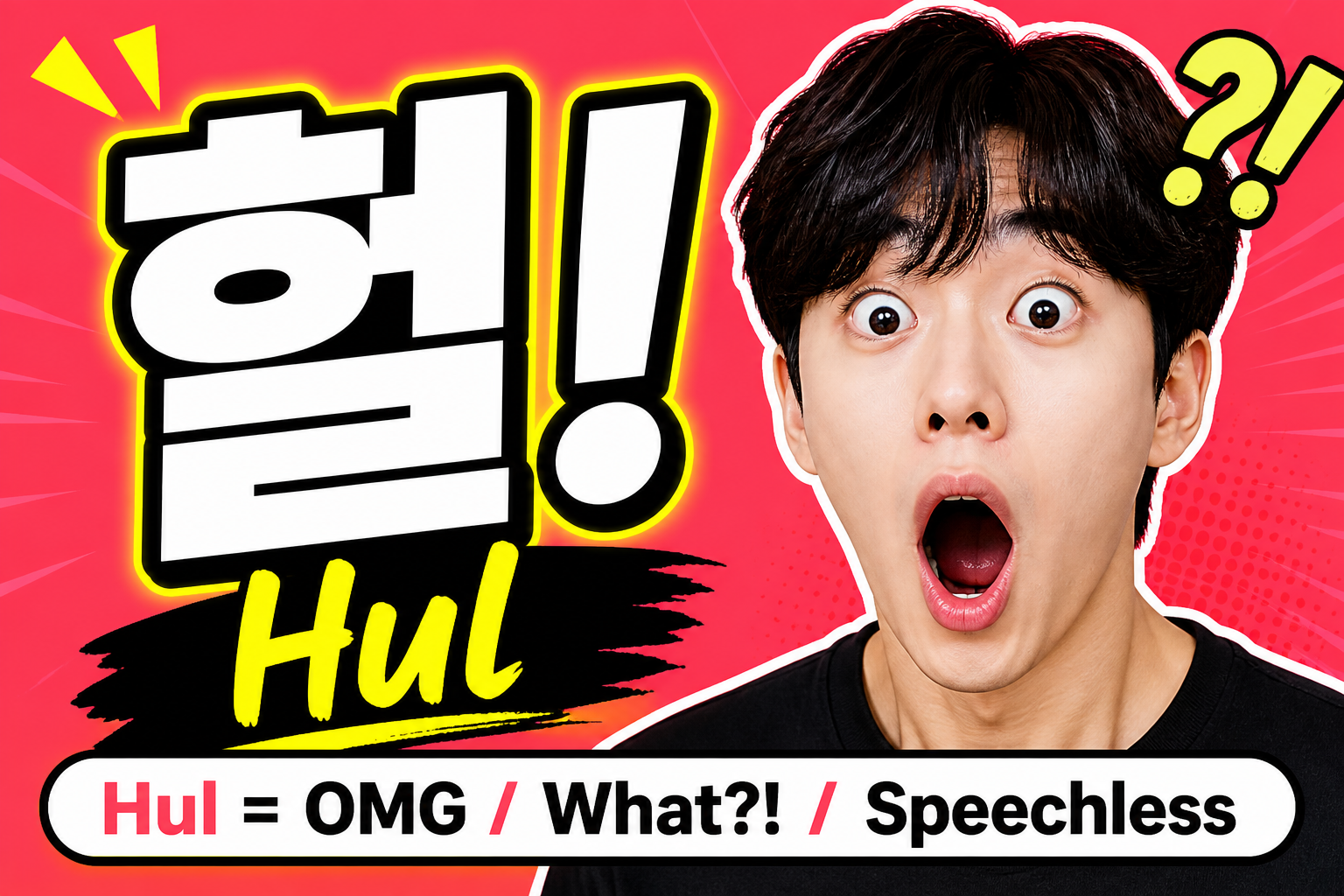
Have you ever had a moment so shockingly absurd or unexpected that your brain literally short-circuited and words failed you?
Imagine opening your refrigerator door to find your roommate ate your leftover birthday cake. Or checking your bank account to realize your rent was deducted twice. Or scrolling Instagram to discover your quiet high school classmate just made their debut in an idol group.
In English, you might gasp: "No way!" or "What the heck?!" or just stand there with your jaw on the floor.
In South Korea, across streets, university campuses, and millions of KakaoTalk chatrooms every single hour, millions of people let out one single, percussive syllable:
Hul in Korean:
"헐..." (Hul / Heol)
If you want to understand modern Korean youth culture, webtoons, YouTube variety shows, and everyday texting, 헐 is a mandatory rite of passage. Let's unpack the cultural mechanics of Korea's favorite exclamation of disbelief.
1. Where Did "헐" Come From?
If you type "no way" into Papago or look up 헐 in an official dictionary, you will find classical entries like 헐하다 (to be cheap) or 헐벗다 (to be poorly clad). But modern Korean 헐 has nothing to do with those definitions!
Modern "헐" is a purely colloquial onomatopoeic exclamation that exploded out of early 2000s Korean internet culture and Cyworld chatrooms.
Linguists and sociologists trace its emotional origin to an involuntary breath:
- The sharp intake or exhale of air when your jaw involuntarily drops open from sudden shock.
- That hollow, speechless feeling when something leaves you completely flabbergasted.
Today, 헐 has officially cemented itself in the Korean vernacular alongside iconic slang terms like 대박 (daebak) and 멘붕 (men-bung, mental breakdown).
2. 헐 vs 대박: The Crucial Emotional Difference
Foreign learners often confuse 헐 (hul) with 대박 (daebak) because both express intense surprise. But using them interchangeably can create hilarious social misunderstandings!
Here is the fundamental difference:
- 대박 (Daebak) = Primarily positive or awe-inspiring surprise. It means "jackpot!", "awesome!", or "mind-blowing!"
- 헐 (Hul) = Primarily shock, negative disbelief, speechlessness, or absurdity. It translates to "No way...", "What on earth...", or "Are you serious?!"
If a friend tearfully texts you that their beloved pet hamster ran away, and you reply "대박!", they will think you are a cold-blooded monster! The only appropriate response is a long, empathetic sigh: "헐..."
3. The Pitch Matrix: How Intonation Changes Everything
Even though 헐 is just one syllable, native speakers modulate its pitch to express an entire rainbow of reactions:
1) The Sharp, High Pitch (헐?! ↗) — Pure Shock
A sudden, high-pitched spike in tone. Used when hearing scandalous gossip or an unbelievable plot twist.
- "헐?! 둘이 사귄다고?!" (What?! Those two are dating?!)
2) The Low, Sinking Pitch (헐... ↘) — Disappointment and Empathy
A slow, deflating exhale. Used when hearing bad news, shared frustration, or a canceled plan.
- "헐... 오늘 야근이라고? 안됐다 진짜..." (Ugh... overtime today? That sucks so much...)
3) The Flat, Deadpan Tone (헐. ➔) — Sarcastic Ridicule
A completely flat, emotionless delivery. Used when someone tells a painfully corny dad joke (아재개그) or does something embarrassingly silly.
- "헐. 하나도 안 웃겨." (Wow. Not even slightly funny.)
4. Real-Life Dialogues: Catching 헐 in the Wild
Let's see how native speakers deploy this punchy reaction across everyday scenarios.
Scene 1: Checking the weather after leaving the umbrella at home (Casual / 반말)
Minjun and Doyoon step out of their apartment building.
- Doyoon: "야 민준아, 하늘 봐봐. 비 쏟아지기 시작하는데?" (Hey Minjun, look at the sky. It’s starting to pour?)
- Minjun: "헐, 진짜? 나 우산 안 챙겨왔는데 대박 망했다..." (Hul, seriously? I didn't bring an umbrella, I'm completely doomed...)
- Doyoon: "내 우산 같이 쓰자. 얼른 들어와." (Share mine. Hurry up and get under here.)
Dialogue Insight: Minjun uses 헐 as a gut-level reaction to an unlucky situation. It bridges raw surprise into problem-solving.
Scene 2: Coworkers discovering the office coffee machine is broken (Polite / 존댓말)
Jiwoo and Manager Han walk into the company breakroom at 8:50 AM on a Monday.
- Manager Han: "지우 씨, 커피 머신에 점검 중이라고 쪽지 붙어있네요." (Jiwoo, there's a note on the coffee machine saying it's under maintenance.)
- Jiwoo: "헐... 오늘 월요일인데 커피 없이 어떻게 버티죠? 너무 아쉽네요." (Hul... it's Monday, how do we survive without coffee? What a bummer.)
- Manager Han: "제가 1층 카페에서 한 잔 살게요. 같이 내려갑시다." (I'll buy a cup at the cafe downstairs. Let's head down together.)
Social Etiquette Note: Notice that Jiwoo uses 헐 in front of her manager. Because 헐 is an involuntary exclamation of sympathy rather than a personal insult, young professionals frequently let it slip in casual office interactions—provided the rest of their sentence remains in polite 존댓말!
Scene 3: Two friends hearing a ridiculous rumor (Casual / 반말)
Sora reads a viral social media post to her roommate.
- Sora: "야, 이 인플루언서 나이 속였대. 스물셋이라고 했는데 사실 서른셋이래!" (Hey, this influencer apparently lied about their age. Said they were 23, but they're actually 33!)
- Yujin: "헐 대박... 십 년을 속였다고? 완전 소름이다." (Hul daebak... lied about ten years? Total goosebumps.)
- Sora: "그치? 인터넷 댓글 난리 났어 지금." (Right? The internet comments are in complete chaos right now.)
Combo Insight: Notice Yujin says 헐 대박. When Koreans encounter something that is both shocking (헐) and monumental (대박), they weld the two words together into the ultimate viral catchphrase!
5. Texting Dynamics on KakaoTalk
In Korean texting culture, 헐 rarely travels alone. Here are the most famous mobile texting variants:
1) The Shock Multiplier: 헐헐헐
Typing it multiple times signals escalating bewilderment:
- "헐헐헐 대박" = "OMG OMG OMG no way"
2) The Letter Extension: 헐ㄹㄹ
Dragging out the final consonant (ㄹ) mimics a person whose voice is shaking from disbelief:
- "헐ㄹㄹ 진짜야 그거?" = "Huuuul is that for real?"
3) Texting Slang: 헐랭 (Heollaeng) / 헐랭구 (Heollaeng-gu)
Adding playful suffix letters creates a cute, exaggerated cartoon vibe:
- "헐랭, 나 지갑 잃어버렸어 ㅠㅠ" (Whoa, I lost my wallet ㅠㅠ)
6. Comparison Table: How to React Naturally
| 헐 | hul / heol | Speechless shock, disbelief | Spilled coffee, sudden bad news, wild gossip | "어떡해 진짜 ㅠㅠ" (What do we do ㅠㅠ) |
| 대박 | dae-bak | Positive awe, amazement | Winning a prize, delicious food, amazing luck | "완전 축하해!" (Huge congratulations!) |
| 헐 대박 | hul dae-bak | Overwhelming mind-blown state | Absurd news, unbelievable plot twists | "소름 돋았어" (I literally got goosebumps) |
| 에이 설마 | e-i seol-ma | Skeptical disbelief | "Come on, no way that's true!" | "거짓말이지?" (You're lying, right?) |
| 세상에 | se-sang-e | Dignified surprise | Cultured polite shock: "Oh my heavens / goodness" | Suitable for older speakers and formal settings |
7. Frequently Asked Questions (Hul in Korean FAQ)
Q1. Can I say "헐" to my Korean boss, professor, or in-laws?
No, please avoid it in formal interactions! While slipping a quiet "헐..." when reacting to a shared mishap (like the printer jamming) is generally tolerated among friendly coworkers, saying "헐!" directly to a boss or elder when they give you instructions sounds immature and unprofessional. To elders, use dignified phrases like "세상에..." (Oh my heavens) or "정말입니까?" (Is that so?).
Q2. Is 헐 considered a curse word or vulgar swear word?
Not at all! 헐 is completely clean and family-friendly. It is rated PG and appears constantly on daytime broadcast television, children's cartoons, and variety shows. It is purely an emotional interjection, not profanity.
Q3. Why do some people spell it "heol" and others "hul"?
In the official Revised Romanization of Korean, the vowel ㅓ is officially romanized as eo, producing heol. However, because English speakers naturally read "hul" as rhyming with the open "uh" sound, many internet users spell it phonetically as hul. Both refer to the exact same Korean word: 헐.