I Don’t Know in Korean: Molla Meaning, 모르겠어요, and What to Say When You’re Not Sure
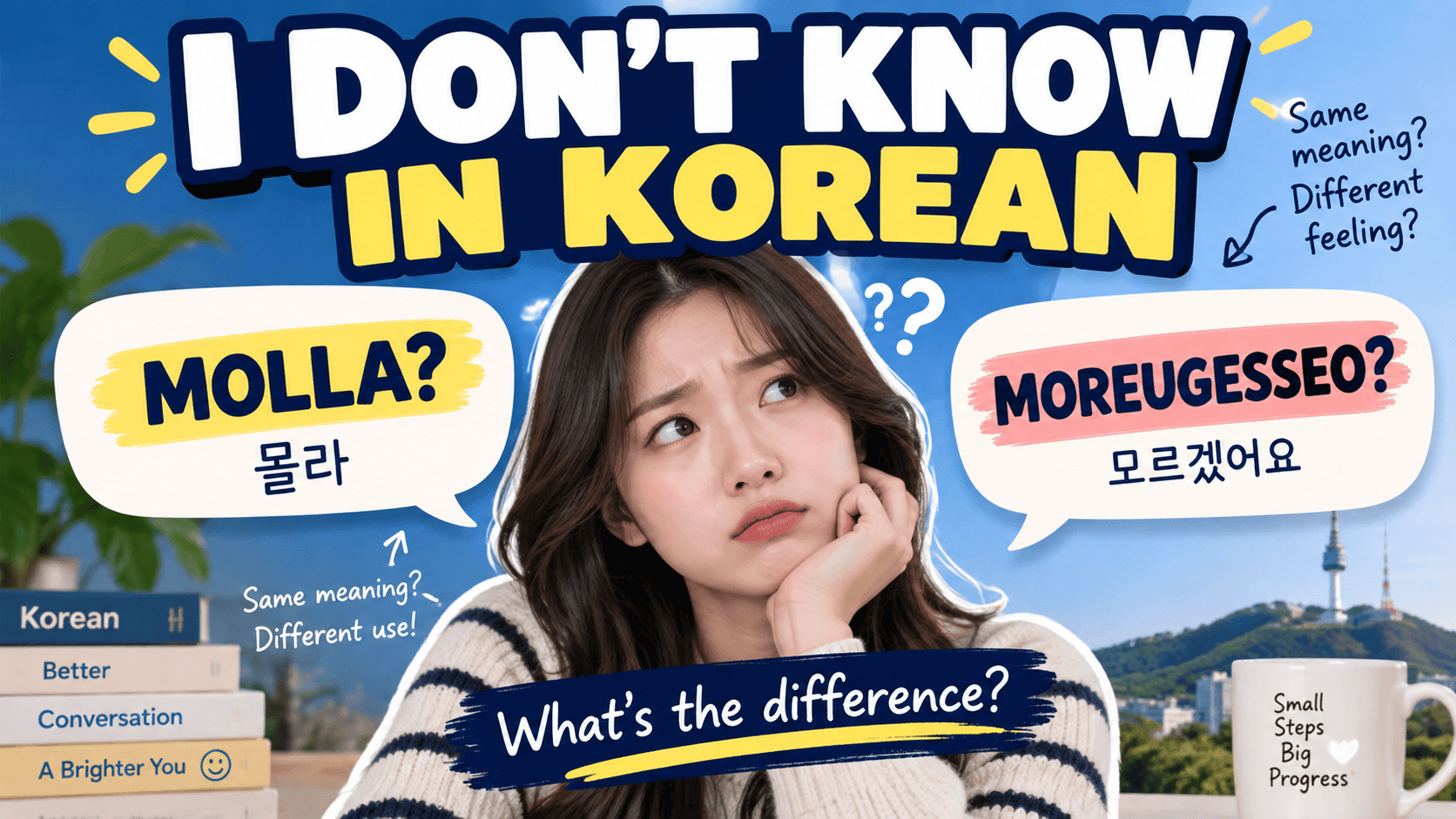
I Don’t Know in Korean: Molla Meaning, 모르겠어요, and What to Say When You’re Not Sure
Someone at work asks me a question I genuinely cannot answer.
If I only say 모르겠습니다. (moreugesseumnida.) — “I don’t know” — the conversation can stop right there.
In my own work experience, I usually try to add the next step instead:
한번 찾아보겠습니다. (hanbeon chajabogetseumnida.)
“I’ll look into it.”
or
확인해보겠습니다. (hwaginhaebogetseumnida.)
“I’ll check.”
The facts have not changed. I still do not know the answer. But the second response tells the other person what happens next. 💼
That is a useful place to start if you are learning i don't know in Korean. Korean has several ways to admit uncertainty, and the best choice often depends on whether you have no information, you are unsure, or you need to check before answering.
First, Ask What Kind of “Not Knowing” This Is
Before memorizing a polite and casual version, separate the situation.
Do you have no information at all? Do you know a little but are not confident? Are you trying to make a decision? Or is someone waiting for you to find the answer?
Actually, those situations can lead to different Korean responses even though English may use “I don’t know” for all of them.
Molla Meaning: When You Simply Don’t Know
The basic molla meaning comes from 모르다 (moreuda), “not to know.” 몰라 (molla) is a casual form you can hear between people who already speak casually with each other.
나도 몰라. (nado molla.)
“I don’t know either.”
몰라. (molla.)
“I don’t know.”
The grammar is simple, but the feeling depends on tone. A relaxed “몰라” between close people can be ordinary. A short, sharp “몰라!” can sound annoyed or dismissive.
So if you search for molla korean meaning, do not stop at “I don’t know.” The relationship and tone still matter.
몰라요 Is Polite, but It Can Still Be Direct
몰라요. (mollayo.) adds a polite ending.
That makes it appropriate in more situations than 몰라, but “polite” does not automatically mean “soft.” If someone expects more information, a bare 몰라요 can still feel like the conversation has ended.
This is why learning i don't know in Korean as a ladder from casual to polite is not enough.
“나도 잘 몰라. 근데…” Leaves the Door Open
When Sua asks me something and I genuinely do not know much about it, I often say:
나도 잘 몰라. 근데 그거 이거 아니야? (nado jal molla. geunde geugeo igeo aniya?)
“I’m not really sure either. But isn’t it this?”
This is different from simply saying 몰라 and stopping.
잘 몰라 (jal molla) literally contains 잘, “well,” but here it gives the sense that I do not know the subject well enough to be confident.
Then 근데… (geunde…) — “but…” — lets me add a guess.
In real conversation, that little extra space is useful. I can admit uncertainty without pretending I have no idea at all. 🤔
모르겠어 Is Useful When You Cannot Decide Yet
There are times when I have information, but I still cannot decide what I think.
Then I might say:
나는 잘 모르겠네. (naneun jal moreugennae.)
“I’m not really sure.” / “I don’t know about that.”
Here, the problem is not always missing information. Sometimes I simply cannot reach a clear judgment yet.
You will also hear:
모르겠어. (moreugesseo.) — casual
모르겠어요. (moreugesseoyo.) — polite
For a beginner, you do not need a long grammar lesson about -겠- to use these naturally. Just remember that 모르겠어/모르겠어요 often fits moments where your answer is not settled.
At Work, “I Don’t Know” May Need a Next Step
This is where my everyday speech changes the most.
With someone close to me, “나도 잘 몰라” can be a complete answer. At work, if someone asks me about something I am responsible for, I usually do not want to stop at “모르겠습니다.”
I would rather say:
한번 찾아보겠습니다.
“I’ll look into it.”
확인해보겠습니다.
“I’ll check.”
Well, this is not a universal rule for every Korean workplace. It is how I learned to handle uncertainty in my own work: if I do not know, I should show the next action instead of ending the conversation with the missing answer.
That distinction adds something important to i don't know in Korean. Sometimes the most useful Korean response is not a better translation of “I don’t know.” It is a sentence about what you will do next.
Use the Not-Knowing Map
You have no information
몰라 / 몰라요
A direct “I don’t know,” with politeness depending on the ending and context.
You know a little, but you are not confident
잘 몰라 / 잘 몰라요
“I don’t know very well” or “I’m not really sure.”
You cannot make a clear judgment yet
모르겠어 / 모르겠어요
“I’m not sure” or “I can’t really tell.”
You need to give an answer later
확인해보겠습니다 / 찾아보겠습니다
“I’ll check” or “I’ll look into it.”
This map is not a set of rigid rules. It is a way to notice what kind of uncertainty you are dealing with before choosing the sentence.
Same Uncertainty, Different Relationship
With Sua:
나도 잘 몰라. 근데…
Thinking out loud:
나는 잘 모르겠네.
At work:
한번 확인해보겠습니다.
None of these sentences magically makes me know more. What changes is the purpose of the conversation.
That is the part worth remembering. If you are learning i don't know in Korean, do not memorize only one phrase. Notice whether you are missing information, expressing uncertainty, or promising to find the answer. Once you know which situation you are in, the Korean response becomes much easier. 🙂