Jjimjilbang: Where to Change, Meet Up, and Pay for Extras
Your First Jjimjilbang Visit: Three Things to Understand
Imagine visiting a jjimjilbang with a friend. You arrive together, pay at the entrance, and receive a locker key. Then the staff directs you toward separate changing areas. Where will you meet again? Do you need to wear the clothes provided by the facility? And does your entrance fee cover everything inside?
A jjimjilbang is a Korean bathhouse and sauna complex, but its different areas do not all follow the same rules. The bathing and changing areas are separated by gender, while designated shared sauna and resting areas allow visitors to spend time together wearing appropriate clothing.
The easiest way to understand a jjimjilbang is to separate three questions: where you change, where you meet your companions, and what your admission fee actually covers. Once you understand these differences, the layout and payment process become much easier to follow.
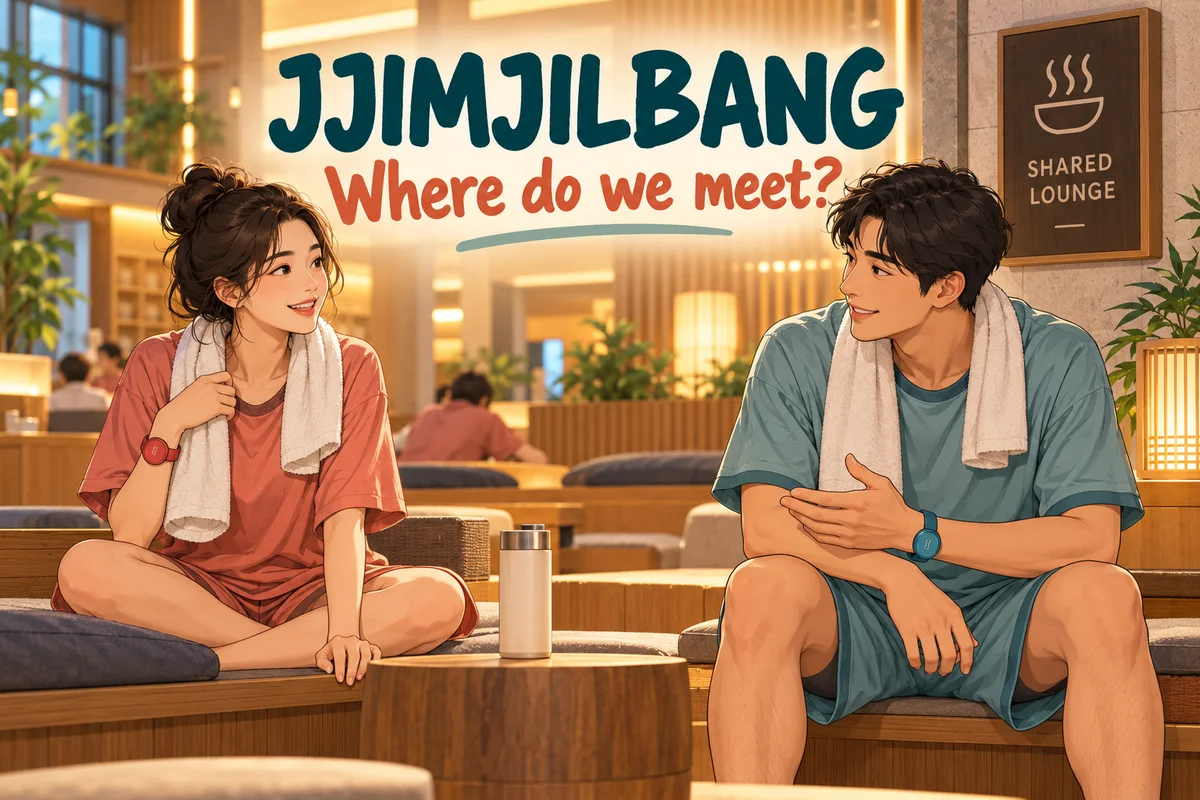
Where Do You Change? Understand the Two Areas
The first important distinction is between the bathing area and the shared jjimjilbang area. They serve different purposes and have different clothing expectations.
The Gender-Separated Bathing and Changing Areas
When you arrive, you will generally be directed to the changing and bathing facilities designated for men or women. You remove your outside clothes and store them in your assigned locker before using the bathing area.
In the traditional bathing area, visitors bathe without clothing. This is different from wearing a swimsuit in a public swimming pool. The space is separated by gender, and the changing area is not a place where mixed-gender groups meet.
This separation is also reflected in Korean regulations. The Public Health Control Act Enforcement Rule states that bath and changing rooms cannot admit males and females aged four or older together. The rule concerns those specific areas; it should not be interpreted as meaning that every room in the entire building is gender-separated.
The Shared Sauna and Resting Area
After changing, visitors who use the shared sweating rooms must wear the appropriate clothing. Many jjimjilbang provide a T-shirt and shorts, sometimes called 찜질복 (jjimjilbok), for this purpose.
The shared area may include heated rooms, resting spaces, snack counters, and other facilities. This is where friends and family members can spend time together after using their separate changing areas.
Korean regulations also address mixed-gender sweating rooms: operators providing these shared rooms must allow visitors to enter wearing the designated sweating clothes. The exact clothing, available facilities, and route between areas can differ by establishment.
One useful distinction is that 목욕탕 (mogyoktang) refers to the bathing facility, while 찜질방 (jjimjilbang) is commonly used for the broader sauna and heated-room experience. The terms are related, but they do not always describe exactly the same part of a building.
Where Should You Meet Your Friends?
This is one of the most practical questions when visiting with someone. You may enter together, but you will not necessarily use the same changing room. Agreeing on a meeting point before separating saves confusion later.
Choose a Shared Location
Good meeting points may include:
- The main common lounge or lobby.
- The entrance to the shared sauna area.
- A clearly marked snack bar or cafeteria.
- A reception or information desk, if visitors can access it from the shared side.
Do not assume that your companion can enter your changing room or wait beside your locker. Instead, choose a location that both people can reach after changing into the required clothing.
For example, two friends can agree to meet at the main lounge after changing. One person uses the men's changing room, the other uses the women's changing room, and both head toward the shared area when they are ready.
Useful Korean Meeting Expressions
Here are three expressions that make the arrangement easier to communicate:
- 공용 공간에서 만나요. — Let's meet in the shared area.
- 로비에서 기다릴게요. — I'll wait in the lobby.
- 찜질방 입구에서 만날까요? — Shall we meet at the jjimjilbang entrance?
Notice the difference between 만나요 and 기다릴게요. 만나요 suggests meeting at an agreed location, while 기다릴게요 tells the other person that you will wait there.
If the building has several floors or separate lounge sections, use a more specific landmark. Saying 매점 앞에서 만나요 (Let's meet in front of the shop) can be clearer than simply saying 안에서 만나요 (Let's meet inside).
Admission Fee vs Extra Charges: What Are You Paying For?
Another common source of confusion is the difference between the entrance fee and additional purchases. Paying to enter a jjimjilbang does not automatically mean that every service inside is included.
1. 입장료 — Admission Fee
입장료 (ipjangnyo) means the admission fee. It is the amount you pay to enter the facility under a particular ticket or entry option.
Depending on the establishment and ticket type, admission may cover access to certain bathing areas, shared sauna rooms, or resting facilities. The included areas and rental items should not be assumed to be identical everywhere.
2. 추가 요금 — Additional Charges
추가 요금 (chuga yogeum) means an additional charge. It refers to money paid beyond the basic admission fee for an item, service, or facility that is not included in the selected entry option.
Examples may include:
- 찜질복 대여 — Renting sauna clothes.
- 식사 — Food or meals.
- 음료 — Drinks.
- 마사지 — Massage services.
- 세신 — A body scrub service.
These are examples of possible paid extras, not a list of services available or separately charged at every jjimjilbang. Some facilities may include certain items in admission, while others may charge for them separately.
A Real Facility Example: Venue G Aqua 24
The official Seoul tourism listing for Venue G Aqua 24 provides a useful example of how one facility presents its prices.
| Item | Listed Price | What It Means |
|---|---|---|
| Daytime adult admission | ₩12,000 | Daytime entrance fee |
| Nighttime adult admission | ₩14,000 | Nighttime sauna admission |
| Jjimjil clothes rental | ₩2,000 | Separate clothing rental charge |
These prices are the published example for this particular venue, not a national price standard. They illustrate why it is useful to distinguish the admission price from a separately listed rental charge.
Questions to Ask Before Paying
You do not need complicated Korean to clarify what is included. These questions are useful:
- 입장료에 찜질복이 포함돼요? — Are sauna clothes included in the admission fee?
- 추가 요금이 있어요? — Are there additional charges?
- 이용 시간은 몇 시간이에요? — How many hours can I use the facility?
- 이 서비스는 별도 요금인가요? — Is this service charged separately?
In particular, distinguish 포함돼요 (is included) from 별도 요금 (a separate charge). The first asks whether something belongs to the price you are already paying. The second identifies a cost that is handled separately.
Facilities Can Differ: Do Not Expect Every Jjimjilbang to Be Identical
The name jjimjilbang describes a type of facility, not one fixed building layout. Some establishments focus mainly on bathing and sauna rooms. Others have larger shared lounges, restaurants, entertainment spaces, or additional relaxation facilities.
For example, one place may have several themed heated rooms, while another may offer a smaller sauna area and a separate cafeteria. Some facilities provide clothing with admission; others list clothing rental separately. The number of rooms, opening hours, available services, and payment arrangements can also vary.
The Korea Tourism Organization describes examples such as snack bars, game rooms, massage chairs, theaters, and other subsidiary facilities. However, the available options depend on the individual venue. One jjimjilbang may have several themed sauna rooms and a snack bar, while another may offer additional entertainment or relaxation facilities. Do not assume that every building has the same rooms, services, or opening hours.
What Is Included in the Admission Fee?
The admission fee generally gives you access to the basic facilities covered by that venue's ticket. Depending on the establishment, this may include the bathing area, changing facilities, shared resting areas, and sauna rooms. Some venues also include sleeping areas or exercise equipment.
It is important to distinguish admission from optional purchases. Food, drinks, massage services, beauty treatments, and certain other amenities may require separate payment. Even when two facilities both call themselves a jjimjilbang, their ticket inclusions can be different.
For example, the Incheon Metropolitan Government's public bath information explains that admission at the facilities it describes includes access to certain indoor amenities, while food, beauty treatments, and massages may involve additional charges. This is useful as an example of how admission and optional services can be separated, not a universal price policy for every Korean bathhouse.
How Extra Charges Are Recorded and Paid
Some jjimjilbangs use an electronic locker key or wristband to record purchases inside the building. You might use it when ordering food or accessing a paid service, then settle the accumulated charges when leaving. Other establishments may use a different payment arrangement.
The Korea Tourism Organization describes facilities where guests use their locker key for purchases at places such as snack bars and massage chairs, returning the key at the counter to pay for additional services. This is one documented payment arrangement, not a guarantee that every jjimjilbang accepts purchases through its locker key.
Before using an optional service, check whether its price is included in admission or charged separately. If the price is unclear, ask the staff before agreeing to the service. You can also check whether payment is made immediately or added to your final bill.
Facilities Can Differ from One Jjimjilbang to Another
One establishment may focus on traditional bathing and several heated rooms. Another may have a large shared lounge, sleeping areas, restaurants, entertainment facilities, or additional relaxation services. Larger complexes may offer more amenities, but a longer list of facilities does not automatically mean that every service is included in the entrance price.
The Korea Tourism Organization's examples include snack bars, game rooms, massage chairs, theaters, and nail salons. Its descriptions also show that facilities can have different types of sauna rooms. These examples illustrate the range of amenities available, rather than a standard checklist that every venue must provide.
It is also worth distinguishing a basic public bath from a larger jjimjilbang complex. A smaller bathhouse may concentrate on bathing and shower facilities, while a larger establishment may provide shared leisure areas and several additional services. The name used by a venue alone does not tell you exactly which facilities are available.
For this reason, compare the actual facilities and ticket conditions rather than assuming that two establishments offer identical experiences. Check the individual venue's current information for its bathing areas, shared rooms, available clothing, operating hours, and optional services.
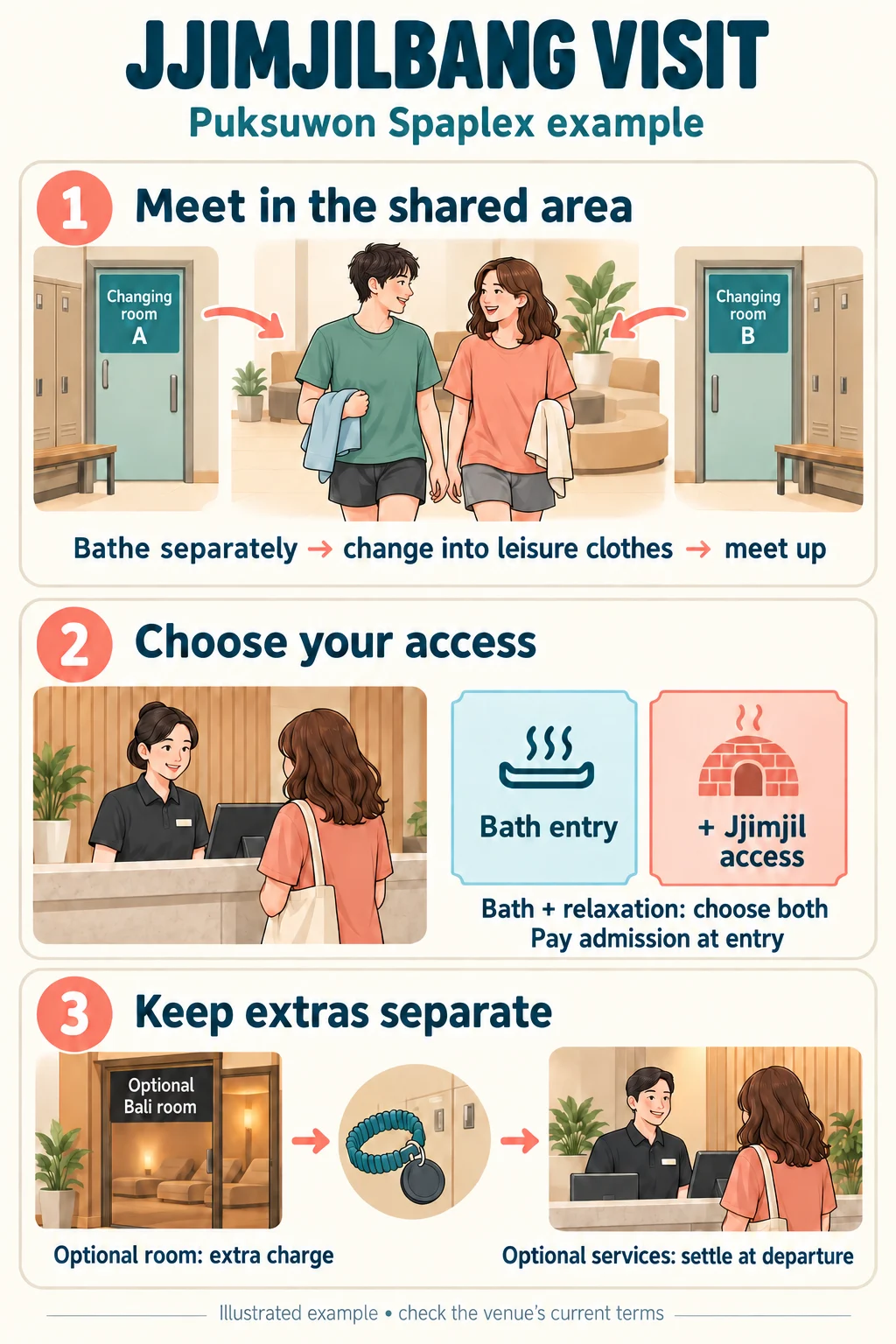
A Simple First-Visit Checklist
If you are visiting a jjimjilbang with a friend or family member for the first time, a little preparation can make the experience easier.
- Before entering: Check the admission price, included facilities, and any time restrictions.
- At the changing area: Follow the signs for the appropriate gender-separated changing and bathing facilities.
- Before entering the shared area: Change into the clothing provided or specified by the establishment.
- When meeting your companion: Agree on a meeting point in the shared, clothed area.
- Before using an extra service: Check its price and whether it is included in admission.
- Before leaving: Find out whether additional purchases have been recorded on your key or wristband and where to settle the bill.
These are practical points to check, not a universal operating procedure. Follow the signs and staff instructions at the facility you visit.
Frequently Asked Questions
Can men and women use the same changing room in a jjimjilbang?
No. The bathing and changing facilities are separated by gender. The shared leisure areas are different: guests change into the clothing provided for the common area before meeting friends or family there. Always follow the facility's signs and instructions.
Where should I meet my friends inside a jjimjilbang?
The shared resting area or main common hall is generally the appropriate place to arrange a meeting. The bathing and changing areas are separate, so do not assume you can meet companions inside those spaces. Agree on a recognizable meeting point before splitting up.
Does the admission fee cover food and massage services?
Not necessarily. Admission usually covers the facilities specified in the ticket, while food, drinks, massages, and other optional services may cost extra. The exact inclusions depend on the establishment. Check the displayed price or ask staff before using an additional service.
Do all jjimjilbangs use locker keys for payment?
No. Some establishments use electronic keys or wristbands to record purchases, while others use different payment arrangements. The Korea Tourism Organization documents the electronic-key method at the facilities it describes, but it should not be treated as a rule for every venue. Ask at reception how purchases are recorded and when you need to pay.
Enjoy Your Visit with a Clear Understanding of the Spaces and Costs
A jjimjilbang is easier to navigate when you understand the difference between its separate bathing and changing areas and its shared, clothed leisure spaces. Agreeing on a meeting point with your companion avoids confusion, while checking admission inclusions and optional charges helps you understand what you are paying for.
Most importantly, remember that jjimjilbangs are not all operated in exactly the same way. Facilities, ticket conditions, payment arrangements, and additional services vary. Check the information provided by the establishment you plan to visit, and enjoy the experience at your own pace.