Korean Table Manners: When to Start and How to Share
Imagine joining a Korean friend and their parents for dinner. Your rice bowl is in front of you, while several dishes sit in the middle of the table. Wait until the eldest person begins eating, then join in.
My first Korean family dinner, I hovered with my spoon mid-air for what felt like an entire minute — the grandmother was on her phone, dinner untouched, and I was too nervous to move. She finally looked up, laughed, and started eating on purpose so I could too. That is the spirit of the whole custom: nobody is grading you, they are just making space for you.
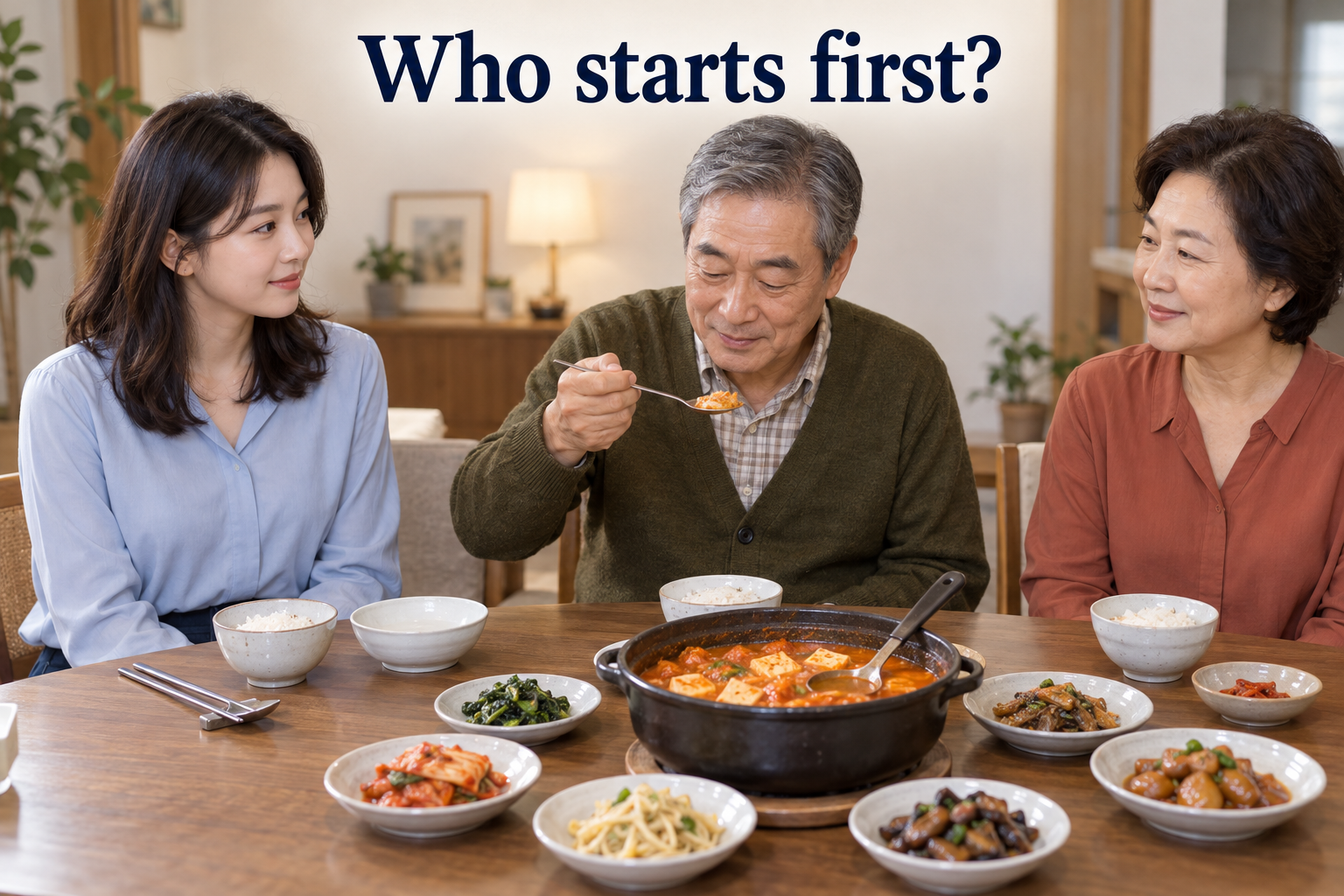
Let the older diners start
Keep your spoon and chopsticks on the table while you wait.
Once the meal is underway, eat at a comfortable pace with the group. Waiting to start does not mean you should deliberately take longer to finish than the oldest person.
Serve the stew into your bowl
Suppose this dinner includes a central pot of stew with a ladle. There is an empty bowl for stew at your place, beside your rice. The small dishes in the middle are banchan (반찬), or side dishes, for everyone to share.
Use the ladle to put some stew into your empty bowl. Return the ladle to the central pot, then use your own spoon to eat from the bowl you have filled. The ladle remains available for the next person who wants a serving.

Keep the bowl on the table and bring the spoon to your mouth. You can use the spoon for rice as well. Put it down before picking up your chopsticks for a side dish.
At this shared table, a dish of kimchi does not become your personal portion just because it sits beside your rice. Leave the dish available to the others. Use a serving utensil when one has been provided for that dish. If the arrangement is unclear, ask your host how they are serving it.
If your host brings the stew already portioned into individual bowls, use your own spoon to eat from the bowl at your place. The banchan stays in the middle for everyone to share.
When you have finished eating
Put your spoon and chopsticks back beside your setting where they started. Do not leave either utensil standing upright in rice.
If you finish before your friend's parents, remain seated while they finish.
Useful Lines to Say at the Table
| Korean | When to say it |
|---|---|
| 잘 먹겠습니다 | Before eating — a thank-you to the host or cook |
| 잘 먹었습니다 | After eating — the same thank-you, completed |
| 많이 드세요 | Inviting elders to eat plenty |
| 맛있어요! | Praising the food, mid-meal |
| 같이 먹어요 | Offering a dish to someone who arrived late or is hesitating |
Frequently Asked Questions
The restaurant made us wait outside. Should I sit or stand when our table is called?
Follow your party — no ceremony here. The real manners start at the table: elders seated first, drinks poured for others before yourself, and the eldest beginning the meal.
Can I lift my rice bowl like in Japan or China?
In Korea, bowls usually stay on the table while the spoon comes to you. Lifting the rice bowl is not a scandal, but nobody at a traditional table will do it, and your spoon works better than tipping anyway.
What if I cannot identify a side dish and I have dietary limits?
Ask, kindly and simply: 이거 뭐예요? Hosts expect the question from guests, and it protects you better than guessing. If something truly does not suit you, leave it quietly in the dish — no explanation owed.
That is really all the table asks of you: a small pause, a shared ladle, a thank-you before and after. Learn those lines and this table stops being a test and becomes what it always was — the friendliest room in the house.