Korean Verb Conjugation, A Starter Table and Two Stem Mistakes
Korean Verb Conjugation, A Starter Table and Two Stem Mistakes
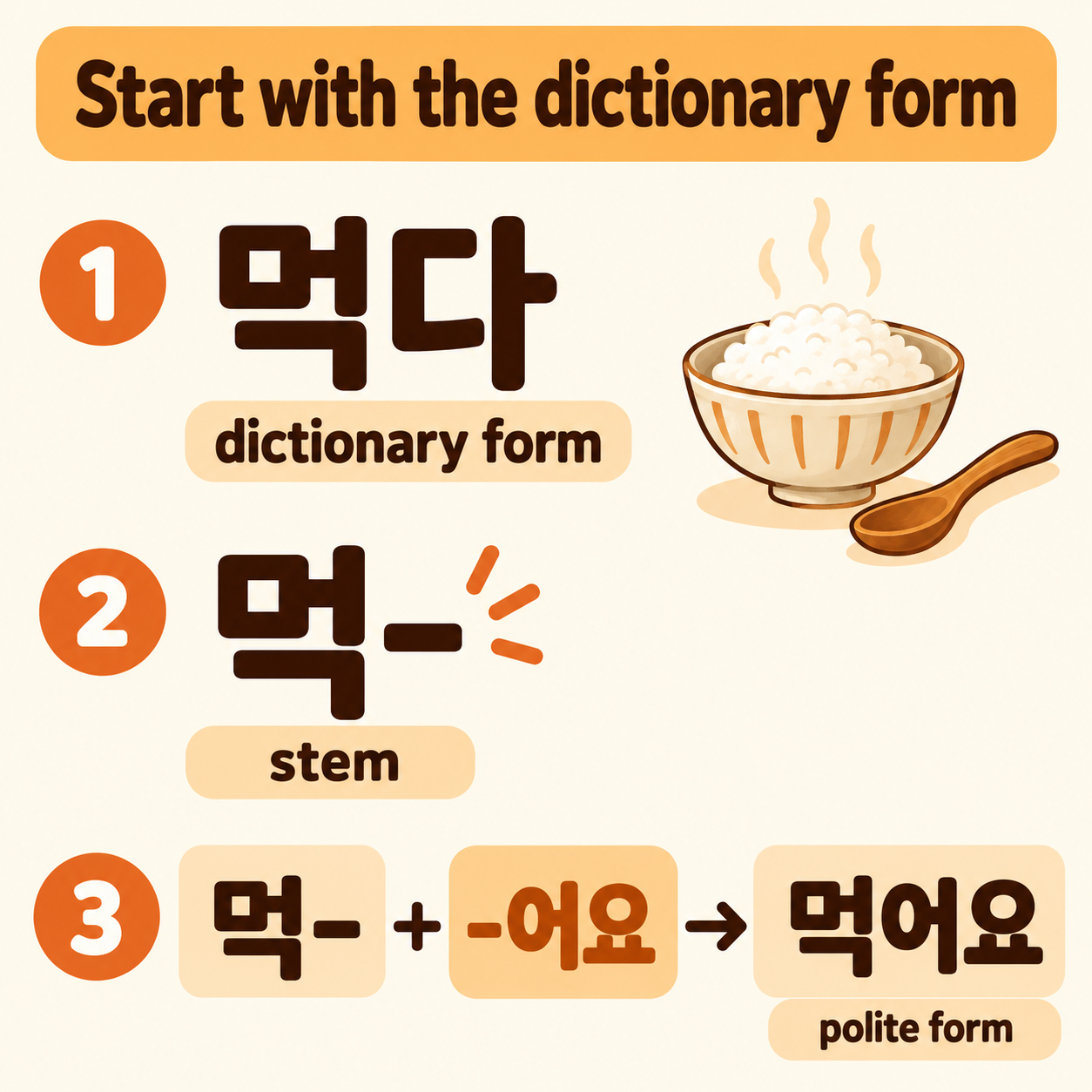
Korean verb conjugation combines a stem with endings. Start with the dictionary form: remove -다 from 먹다, to eat, to get 먹-. Adding -어요 gives 먹어요. But a form you have already learned, such as 해요, is not necessarily a stem with 요 attached.
A Korean verb conjugation table for statements
These five rows compare polite non-past, polite past and formal non-past statements. The English column identifies the action; a full sentence supplies the person and time. This is a starter set, not a table of every ending.
| Dictionary form | Meaning | Polite non-past | Polite past | Formal non-past |
|---|---|---|---|---|
| 가다 | go | 가요 | 갔어요 | 갑니다 |
| 먹다 | eat | 먹어요 | 먹었어요 | 먹습니다 |
| 하다 | do | 해요 | 했어요 | 합니다 |
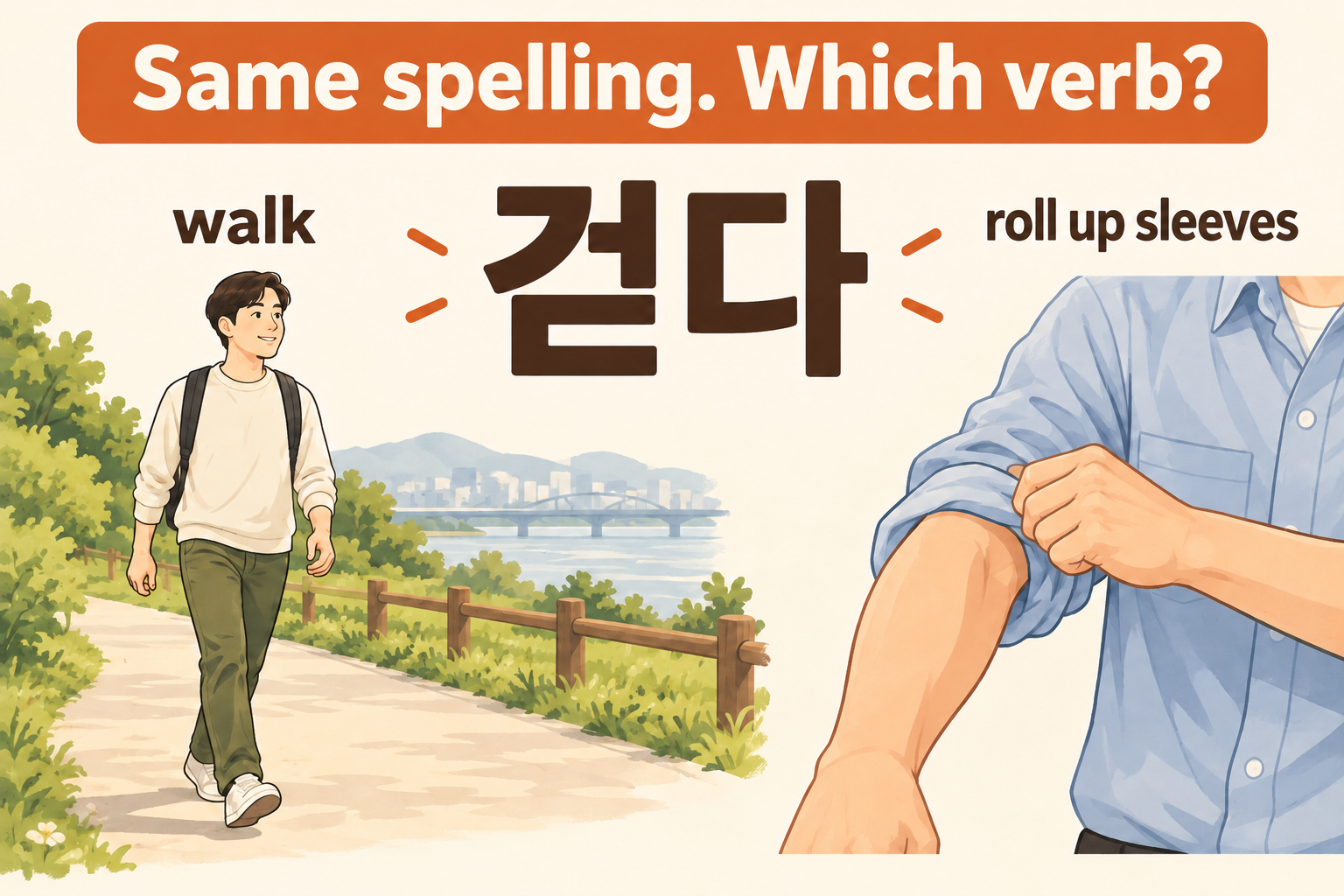
| 걷다 | walk | 걸어요 | 걸었어요 | 걷습니다 |
| 걷다 | roll up, as with sleeves | 걷어요 | 걷었어요 | 걷습니다 |
For the polite forms, the basic choice is -아 after a stem’s final vowel ㅏ or ㅗ, and -어 after other vowels. Contractions and irregular patterns can change the result: 가 + 아요 becomes 가요, while 하다 gives 해요. The past forms here use -았- or -었-, with 하다 giving 했어요. The formal column changes how the statement addresses the listener; it does not make the action past.
Choose the meaning before applying an irregular pattern
Suppose a vocabulary note changes every 걷다 to 걸어요. That works for walking, but not for rolling up sleeves. The Korean Basic Dictionary gives separate entries with different forms: 걸어 for walking and 걷어 for rolling up.
Correct the note by keeping the intended action beside each form:
- 길을 걸어요. — Someone walks along the road.
- 소매를 걷어요. — Someone rolls up their sleeves.

In the second sentence, changing 걷어요 to 걸어요 would not be a spelling improvement. You would be applying the walking entry’s pattern to a different verb. A dictionary lookup needs the matching meaning, not just matching letters.
Do not use a finished polite form as the next stem
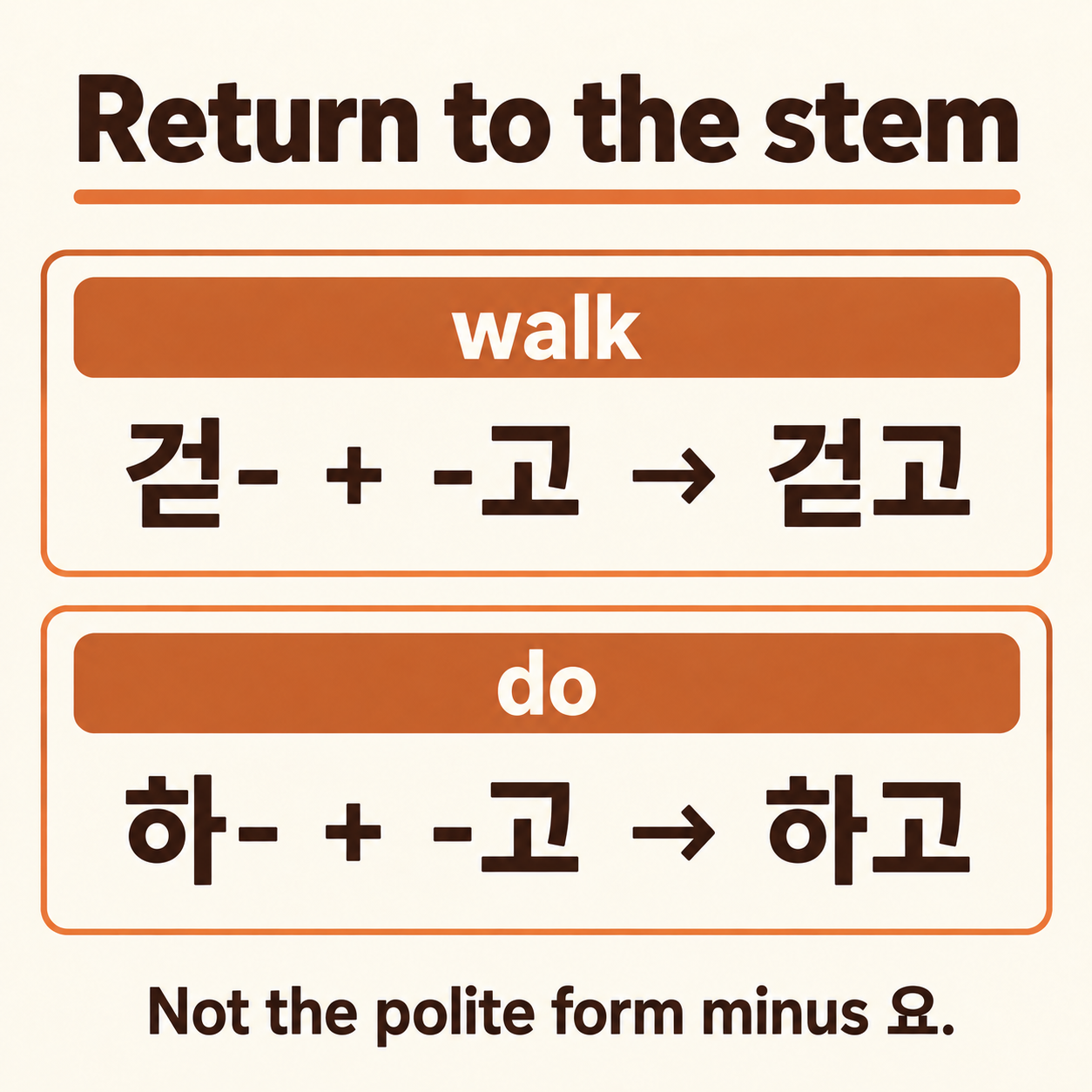
The ending -고 can connect actions in sequence. For the simple connections below, start from the dictionary stem, not from the polite form minus 요.
If you replace 요 with 고 in 걸어요 and 해요, you get 걸어고 and 해고. Neither is the intended verb connection here, but the two mistakes have different causes.
- In 걸어요, the walking verb’s ㄷ has changed to ㄹ before the vowel-led ending. Removing 요 still leaves that changed shape and 어. Return to 걷다: 걷- + -고 → 걷고.
- In 해요, 해 is the shortened form of 하여. Removing 요 does not recover 하-. Return to 하다: 하- + -고 → 하고.
걷고 쉬어요. means Someone walks and then rests. 숙제를 하고 쉬어요. means Someone does their homework and then rests. The first action takes -고; the sentence still ends politely with 쉬어요.
Try another changed stem
듣다 means to listen, and its polite form is 들어요. To connect listening to music with doing homework afterward, complete 음악을 ___ 숙제를 해요 using -고. 음악 means music; 숙제 means homework.
Show the connection
음악을 듣고 숙제를 해요. — Someone listens to music and then does their homework. Use 듣- + -고 → 듣고, not 들어고. The ㄷ-to-ㄹ change in 들어요 does not carry over before 고.