Months in Korean: All 12 Names, From Calendar Labels to Dates
Months in Korean: All 12 Names, From Calendar Labels to Dates
The two sixes in 6월 6일 do not become the same Korean syllable. June is 유월 (yuwol), but the sixth day keeps 육. Most months in Korean follow a Sino-Korean number plus 월. June and October have special written forms.

All twelve calendar labels
The Hangul column gives the names to write. The romanized readings help you connect them to their sounds.
| English | Calendar label | Hangul | Reading aid |
|---|---|---|---|
| January | 1월 | 일월 | irwol |
| February | 2월 | 이월 | iwol |
| March | 3월 | 삼월 | samwol |
| April | 4월 | 사월 | sawol |
| May | 5월 | 오월 | owol |
| June | 6월 | 유월 | yuwol |
| July | 7월 | 칠월 | chirwol |
| August | 8월 | 팔월 | parwol |
| September | 9월 | 구월 | guwol |
| October | 10월 | 시월 | siwol |
| November | 11월 | 십일월 | sibirwol |
| December | 12월 | 십이월 | sibiwol |
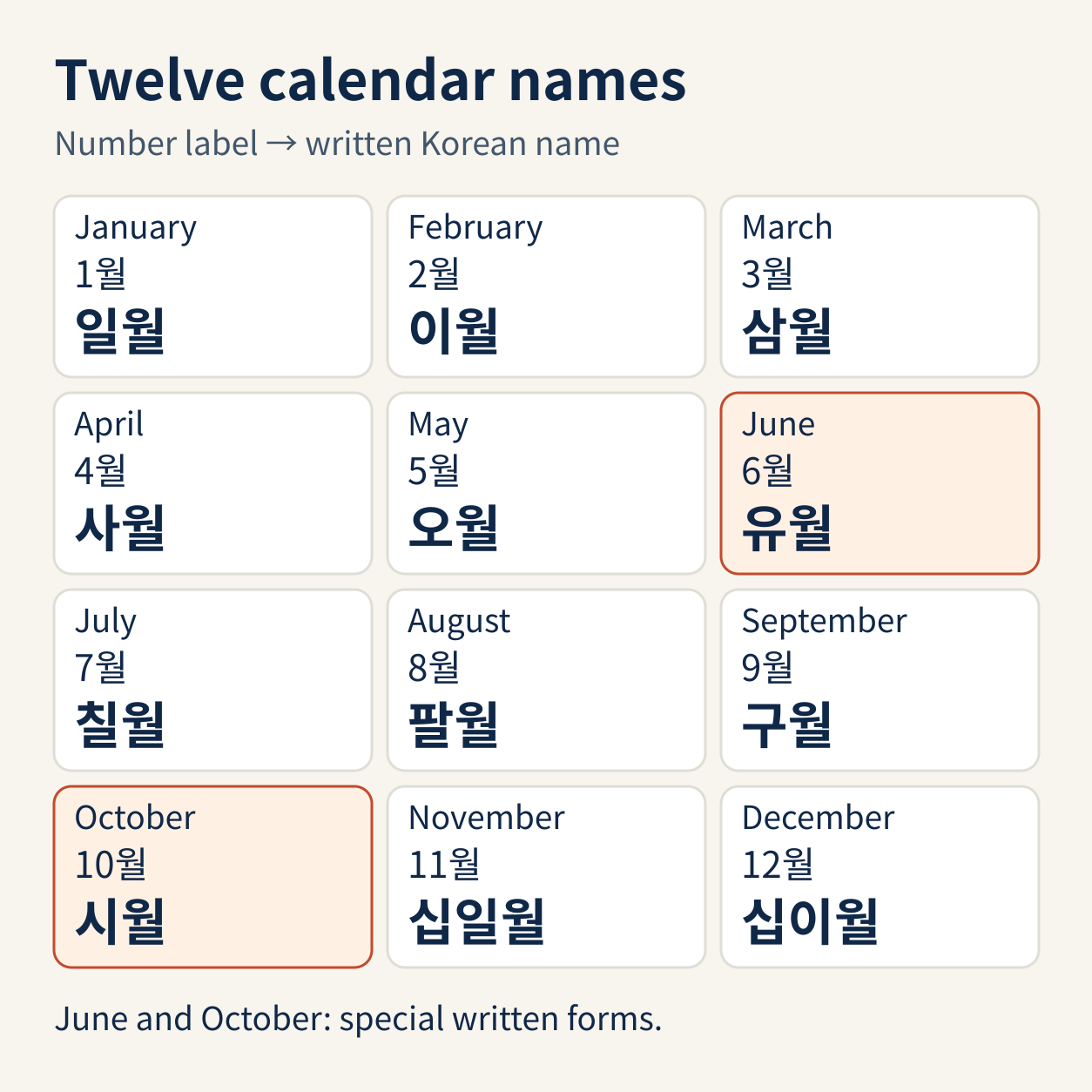
These are calendar names: 3월 means March. For the number system behind the labels, see Sino-Korean numbers.
What changes in writing, and what changes only in sound
For January, the official learner dictionary gives the spelling 일월 and the pronunciation [이뤌]. The brackets show sound. If you are writing the name on a calendar, keep 일월 rather than copying 이뤌.
June works differently. Its standard spelling is 유월, not 육월. October is 시월, not 십월. Those forms belong in the written name itself; they are not merely pronunciation notes beside a different spelling.
- 1월 → 일월 → [이뤌]: numeral label, written name, sound.
- 6월 → 유월 → [유월]: the written name already has 유.
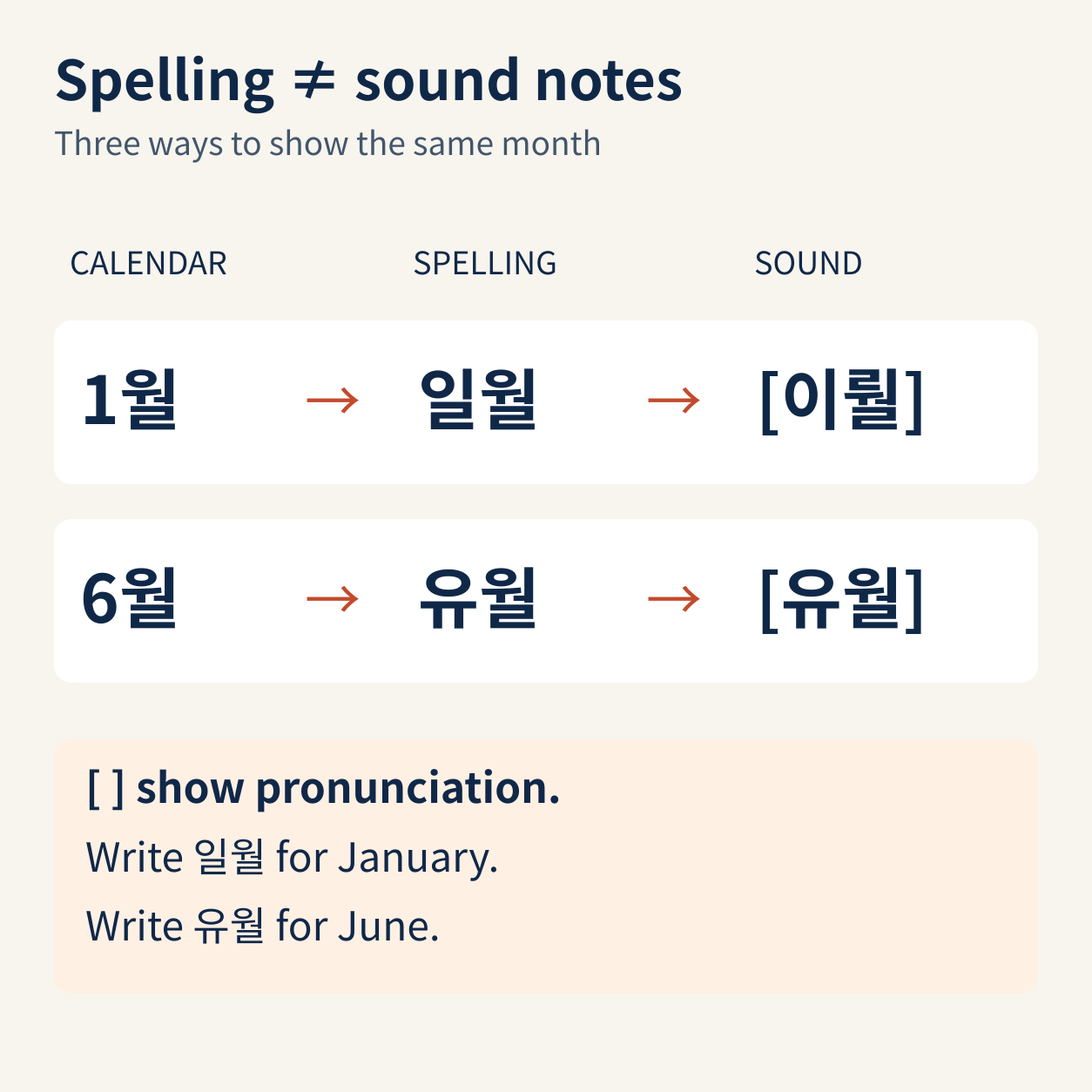
November and December keep their written 십: 십일월 and 십이월. Their readings are [시비뤌] and [시비월], respectively. The special spelling of October does not turn November into 시일월. The Tokyo University of Foreign Studies reference lists the twelve names and their reading differences.
Keep the month and day in their own places
A full date can be written 2026년 6월 6일: year, month, day. The middle part names June; the last part identifies its sixth day. In Hangul, the last two parts are 유월 육 일. The numeral for six remains 육 before the day unit 일.
October 10 follows the same boundary: 10월 10일 → 시월 십 일. Only the calendar name takes 시. The day still uses 십. The National Institute of Korean Language explicitly distinguishes these forms.
Now compare two dates with 1 and 11 swapped:
| Date | Written in Hangul | Meaning |
|---|---|---|
| 11월 1일 | 십일월 일 일 | November 1 |
| 1월 11일 | 일월 십일 일 | January 11 |
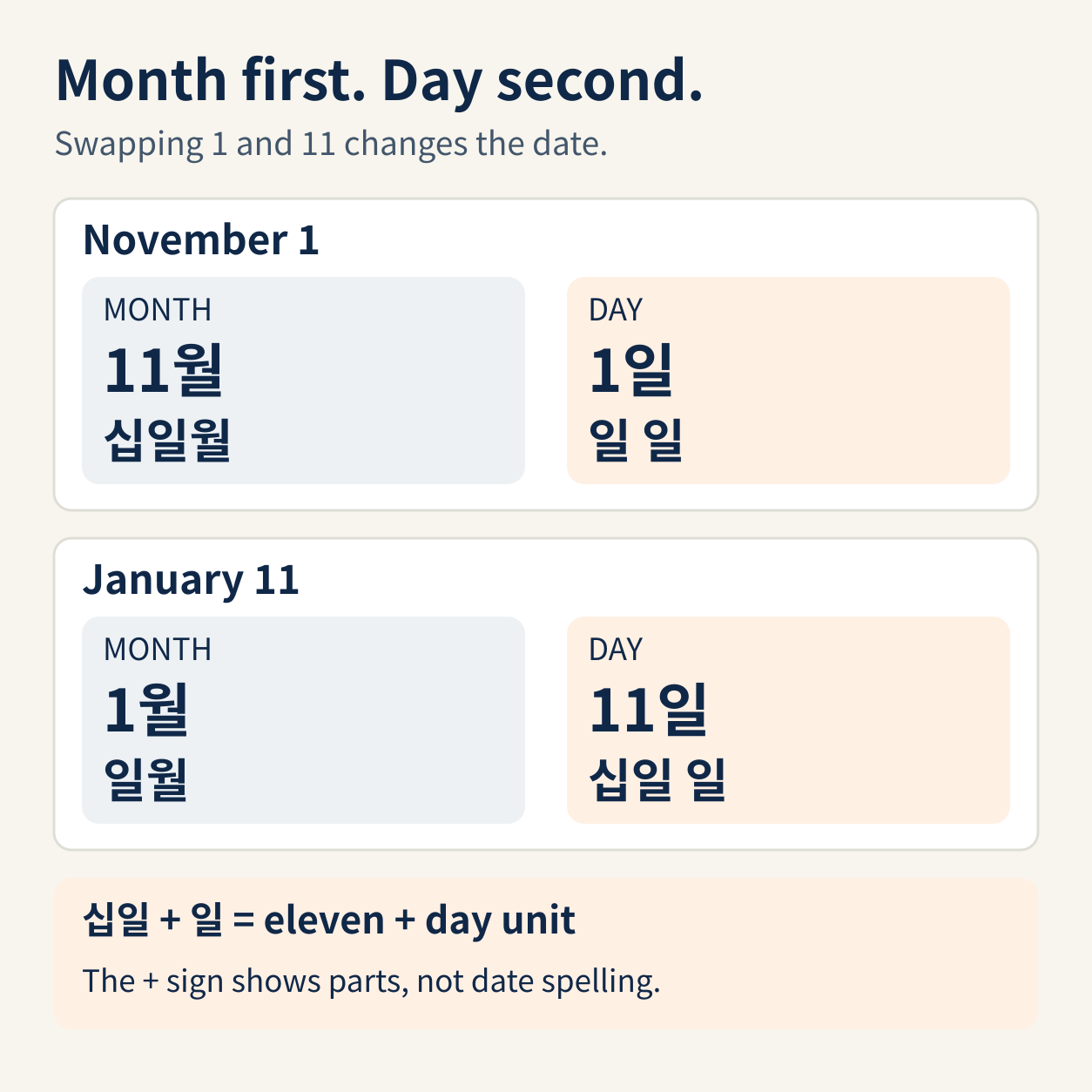
In the first row, 십일 + 월 names November. The following 일 + 일 contains the number one and the day unit. In the second row, 일 + 월 names January, while 십일 + 일 gives day eleven. The plus signs expose the parts; they are not part of the date's spelling.
The repeated 일 is therefore meaningful. In 십일 일, the first belongs to the number eleven and the last labels it as a day. Writing 십 일 instead would give day ten. You can also write the attached form 십일일; the meaning remains eleven followed by the day unit.