Native Korean Numbers, Build the Count Before You Shorten It
Native Korean Numbers, Build the Count Before You Shorten It
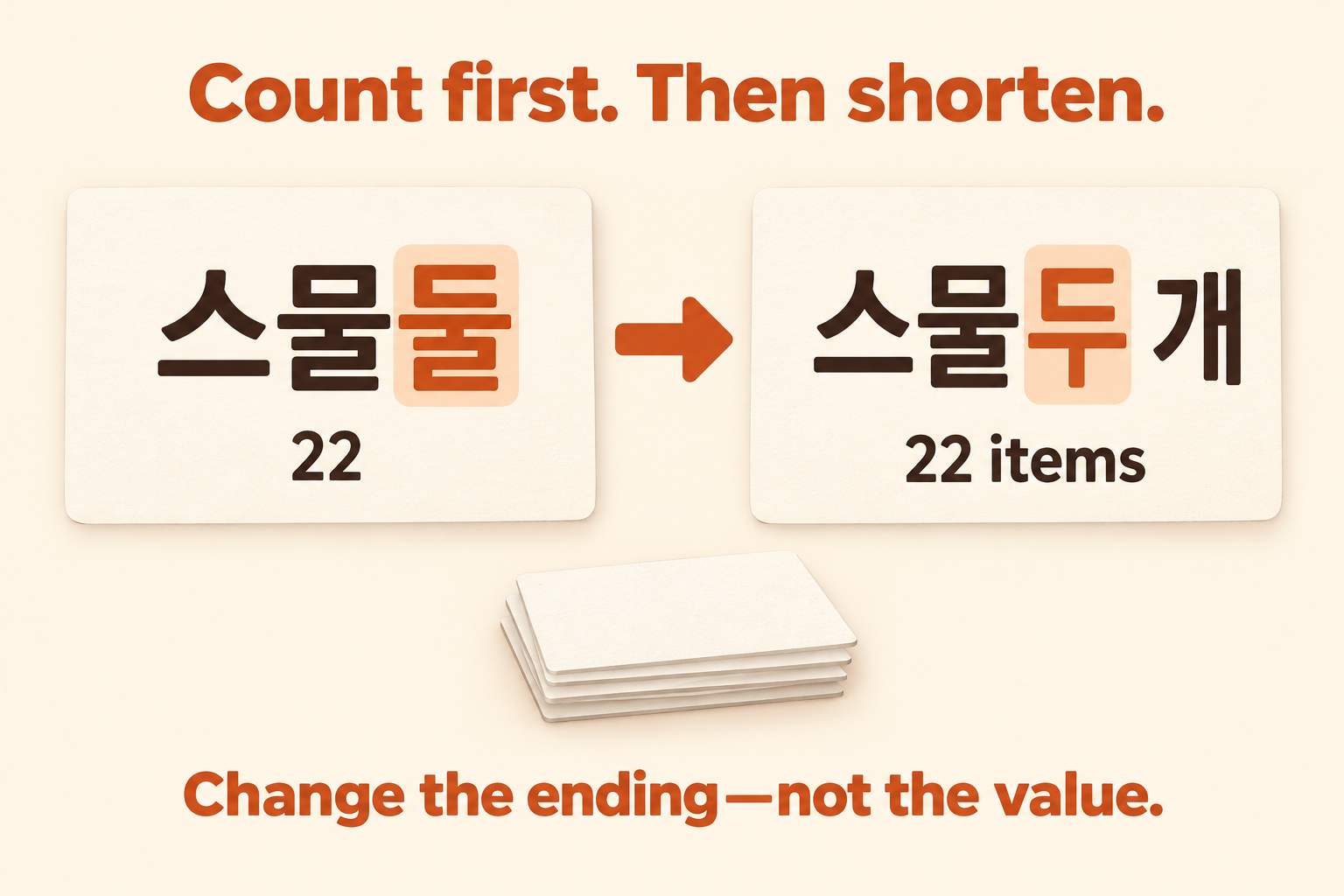
Native Korean numbers begin 하나, 둘, 셋—one, two, three. The familiar sequence hana dul set is a romanized reading aid for those first three words. This is the set used in expressions such as 두 개, “two items,” alongside the separate Sino-Korean set that begins 일, 이, 삼.
Two different mistakes can hide inside a quantity. A learner may build twenty-two correctly but change the wrong part before a counter. Or they may read 한두 as an exact total when it means “one or two.” The spelling and the amount need separate checks.
The counting forms from one to ninety-nine
The table shows written forms, not a transcription of connected speech.
| Value | Written form |
|---|---|
| 1 | 하나 |
| 2 | 둘 |
| 3 | 셋 |
| 4 | 넷 |
| 5 | 다섯 |
| 6 | 여섯 |
| 7 | 일곱 |
| 8 | 여덟 |
| 9 | 아홉 |
| 10 | 열 |
The tens have their own words. They are not made by putting 둘 or 셋 in front of 열.
| Value | Written form |
|---|---|
| 20 | 스물 |
| 30 | 서른 |
| 40 | 마흔 |
| 50 | 쉰 |
| 60 | 예순 |
| 70 | 일흔 |
| 80 | 여든 |
| 90 | 아흔 |
For the values between these tens, put the tens part first and the ones part after it: 열둘 is 10 + 2, or 12; 스물둘 is 20 + 2, or 22.
Two wrong routes to twenty-two items
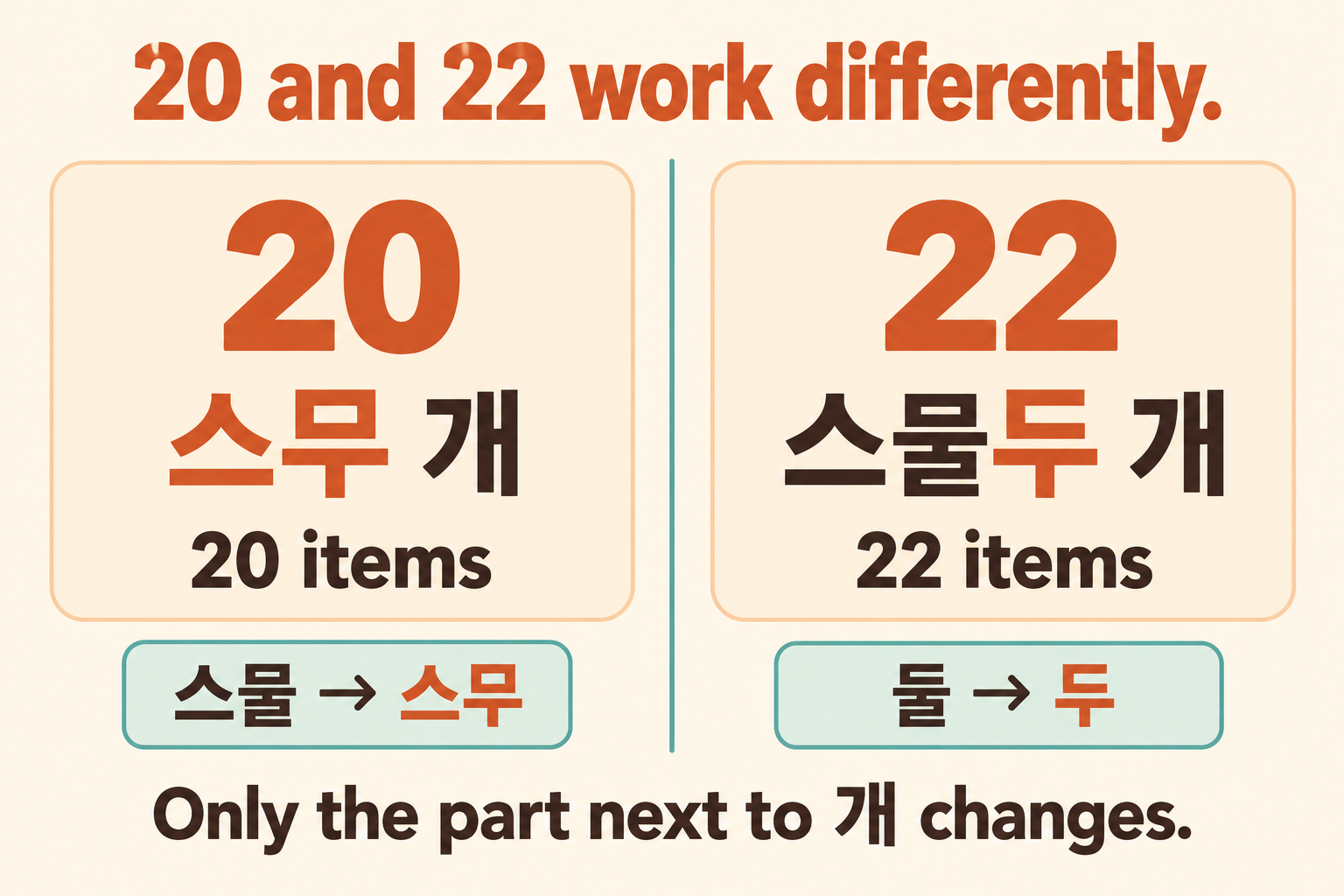
With the counter 개, the forms for 1, 2, 3, 4 and 20 are 한, 두, 세, 네 and 스무. Other entries in the tables do not change in this pattern. A counter names the unit being counted; here the unit stays fixed as individual items.

Start with twenty-two, 스물둘. The part immediately before 개 is 둘, so that part becomes 두. The result is 스물두 개. Do not turn 스물 into 스무 first and then attach the remaining part.
| Incorrect attempt | What went wrong | Minimal repair |
|---|---|---|
| 스무두 개 | The tens part was changed even though another component follows it. | Restore 스물; keep 두. |
| 스물둘 개 | 둘 was left unchanged before 개. | Change the final 둘 to 두; keep 스물. |
For exactly twenty items, there is no ones component between 스물 and the counter, so the phrase is 스무 개.
Not every joined expression is an addition
When reading Korean counting numbers in a message, do not extend the tens-plus-ones rule to every combination you recognize. 한두 means “one or two”; 두세 means “two or three.” They do not mean 1 + 2 or 2 + 3.
Compare 열두 개 with 한두 개. The counter is identical. The first gives an exact count of twelve. The second gives a small approximate quantity rather than one exact count. Changing the counter would not make that quantity exact.
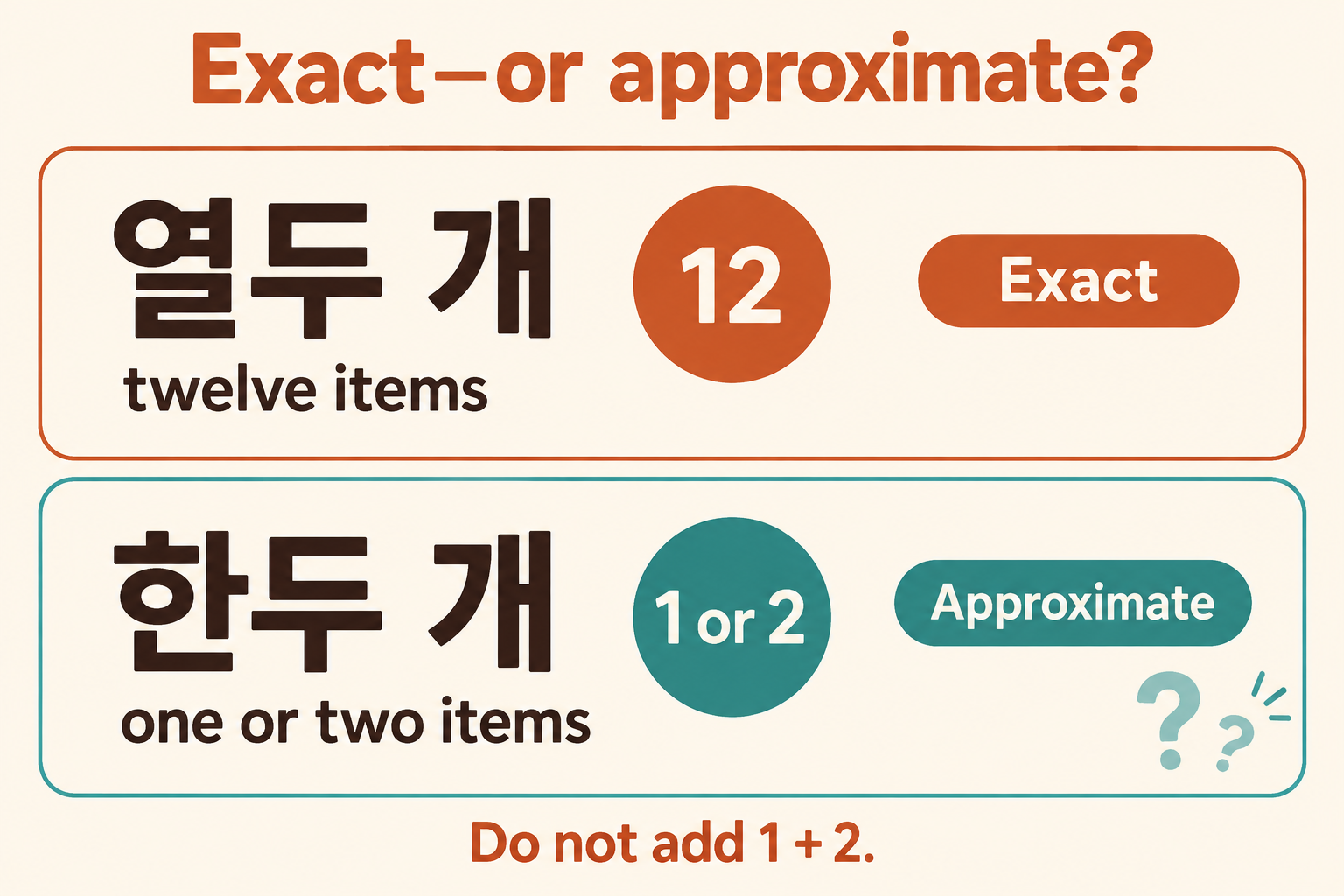
Suppose you need to copy a note into a field that requires an exact item count. The note says 한두 개. Entering 3 would wrongly add the components; entering 12 would confuse 한두 with 열두. Even entering 1 or 2 selects a value the note did not settle. Preserve “one or two” in the translation, and get a confirmed count before filling that exact-value field.
Repair the form without changing the quantity
To write 33 items, suppose you put 서른셋 개. Which part needs repair?
Check the repair
The final 셋 becomes 세, giving 서른세 개. The value remains thirty-three.