Nunchi Meaning: Why “Reading the Room” Does Not Fully Explain 눈치
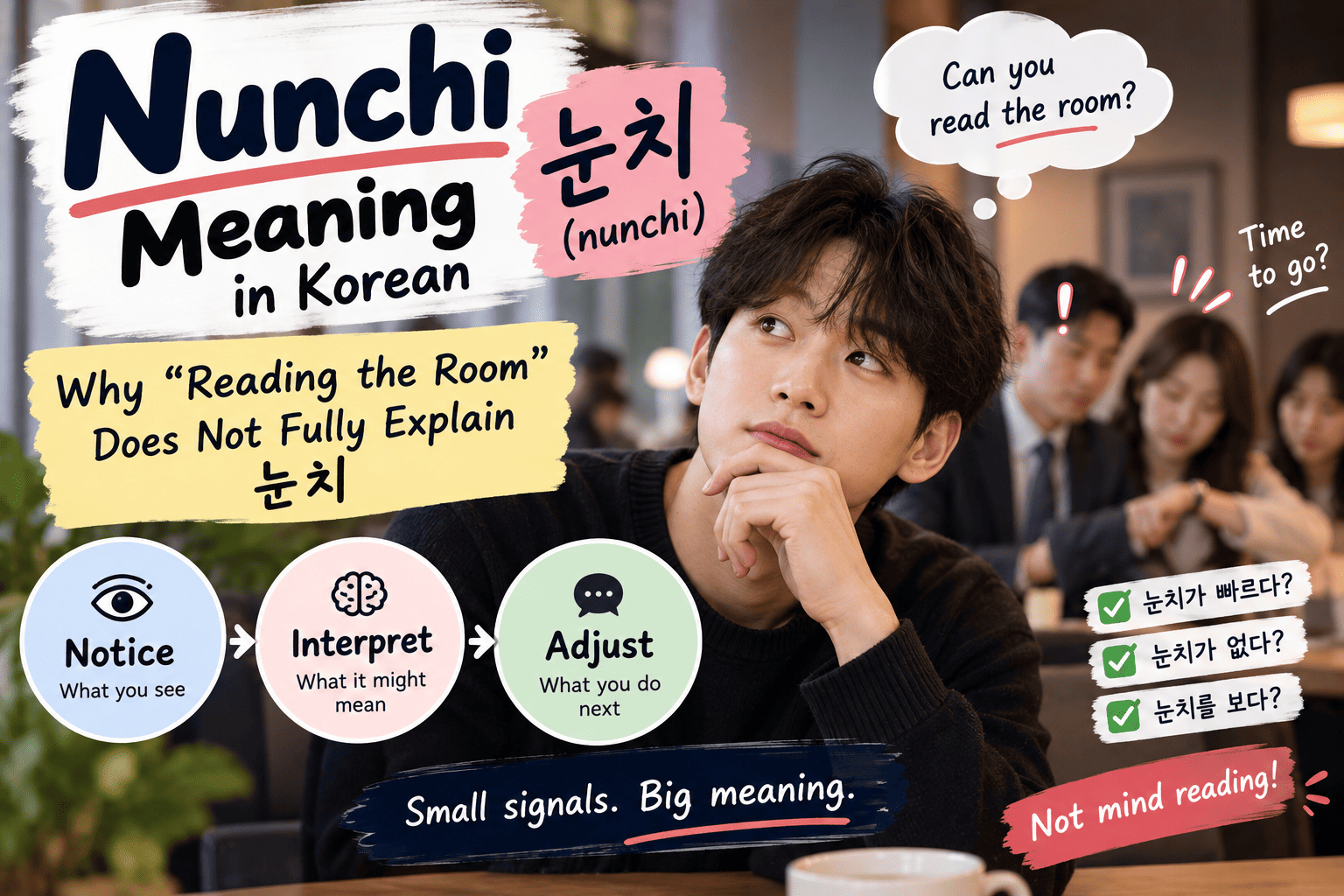
Nunchi Meaning: Why “Reading the Room” Does Not Fully Explain 눈치
There is one dumpling left on the plate.
Nobody says they want it.
One person glances at it, then looks away. Someone else nudges the plate toward the middle of the table. A third person reaches for it without noticing any of this.
Was that person lacking 눈치?
Maybe.
That tiny scene gets surprisingly close to what 눈치 (nunchi) feels like in everyday Korean. It is often translated as “reading the room,” and that translation is useful. It just leaves a few things behind.
Nunchi is not only about sensing the mood of a whole room. Sometimes it is about one face, one pause, a change in someone’s voice, or the timing of a question. And after you notice those clues, there is still another decision to make: do you change what you were about to do?
So, what does 눈치 actually mean? Nunchi Meaning
눈치 (nunchi) is the ability to pick up on what another person may be feeling or what is happening in a situation without everything being said directly.
That sounds close to “reading the room.” In many situations, it is.
But imagine talking to one friend who suddenly starts answering more briefly than before. There is no “room” to read. The atmosphere of an entire group may not have changed at all.
You still notice something.
Maybe their expression changed. Maybe their answers became shorter. Maybe they keep checking the time.
You have clues.
What those clues mean is another matter.
And that difference matters, because having nunchi does not mean magically knowing what is inside someone else’s head.
Nunchi starts with noticing, not mind-reading
Suppose your coworker usually chats with you in the morning, but today they answer with only a few words.
You notice it.
That part is real.
Then your brain starts filling in the blank:
“Are they angry with me?”
That part is an interpretation.
The two are easy to mix up.
Actually, this is where talking about nunchi can become more useful than simply telling someone to “read the room.” Good social judgment does not require you to treat every guess as a fact.
You might notice that someone seems quieter than usual and give them a little space. Fine.
You do not have to decide that they secretly hate you.
👀 Nunchi works with clues. Clues are not proof.
Notice. Interpret. Adjust.
Here is a simple way I like to think about nunchi.
Notice
What can you actually see or hear?
Someone stopped talking.
A person looked toward the clock.
Everyone else has started putting their things away.
Your friend hesitated before answering.
Interpret
What might those things mean?
Maybe the conversation should end.
Maybe your friend is uncomfortable.
Maybe everyone is preparing to leave.
Maybe nothing is wrong at all.
Adjust
Now you choose what to do.
Change the subject.
Wait before asking another question.
Offer the other person an easy way to say no.
Or do nothing, because you do not have enough information yet.
That last option is worth keeping.
Nunchi is not a command to react to every eyebrow movement in the room.
Try it at 5:55 p.m. 💼
You are at work and have one more question.
It is 5:55.
You look around. A few people are closing documents. Someone has already put on their jacket. The person you want to ask is still at their desk, but they are packing a bag while checking their phone.
No one has told you:
“Do not ask a question now.”
You are technically free to ask.
Nunchi enters before you speak.
Is this urgent?
Can it wait until tomorrow?
Does the question need five seconds or twenty minutes?
You may still decide to ask. The point is that you noticed the timing before acting.
That is a better picture of nunchi than imagining a mysterious Korean ability to know what everybody is thinking.
The same clue can lead to different answers
Let’s make it less comfortable.
You are eating with three friends. There is one piece of food left.
Nobody takes it.
What should you do?
Well, there is no universal nunchi answer.
Maybe everyone is full.
Maybe someone wants it but is waiting.
Maybe the group is close enough that somebody will simply say, “Are you eating that?”
Maybe you can take it and nobody cares.
This is exactly why 눈치 should not be taught as a secret list of Korean social rules.
The situation gives you clues. Your relationship with the people there changes how you read them.
A table of close friends does not work exactly like a meeting with people you barely know.
What does 눈치가 빠르다 mean?
눈치가 빠르다 (nunchiga ppareuda) literally describes someone whose nunchi is “fast.”
In everyday use, it can describe someone who quickly picks up on what is happening.
Imagine a friend quietly trying to prepare a surprise. Another person notices one strange detail, looks around once, and immediately understands what is going on.
눈치가 빠르네.
Nunchiga ppareune.
“You catch on quickly.”
Depending on the situation, that can be useful—or mildly annoying if you were trying to keep the surprise secret.
And 눈치가 없다?
눈치가 없다 (nunchiga eopda) means that someone is not picking up on the social cues or situation around them.
This expression can sound much sharper than a neutral description.
Imagine a group is clearly trying to wrap up a conversation, but one person keeps starting new topics. Or somebody continues making jokes after the mood has obviously become serious.
A person watching that might think:
눈치가 없네.
Nunchiga eomne.
Something like, “They really aren’t picking up on it.”
Calling someone 눈치 없다 can be critical, so it is not a label I would casually throw at people just because they missed one hint.
눈치를 보다 feels a little different
There is another expression you will hear often:
눈치를 보다 (nunchireul boda).
The literal pieces look strange in English—almost like “looking at nunchi.” In actual conversation, it can carry the feeling of watching someone’s reaction, checking how they might respond, or feeling cautious because of another person.
For example, imagine wanting to leave early but repeatedly checking your manager’s mood before mentioning it.
You are not simply “reading the room” once.
You are watching for a reaction before deciding what feels safe or appropriate to do.
That can become uncomfortable too. Someone who is constantly 눈치를 보다 may feel restricted rather than socially brilliant.
So nunchi is not automatically a compliment in every form.
What about 눈치껏?
눈치껏 (nunchikkeot) is another useful word because it shows nunchi turning into action.
Imagine someone says:
눈치껏 해.
Nunchikkeot hae.
The feeling is roughly:
“Use your judgment.”
“Figure out what fits the situation.”
It assumes that not every detail needs to be spelled out.
Of course, that can be frustrating if you genuinely do not know what is expected. Anyone who has ever been new at a job probably understands that feeling.
A quick nunchi test
Here are three situations. Do not look for one “Korean” answer. Look for the clues first.
Situation 1
You are explaining something, and the other person has looked at their phone three times in one minute.
What do you actually know?
They looked at their phone three times.
What might you infer?
They may be busy, waiting for something, distracted, or hoping the conversation ends soon.
A reasonable adjustment might be to shorten what you are saying or ask whether they need to go.
Situation 2
Everyone at a meeting starts closing laptops, except the person leading it.
You have another question.
Maybe ask it. Maybe save it.
The urgency of the question matters. So does how long it will take.
There is no nunchi formula that decides for you.
Situation 3
A friend says “괜찮아” but looks uncomfortable.
You notice the mismatch.
That does not give you permission to announce what your friend “really feels.”
You could simply leave a little room:
진짜 괜찮아?
Jinjja gwaenchana?
“Are you really okay?”
Then let them answer for themselves.
Nunchi is useful partly because it can be wrong
This may sound strange, but I think it is important.
If nunchi were perfect, it would not be social judgment. It would be telepathy.
People misread expressions. They overthink silence. Sometimes somebody looks annoyed because they are tired. Sometimes the person checking the clock really does have somewhere to be.
The useful version of nunchi leaves a little uncertainty.
You notice.
You make a reasonable guess.
You adjust without pretending your guess is a fact.
That is also why someone can have good nunchi and still ask a direct question. Picking up on a hint does not mean every conversation has to remain unspoken.
“Reading the room” is a good start
If someone asks for a quick nunchi meaning in English, “reading the room” is still one of the easiest places to begin.
Just do not let the English phrase shrink the Korean word too much.
눈치 can show up in a room full of people, in a two-person conversation, at work, over dinner, or in the half-second before you decide whether now is a good time to speak.
Sometimes you notice the mood.
Sometimes you notice one person.
Sometimes you notice something—and wisely decide you still do not know enough.
Back at the table, the last dumpling is still sitting there.
You look at your friends.
One of them laughs.
“Are you going to eat that or just stare at it?”
Fair enough.