Oppa Meaning in Korean: Why 오빠 Does Not Automatically Mean “Boyfriend”
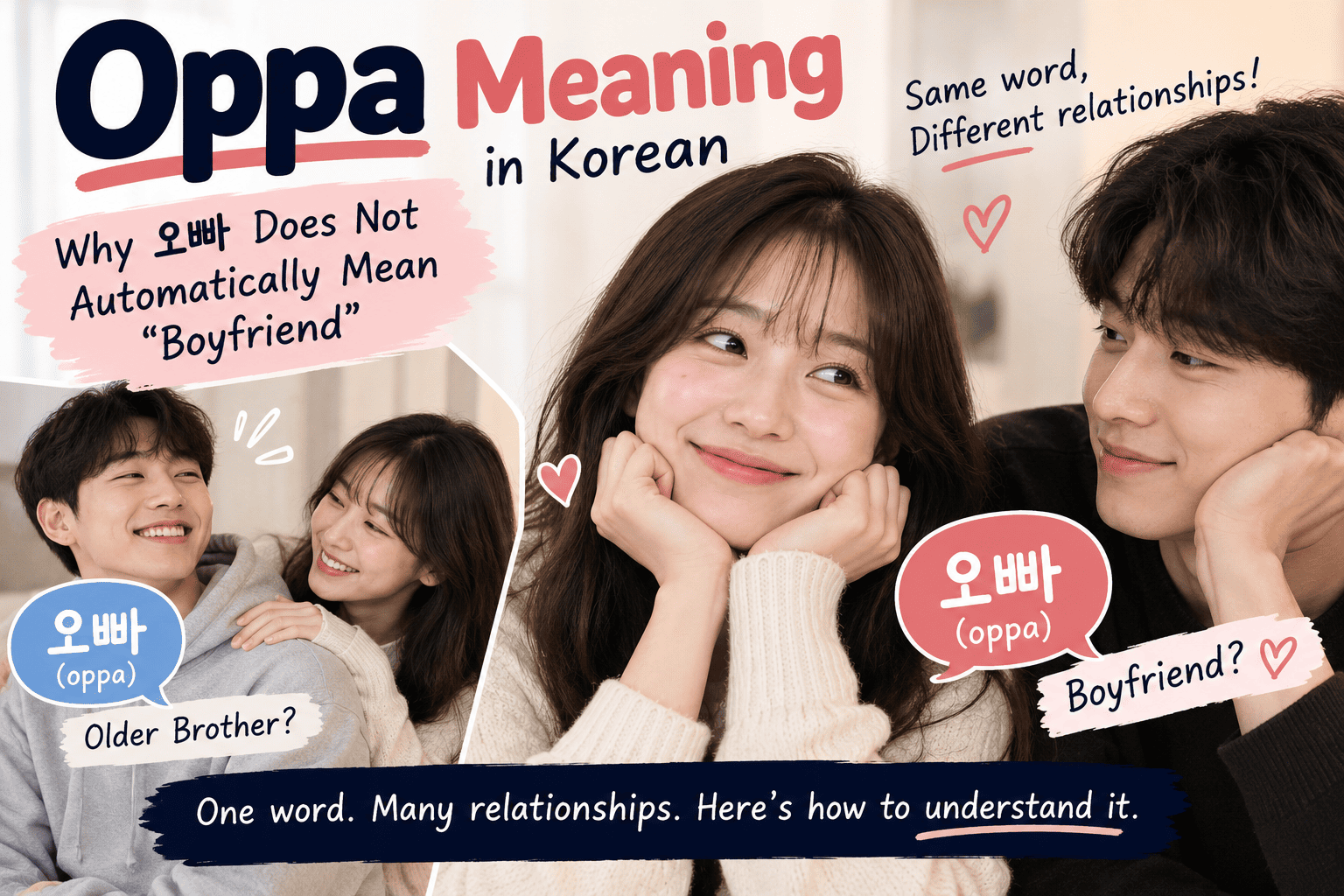
Oppa Meaning in Korean: Why 오빠 Does Not Automatically Mean “Boyfriend”
If you watch Korean dramas or follow K-pop, you have probably heard the word 오빠 (oppa) many times.
A woman says it to her actual older brother. Another woman says it to a man she is dating. Someone else talks about a male friend and calls him 오빠.
That can create an obvious question for Korean learners:
If a woman calls a man “oppa,” are they dating?
Not necessarily.
The easiest English translation of 오빠 is “older brother,” but that translation does not explain the full way the word works in Korean relationships. At the same time, translating it as “boyfriend” creates an even bigger misunderstanding.
A better way to understand oppa is to treat it as relationship information. It tells you something about the speaker, the man she is referring to, their age relationship, and often their level of closeness. But it does not tell you the entire relationship by itself.
The Shortest Accurate Meaning of 오빠
The word is written 오빠 and romanized as oppa. The double consonant ㅃ is a tense Korean consonant, so the middle sound is firmer than a soft English “p.”
The Korean-English Learners’ Dictionary from the National Institute of Korean Language gives 오빠 two closely related uses.
First, a girl or woman can use 오빠 (oppa) to refer to or address an older male sibling or older male cousin.
Second, a girl or woman can use the same word affectionately for an older male who is not her relative.
That second meaning is the reason the simple translation “older brother” quickly becomes confusing outside a family.
The official dictionary itself includes examples such as 아는 오빠 (aneun oppa), meaning an older male acquaintance, and 친한 오빠 (chinhan oppa), meaning a close older male.
So the useful starting point is:
오빠 usually involves a female speaker and an older male, but the man does not have to be her biological brother.
Think of Oppa as a Relationship Map
Instead of memorizing “oppa has three meanings,” it is more useful to ask what relationship already exists between the two people.
The same word can appear in very different relationships because 오빠 does not function exactly like an English relationship label such as “brother,” “friend,” or “boyfriend.”
There are three major zones to understand.
Zone 1: Family
This is the most direct meaning.
A younger sister can call her older brother:
오빠 (oppa)
Older brother
The same basic family use can also apply to an older male cousin.
A simple family example
오빠, 엄마가 불러. (oppa, eommaga bulleo.)
Oppa, Mom is calling you.
There is nothing romantic about this use. It is simply a family term.
Zone 2: A Close Older Male Who Is Not Family
This is where English translation becomes more difficult.
Korean kinship terms can extend beyond actual family relationships. 오빠 can therefore be used for an older male with whom a woman has an established, familiar relationship.
For example, a woman might say:
친한 오빠가 있어요. (chinhan oppaga isseoyo.)
I have a close older male friend.
Calling him “brother” in English may make the relationship sound biological when it is not. Calling him a “boyfriend” would also be wrong unless they are actually dating.
The Korean word carries information that does not fit neatly into one English noun.
Research on Korean terms of address has also examined how kinship terms such as 오빠 can extend into non-family social relationships. In other words, this is not simply something invented by K-dramas. It is part of a broader feature of Korean address practices.
Zone 3: A Romantic Partner
A woman may also call an older boyfriend or romantic partner 오빠 (oppa).
This is probably the use that international viewers notice most easily in romantic K-dramas.
For example:
오빠, 오늘 뭐 해? (oppa, oneul mwo hae?)
Oppa, what are you doing today?
If the speakers are already a couple, 오빠 can sound affectionate and intimate.
But there is an important logical difference:
A boyfriend can be called oppa, but a man called oppa is not automatically a boyfriend.
That distinction solves a large part of the confusion.
Same Word, Two Completely Different Relationships
I see this difference clearly in my own everyday life.
My girlfriend has a biological older brother, and she calls him 오빠 (oppa).
She also calls me 오빠 because I am older than she is.
The word is exactly the same.
The relationships obviously are not.
When she says 오빠 to her brother, it identifies a real family relationship. When she uses it with me, we already have a romantic relationship, so the same word can also work as an affectionate way of addressing me.
That everyday contrast is one reason I would not translate oppa as “boyfriend.” If the word itself meant boyfriend, the family use would make no sense.
At the same time, I understand why the word can feel romantic to foreign viewers. In a relationship, the way someone says 오빠 can feel warm and affectionate.
Personally, when a younger woman calls an older man 오빠, I can sometimes feel a sense of warmth and a certain acknowledgment of the age relationship. I also understand why some men may enjoy hearing it in the right relationship.
But that is not a universal rule about Korean men. Some people like the term, some may feel neutral about it, and the relationship matters much more than the word alone.
What Can You Actually Learn When You Hear “Oppa”?
Suppose you are watching a drama.
A woman walks into a room, sees a man, and says:
오빠! (oppa!)
What have you actually learned?
You Have a Clue About the Speaker
In the standard meanings described above, 오빠 is used from a female speaker’s perspective.
A male speaker normally uses a different kinship term, such as 형 (hyeong), for an older male brother or a close older male.
That does not mean you need to learn the entire Korean kinship system before understanding oppa. It simply shows that the speaker’s own gender is built into the conventional use of the word.
You Have a Clue About Age
The man is normally older than the female speaker.
This is another major difference from an English word like “boyfriend.” Boyfriend says nothing about whether the man is older or younger.
Oppa normally does.
You Probably Have a Clue About Familiarity
If he is not actually her brother or cousin, the use of oppa often suggests that some level of familiar relationship has already been established.
That does not mean every relationship using oppa has exactly the same degree of closeness.
It means you should not treat the word as a generic polite title for every older Korean man.
What You Cannot Know From “Oppa” Alone
The interesting part is that the word also leaves several important questions unanswered.
You Cannot Know Whether They Are Dating
This is the biggest mistake to avoid.
If a woman calls a man oppa, he could be:
her biological older brother,
her older cousin,
a familiar older male friend,
an older senior she is close to,
or an older romantic partner.
The word by itself does not tell you which one.
You Cannot Know Whether She Is Flirting
Because oppa can appear in romantic contexts, learners sometimes assume that saying it is automatically flirtatious.
That cannot be true if the same woman naturally uses the word for her biological brother.
Tone, situation, existing relationship, and the rest of the conversation matter.
A romantic partner may use oppa affectionately. A younger sister may use the same word while arguing with her brother about who finished the food in the refrigerator.
The vocabulary did not change. The relationship did.
You Cannot Know Whether He Is Her Actual Brother
The opposite mistake is possible too.
If subtitles translate oppa as “brother,” an English-speaking viewer may assume the characters are related.
But Korean usage allows the term to extend beyond biological family.
This is why subtitles sometimes leave oppa untranslated. One English word may force the relationship into a category that the Korean expression itself has not fully specified.
Why Does a Family Word Work Outside the Family?
This part of Korean can seem unusual if your first language keeps family titles and social titles strictly separate.
Korean does not always keep those categories completely separate.
Researchers have studied the extension of Korean kinship terms into non-family relationships. Terms that originally describe family relationships can also become social forms of address when factors such as age, gender, and familiarity align.
This does not mean that Korean speakers pretend close friends are literally family members.
It means some Korean relationship terms carry social information that English usually expresses in other ways.
Consider what happens with 오빠.
The word can simultaneously signal:
a female speaker,
an older male listener or referent,
and some kind of recognized relationship between them.
English often needs several different nouns to describe the final relationship. Korean can retain the same form of address while the social relationship changes.
That is why trying to find one permanent English substitute for oppa is so difficult.
Why K-Pop and K-Drama Can Make Oppa Look More Romantic Than It Is
For many international learners, the first exposure to oppa does not happen inside a Korean family.
It happens in a drama, song, variety show, fan post, or K-pop community.
That changes the first impression of the word.
A 2025 study in Korean Semantics traced the use of 오빠 across twentieth-century Korean corpus material and also examined the romanized word oppa in global K-pop discussions on Reddit.
The study shows that oppa has a history inside Korean well before today's international fandom culture, while the romanized form has also taken on recognizable cultural meaning in global K-pop spaces.
This distinction matters.
K-pop did not invent the Korean word 오빠.
Instead, global Korean popular culture helped make one particular side of the word highly visible outside Korea.
If your first hundred examples of oppa come from attractive male celebrities and romantic drama scenes, it is understandable that the word starts to feel inherently romantic.
Everyday Korean usage is broader.
Can You Call an Older Korean Man “Oppa”?
Knowing what the word means is different from knowing when you should use it.
One of the most common learner mistakes is assuming that age alone is enough.
It is not.
First: Does the Basic Speaker Relationship Fit?
In the conventional meaning discussed here, oppa is a term used from a female speaker’s perspective for an older male.
If that basic relationship is not present, copying the word simply because you heard it in a drama is already risky.
Second: Is He Actually Older?
Oppa contains an age relationship.
A woman normally would not call a younger man oppa simply because they are close.
The person being addressed is expected to be older than the female speaker in the ordinary use of the term.
Third: Is There Enough Familiarity?
This is the part that a dictionary translation cannot decide for you.
A man being older than you does not automatically make him your oppa.
If you have just met someone in a formal or professional setting, suddenly calling him oppa can imply a kind of familiarity that has not actually been established.
In those situations, Koreans have many other ways to address people through names, titles, professional roles, or polite forms.
Fourth: How Do the Two of You Already Address Each Other?
Relationships usually develop before intimate forms of address feel natural.
That means one useful question is:
Has this way of addressing each other already become normal between us?
If the answer is no, forcing oppa because it sounds Korean can make the interaction less natural rather than more natural.
Learning Korean culture is not about using the most Korean-sounding word available. It is about understanding why a particular word fits a particular relationship.
Three Things Oppa Does Not Prove
1. It Does Not Prove They Are a Couple
A romantic partner may be oppa.
A brother may also be oppa.
A familiar older male may also be oppa.
You need more information before deciding the relationship is romantic.
2. It Does Not Prove She Is Flirting
The word can sound affectionate in a romantic relationship, but affection and flirtation are not built permanently into the dictionary meaning.
Look at tone, situation, and the existing relationship instead.
3. It Does Not Mean Every Older Man Can Be Called Oppa
Age is only one piece of the relationship.
Calling a stranger oppa because he happens to be older can ignore the familiarity that normally makes the non-family use natural.
The Most Useful Way to Understand Oppa
If you remember oppa only as “older brother,” you may become confused when a woman uses it for someone she is dating.
If you remember oppa as “boyfriend,” you will become confused the moment she says the same word to her real brother.
Neither translation is enough by itself.
Instead, treat 오빠 (oppa) as a piece of relationship information.
It can tell you that the conventional speaker is female.
It can tell you that the man is older.
It may tell you that some degree of family connection or social familiarity exists.
But it cannot, by itself, tell you whether the two people are siblings, friends, or romantic partners.
That final piece comes from the relationship around the word.
So the next time a Korean woman says 오빠, do not immediately ask:
“What English noun does oppa mean?”
Ask instead:
“What relationship already exists between these two people?”
That question will usually teach you much more about what oppa means in that moment.
Hear “Oppa” in Korean Pop Culture
The word 오빠 (oppa) also appears frequently in Korean popular culture. One familiar example is the Korean song “오빠야”, where the word is used in an affectionate context. Hearing the word in a song can help learners notice how different it feels from the family use of 오빠 described earlier.