Sino Korean Numbers in Writing From 1 to 1000
Sino Korean Numbers in Writing From 1 to 1000
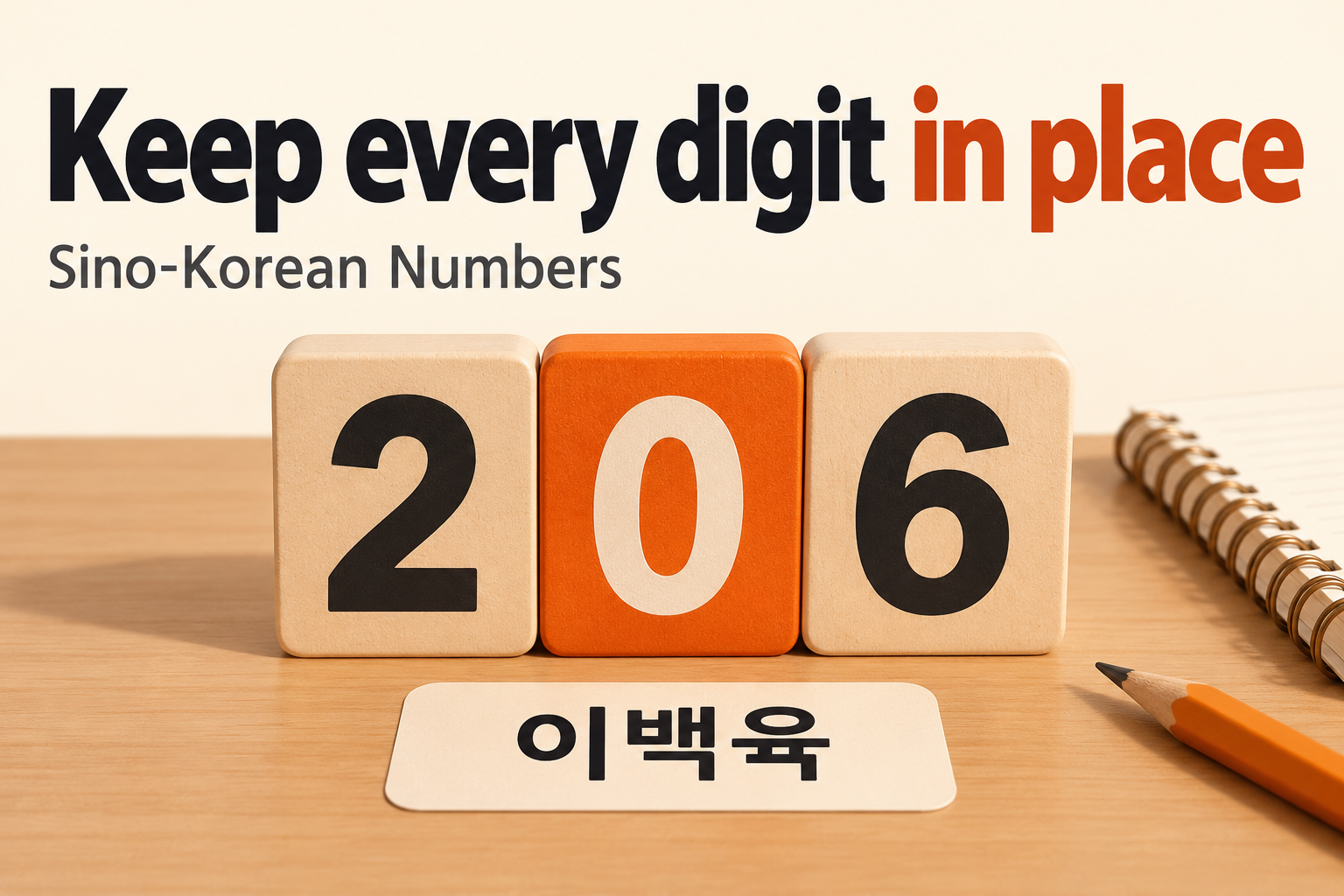
Sino Korean numbers start 일, 이, 삼—one, two, three. They combine with 십, “ten,” 백, “hundred,” and 천, “thousand,” to build larger values. This is the number set borrowed from Chinese, separate from the native set 하나, 둘, 셋.
A zero can disappear from the number's written Korean form without disappearing from its value. 이백육 is 206, not 26. But when reading an explicitly digit-by-digit sequence such as 007, both zeros remain part of the sequence.
The building blocks for 1–100 and 1–1000
The Tokyo University of Foreign Studies module gives the first ten forms below. These are spellings, not transcriptions of connected speech.
| Value | Korean |
|---|---|
| 1 | 일 |
| 2 | 이 |
| 3 | 삼 |
| 4 | 사 |
| 5 | 오 |
| 6 | 육 |
| 7 | 칠 |
| 8 | 팔 |
| 9 | 구 |
| 10 | 십 |
| Value | Korean |
|---|---|
| 20 | 이십 |
| 30 | 삼십 |
| 40 | 사십 |
| 50 | 오십 |
| 60 | 육십 |
| 70 | 칠십 |
| 80 | 팔십 |
| 90 | 구십 |
| 100 | 백 |
| 1000 | 천 |
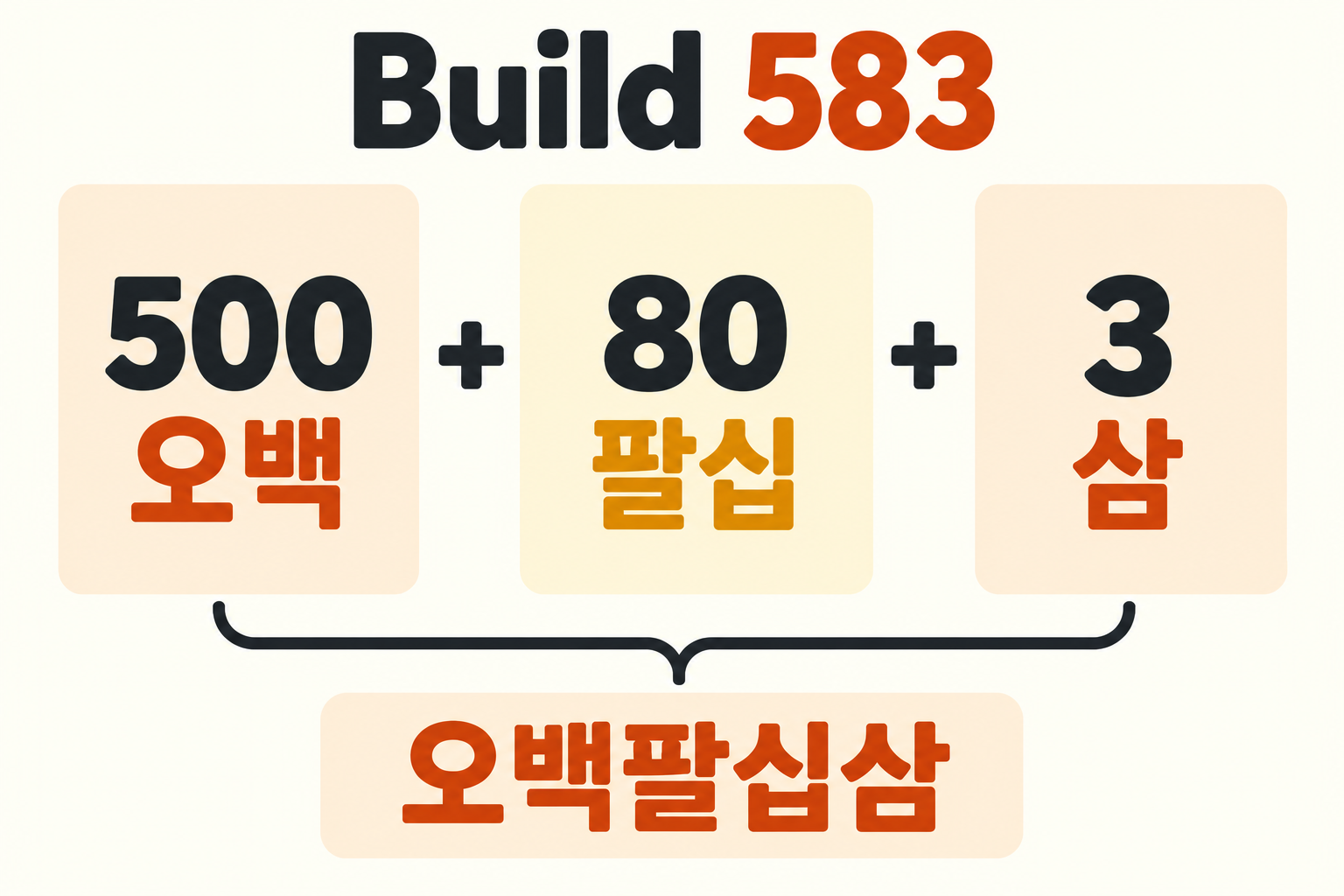
For 11–99, put the tens before the ones: 십일 is 10 + 1; 사십칠 is 4 × 10 + 7. For hundreds, put that component first: 오백팔십삼 is 5 × 100 + 8 × 10 + 3, or 583. A zero-valued place contributes no word in this whole-number pattern. The university's larger-number lesson includes 이백육 for 206.
In the ordinary whole-number forms used here, write 십, 백 and 천 without an initial 일: 10 is 십, 100 is 백 and 1000 is 천. For example, 110 is 백십 and 111 is 백십일.
Recover the place, not just the digits
A NIKL comparison of South and North Korean usage gives 백오 for 105 in its South Korean example. The South Korean whole-number pattern is the one used here.
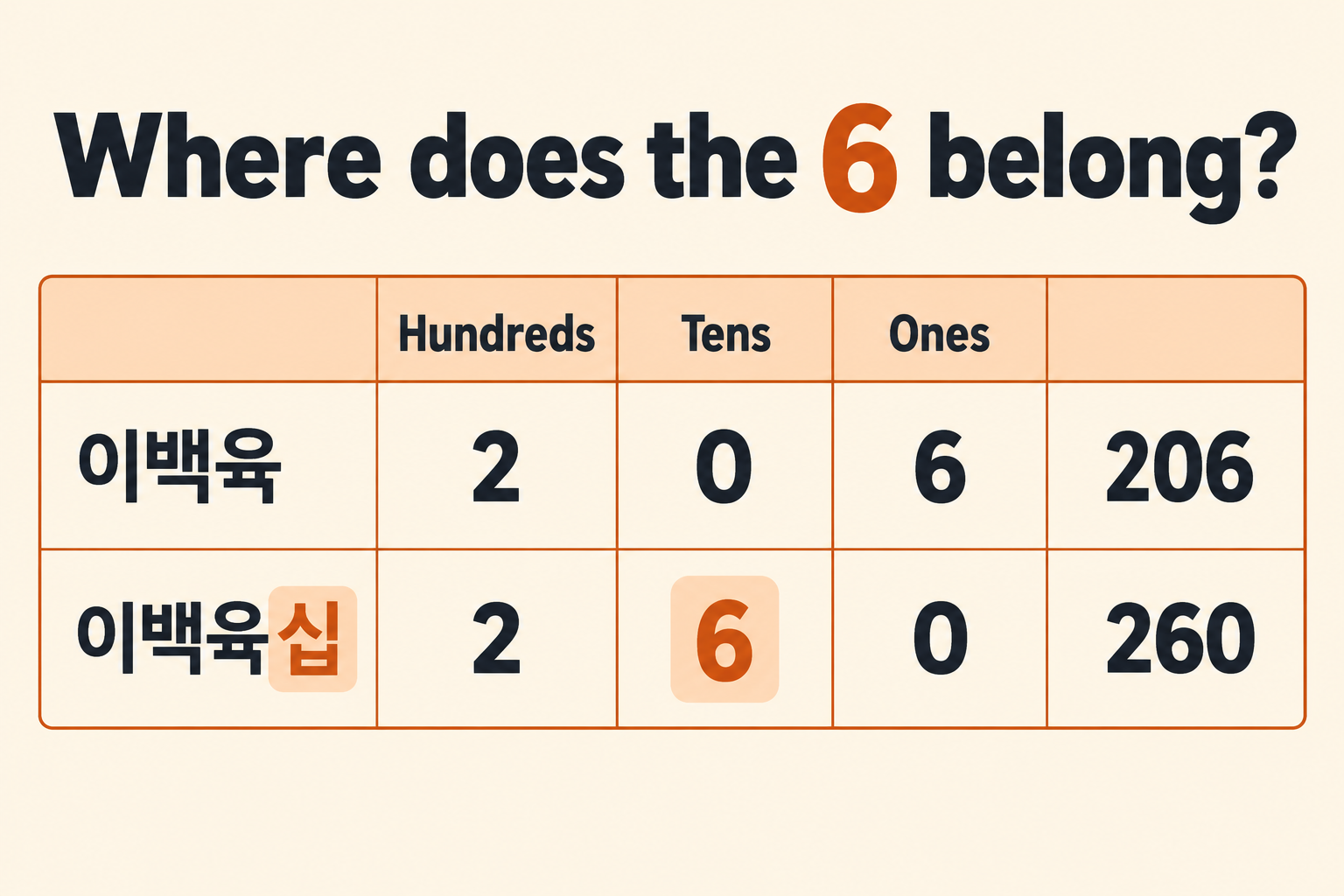
If you transcribe 이백육 as 26, you have kept 이 and 육 but discarded what 백 does. It places the two in the hundreds column. There is no 십 component, so the tens column is zero; 육 occupies the ones column.
| Form | Hundreds | Tens | Ones | Value |
|---|---|---|---|---|
| 이백육 | 2 | 0 | 6 | 206 |
| 이백육십 | 2 | 6 | 0 | 260 |
To repair the transcription of 이백육, change 26 to 206, not 260. Adding 십 after 육 would move the six into the tens place and change the value.
Compare 백십일 with 이백육. In 백십일, 백 and 십 each stand for one unit of that size, even without an 일 before them; the final 일 supplies the ones digit. In 이백육, the 십 component is absent altogether, so the tens place is zero. An unspoken one before a unit and a missing unit do different jobs.
Two names for zero do not remove a digit
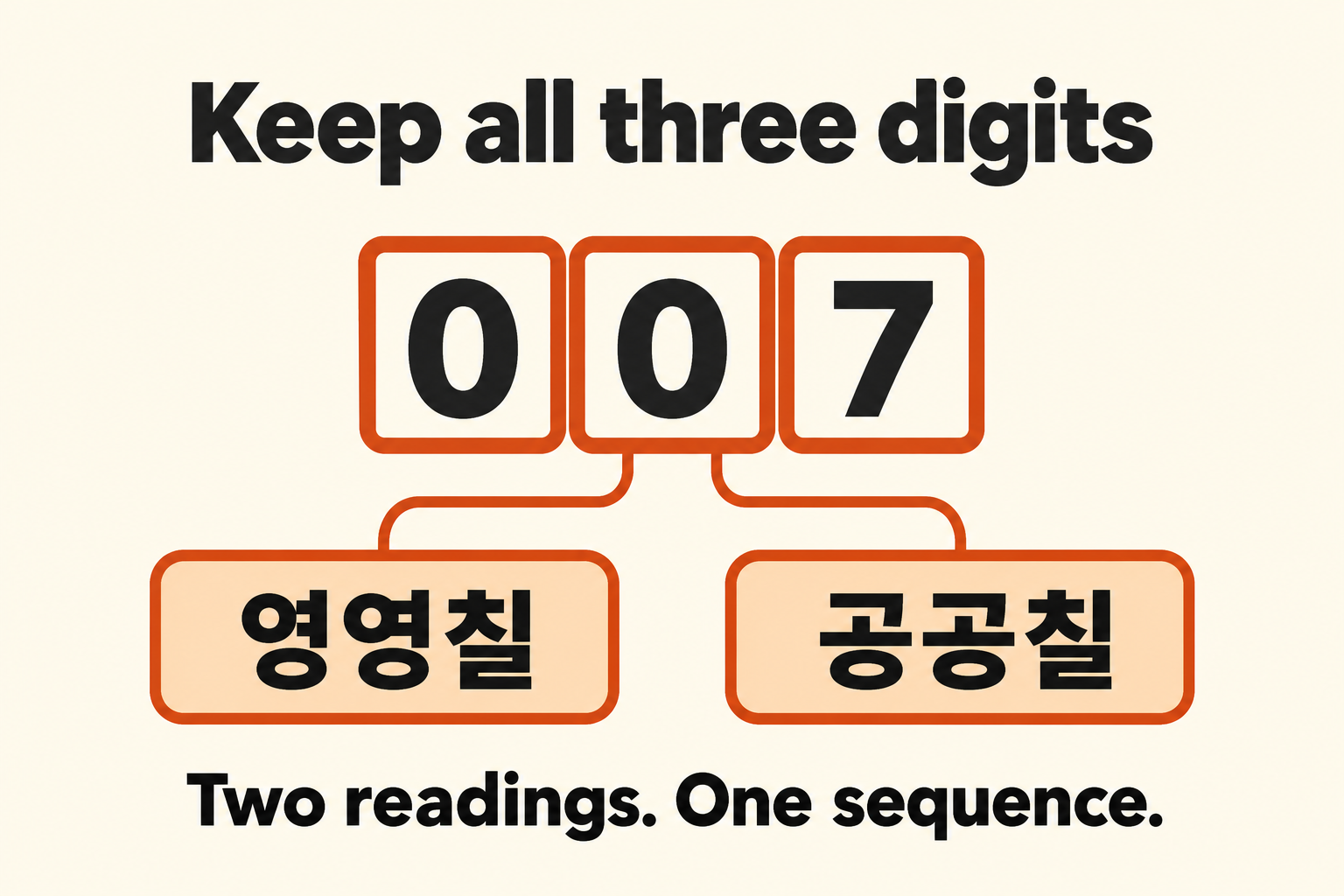
The National Institute of Korean Language's answer about 영 and 공 explicitly gives two readings for 007: 영영칠 and 공공칠. Both 영 and 공 can name zero.
When copying that three-digit sequence, write 007 for either reading. Changing the zero word does not change the sequence. Writing 07, however, loses one position; writing 7 loses two. The whole-number value seven and the three-character sequence 007 are different things to preserve.
Try another number
Write 칠백사 in digits as a whole number. Which column has no component?
The hundreds column contains 7, the tens column is empty, and the ones column contains 4: 704. Writing 74 would again discard 백's place value.