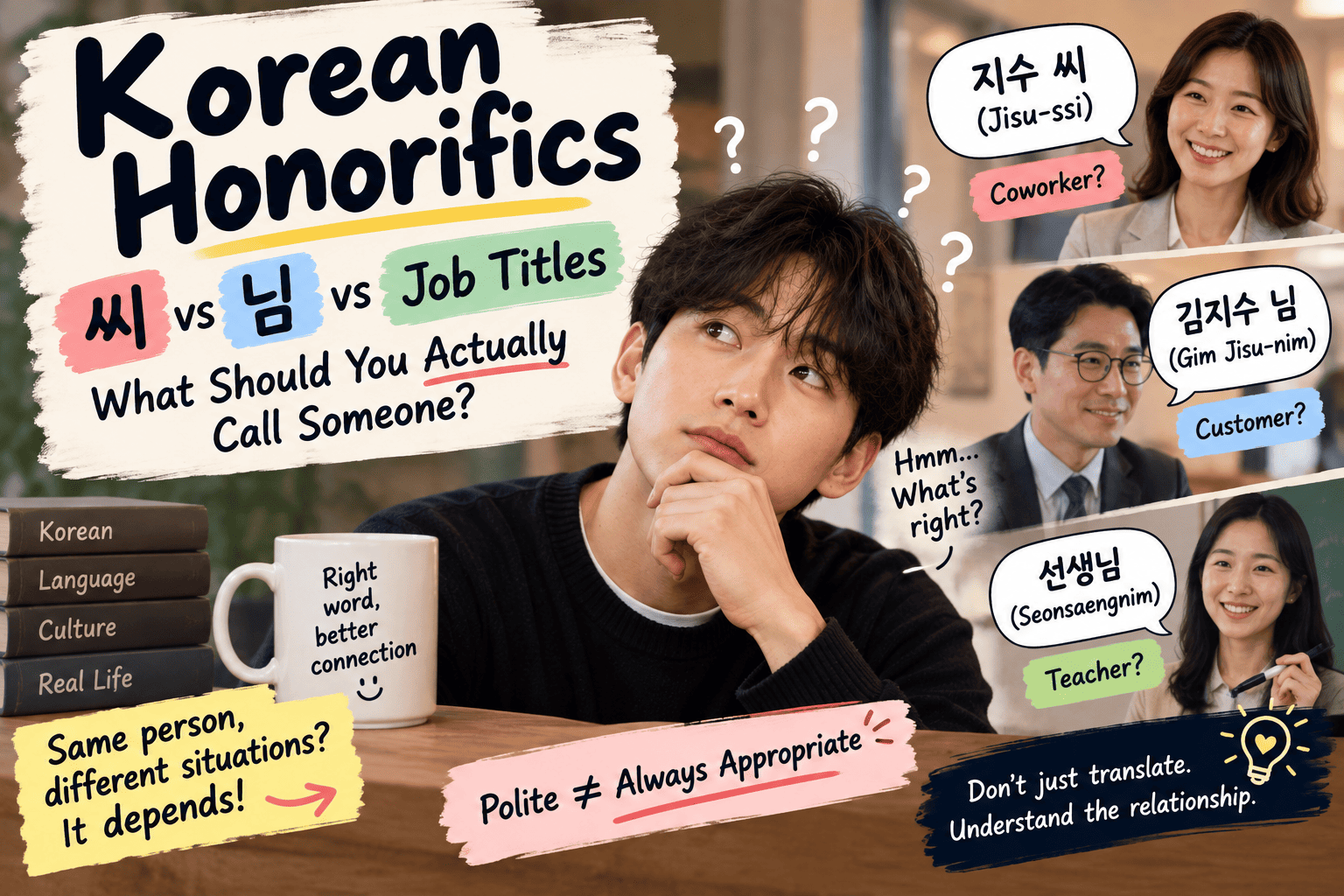
Korean Honorifics: 씨 vs 님 vs Job Titles — What Should You Actually Call Someone?
You start a new job in Korea. Someone introduces himself as 김민수, and for a moment you think the hard part is over. You know his name.
Then the people around you make things complicated.
One coworker says 민수 씨 (Minsu ssi). Someone at the front desk says 김민수 님 (Gim Minsu nim). Another employee never uses his name at all and calls him 팀장님 (timjangnim), meaning “team leader.”
Same person. Three ways to address him.
Well, this is where Korean honorifics become much easier to understand if you stop asking, “Which suffix is the most polite?” and ask a different question instead:
Am I addressing this person by name, or by the role they have in this situation?
That one distinction will save you from quite a few awkward moments. 🙂
Korean Honorifics Are More Than Polite Endings
The phrase Korean honorifics covers a much larger system than this article can — or should — explain at once. Korean also changes verb endings, vocabulary, pronouns, and speech levels depending on the relationship between speakers.
Here, we are dealing with one specific problem: what do you actually call the person standing in front of you?
This matters because English speakers often approach Korean names with an English pattern in mind. If “Mr.” and “Ms.” are polite, then perhaps adding 씨 (ssi) to any Korean name should also be polite enough.
Not quite.
The Korean-English Learners’ Dictionary from the National Institute of Korean Language describes 씨 (ssi) as a respectful form used after a person’s surname or name, while noting that it is mainly used for coworkers or people of lower status. The same dictionary describes 님 (nim) after a name as a more deferential form than 씨.
That already tells us something important. “Polite” is not a single ladder where you simply keep adding more respect until nothing can go wrong. A form can be respectful and still feel mismatched to a particular relationship.
Before Choosing 씨 or 님, Ask Whether the Name Matters at All
Imagine that you meet three people in Korea.
The first is a new coworker at roughly the same level as you.
The second is a customer whose name you need to call in a waiting room.
The third is your teacher.
You know all three names. But that does not mean Korean speakers will naturally address all three people by name.
Name-Based Address
Some relationships make a name-based form natural.
You might hear:
지수 씨 (Jisu ssi)
or:
김지수 님 (Gim Jisu nim)
Both attach a respectful form to a person’s name, but they do not automatically belong in the same setting.
Role-Based Address
In other situations, the role itself becomes the normal way to address the person.
A student usually does not need to repeatedly call a teacher by their full personal name. 선생님 (seonsaengnim) already works as a respectful form of address.
At work, a person may similarly be addressed by a position such as 팀장님 (timjangnim), “team leader,” rather than by first name.
So before asking “씨 or 님?”, sometimes the better question is:
Should I be using this person’s name at all?
씨 (ssi): Respectful, but Not Universal
씨 (ssi) is one of the first Korean honorifics many learners encounter. It often appears after a surname, full name, or given name.
For example:
지수 씨, 점심 먹었어요? (Jisu ssi, jeomsim meogeosseoyo?)
Jisu, have you had lunch?
In a workplace where two people are colleagues at a similar level, this can sound perfectly ordinary.
The tricky part is that English subtitles often make 씨 look like a direct replacement for “Mr.” or “Ms.” That can encourage learners to attach it to almost anyone they want to address politely.
But Korean usage is more relationship-sensitive than that.
Why 씨 Works Well Between Many Coworkers
Suppose two employees join a company around the same time and neither has a special title that the other normally uses.
One might say:
민수 씨, 이거 확인하셨어요? (Minsu ssi, igeo hwaginhasyeosseoyo?)
Minsu, did you check this?
Nothing unusual there. 씨 gives the name a respectful form without pretending the relationship is especially intimate.
And this is exactly why Korean learners often find it useful: it solves many ordinary peer-level situations.
But 씨 Can Be Polite and Still Feel Wrong
Now change only one thing.
Minsu is no longer your peer. He is a senior executive at your company, and everyone else addresses him using his position.
You walk into the office and cheerfully say:
민수 씨! (Minsu ssi!)
The problem is not that 씨 suddenly became an insulting word. It did not.
The problem is that the form can ignore a workplace relationship that everyone else is recognizing through a title.
This is a useful distinction for learners: a respectful word is not automatically the socially appropriate word.
님 (nim): More Respectful, but Still Context-Dependent
Now we come to 님 (nim).
When 님 follows a person’s name, the National Institute of Korean Language describes it as a deferential form and specifically notes that it expresses more respect than 씨.
One official dictionary example is:
박유민 님, 진료실로 들어오세요. (Bak Yumin nim, jinryosillo deureooseyo.)
Park Yumin, please enter the consultation room.
This type of name-plus-님 form is easy to encounter in clinics, customer service, formal announcements, online services, or other situations where the speaker wants to address someone respectfully without relying on a personal relationship.
That does not mean you should replace every 씨 with 님 and assume the sentence has improved.
Language is annoyingly human like that. 👀
Name + 님
When a person is being called by name in a formal service setting, 이름 + 님 can be natural.
For example:
김지수 님, 주문하신 음료 나왔습니다. (Gim Jisu nim, jumunhasin eumnyo nawatsseumnida.)
Kim Jisu, your drink is ready.
The relationship here is not “close friend” or “coworker.” It is a formal interaction where the speaker is addressing a customer or participant deferentially.
Title + 님 Is a Different Pattern
There is another 님 that learners meet constantly: the suffix -님 (-nim) attached to certain titles or status nouns.
The official learner dictionary defines this suffix as adding honorific meaning and gives examples such as 선생님 (seonsaengnim).
In workplaces, you may also encounter titles such as:
팀장님 (timjangnim)
Team leader
부장님 (bujangnim)
Department head / general manager, depending on the company
사장님 (sajangnim)
Company president, owner, or boss, depending on context
The exact English translation of a Korean corporate title can vary from one company to another, so memorizing an English equivalent is often less useful than learning how the title functions inside that organization.
One Person, Three Rooms: Watch the Address Change
Let’s keep the person identical and change only the setting.
Her name is 김지수.
That way, you can see why Korean honorifics are not simply a scale from “less polite” to “more polite.”
Room 1: Jisu Is Your Coworker
You joined around the same time, work at similar levels, and your office commonly uses 씨 between coworkers.
You might say:
지수 씨, 회의 몇 시예요? (Jisu ssi, hoeui myeot siyeyo?)
Jisu, what time is the meeting?
Here, 씨 fits the relationship neatly.
Room 2: Jisu Is a Customer Waiting for an Appointment
Now you work at a reception desk. You need to call her name across a waiting area.
You may hear:
김지수 님? (Gim Jisu nim?)
The person has not suddenly become “more important” than she was in the office example. The situation changed.
The service relationship calls for a different form of address.
Room 3: Jisu Is Your Teacher
Now imagine that Jisu teaches your Korean class.
You could know her full name perfectly well and still address her as:
선생님 (seonsaengnim)
Teacher
The role itself is doing the work.
Calling her simply 지수 씨 would not become better just because 씨 is technically respectful.
Same person. Different room. Different relationship.
The Korean Workplace Is Where This Gets Real Fast 💼
I learned this less from a grammar book and more from being the new person at a company.
When I first started working, there were moments when I genuinely did not know what I was supposed to call someone. I knew the person’s name, sure, but that was not the same as knowing the right form of address.
So I did something simple: I listened.
If everyone called someone 상무님 (sangmunim), I called him 상무님. If coworkers used another title, I followed that pattern instead of inventing my own.
After working for a while, I developed an even simpler habit. These days, when I visit a company, I like getting the person’s business card early. 🙂
A Korean business card often tells me more than a name does. I can see the person’s department, role, or title, and that gives me a much better clue about how the organization recognizes that person.
It is not a perfect rule — companies have different cultures, and not every printed title is necessarily the form people use aloud. Still, the card gives me a starting point.
And if I am still unsure? I listen to how the people who already work there address that person.
That habit has been more useful in real workplaces than trying to memorize a giant chart of Korean titles.
Why a Business Card Can Be More Useful Than an Age Guess
Foreign learners sometimes hear that Korean social language is about age and then start trying to solve every interaction by calculating who is older.
Age can matter. But a workplace introduces another layer: role.
A person may be younger than you but hold a position that everyone in the company addresses formally. Another person may be older but work alongside you in a relationship where the office uses a different pattern.
This is why a title on a business card can be surprisingly useful. It tells you something concrete about the organizational relationship instead of forcing you to guess from age alone.
Again, you still need context. But at least you are looking at the right kind of information.
씨 vs 님 Is Not a Simple Politeness Contest
If you search for Korean honorifics online, you may eventually encounter a neat formula:
씨 = polite
님 = more polite
There is some truth behind that distinction. The official dictionary itself says name-plus-님 carries greater honorific meaning than 씨.
But if you stop there, you can make strange choices.
Suppose your teacher is standing in front of you.
Would calling them by full name plus 님 necessarily be more natural than simply saying 선생님?
No.
Because the missing information is not politeness. It is relationship structure.
The same applies at work. A senior manager’s title may be far more natural than attaching a supposedly stronger suffix to the manager’s personal name.
So, yes, knowing the difference between 씨 and 님 matters. But knowing when Korean prefers a role over a name matters more.
Do Not Translate 씨 Directly as “Mr.” or “Ms.”
This is a particularly stubborn trap.
If subtitles repeatedly translate 민수 씨 as “Mr. Minsu,” it is natural to start thinking:
씨 = Mr./Ms.
Useful shortcut? Sometimes.
Reliable rule? No.
English “Mr. Kim” can be used respectfully for people in situations where Korean speakers might choose a job title instead. Korean 씨 also appears in peer relationships that do not feel exactly like English “Mr.” or “Ms.”
So instead of memorizing an equation, learn the Korean expression as its own social tool:
씨 (ssi) respectfully addresses someone by name, particularly in relationships where that style fits.
That is less tidy than “씨 = Mr.”, but it will cause fewer mistakes.
When a Job Title Beats a Personal Name
Korean workplaces give titles a lot of practical work to do.
If someone is introduced to you as:
김민수 팀장님 (Gim Minsu timjangnim)
you may later simply hear:
팀장님 (timjangnim)
The name becomes unnecessary because everyone understands which team leader is being addressed.
This can feel unusual to English speakers who are accustomed to using first names frequently at work.
But from a Korean perspective, the title immediately shows the relationship relevant to that conversation.
And this is another reason a company’s own habits matter. One workplace may rely heavily on traditional titles. Another may deliberately use names or simplified titles. Some companies have tried to flatten workplace address systems altogether.
There is no benefit in learning one rigid rule and then ignoring what everyone around you is actually saying.
A Practical Starting Point for Your First Day
You do not need to solve the entire Korean honorific system before walking into your first Korean workplace.
Start with something much more manageable.
If the Person Has an Established Title
Listen for whether coworkers normally use that title.
If everyone says 팀장님 (timjangnim), that is a very strong clue that you should not suddenly decide to call the person 민수 씨.
If You Are Peers and Everyone Uses Names
이름 + 씨 may be a natural option.
But workplace culture still matters. A Korean office is not a laboratory where every company follows exactly the same naming system.
If You Are Calling a Customer or Participant Formally
이름 + 님 is common in many service and formal-address contexts.
Listen to announcements in clinics, stores, events, or customer-service settings and you will notice this pattern frequently.
If You Have No Idea
Okay, this one is easy.
Do not improvise.
Look at the business card if you have one. Listen to how coworkers address the person. If necessary, politely ask what you should call them.
A five-second question is usually better than confidently using the wrong title for three months.
Three Mistakes That Make Korean Honorifics Harder Than They Need to Be
Mistake 1: Assuming the Most Respectful-Sounding Form Is Always Best
More honorific meaning does not automatically mean more natural usage.
A title that fits the relationship can sound far more appropriate than an excessively deferential name form.
Mistake 2: Calling Every Older Person 씨
씨 is respectful, but its normal usage is not simply “any person I respect.”
Especially in hierarchical or role-based relationships, a title may be more natural.
Mistake 3: Memorizing Titles Without Watching the Workplace
You can learn twenty Korean corporate titles and still feel lost if the company in front of you uses a different internal culture.
눈앞의 회사가 완전히 다른 내부 문화를 가지고 있다면 여전히 헤매게 될 수 있습니다.
The vocabulary helps. Observation finishes the job.
Korean Honorifics Make More Sense When You Stop Ranking Them
When learners first meet 씨, 님, 선생님, 팀장님, and other Korean honorifics, they often try to arrange everything into one vertical chart:
casual → polite → more polite → extremely polite.
That chart looks convenient. Real conversation is messier — and more interesting.
씨 (ssi) can be perfectly respectful between coworkers, yet feel inappropriate for a senior whose position is normally used as a title.
님 (nim) can respectfully follow a person’s name in formal settings, while -님 (-nim) can also be attached to certain roles and titles.
And sometimes the most natural thing is not to use the person’s name at all.
That is why my practical rule is still the same one I learned as a new employee: look at the relationship before choosing the word.
These days, I just get the business card a little earlier. That saves time too. 🙂


