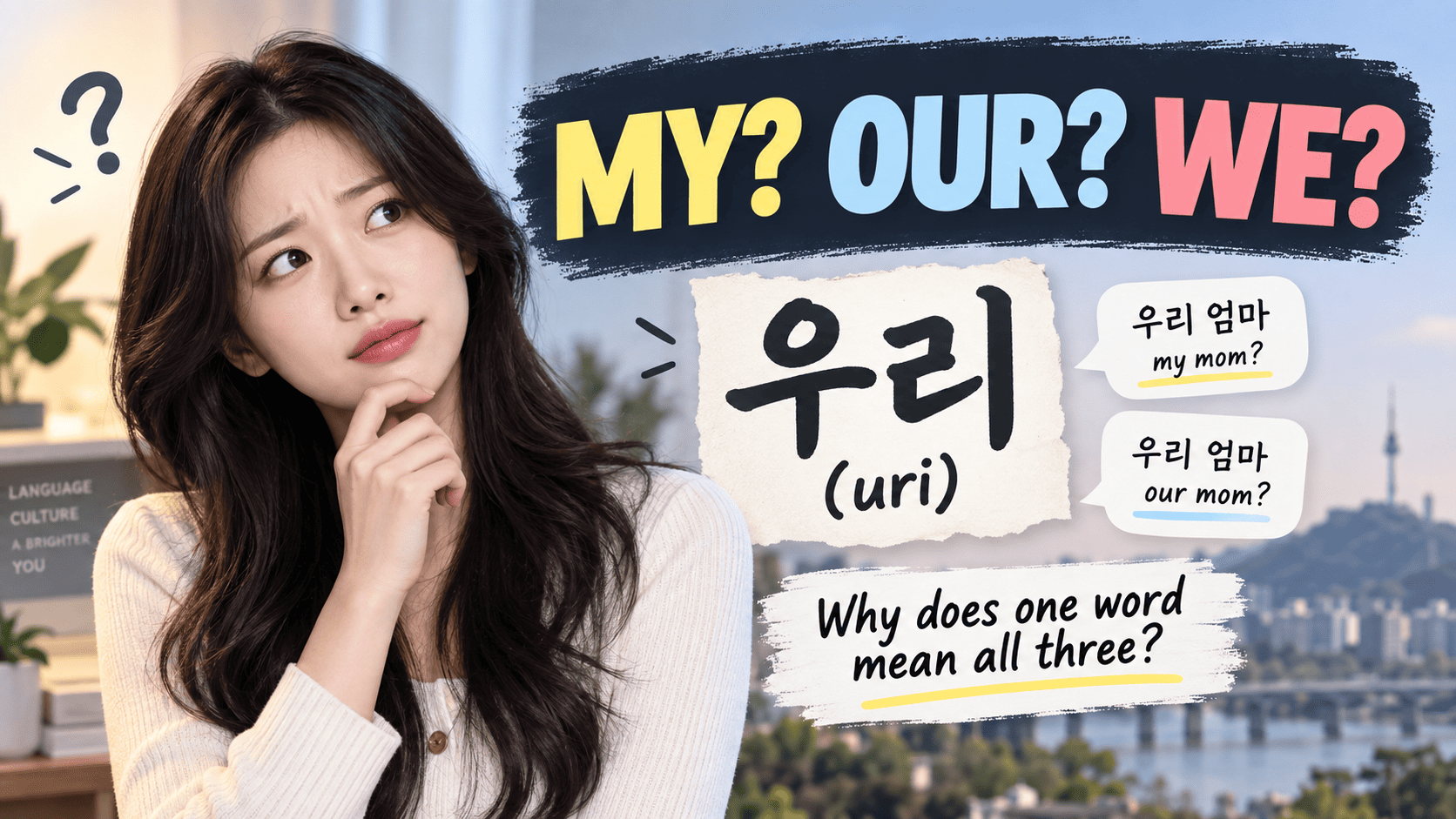
Uri Korean Meaning Explained: Why 우리 Can Mean “My,” “Our,” or “We”
Try translating these three sentences before reading any explanation. 🧩
우리 엄마는 부산에 살아요. (uri eommaneun Busan-e sarayo.)
My mother lives in Busan.
우리 회사는 서울에 있어요. (uri hoesaneun Seoul-e isseoyo.)
My company is in Seoul. / Our company is in Seoul.
우리는 내일 가요. (urineun naeil gayo.)
We’re going tomorrow.
There is only one Korean word at the beginning of all three examples: 우리 (uri).
If you learned that 우리 simply means “we” or “our,” the first sentence probably looks strange. How did “our mother” suddenly become “my mother”? And if 우리 can mean “my,” why does the last sentence still mean “we”?
Actually, the problem is not that 우리 has one mysterious Korean meaning that English cannot express. The problem is trying to translate the word before figuring out what job it is doing in the sentence.
Instead of memorizing 우리 = our, it is much more useful to ask two questions: What is 우리 pointing to here, and is the listener inside that group?
One Word, Three Different Jobs
The National Institute of Korean Language’s Basic Korean Dictionary does not treat 우리 as having only one narrow use. It includes the ordinary plural pronoun meaning of “we,” but it also recognizes a use in which a speaker refers in a familiar way to something closely connected to them.
A 2025 Korean linguistics study also examines what researchers call the singular use of 우리 in expressions such as 우리 엄마, 우리 집, and 우리 동네. In other words, this is not simply a quirky mistranslation invented by learners. It is a real feature of Korean usage.
For a learner, though, linguistic labels are less useful than being able to recognize the pattern in conversation. So let’s divide the work of 우리 into three practical types.
1. 우리 Can Be a Real “We”
Sometimes there is no puzzle at all.
우리는 내일 가요. (urineun naeil gayo.)
“We’re going tomorrow.”
Here, 우리 refers to the speaker plus at least one other person. The English translation is naturally “we.”
You may also hear:
우리 같이 먹어요. (uri gachi meogeoyo.)
“Let’s eat together.”
In this case, the listener is invited into the action. 우리 is genuinely describing more than one person.
2. 우리 Can Appear Before Something Closely Connected to the Speaker
Now consider:
우리 엄마 (uri eomma)
“My mom” in many contexts
우리 집 (uri jip)
“My home” or “our home,” depending on context
A learner may stop at the mathematics: one speaker + one mother = surely “my mother.” Korean is not doing arithmetic here.
우리 can mark a close connection between the speaker and the person, place, or group being discussed. That is why translating the pronoun mechanically can produce awkward English even when the Korean sentence is perfectly ordinary.
Notice something important: this does not mean that 우리 has simply become the Korean word for “my.” If you treat it that way, a new set of mistakes appears immediately.
3. 우리 Can Mark a Group the Speaker Belongs To
Consider 우리 회사 (uri hoesa).
If I say it to someone who works somewhere else, English will often prefer:
“My company.”
But if I say the same expression to a coworker from the same company, “our company” may fit perfectly.
The Korean phrase did not change.
The relationship between the people listening did.
Try the Listener Test 👀
Here is a more useful test than asking, “Does 우리 mean my or our?”
Ask whether the listener is inside the 우리.
This will not solve every Korean sentence automatically, but it gives you a much better starting point.
Case A: 우리 엄마
A Korean friend tells you:
우리 엄마는 요리를 잘해요. (uri eommaneun yorireul jalhaeyo.)
“My mom is a good cook.”
You are probably not part of the speaker’s family. The speaker is not claiming that you share the same mother.
The listener is outside the relationship being expressed, so natural English usually moves toward “my mom.”
Case B: 우리 회사
Your coworker says:
우리 회사는 금요일에 쉬어요. (uri hoesaneun geumyoil-e swieoyo.)
“Our company is closed on Friday.”
You both work there. This time the listener can be inside the group, so “our company” is completely natural.
Now imagine the same sentence spoken to a taxi driver. The Korean speaker could still say 우리 회사, but English would probably use “my company.”
Same Korean expression. Different conversational boundary.
Case C: 우리는 내일 가요
우리는 내일 가요. (urineun naeil gayo.)
“We’re going tomorrow.”
Here 우리 functions as an actual personal pronoun. Context tells you who belongs to “we.” Korean does not need to encode every member of that group inside the word itself.
So the useful question is not only “What does 우리 mean?”
It is also: Who belongs to this 우리 right now?
Why “우리 엄마 = Our Mom” Is the Wrong Question
One of the most common explanations online starts with a funny-looking translation:
우리 엄마 = our mom
Then comes the cultural explanation: Koreans say “our mom” because Korean society emphasizes groups and collectivism.
That idea can provide some cultural context. But if you stop there, it creates another misconception — as though every unusual use of 우리 can be explained by saying “Koreans think collectively.”
Well, real language is messier than that.
The better question is:
What relationship is 우리 marking in this sentence?
A person does not need siblings to say 우리 엄마. The expression does not require several children literally sharing one mother. Research on the singular-type use of 우리 specifically examines expressions such as 우리 엄마 and 우리 집 where ordinary English possession does not line up neatly with the Korean form.
That is why translating the relationship often works better than translating the individual word.
The Collectivism Explanation Helps — Until It Doesn’t
There is a reason discussions of 우리 often lead to ideas such as belonging, in-groups, community, and shared identity. Korean-language scholarship has examined 우리 in relation to group boundaries and relationships between speakers.
But culture should help explain usage, not replace the usage itself.
If someone learns only this:
“Koreans prefer ‘our’ because Korean culture is collectivist.”
they still cannot confidently translate a real sentence containing 우리.
They also risk turning a flexible linguistic pattern into a stereotype about every Korean person.
A more practical rule is:
Culture may help explain why a pattern feels natural. Context tells you what the sentence means.
Can You Put 우리 Before Anything?
No. This is where treating 우리 as a decorative Korean version of “my” causes trouble.
Compare these nouns:
우리 엄마 (uri eomma)
Often natural for “my mom.”
우리 집 (uri jip)
Very common; the English translation can be “my home” or “our home.”
우리 학교 (uri hakgyo)
“Our school” or “my school,” depending on who is speaking to whom.
우리 회사 (uri hoesa)
“Our company” or “my company,” again depending on context.
Now imagine pointing at the personal phone in your hand and using 우리 휴대폰 (uri hyudaepon) merely because you want to say “my phone.” That does not follow automatically from the examples above.
The same goes for a random pair of shoes, a pen, or a coffee you personally bought. You cannot simply replace every English “my” with 우리.
Of course, unusual contexts can make unusual expressions possible. Several people may genuinely share an object, a speaker may personify something affectionately, or a particular relationship may make an expression sound natural. That is exactly why a rigid “allowed nouns” list would be misleading.
The pattern is about relationships and context, not a vocabulary cheat code.
A Four-Step Way to Read 우리 in a Real Sentence
Okay, suppose you see 우리 in a drama subtitle, a message, or a Korean conversation. 💬 Instead of reaching immediately for “our,” try this sequence.
Step 1: Is 우리 the subject itself?
If you see a form such as 우리는 (urineun) or 우리가 (uriga), check whether 우리 is actually referring to a group of people including the speaker.
If yes, “we” is a strong starting point.
Step 2: Does 우리 come before another noun?
Look at what follows it:
우리 엄마
우리 집
우리 학교
우리 회사
Now you are dealing with a relationship between the speaker and that noun, not merely translating an isolated pronoun.
Step 3: Is the listener part of the same group?
If two coworkers discuss 우리 회사, “our company” makes sense.
If an employee tells an outsider about 우리 회사, natural English may prefer “my company.”
Do not change the Korean first. Change your understanding of the people involved.
Step 4: What Would Natural English Say Here?
This final step matters because good translation is not word replacement.
If “our mother” sounds as though the speaker and listener are siblings when they clearly are not, English is signaling that something went wrong.
Return to the relationship, then translate.
Back to the Three-Sentence Puzzle
Now look at the opening examples again.
우리 엄마는 부산에 살아요.
The speaker is talking about a closely related person. In an ordinary conversation with an outsider, natural English is likely:
“My mother lives in Busan.”
Next:
우리 회사는 서울에 있어요.
Without knowing who is listening, both interpretations remain possible.
A coworker may hear:
“Our company is in Seoul.”
An outsider may understand:
“My company is in Seoul.”
Finally:
우리는 내일 가요.
Here 우리 refers directly to people forming a group with the speaker:
“We’re going tomorrow.”
Nothing about the spelling of 우리 changed across those examples. What changed was its job in the sentence and the relationship surrounding it.
Do Not Memorize 우리 as a Single English Word
If you remember 우리 only as “our,” expressions such as 우리 엄마 will keep looking illogical.
If you switch and memorize it as “my,” different sentences will start breaking instead.
There is a simpler way to think about it.
When you meet 우리, pause before translating it. Look at the noun beside it, identify the people involved, and ask whether the listener belongs inside the group.
Sometimes the answer will be “we.” Sometimes “our.” Sometimes natural English will choose “my.”
때로는 자연스러운 영어 표현으로 "나의"가 선택될 수도 있습니다.


