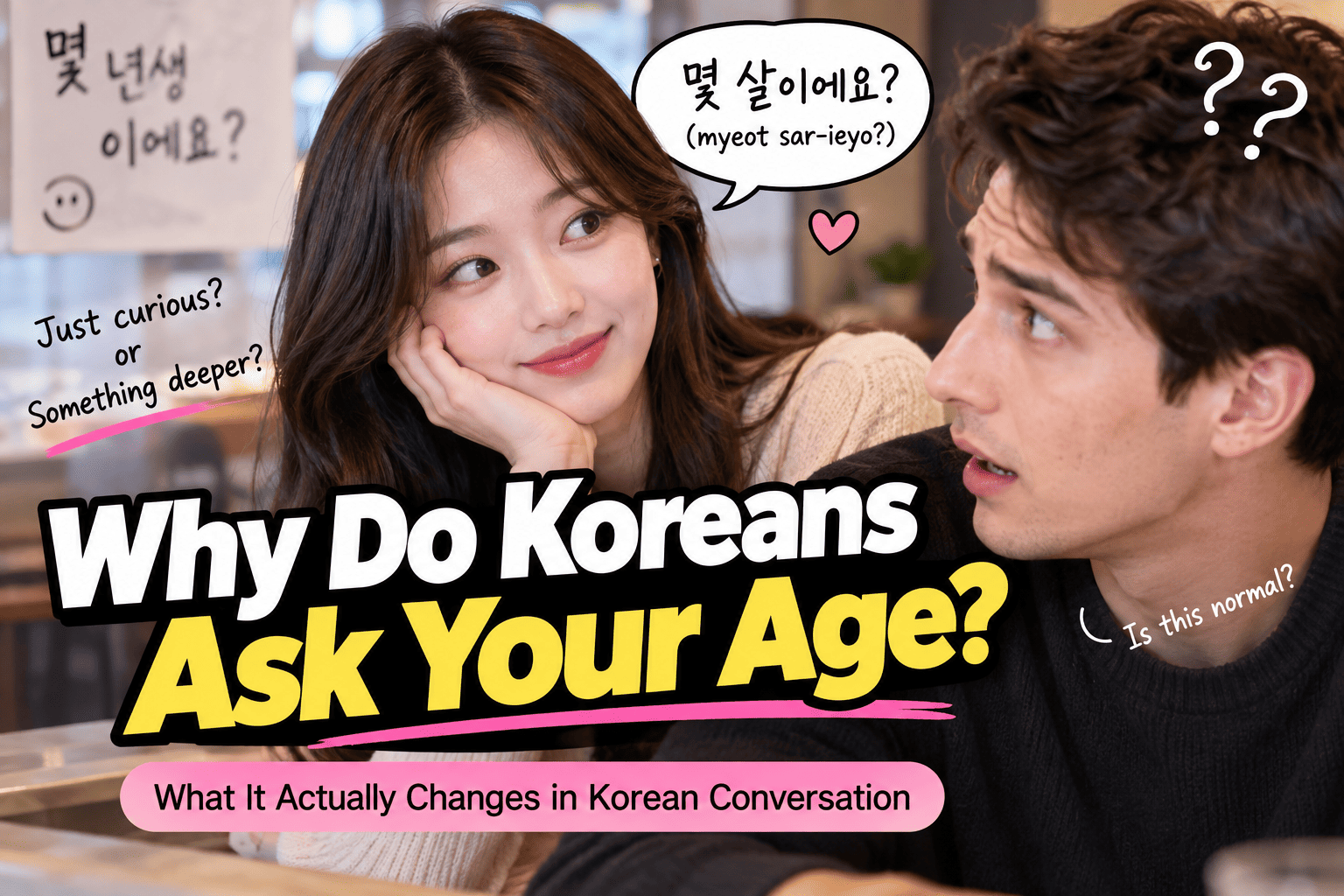
Why Do Koreans Ask Your Age? What It Actually Changes in Korean Conversation
You meet someone in Korea for the first time. The conversation is going well, you have barely finished introducing yourselves, and then comes a question that can feel surprisingly personal: “How old are you?” 👀
If you come from a culture where age is rarely discussed with new people, the question may sound nosy. But in Korean conversation, asking someone’s age can serve another purpose. It gives the speakers one piece of information about how they relate to each other.
Actually, age does not work like a switch that automatically changes polite Korean into casual Korean. It is better understood as one coordinate on a social map. Age matters, but so do familiarity, the setting, and the roles of the people speaking.
That distinction is important. Otherwise, a learner can easily walk away with a rule that sounds simple — “older person gets polite speech, same age means casual speech” — but does not work reliably in real conversations.
The Age Question Is Often a Relationship Question
Two common questions you may hear are 몇 살이에요? (myeot sar-ieyo?), meaning “How old are you?”, and 몇 년생이에요? (myeot nyeonsaeng-ieyo?), meaning “What year were you born?”
They give similar information, but they do not always feel identical in conversation.
When Someone Asks 몇 살이에요?
몇 살이에요? (myeot sar-ieyo?) — “How old are you?”
This asks directly for your age. Depending on the situation and the people involved, it can feel perfectly ordinary or rather personal. Context still matters.
The important part for a Korean learner is what happens after the answer. The speaker may now know whether you are older, younger, or roughly the same age, but that information alone does not dictate every word that follows.
When Someone Asks 몇 년생이에요?
몇 년생이에요? (myeot nyeonsaeng-ieyo?) — “What year were you born?”
You may also hear people ask for a birth year instead of an age. A birth year makes it easy to compare whether two people are the same age or who was born earlier without having to calculate an age number first.
For example:
“몇 년생이에요?” (myeot nyeonsaeng-ieyo?)
“What year were you born?”
“2000년생이에요.” (icheon-nyeonsaeng-ieyo.)
“I was born in 2000.”
The answer may immediately reveal that two people are 동갑 (donggap), meaning the same age. But something interesting happens here: knowing that you are 동갑 still does not automatically give either person permission to switch to 반말.
Think of Age as One Part of a Relationship Signal Stack
For practical purposes, I find it more useful to imagine four signals being read at the same time: age, relationship, familiarity, and setting.
This is not an official Korean grammar formula. It is simply a useful way to avoid the misleading idea that age controls everything.
Signal 1: Age
Age can help speakers understand whether someone is older, younger, or the same age. Korean honorific speech has long been connected with social relationships, and linguistic research has identified age as an important factor in how speakers choose forms of address and speech levels.
Important does not mean exclusive.
Signal 2: Your Relationship
Imagine two people who are both 25. One pair has just met at a professional event. Another pair has been close friends since high school.
Their birth years are identical. Their relationship is not.
That difference can affect how naturally polite or casual speech feels.
Signal 3: Familiarity
Korean has 존댓말 (jondaenmal), broadly referring to respectful or polite speech, and 반말 (banmal), casual speech used in appropriate relationships.
A person being younger than you does not mean that you should immediately use 반말 with them. Someone you met thirty seconds ago is still someone you met thirty seconds ago.
Well, this is where many simplified explanations of Korean age culture become misleading.
Research on Korean honorific use does not treat speech choice as an age-only system. Studies have also examined variables such as intimacy, social position, formality, and the relationship between speakers. The exact combination changes with the situation.
Signal 4: The Setting
The same two people can speak differently in different places.
Two colleagues who speak casually while having dinner may use more polite language during a formal meeting. Two people who are the same age may still maintain 존댓말 because their relationship is professional, distant, or simply not close enough for either person to change.
Age stays the same. The setting changes.
So does the language.
Same Age Does Not Automatically Mean Banmal
This deserves its own section because it is one of the easiest mistakes for Korean learners to make. 🙂
Suppose Mina and Jisoo discover that they were both born in the same year. Let us keep their ages exactly the same and change only the situation.
The Same Two People, Four Different Moments
Moment 1: They Have Just Met
Mina and Jisoo have exchanged names and discovered that they are 동갑. They have known each other for perhaps two minutes.
Using polite speech is still completely reasonable. Being the same age has given them useful information about their relationship, but it has not magically created familiarity.
Moment 2: They Have Talked for a While
Later, one of them might say:
우리 동갑이네요. (uri donggab-ineyo.)
“We’re the same age.”
Then the conversation may continue with:
말 놓을까요? (mal noeulkkayo?)
“Shall we speak casually?”
This little exchange is much more useful for learners than memorizing “same age = banmal.” The relationship changes because the speakers acknowledge it together.
Moment 3: They Become Close Friends
Once Mina and Jisoo are comfortable with each other, 반말 may feel completely natural between them.
Now the same age that was merely information during their first meeting becomes part of an easy peer relationship.
Moment 4: They Meet in a Formal Situation
Put the same friends into a professional setting and the language can shift again.
They have not become different ages. They have not forgotten that they are friends. The situation simply creates another social signal.
This is why a straight line from “age” to “speech level” does not explain Korean conversation very well.
Then What Does Knowing Someone’s Age Actually Change?
It can change several things, but “can” is the important word here.
It Helps Place the Relationship
Knowing the age difference can give speakers a clearer picture of where they stand relative to each other. In some relationships, that may also affect which kinship-style terms or titles feel natural.
If you are learning Korean through dramas, you have probably noticed words such as 오빠, 언니, 형, and 누나. Age is relevant to those terms, but age alone does not explain their full usage. Relationship and gender also matter, which is why treating them as simple substitutes for a person’s name creates problems quickly.
It Can Affect How a Change to Casual Speech Happens
Discovering that someone is the same age can make a transition to casual speech easier. It does not require that transition.
This difference is subtle but useful:
Same age can remove one barrier to casual speech. It does not remove every barrier.
That is a much safer rule to carry into an actual Korean conversation.
It Can Give Context to Other Social Information
Age may sit beside job position, school year, family relationship, seniority, and familiarity. Which factor matters most depends on where the conversation is happening and who is involved.
A university club, a family gathering, a company meeting, and a casual night out are not socially identical spaces. It would be strange to expect one age rule to control all four.
What About Korea’s 2023 Change to the Age System?
There is an important distinction here because two different topics are often mixed together.
On June 28, 2023, changes to Korean law clarified the use of the international age system — often called 만 나이 (man nai) in Korean — as the general standard for calculating age in laws and administrative matters.
Before that change, several ways of describing age could appear in Korean life, including the traditional counting-age system and a year-based calculation used in some legal contexts.
But the legal change did not rewrite Korean speech etiquette overnight.
Someone asking 몇 년생이에요? is not necessarily trying to calculate your official legal age. A birth year can simply provide social context between two people.
That is why “Korea changed its age system in 2023” and “Why do people ask each other their age?” should not be treated as the same question.
What Should You Do If Someone in Korea Asks Your Age?
Okay, the practical part is much easier than all the cultural theory. 💬
You Can Simply Answer
If you are comfortable sharing your age, you can answer normally. When someone asks for your birth year, answering with the year is enough.
2000년생이에요. (icheon-nyeonsaeng-ieyo.)
“I was born in 2000.”
You do not need to immediately decide whether the other person is now your senior, junior, friend, older brother, older sister, or anything else. Let the relationship develop through the conversation.
Keep Polite Speech When You Are Unsure
If you have just met someone, staying with 존댓말 is a comfortable default while you figure out the relationship.
Learning that someone is younger than you is not a command to switch to 반말.
And learning that someone is the same age is not one either.
Listen for an Explicit Change
If the conversation becomes friendly, you might hear something such as 말 놓을까요? (mal noeulkkayo?).
The expression uses 말 놓다 (mal nota), literally referring to dropping the polite level and speaking more casually.
When that happens, the important moment is not simply the discovery of age. It is the two speakers negotiating a different relationship.
That small interaction tells you much more about real Korean conversation than a chart saying “older = formal, younger = informal.”
A Better Way to Remember Korean Age Culture
It can help Korean speakers understand a relationship, but it works together with familiarity, roles, social setting, and the relationship the two people actually build.
So when someone in Korea asks your age early in a conversation, you do not need to assume they are ranking your value as a person. At the same time, you do not need to pretend the question has no social meaning.


