Korean Sentence Structure, Roles and Verb Groups in Korean Word Order
Korean sentence structure usually puts the predicate at the end of a simple clause. The predicate tells you what happens or what something is like. A sentence with an object often follows subject–object–verb order: 지수가 책을 읽어요 means Jisu reads a book.
But the final unit can be longer than one word, and the words before it do different jobs. Compare 지수가 책을 읽어요 with 지수가 책을 읽고 있어요, Jisu is reading a book. In the second sentence, 읽고 있어요 belongs together.
A starting pattern for Korean word order
These short sentences have different shapes:
| Sentence | Meaning | Parts shown |
|---|---|---|
| 비가 와요. | It is raining. | Subject + predicate |
| 날씨가 추워요. | The weather is cold. | Subject + descriptive predicate |
| 지수가 책을 읽어요. | Jisu reads a book. | Subject + object + predicate |
The English is in is cold does not need a separate Korean word here. 추워요 supplies the description and ends the sentence. Noun identification uses a different construction, such as 학생이에요, is a student.
Particles attach to nouns: 가 marks the subject in 지수가, while 을 marks the object in 책을. A topic marker such as 은 or 는 can also appear at the beginning, but topic and subject are not interchangeable labels.
Fill the roles before rearranging the words
For the ordinary giving sense of 주다, the Korean Basic Dictionary gives this pattern:
1이 2에/에게 3을 주다
The numbers label participants. They are not instructions to write exactly three words. With a person receiving an object, the pattern identifies a giver, a recipient marked with 에게, and a thing given marked with 을/를.
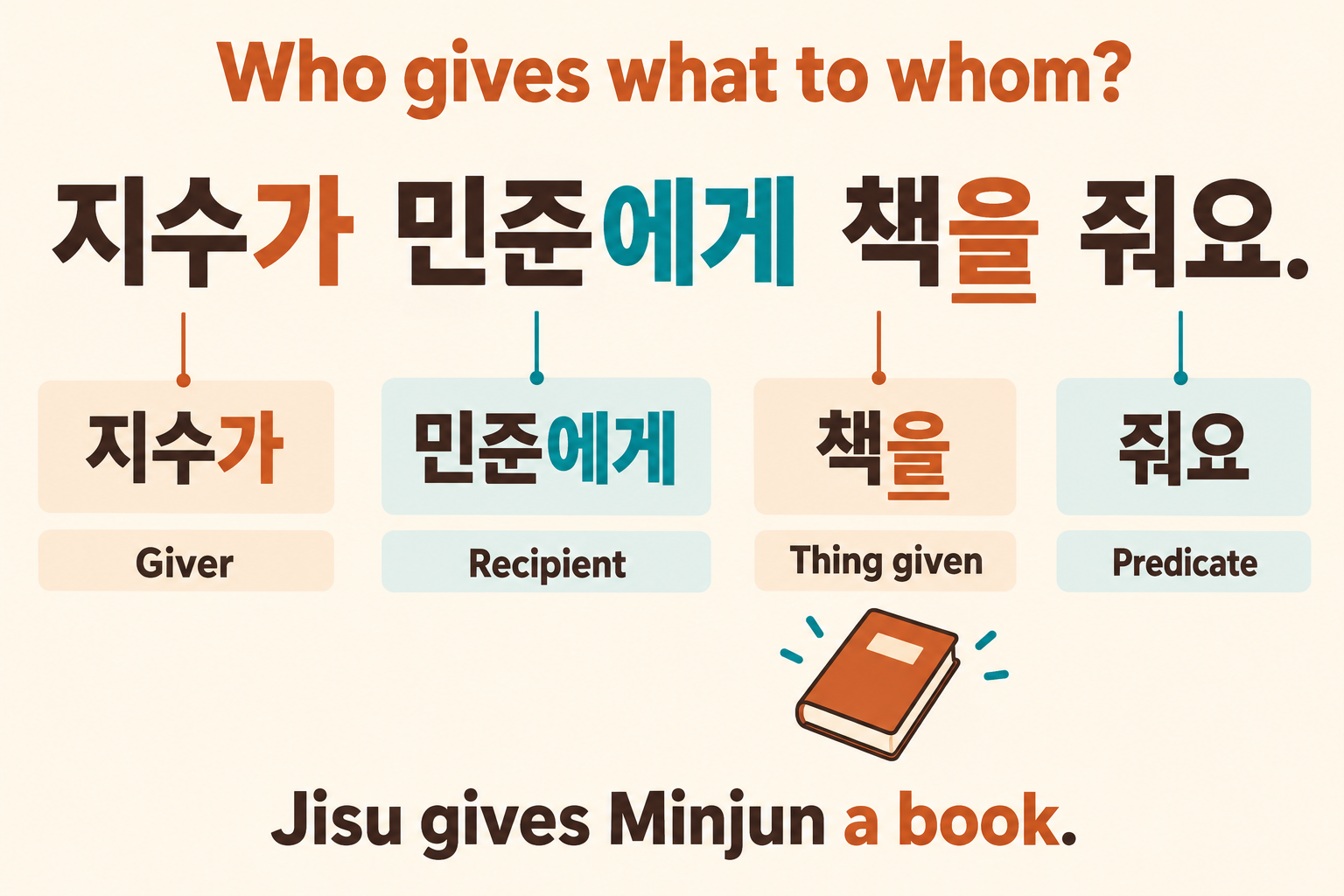
To say that Jisu gives Minjun a book, assign those roles first:
- Giver: 지수 → 지수가
- Recipient: 민준 → 민준에게
- Thing given: 책 → 책을
지수가 민준에게 책을 줘요.
Jisu gives Minjun a book.
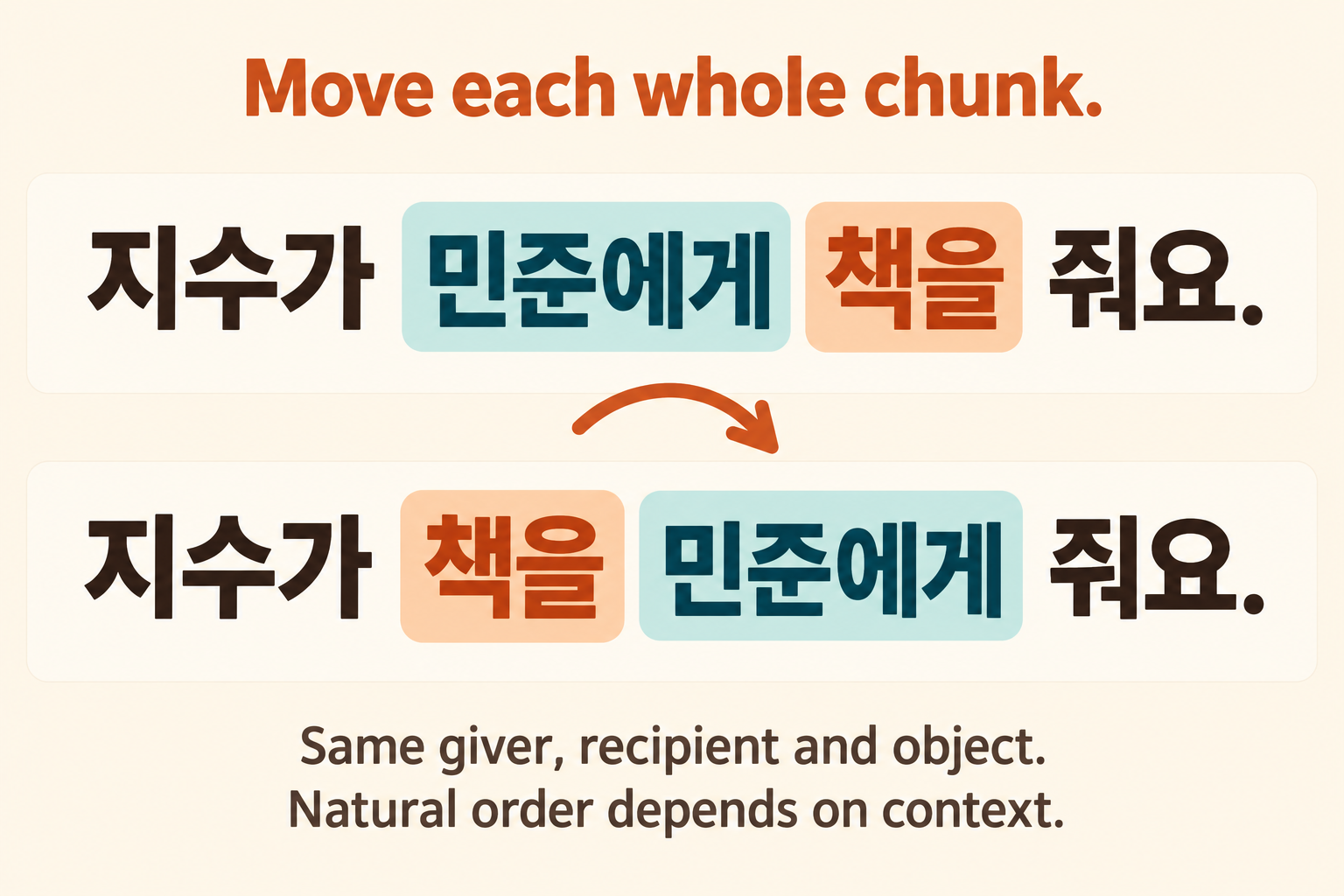
English places Minjun and a book next to each other after gives. Korean marks their different roles. Changing the order to 지수가 책을 민준에게 줘요 preserves who gives what to whom because 책을 and 민준에게 retain their particles. The surrounding conversation can make one order more natural.
Move the noun and its particle together. Taking 에게 away from 민준 and attaching it to 책 would change the role markings, not merely the order.
A role can also remain understood without being spoken. If the conversation has already established the book and its recipient, 줬어요 can answer whether the giver handed it over. The book and recipient have not vanished from the event. A short reply therefore does not prove that the verb has no object or recipient.
The predicate may cross a space
Now look at the end of this sentence:
지수가 영화를 보고 있어요.
Jisu is watching a movie.
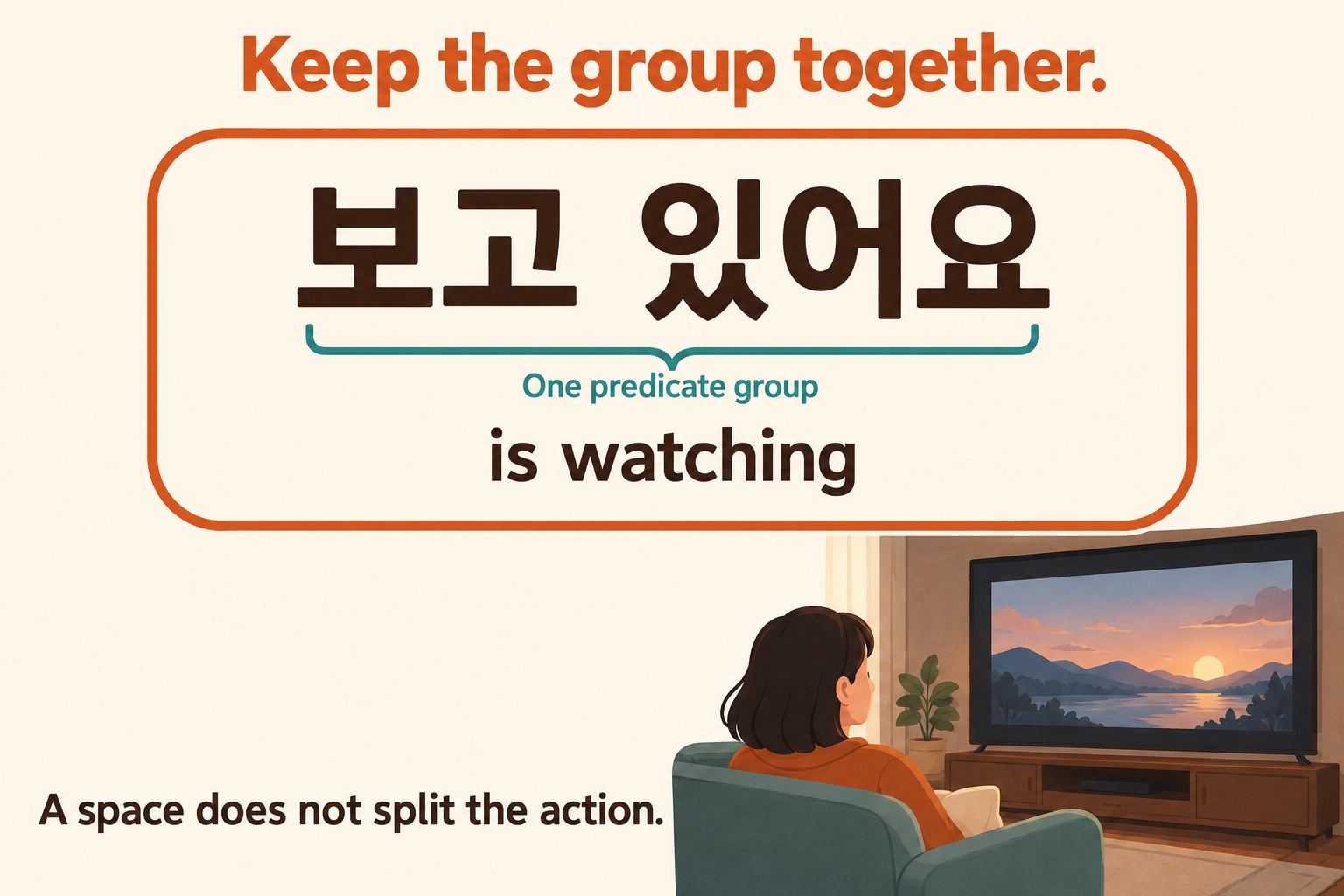
The predicate is 보고 있어요. 보다 supplies the watching action. The auxiliary construction -고 있다 presents that action as in progress here. Translating 있어요 alone as exists would leave the watching action disconnected.
That changes how you apply the instruction to put the verb last. The whole group goes at the end: 보고 followed by 있어요. You do not reverse those two pieces when arranging the other parts.
Compare:
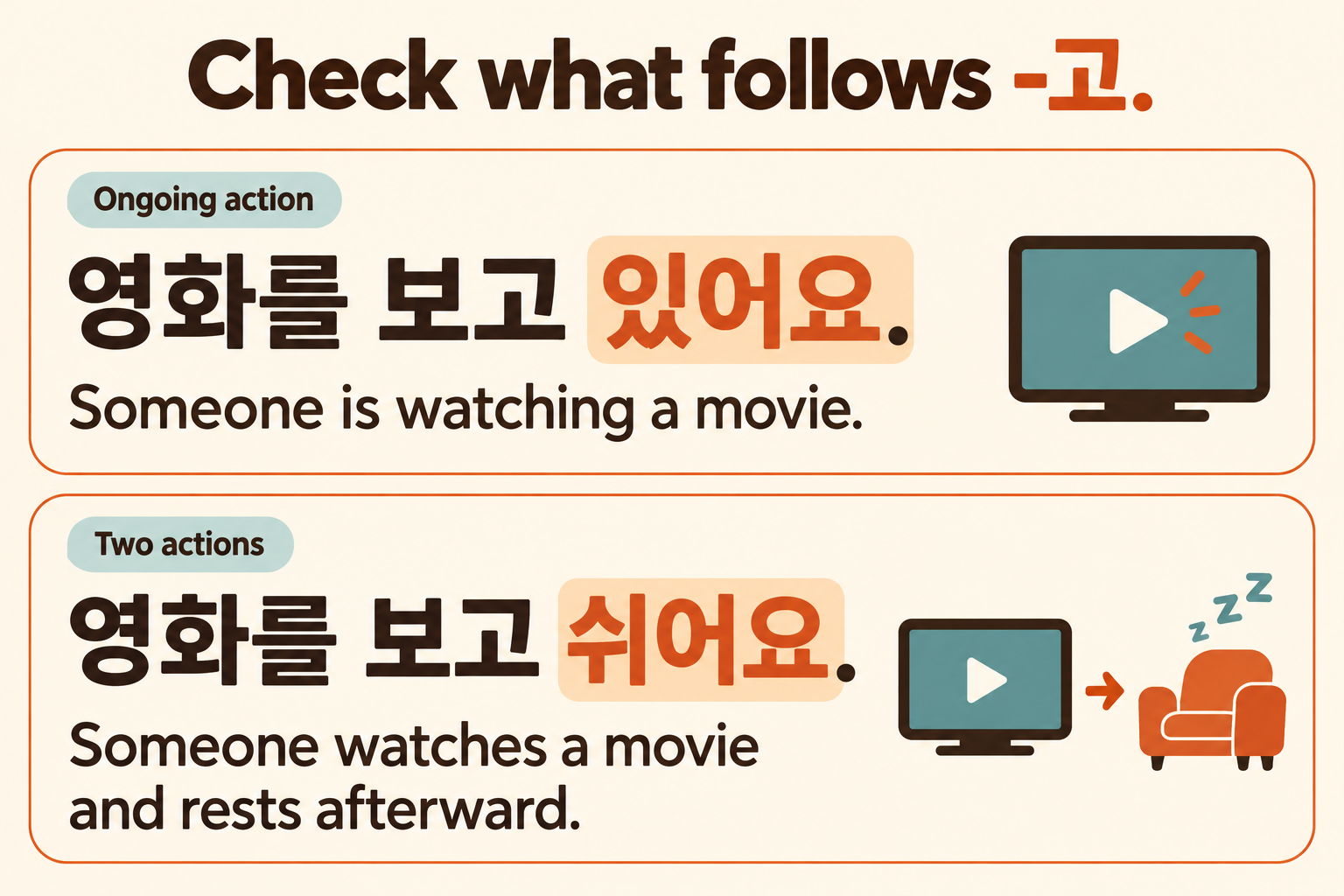
- 영화를 보고 있어요. — Someone is watching a movie.
- 영화를 보고 쉬어요. — Someone watches a movie and rests afterward.
In the first, 있다 helps express the ongoing action. In the second, 쉬다 supplies another action. The ending -고 alone does not tell you that every following word starts an independent action. Check what follows it.
Build a sentence about a key changing hands
Sora is handing a key to Joon now. Use 주다 for giving and the -고 있어요 construction for the action in progress. The names are 소라 and 준; a key is 열쇠. Before looking below, assign the giver, recipient and object, then assemble the final group.
Show the sentence and its parts
소라가 준에게 열쇠를 주고 있어요.
Sora is giving Joon a key.
소라가 identifies the giver. 준에게 identifies the recipient. 열쇠를 identifies the object. 주고 있어요 is the predicate group. The vowel-ending 열쇠 takes 를 rather than 을.
To ask what Sora is giving Joon, replace the object with 무엇을: 소라가 준에게 무엇을 주고 있어요? The question word can occupy the answer's position; it does not have to move to the beginning. The recipient and the ongoing-action group remain in place.
'Real Korean Language & Everyday Korea' 카테고리의 다른 글
| Hungry in Korean, From Baegopa to a Polite Reply (0) | 2026.10.29 |
|---|---|
| How to Say I Love You in Korean, Saranghae Meaning and Written Phrases (0) | 2026.10.29 |
| Native Korean Numbers, Build the Count Before You Shorten It (0) | 2026.10.29 |
| Korean Texting Slang, Read the Letters Without Inventing the Missing Words (0) | 2026.10.29 |
| Korean Verb Conjugation, A Starter Table and Two Stem Mistakes (0) | 2026.10.29 |
| Cute in Korean, Who the Sentence Is Describing (0) | 2026.10.29 |
| Ottoke Meaning, When to Write 어떡해 and When to Correct It (0) | 2026.10.29 |
| Yeoboseyo Meaning, A Phone Hello and the Replies It Allows (0) | 2026.10.29 |


