Korean Texting Slang, Read the Letters Without Inventing the Missing Words
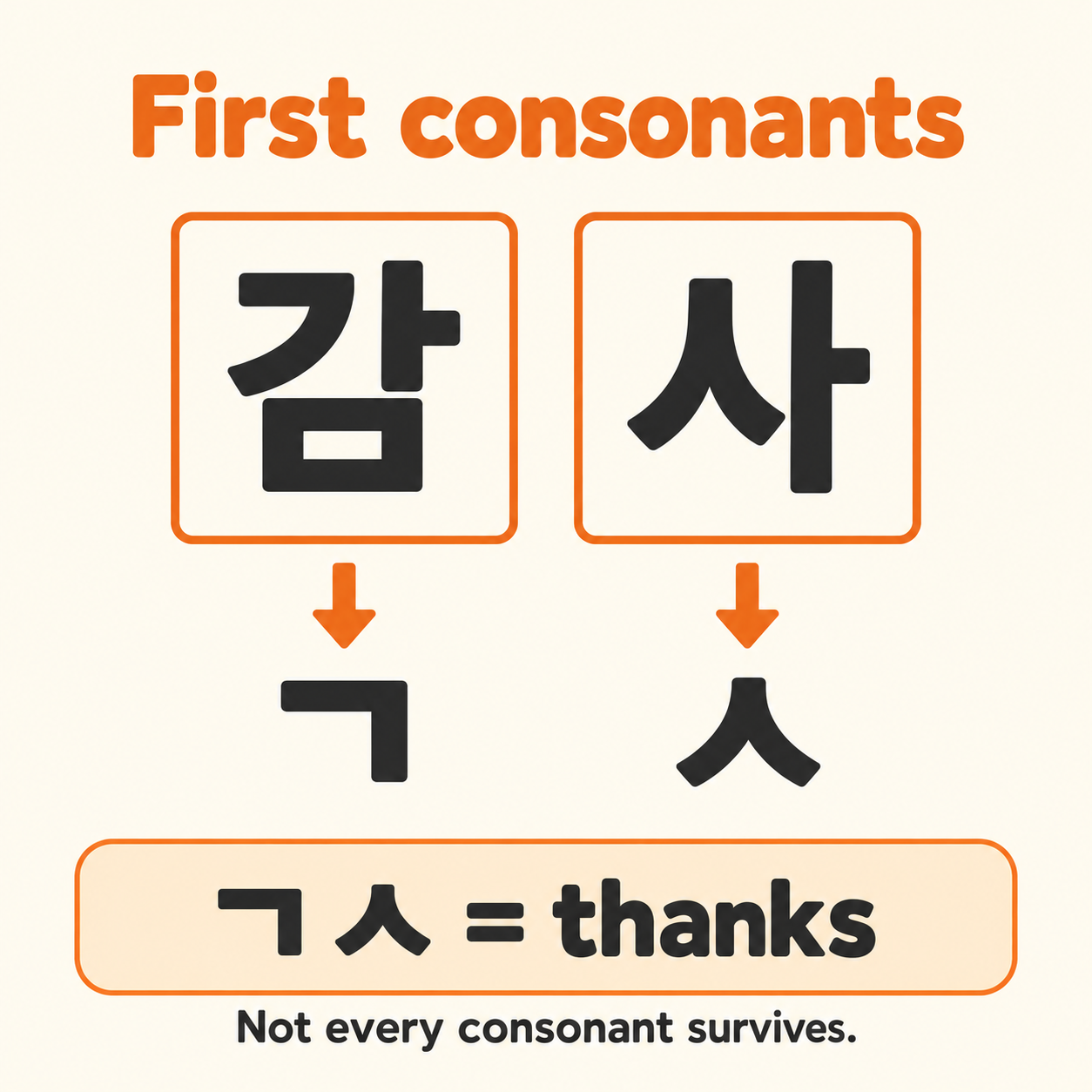
It is one in the morning in a shared house in Mapo, and the group chat for tomorrow's hike lights up: ㄱㅅㅋㅋㅠㅠ. You know the hike starts at seven. You do not know whether you have just been thanked, laughed at, or cried at, and the four strangers in the chat are already asleep. Korean texting slang looks like a keyboard fell over, but it runs on two or three mechanical rules, and once you can see the machinery, a string like ㄱㅅㅋㅋㅠㅠ becomes three separate messages — thanks, laughter, and a small dramatic tear — that you can decode in the time it takes to unlock your phone.
The initials system: take the first consonant and stop
Korean syllables are built as consonant-plus-vowel blocks, which makes them unusually easy to abbreviate: strip the vowels and the reading survives. The National Institute of Korean Language's teaching booklet for young people records the two foundational examples. ㄱㅅ is 감사 (gamsa), "thanks" — the initials of 감 and 사, with the final ㅁ of 감 deliberately not retained. ㅈㅅ is 죄송 (joesong), "sorry." Keeping every consonant, including the bottom-position batchim, would produce a different and meaningless string; the system keeps only the first consonant of each syllable.
The same booklet's rows include ㅎㅎ for 하하 or 호호 and ㅋㅋㅋ for 크크크 or 키키, both written laughter. Note what the table is actually claiming: more than one full form can sit behind the same consonant string, because the vowels are gone. The code records a shape, not a unique word.
One symbol in the standard set works by picture instead of initials: ㅠㅠ is a crying face — two streams of tears drawn with the letter ㅠ — and a 2002 article by a researcher at the institute describes it as exactly that. Reading each ㅠ aloud as "yu" misses the use entirely, and ㅜㅜ is the same face with a different eye.
The same code at three volumes
Consonant strings have registers the way verbs have speech levels. Laughter is the clearest ladder. A single ㅋ appended to a statement — 늦었어ㅋ — is a softener, close to a smile; ㅋㅋ is ordinary friendly laughter; ㅋㅋㅋ and up read as genuine amusement, and ㅋㅋㅋㅋㅋㅋ is the group chat losing it. ㅎㅎ is a gentler, sometimes more careful laugh, the one you use when the joke is not that funny but you want to be kind. ㅠㅠ and ㅜㅜ are rarely real grief; they are performative whining — 연락 없어서 ㅠㅠ ("no reply, ㅠㅠ") — and the reader is expected to smile. The volume rule applies to everything: a code repeated reads louder, and a code used with an elder is usually better spelled out in full.
Three threads, decoded
Between friends (반말, full slang density)
A: 오늘 7시 콘서트 ㄱ? — Oneul ilgop konsoteu gi? — Concert at seven today, going? (ㄱ from 가) B: ㄱㄱ! ㅋㅋㅋ 몇 시에 만나? — Gogo! Myeot sie manna? — Going going! Haha, what time do we meet? A: 6시 반. 늦으면 니 몫 없음 ㅋ — Yeosie ban. Neujeumyeon ni mok eopseum k. — Six thirty. If you're late your share is gone, lol.
Polite chat with a colleague (존댓말, light slang)
A: 회의 5분 늦을 것 같아요 ㅈㅅ — Hoei obun neujeul geot gatayo, ㅈㅅ — I think I'll be five minutes late to the meeting, sorry. B: ㅇㅋㅇㅋ 천천히 오세요 — OK OK cheoncheonhi oseyo — It's fine, come slowly.
With an elder (no codes at all)
A: 어머니, 내일 연락드릴게요. 감사합니다. — Eomeoni, naeil yeollakdeurilgeyo. Gamsahamnida. — Mother, I'll call you tomorrow. Thank you. B: 그래, 조심해서 다녀와. — Geurae, josimhaeseo daryeowa. — All right, travel safe.
Notice thread two: ㅈㅅ is acceptable to a colleague exactly because the sentence around it is polite, while the reply spells nothing out. Thread three is not stilted — it is how respect types.
The mistakes that cost the most
First, inventing expansions. A note that renders ㅇㅎ as 하이 ("hi") has failed on two counts: the institute's messenger-corpus report lists ㅇㅎ as either 아하 or 오호 ("aha" / "oh!"), and ㅎㅇ is the code for 하이 — the consonants are in the opposite order. When two expansions are documented, as with both 아하 and 오호 behind ㅇㅎ, the honest reading keeps both rather than guessing. The missing vowels cannot be recovered from two initials, and pretending otherwise is how wrong meanings get archived.
Second, misreading attached laughter. The corpus report's example 목표이긴한뎋ㅎㅎ splits into the phrase 목표이긴 한데 ("it is a goal, though") plus laughter. The final block 뎋 is 데 with an attached ㅎ; move the letter into the laugh and three of them line up: 목표이긴 한데 + ㅎㅎㅎ. The lesson is a habit, not a rule — a final ㅎ sometimes belongs to the laughter next door, and checking the boundary beats force-feeding the block to a dictionary.
Third, using codes where spelling is required. In an April 7, 2026 answer, the institute identifies forms including ㄱㅅ as outside standard spelling: recognizing a message does not make its code appropriate for schoolwork, an exam, or a formal document. Write the intended words in full.
Fourth, the innocent-looking profanity. ㅅㅂ abbreviates a strong Korean expletive, and ㅗ (the letter "o") doubles as an obscene gesture when it arrives alone. Neither will be explained to you before it offends someone; recognizing them is self-defense, and sending them is the mistake.
Fifth, tone-carrying single letters. A bare ㅋ after bad news reads cold; ㅠㅠ in a complaint to an elder reads childish. When in doubt, the vowel-complete word is never wrong in a way the code might be.
Beyond the initials: the current dictionary
Two codes dominate current speech and text alike. ㄹㅇ (from 리얼, "real") means "for real, no exaggeration," and ㅇㅈ (인정) means "admitted, agreed, facts" — its negative ㅂㅇㅈ (불인정) refuses. Both predate the chat apps that spread them and both now appear in spoken sentences. Alongside them: ㄷㄷ (덜덜, a shudder — "that's shaking"), ㅊㅋ (추카, "congrats"), and ㅂㅂ (빠이빠이, "bye bye"). The rule that survives every update on this list is the one the institute's booklet built in: initials carry sound, not spelling, and the vowels you supply in your head are a guess — a guess that is fine at bus-stop speed and wrong on a transcript.
Korean texting codes at a glance
| ㄱㅅ | 감사 | Thanks | Nonstandard; spell out in writing |
| ㅈㅅ | 죄송 | Sorry | Light apology; chat register |
| ㅋㅋ / ㅋㅋㅋ | 크크크, 키키 | Laughter, louder with length | Single ㅋ is a softener |
| ㅎㅎ | 하하, 호호 | Gentler laugh | Kind laughter, or a careful pause |
| ㅠㅠ / ㅜㅜ | (crying-face symbol) | Performed tears, not real grief | Picture, not initials |
| ㄹㅇ / ㅇㅈ | 리얼 / 인정 | For real / agreed | Now used in speech too |
| ㅅㅂ | (expletive) | Strong profanity | Recognize, never send |
Frequently asked questions
What does ㄱㅅ mean in Korean texting? ㄱㅅ means "thanks." It keeps the first consonant of each syllable of 감사 (gamsa), and ㅈㅅ is its counterpart, "sorry," from 죄송 (joesong). The National Institute of Korean Language records both in its teaching booklet — and separately states, in an April 7, 2026 answer, that they are outside standard spelling, so they belong in chat, not in written assignments.
What is the difference between ㅋㅋ and ㅎㅎ? Both are written laughter, and the booklet gives both 하하/호호 and 크크크/키키 as their full forms. In current use ㅋㅋ is the ordinary, louder laugh that grows with repetition — ㅋㅋㅋㅋ is genuine amusement — while ㅎㅎ is the softer, more careful laugh. A single ㅋ is not laughter at all but a smile attached to the sentence.
Can I decode a Korean consonant string by looking up the full word? Only sometimes, and never with certainty. More than one word can share the same initials — the report lists both 아하 and 오호 behind ㅇㅎ — and symbols like ㅠㅠ are pictures, not initials at all. Recover the boundary of attached laughter (뎋 = 데 + ㅎ), keep the documented candidates, and do not invent the missing vowels.
'Real Korean Language & Everyday Korea' 카테고리의 다른 글
| Months in Korean: All 12 Names, From Calendar Labels to Dates (0) | 2026.10.29 |
|---|---|
| Hungry in Korean, From Baegopa to a Polite Reply (0) | 2026.10.29 |
| How to Say I Love You in Korean, Saranghae Meaning and Written Phrases (0) | 2026.10.29 |
| Native Korean Numbers, Build the Count Before You Shorten It (0) | 2026.10.29 |
| Korean Sentence Structure, Roles and Verb Groups in Korean Word Order (0) | 2026.10.29 |
| Korean Verb Conjugation, A Starter Table and Two Stem Mistakes (0) | 2026.10.29 |
| Cute in Korean, Who the Sentence Is Describing (0) | 2026.10.29 |
| Ottoke Meaning, When to Write 어떡해 and When to Correct It (0) | 2026.10.29 |


