Hungry in Korean, From Baegopa to a Polite Reply
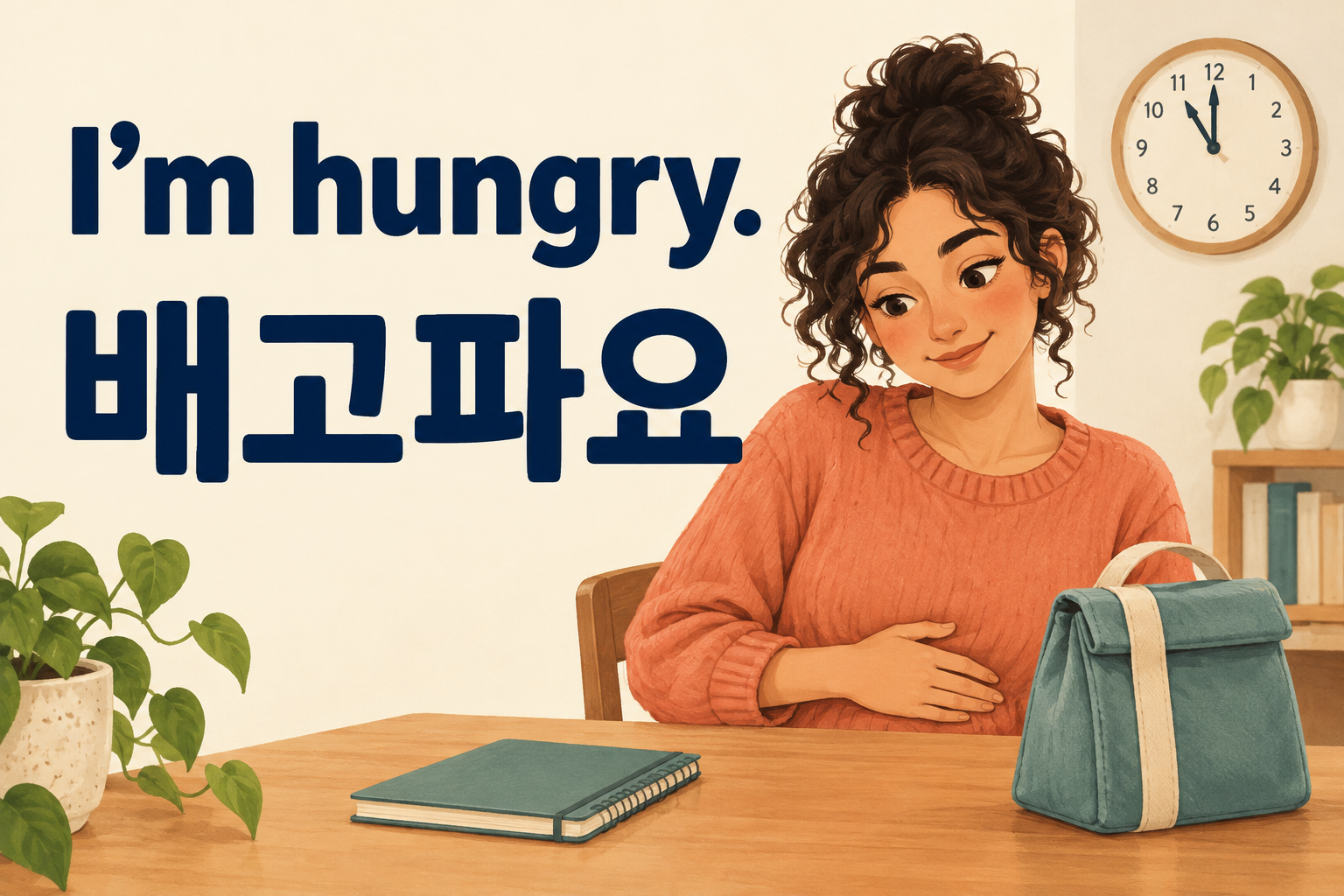
Lunch is still an hour away. You want to tell a new classmate you could eat now. To say I am hungry in Korean politely, use 배고파요 (baegopayo). With a friend you already speak casually with, 배고파 (baegopa) fits.
Both describe the feeling that you need something to eat. You can say either without adding a separate word for I when you are talking about yourself. The ending changes how you address the listener.
Baegopa meaning and the word it comes from
The dictionary form is 배고프다 (baegopeuda), an adjective meaning to be hungry. Its ending changes when you put it into conversation. The casual expression is an ordinary form of that adjective.
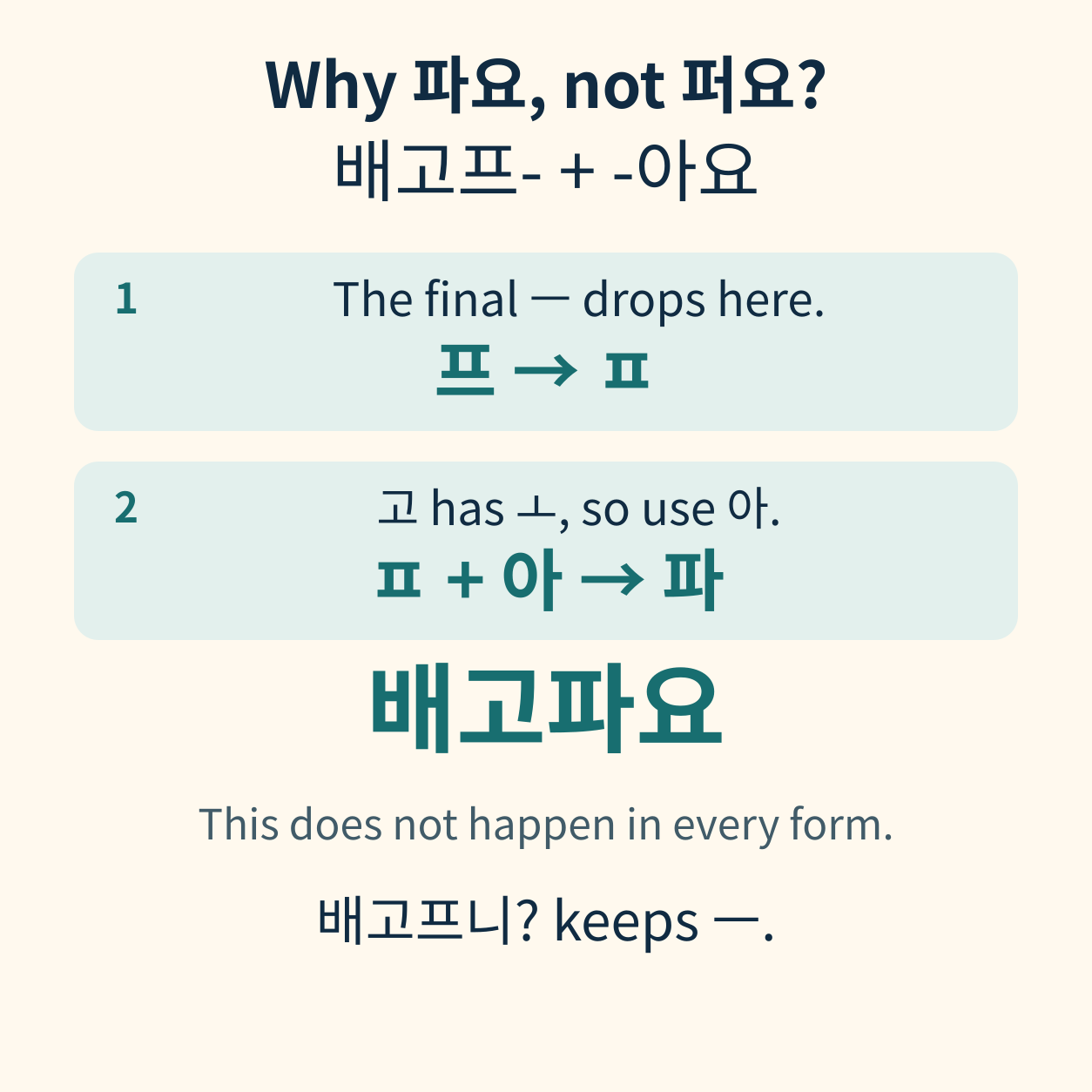
Start with the stem 배고프-, the part before 다. To form the polite ending here, the final vowel ㅡ in 프 drops out. The preceding syllable 고 has ㅗ, so the ending uses 아. That leaves 파 where the dictionary form had 프:
배고프- + -아요 → 배고파요
The preceding ㅗ is why this form has 파요 rather than 퍼요. The casual version ends in 파 through the same vowel change.
The ㅡ has not disappeared from the word altogether. It remains in 배고프니? (baegopeuni?), another casual way to ask Are you hungry?
Where the extra 가 comes from
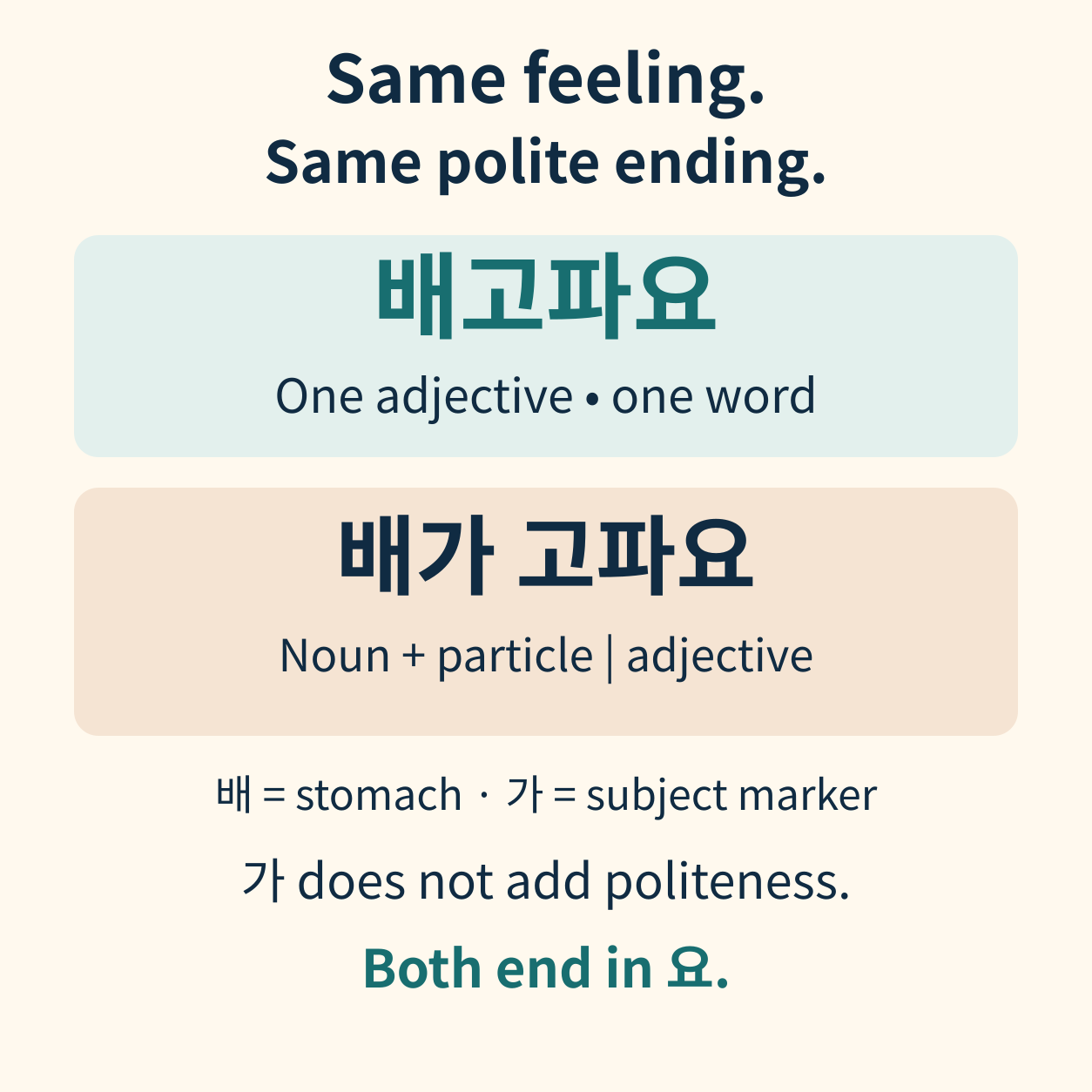
You may also hear 배가 고파요 (baega gopayo). It expresses the same state. Here, 배 means stomach, 가 marks it as the subject, and 고파요 describes it. A close structural reading is My stomach is hungry; the natural English translation is still I’m hungry.
There are two constructions behind the similar sound:
- 배고프다 → 배고파요: one adjective, written together.
- 배 + 가 + 고프다 → 배가 고파요: a noun with its particle, followed by a separate adjective.
The longer version has the same polite ending. The extra 가 identifies the subject; it does not add another level of politeness. Keep the space after 배가 when writing the expanded phrase.
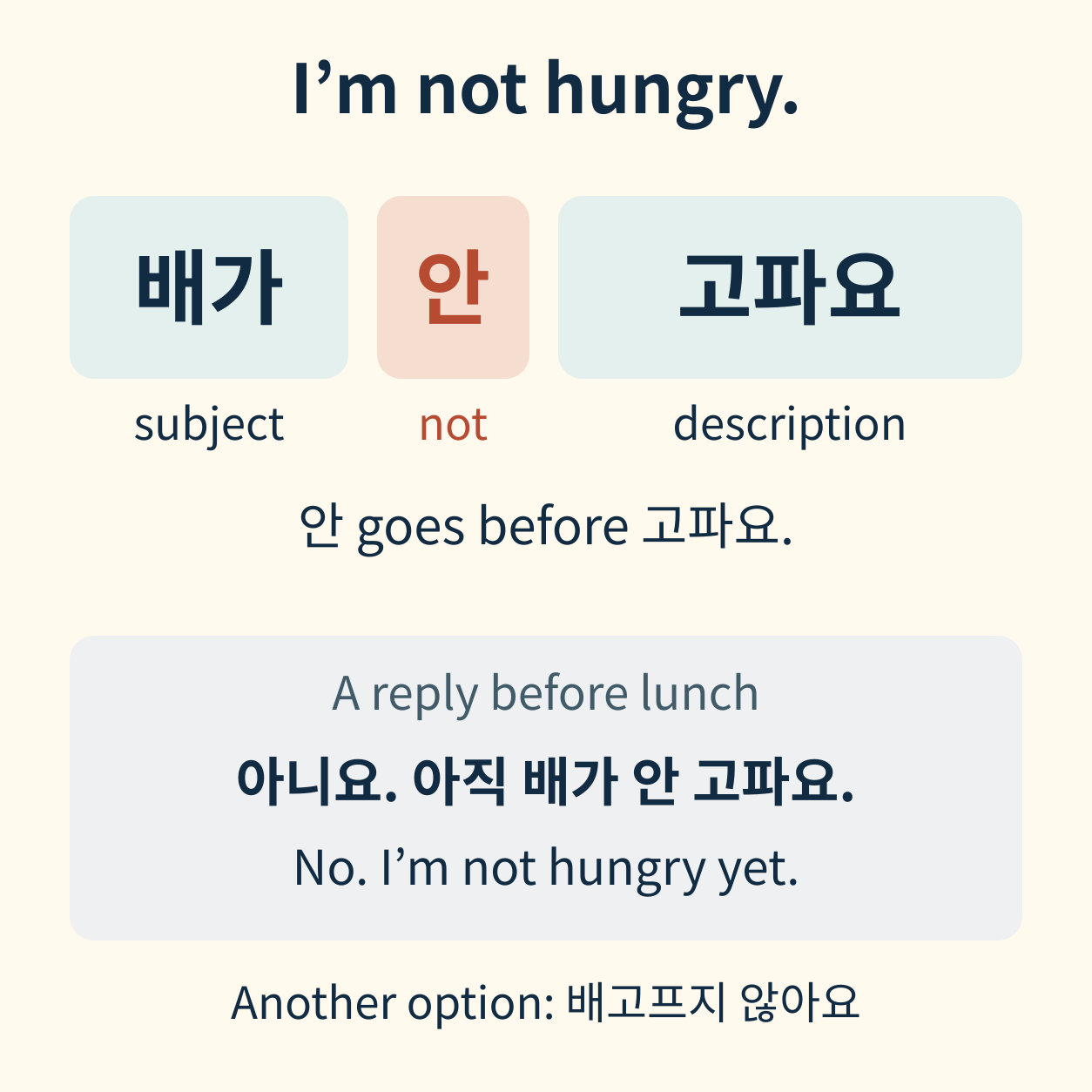
That space becomes useful when you need a negative reply. Put 안, meaning not, before 고파요:
배가 안 고파요.
Baega an gopayo.
I’m not hungry.
The noun and its particle stay together on the left. The separate 안 negates the description on the right. You may also hear 배 안 고파요 with 가 left out.
Another option is 배고프지 않아요 (baegopeuji anayo). This keeps the single adjective and adds -지 않아요 to make it negative.
A reply before lunch
Imagine this exchange with a classmate before lunch:
배고파요?
Baegopayo?
Are you hungry?
The polite form can be a question as well as a statement. If you are not hungry, a complete reply is:
아니요. 아직 배가 안 고파요.
Aniyo. Ajik baega an gopayo.
No. I’m not hungry yet.
아직 adds yet to this negative reply. If you are ready to eat, you can answer 네, 배가 많이 고파요 (ne, baega mani gopayo) — Yes, I’m very hungry. 많이 strengthens the description while the ending stays polite.
'Real Korean Language & Everyday Korea' 카테고리의 다른 글
| What Are You Doing in Korean? From the Question to Your Reply (0) | 2026.10.31 |
|---|---|
| Hanji: How Korean Paper Takes Shape (0) | 2026.10.31 |
| Friend in Korean: Say Close Friend or Best Friend Clearly (0) | 2026.10.30 |
| Months in Korean: All 12 Names, From Calendar Labels to Dates (0) | 2026.10.29 |
| How to Say I Love You in Korean, Saranghae Meaning and Written Phrases (0) | 2026.10.29 |
| Native Korean Numbers, Build the Count Before You Shorten It (0) | 2026.10.29 |
| Korean Texting Slang, Read the Letters Without Inventing the Missing Words (0) | 2026.10.29 |
| Korean Sentence Structure, Roles and Verb Groups in Korean Word Order (0) | 2026.10.29 |


