Hanji: How Korean Paper Takes Shape
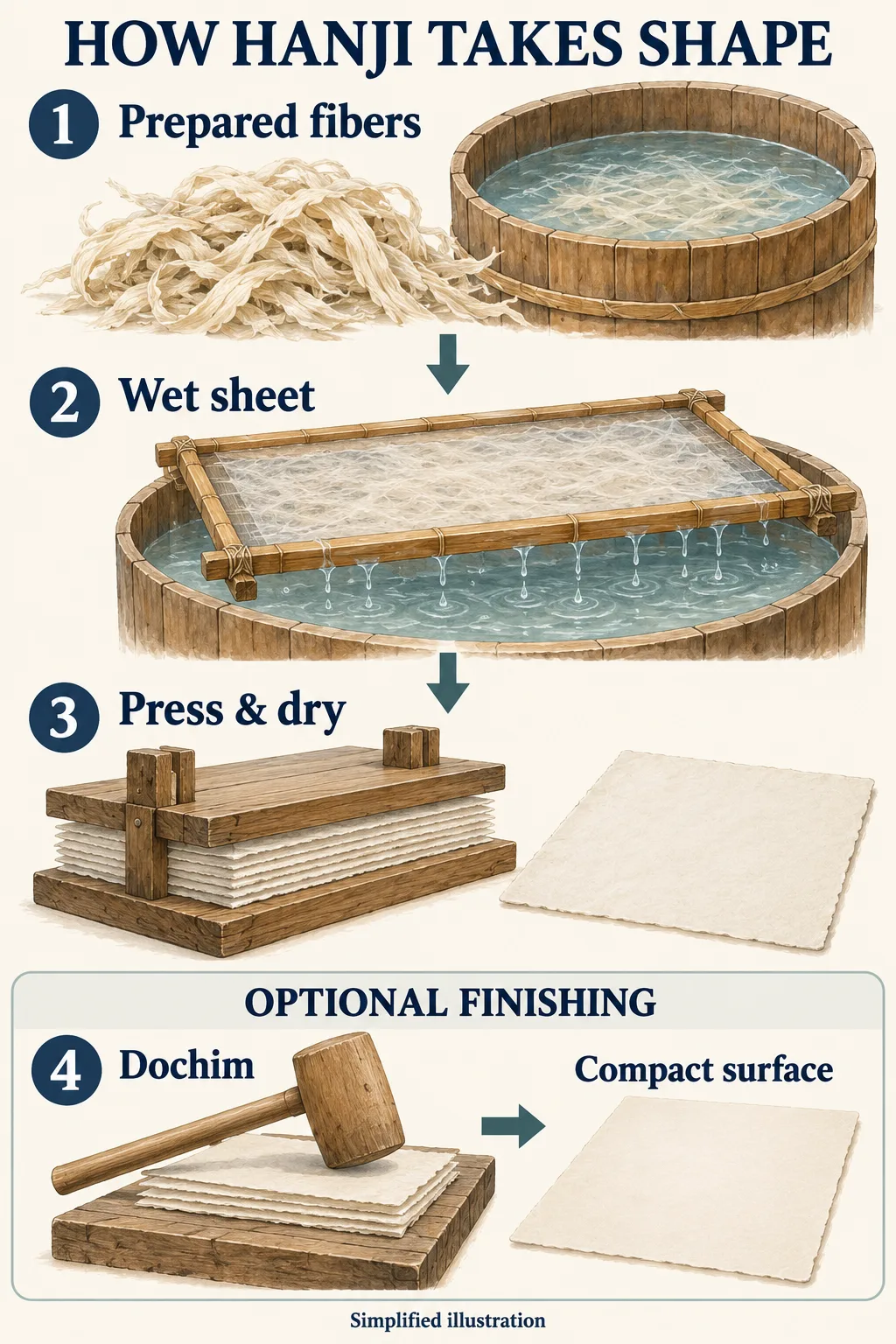
Hanji (한지) is traditional Korean paper made from the inner bark of paper mulberry. Its making continues through several different kinds of work: preparing the fibers, forming a wet sheet and drying it. Some sheets receive a further treatment called dochim, which changes the surface that meets the ink.
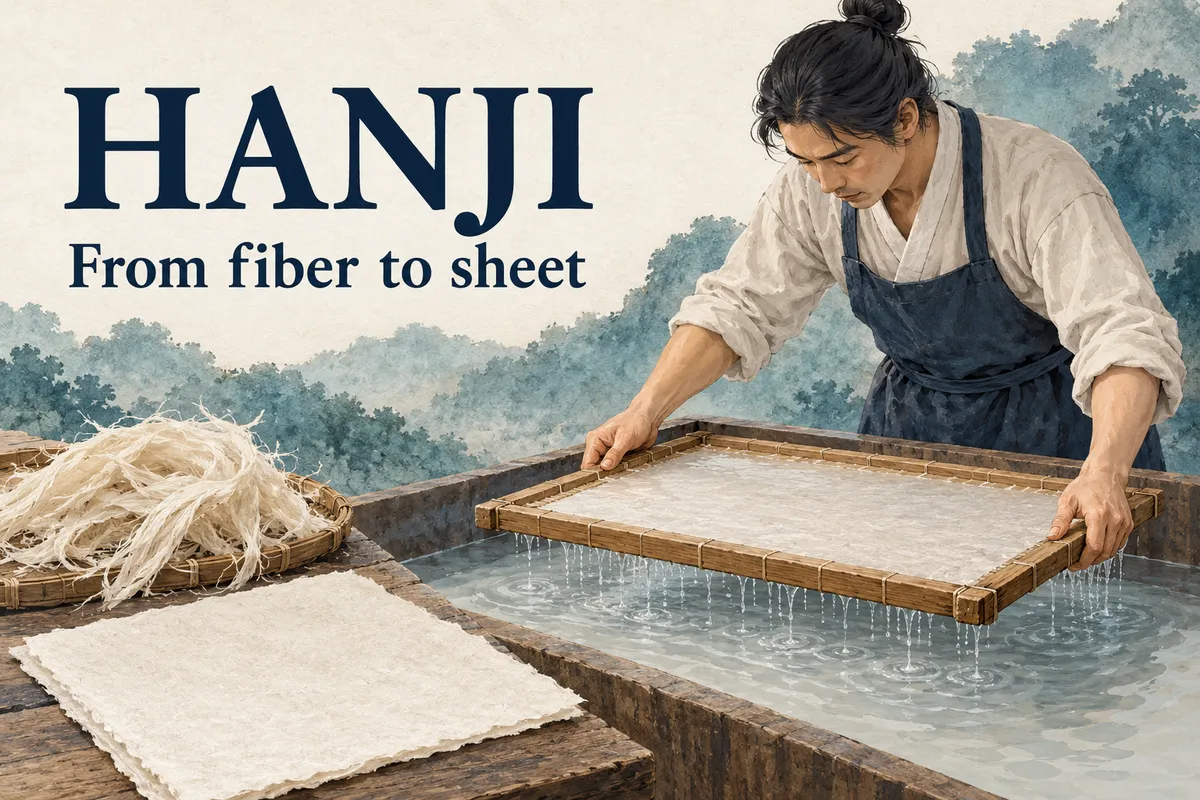
From inner bark to loose fibers
The paper mulberry used for this work is called dak (닥) in Korean. When making hanji paper by hand, the outer bark is removed to obtain the lighter inner bark. Cleaning and cooking prepare this material for beating, which separates it into fibers.
At this stage, there is no sheet to write on. The prepared fibers still need to be spread into a thin layer. That happens in a vat of water.
Lifting a sheet from the vat
The fibers are mixed with water so they can spread across the papermaking screen. A plant-derived formation aid keeps them dispersed and slows drainage, giving the papermaker time to distribute them.
A bamboo screen lifts the mixture from the vat. Water drains through it while fibers collect on its surface. The screen supports this fragile wet layer; it does not become part of the paper.
The papermaker transfers the wet sheet off the screen, leaving the tool ready for another sheet. Pressing and drying remove the remaining water. What began as loose fibers in a vat is now a sheet that can be handled on its own.
Why hammer paper after it dries?
Some dried sheets undergo dochim (도침), a finishing treatment that compacts the paper through pounding. It can produce a smoother, more lustrous surface and reduce ink bleeding.
Earlier beating worked on prepared bark to separate its fibers. Dochim works on an existing sheet, pressing its structure closer together. The same broad action—beating—serves a different purpose because the material has changed.
Hanji identifies a paper tradition and material, but the name alone does not tell you whether a particular sheet has received this ink-affecting finish.
'Real Korean Language & Everyday Korea' 카테고리의 다른 글
| Gwenchana in Korean: "I'm Okay," "Are You Okay?" and That Comforting Little Word (0) | 2026.11.02 |
|---|---|
| Sad in Korean: Feeling Sad, Looking Sad, and 아쉬워요 (0) | 2026.11.01 |
| Norigae Meaning: Reading the Pendants of Korean Dress (0) | 2026.10.31 |
| What Are You Doing in Korean? From the Question to Your Reply (0) | 2026.10.31 |
| Friend in Korean: Say Close Friend or Best Friend Clearly (0) | 2026.10.30 |
| Months in Korean: All 12 Names, From Calendar Labels to Dates (0) | 2026.10.29 |
| Hungry in Korean, From Baegopa to a Polite Reply (0) | 2026.10.29 |
| How to Say I Love You in Korean, Saranghae Meaning and Written Phrases (0) | 2026.10.29 |


