What Are You Doing in Korean? From the Question to Your Reply

A friend messages you on KakaoTalk out of nowhere at 2:00 PM on a Saturday.
"뭐 해?" (mwo hae?)
You look at your phone. You aren’t doing anything remarkable—just lying on the sofa scrolling through your feed.
How do you answer? Do you describe your exact physical action, or are they actually asking if you are free to meet up? And if your Korean coworker or university professor asked you the exact same question in person, would you use the same words?
In English, "What are you doing?" sounds straightforward. But in Korean, asking what someone is doing—and replying to it—depends heavily on three things: who you are talking to, whether you are asking about right now or future plans, and the hidden social cue behind the question.
Here is the complete guide to mastering "What are you doing?" in Korean, from casual texting to workplace politeness, along with the natural replies Koreans actually use every day.
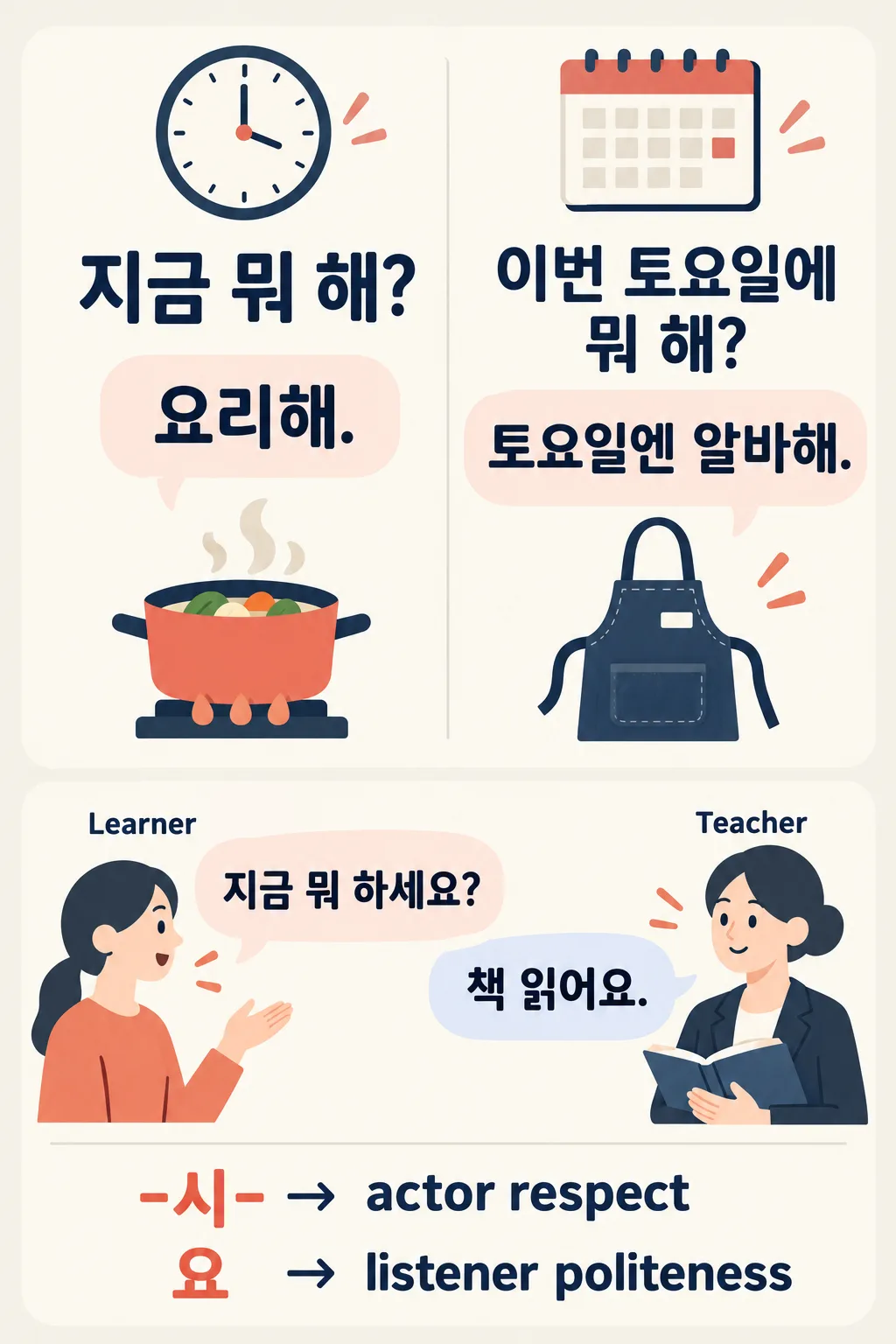
1. The Core Form: 뭐 해요? vs 뭐 해?
The verb at the heart of this phrase is 하다 (hada), meaning "to do." Combined with 뭐 (mwo), the conversational contraction of 무엇 (mueot, "what"), it forms the universal question for asking about someone’s activity.
The politeness level changes depending on the ending:
뭐 해요? (mwo haeyo?) — Polite Speech (존댓말)
This is the standard polite form ending in -요 (-yo). It is safe, friendly, and appropriate for:
- Acquaintances and classmates you aren’t close with yet
- People similar in age or slightly older in casual social settings
- Language exchange partners and friendly colleagues
뭐 해? (mwo hae?) — Casual Speech (반말)
Dropping the -요 gives you the informal, casual version. Use this exclusively with:
- Close friends of the same age
- Younger friends, siblings, or children
- Someone with whom you have explicitly agreed to drop honorifics (말 놓기)
Important Rule: Never say "뭐 해?" to someone older than you, a teacher, a client, or a stranger, even if you are just trying to be friendly. In Korean social hierarchy, dropping honorifics uninvited sounds abrupt and disrespectful.
2. Asking About "Right Now" vs "Future Plans"
In Korean, the exact same sentence structure can refer to what is happening at this very second, or what someone is planning to do later this evening or next weekend. The time word placed before the verb does all the work.
Asking About Right Now: 지금 (jigeum)
When you want to know what someone is doing at the present moment, add 지금 (now):
Friend A: 지금 뭐 해? (jigeum mwo hae?)
What are you doing right now?
Friend B: 나 지금 요리해. (na jigeum yorihae.)
I'm cooking right now.
Asking About Upcoming Plans: 이번 주말에 / 오늘 저녁에
When asking about a plan, simply attach the time marker -에 (-e) to the time word:
Friend A: 이번 토요일에 뭐 해? (ibeon toyoire mwo hae?)
What are you doing this Saturday?
Friend B: 토요일엔 알바해. (toyoiren alba-hae.)
I'm working my part-time job on Saturday.
Notice how Friend B answers the Saturday question with a plan (working part-time), even if they are currently sitting on a bus reading a book. In Korean, you do not need complex future tense conjugations like "What will you be doing?"; present tense with a clear time word is the natural way to talk about near-future schedules.
3. The Honorific Level: When to Use 뭐 하세요?
When addressing someone who deserves higher social respect—such as a professor, an older relative, a boss, or an elderly neighbor—neither 뭐 해 nor 뭐 해요 is polite enough.
Instead, you use the honorific infix -시- (-si-):
Student: 교수님, 지금 뭐 하세요? (gyosunim, jigeum mwo haseyo?)
Professor, what are you doing right now?
Professor: 다음 수업 준비하고 있어요. (daeum sueop junbihago isseoyo.)
I’m preparing for the next class.
The Golden Rule: Never Use -시- on Yourself!
The element -시- exists solely to honor and elevate the other person.
A very common mistake made by intermediate Korean learners is echoing the question back in their answer:
- Wrong: "저 지금 요리하세요." (Elevating yourself—sounds awkward and grammatically incorrect)
- Correct: "저 지금 요리해요." or "요리하고 있어요." (Humble polite ending in -요)
The professor in the example above asks with 하세요 because they honor the student or elder, but replies with 있어요 or 해요 without the honorific infix.
4. How Koreans Actually Reply in Real Life
Textbooks often teach full, grammatically rigid sentences like "저는 사과를 먹고 있습니다" (I am eating an apple). In real life, native speakers keep their replies concise, situational, and relatable.
Casual Replies to Friends (반말)
If a friend asks you "지금 뭐 해?", here are the most natural go-to responses:
- 그냥 있어 (geunyang isseo)
Literally: "Just being/existing."
Meaning: "Not much," "Just chilling," "Nothing special." This is the single most common answer in Korea. - 누워있어 (nuwo-isseo)
Meaning: "Just lying down / resting in bed." - 넷플릭스 봐 (nepeullikseu bwa)
Meaning: "Watching Netflix." - 일하는 중 / 과제하는 중 (ilhaneun jung / gwajehaneun jung)
Meaning: "In the middle of working / doing homework." Adding ~하는 중 (-haneun jung) emphasizes that you are currently busy. - 밥 먹어 (bap meogeo)
Meaning: "Eating a meal."
Polite Replies to Colleagues and Acquaintances (존댓말)
Simply attach -요 (-yo) or use the continuous aspect -고 있어요 (-go isseoyo):
- 그냥 쉬고 있어요 (geunyang swigo isseoyo)
Meaning: "I'm just resting / relaxing." - 일하고 있어요 (ilhago isseoyo)
Meaning: "I'm working right now." - 퇴근하는 중이에요 (toegeunhaneun jung-ieyo)
Meaning: "I'm on my way home from work." - 친구 만나고 있어요 (chingu mannago isseoyo)
Meaning: "I'm hanging out with a friend."
5. The Hidden Meaning Behind "뭐 해?" on KakaoTalk
In Korean texting culture, especially between friends, "뭐 해?" rarely means that the sender genuinely needs an inventory of your physical movements.
Nine times out of ten, it functions as a casual "ping"—an icebreaker meaning:
- "Are you bored? Want to chat?"
- "Are you busy right now, or do you have time to grab dinner/coffee?"
Because of this, replying with a simple status update like "그냥 있어, 왜?" (Nothing much, why?) or "누워있는데 왜? ㅋㅋㅋ" (Just lying down, what's up?) invites the other person to state their actual reason for messaging you.
Common Texting Slang Variations
On messaging apps like KakaoTalk or Instagram DM, you will frequently see informal variations:
- 뭐해? / 뭐함? (mwoham?): The noun-ending form (~함), used among very close friends to sound blunt and casual.
- 뭐하냐? (mwohanya?): Slightly more playful or teasing, common among male friends or close buddies.
- 뭐하심? (mwohasim?): A blend of casual slang with honorific -시-, used playfully among peers.
6. Summary Comparison Table
| 뭐 해? | mwo hae? | Casual (반말) | Close friends, same age, younger | 그냥 있어 / 누워있어 |
| 뭐 해요? | mwo haeyo? | Polite (존댓말) | Acquaintances, colleagues, public | 그냥 쉬고 있어요 / 일해요 |
| 뭐 하세요? | mwo haseyo? | Honorific (존칭) | Elders, teachers, seniors at work | [Activity] + 하고 있어요 |
| 어떤 일 하고 계세요? | eotteon il hago gyeseyo? | Formal Honorific | Clients, formal business meetings | [Project/Work description] |
7. Frequently Asked Questions (FAQ)
Q1. Can I use "무엇을 합니까?" (mueoseul hamnikka?) in daily conversation?
While grammatically correct, 무엇을 합니까 is extremely formal (하십시오체). In everyday spoken Korean, it sounds like an interview or a news broadcast. For general daily life, stick to 뭐 해요? (polite) or 뭐 하세요? (honorific).
Q2. How do I politely ask my boss what they are doing without sounding nosy?
Asking your direct supervisor "뭐 하세요?" can sometimes sound overly casual or intrusive. In professional Korean office culture, it is much more natural to frame it around their schedule or availability:
"팀장님, 지금 잠깐 말씀 나누실 시간 있으신가요?" (Manager, do you have a brief moment to talk right now?)
Q3. What is the difference between "뭐 해?" and "어떻게 지내?"
"뭐 해?" asks about an immediate activity or specific schedule (Right now / This weekend). "어떻게 지내?" (eotteoke jinae?) translates to "How have you been?", which asks about someone's general life condition over the past weeks or months since you last saw them.
'Real Korean Language & Everyday Korea' 카테고리의 다른 글
| Jinjja in Korean: "Really?" "Seriously?" and the Nuance Behind 진짜 vs 정말 (0) | 2026.11.02 |
|---|---|
| Gwenchana in Korean: "I'm Okay," "Are You Okay?" and That Comforting Little Word (0) | 2026.11.02 |
| Sad in Korean: Feeling Sad, Looking Sad, and 아쉬워요 (0) | 2026.11.01 |
| Norigae Meaning: Reading the Pendants of Korean Dress (0) | 2026.10.31 |
| Hanji: How Korean Paper Takes Shape (0) | 2026.10.31 |
| Friend in Korean: Say Close Friend or Best Friend Clearly (0) | 2026.10.30 |
| Months in Korean: All 12 Names, From Calendar Labels to Dates (0) | 2026.10.29 |
| Hungry in Korean, From Baegopa to a Polite Reply (0) | 2026.10.29 |


