Friend in Korean: Say Close Friend or Best Friend Clearly
Imagine writing a few words about Yuna, a friend from university. You want to say she has been a good friend to you. Calling her your best friend would add something you may not mean.
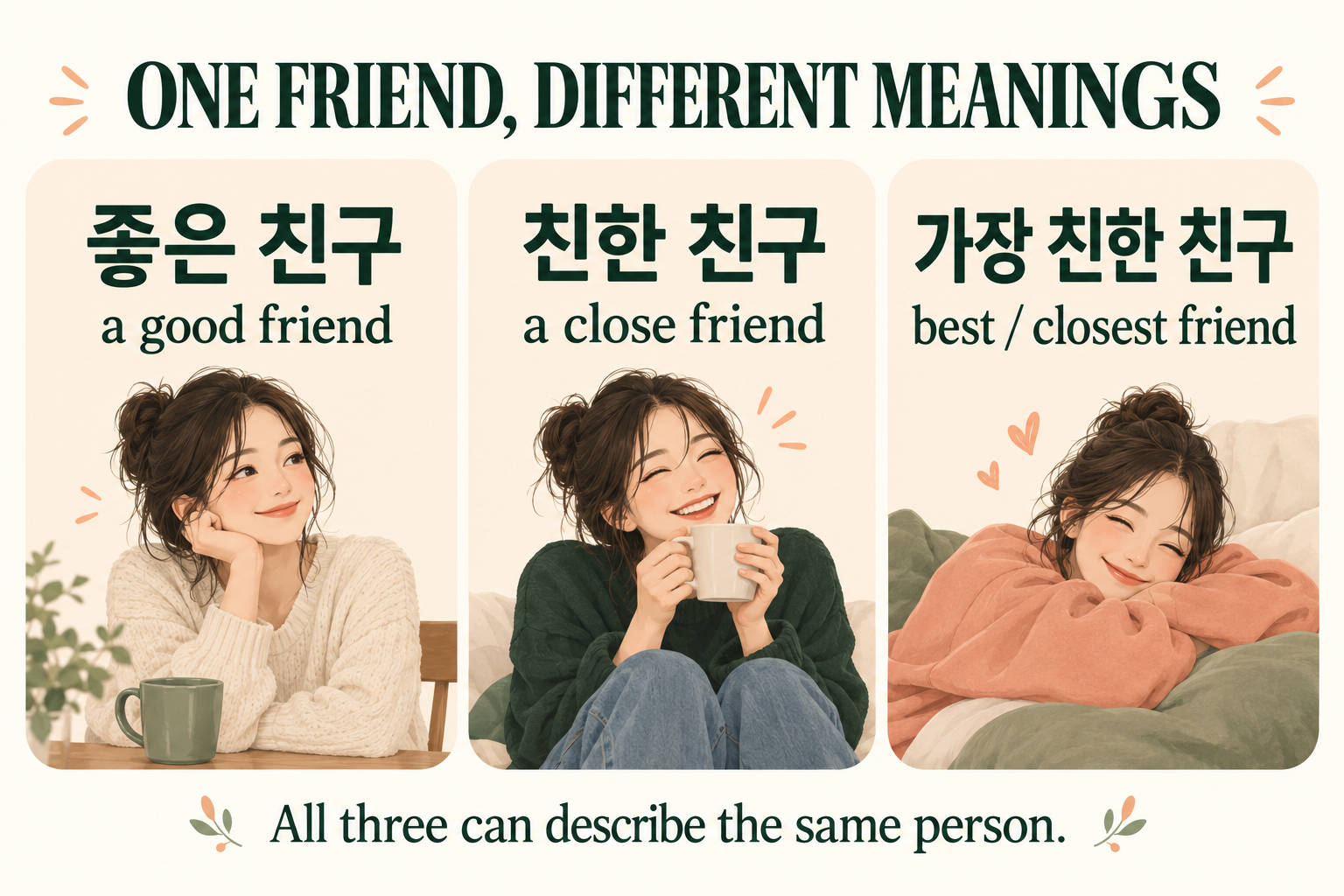
The Korean word for friend is 친구 (chingu). A close friend is 친한 친구 (chinhan chingu). To say best friend in Korean, use 가장 친한 친구 (gajang chinhan chingu), literally closest friend.

Using 친구 in a sentence
The noun refers to a person you have a friendship with. To tell someone that Yuna is your friend, you can say:
유나는 제 친구예요.
Yunaneun je chingu-yeyo.
Yuna is my friend.
제 means my here. The sentence identifies your relationship without specifying that she is your closest friend. You can add a description before 친구 to say more about that relationship.
A good friend, a close friend, or your best friend
Keep Yuna as the person being described and change the words around her name.
유나는 좋은 친구예요.
Yunaneun joeun chingu-yeyo.
Yuna is a good friend.
좋은 comes from 좋다, meaning good. Here it is a positive description of Yuna as a friend. Perhaps she helped you move or listened when you had a difficult week. The sentence praises her; it does not explicitly compare your closeness to her with your other friendships.
유나는 제 친한 친구예요.
Yunaneun je chinhan chingu-yeyo.
Yuna is a close friend of mine.
친한 comes from 친하다, which describes a close relationship. This sentence makes that closeness explicit. It does not say she is the closest of all.
유나는 제 가장 친한 친구예요.
Yunaneun je gajang chinhan chingu-yeyo.
Yuna is my best friend.
가장 means most here, so 가장 친한 describes the greatest closeness. You can also use 제일 친한 친구 (jeil chinhan chingu) for best friend. 제일 supplies the same superlative meaning in this phrase.
If your intended message is simply that Yuna is a good friend, replacing 좋은 with 가장 친한 changes the claim. It is not a more accurate translation of the same thought. Keep 좋은 when that positive description is what you mean.
All three sentences could be true about Yuna. A person can be a good friend and a close friend, and she may also be your closest friend. The wording decides which of those things you actually say.
Where 단짝 fits
단짝 (danjjak) describes a close companion: someone you get along with and regularly spend time with. You may also see 단짝 친구 (danjjak chingu).
Compare the emphasis. 가장 친한 친구 explicitly describes someone as your closest friend. 단짝 brings out the close-companion relationship. It does not contain the most element found in 가장 친한, and the two expressions can describe the same person.

For example, imagine introducing Yuna to a hiking group:
유나는 제 가장 친한 친구예요.
주말마다 같이 등산하는 제 단짝이에요.
Yunaneun je gajang chinhan chingu-yeyo.
Jumalmada gachi deungsanhaneun je danjjag-ieyo.
Yuna is my best friend.
She is my close companion, the one I go hiking with every weekend.
The first sentence tells the group how close she is to you. The second adds the companionship behind that description. 주말마다 같이 등산하는 supplies the shared activity—hiking together every weekend—while 단짝 names the close companion.

'Real Korean Language & Everyday Korea' 카테고리의 다른 글
| Sad in Korean: Feeling Sad, Looking Sad, and 아쉬워요 (0) | 2026.11.01 |
|---|---|
| Norigae Meaning: Reading the Pendants of Korean Dress (0) | 2026.10.31 |
| What Are You Doing in Korean? From the Question to Your Reply (0) | 2026.10.31 |
| Hanji: How Korean Paper Takes Shape (0) | 2026.10.31 |
| Months in Korean: All 12 Names, From Calendar Labels to Dates (0) | 2026.10.29 |
| Hungry in Korean, From Baegopa to a Polite Reply (0) | 2026.10.29 |
| How to Say I Love You in Korean, Saranghae Meaning and Written Phrases (0) | 2026.10.29 |
| Native Korean Numbers, Build the Count Before You Shorten It (0) | 2026.10.29 |


