Norigae Meaning: Reading the Pendants of Korean Dress
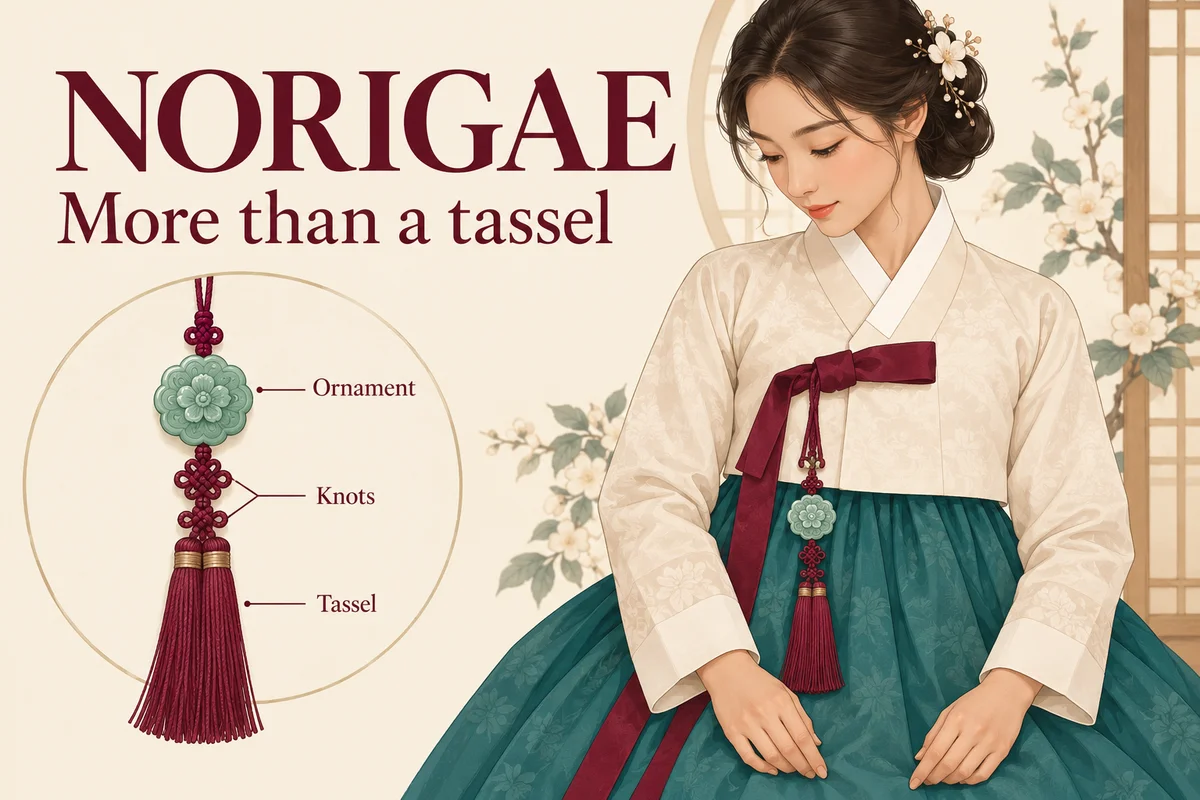
A norigae (노리개) is a traditional Korean pendant ornament worn with hanbok. A main ornament, knotted cords and tassels form the hanging decoration. Some are worn together as a set, and their small objects can carry practical uses as well as symbolic meanings.
Where the ornament sits
A Korean norigae can hang from the jacket ties or the skirt’s waistband, with its decoration visible below the short jacket. The carved or shaped object catches the eye above the tassels.
Count the pendants, not every shape
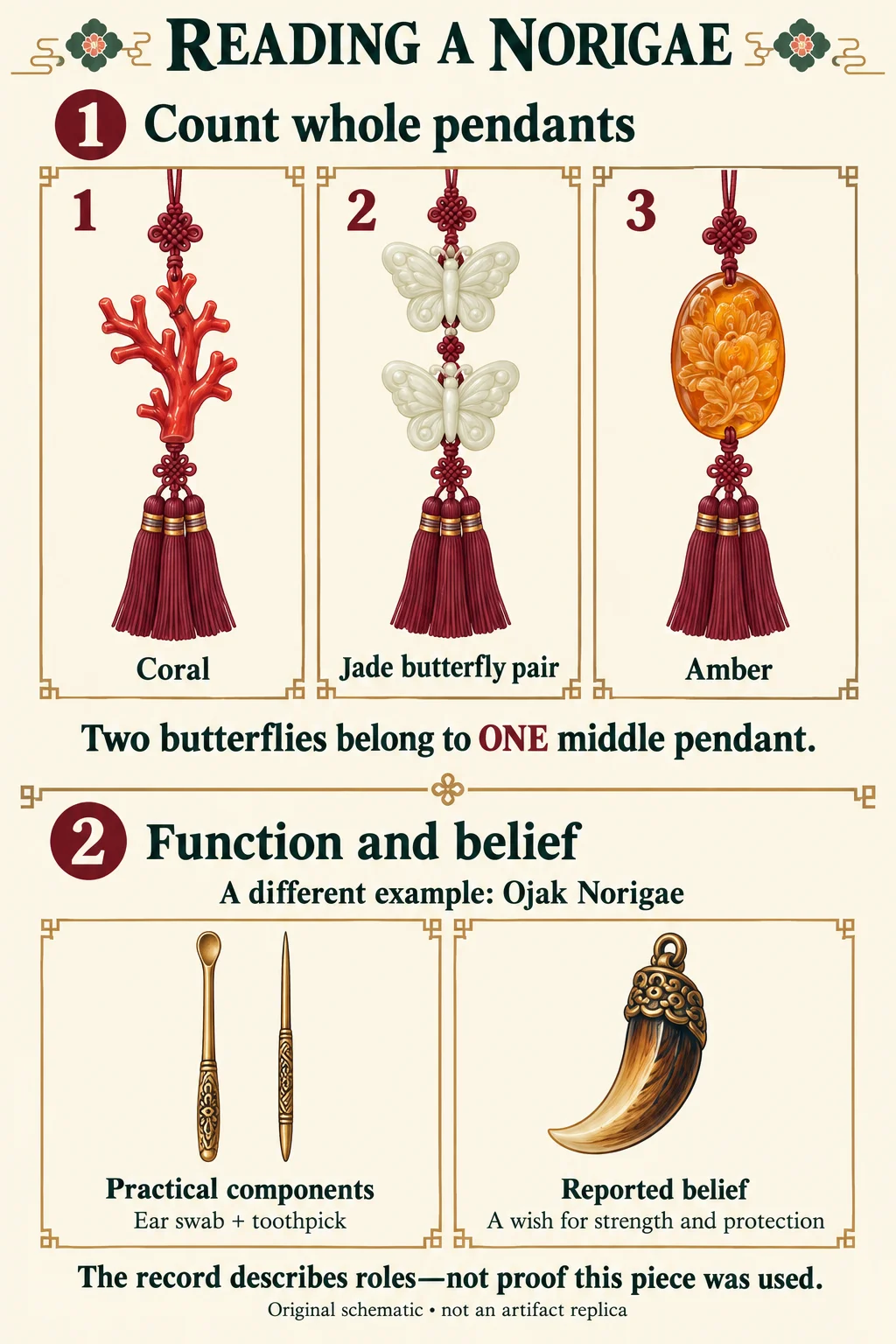
The National Palace Museum of Korea holds a samjak-norigae, a three-pendant set belonging to the consort of Imperial Prince Yeong. Follow its three groups from left to right:
- Left: a branch-shaped coral ornament with its hanging knots and tassels.
- Middle: a pair of white jade butterflies belonging to one pendant.
- Right: a carved amber ornament with its own tassel group.
The middle pendant contains two butterfly figures. Counting each butterfly separately would turn the three groups into four carved objects. The museum’s count follows the complete hanging pendants, so the butterfly pair stays together as the middle unit. The many threads below each ornament belong to its tassels; they do not add more pendants to the set.
A small tool and a protective wish
A different example, designer Lee Young Hee’s Ojak Norigae, brings practical objects and protective associations into one ornament. Its collection description identifies a small item called bang-ah-dari as an ear swab and a toothpick grouped together.
That description explains what the small implements were for. It does not establish that this particular designer piece was used. The same record describes a tiger’s claw through a belief: it was thought to give the wearer a tiger’s strength and courage against evil forces.
The ear swab and toothpick explain a practical role within the decoration. The claw’s protective association explains a wish attached to an object, rather than a physical task it performs.
'Real Korean Language & Everyday Korea' 카테고리의 다른 글
| Hul in Korean: The Slang for Shock, Disbelief, and Speechless Moments "헐~" (0) | 2026.11.03 |
|---|---|
| Jinjja in Korean: "Really?" "Seriously?" and the Nuance Behind 진짜 vs 정말 (0) | 2026.11.02 |
| Gwenchana in Korean: "I'm Okay," "Are You Okay?" and That Comforting Little Word (0) | 2026.11.02 |
| Sad in Korean: Feeling Sad, Looking Sad, and 아쉬워요 (0) | 2026.11.01 |
| What Are You Doing in Korean? From the Question to Your Reply (0) | 2026.10.31 |
| Hanji: How Korean Paper Takes Shape (0) | 2026.10.31 |
| Friend in Korean: Say Close Friend or Best Friend Clearly (0) | 2026.10.30 |
| Months in Korean: All 12 Names, From Calendar Labels to Dates (0) | 2026.10.29 |


