Sad in Korean: Feeling Sad, Looking Sad, and 아쉬워요
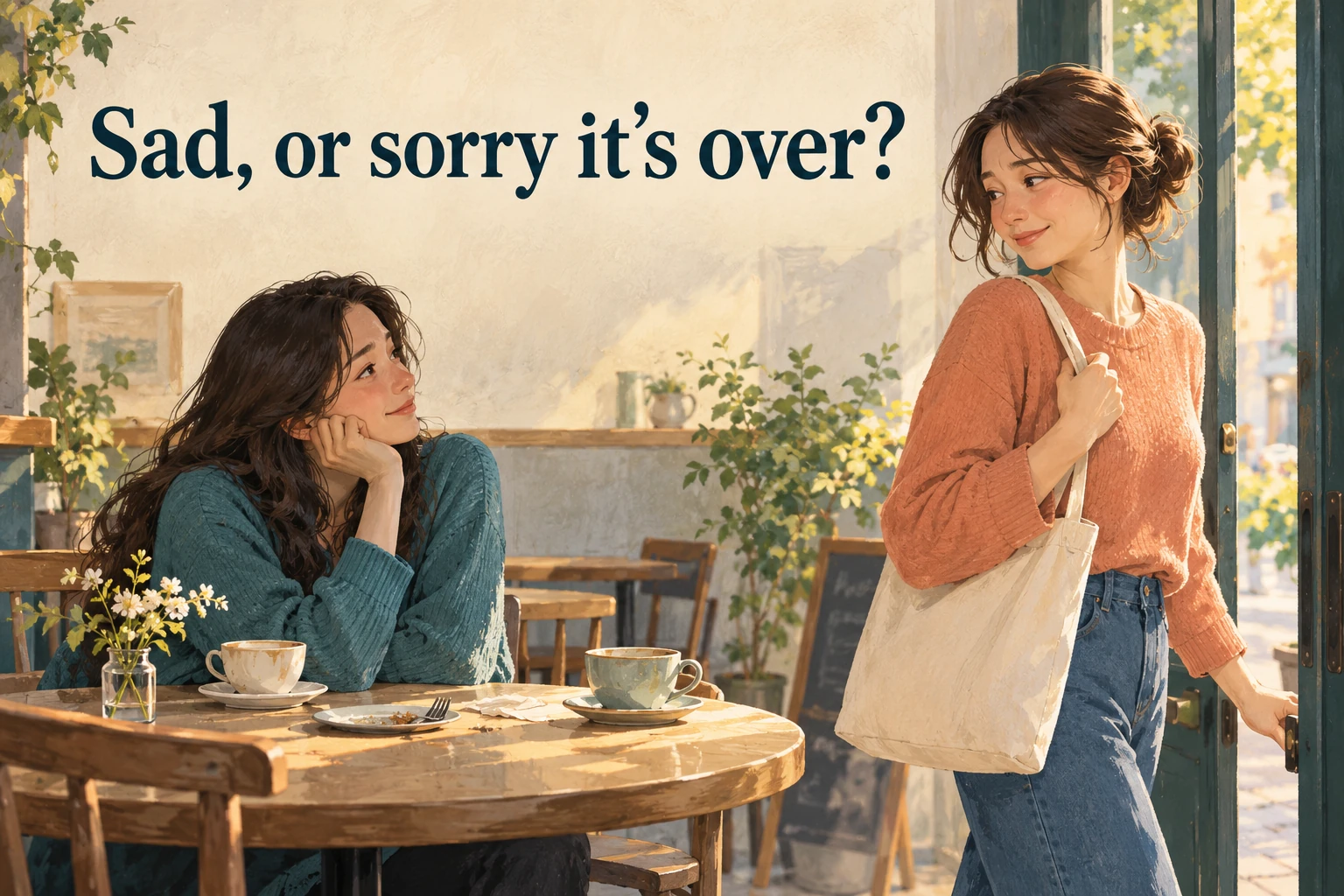
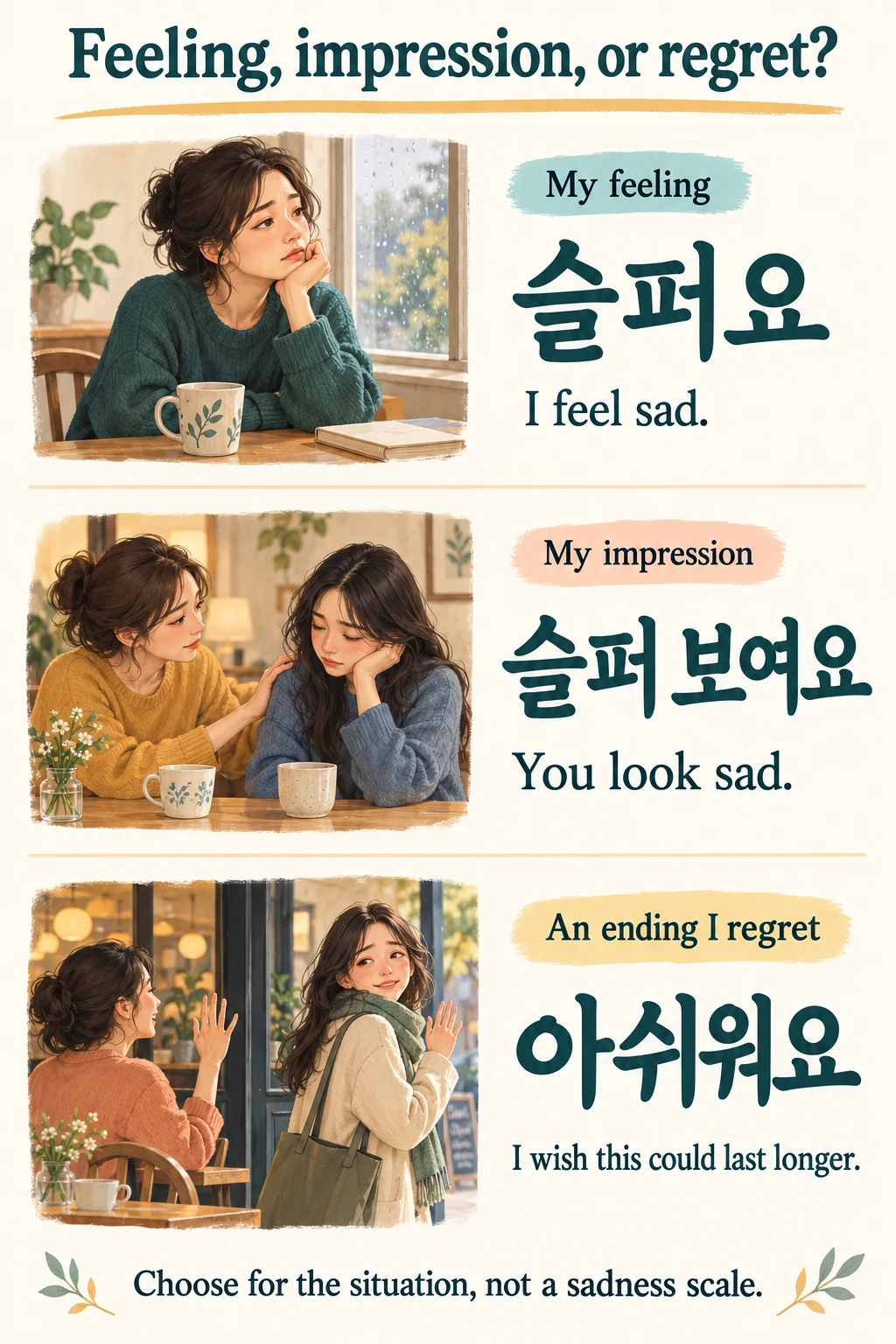
Imagine a friend is leaving after a short visit. You had hoped to spend another afternoon together. To say that you feel sad, you can use 슬퍼요 (seulpeoyo). 아쉬워요 can instead emphasize your regret that the visit is ending.
Both feelings can belong to that goodbye. You might be upset about the separation, disappointed that your plans were cut short, or reluctant to let a pleasant afternoon finish. Choosing a Korean expression starts with what you want your listener to understand, rather than deciding whether the occasion is serious enough to qualify as sad.
There is another distinction when you describe somebody else. You know your own feelings directly; a quiet face gives you only an impression. Korean lets you say that someone looks sad without presenting their expression as a confirmed account of what they feel.
Saying sad in Korean: from 슬프다 to a sentence
슬프다 (seulpeuda) is the dictionary form. For the everyday polite form, remove 다 and change 슬프 to 슬퍼 before adding 요: 슬퍼요. The vowel ㅡ drops in this particular combination. Simply attaching 요 to the dictionary stem produces 슬프요, which is not the form to use.
On its own, 슬퍼요 can mean “I’m sad” when you are answering about yourself. Add 오늘, meaning “today,” to locate the feeling in time: 오늘 슬퍼요, “I feel sad today.” If the conversation already establishes who feels sad, you do not need to keep repeating “I.”
For an observation, use 슬퍼 보여요: “looks sad.” In 민지가 슬퍼 보여요, “Minji looks sad,” 민지가 identifies Minji as the person described; 가 is the subject marker attached to this name. The phrase 슬퍼 combines with 보여요 to express an appearance. Change the name to 준호 and the description becomes 준호가 슬퍼 보여요. You have changed the person, while retaining the kind of claim you are making.
Someone can correct that impression. A tired expression might look sad to an observer even when the person feels perfectly content.
The same feeling, a different listener
Suppose a friend is leaving today. When you say sad in Korean here, the feeling stays the same; the listener and delivery change.
With someone you already speak casually to
슬퍼 is the casual form. You could tell a close friend 오늘 슬퍼, “I feel sad today,” if casual speech is already normal between you. The missing 요 changes how you address the listener, not the strength of your sadness. Being friendly with a new acquaintance does not by itself establish that both of you are comfortable with casual speech.
In a polite conversation
오늘 슬퍼요 expresses the same message politely. This fits a conversation where you normally use 해요체. You can sound warm while keeping 요; politeness does not require an impersonal delivery. Conversely, switching to the casual ending because a subject feels personal may create an unexpected change in the relationship.
In a formal statement
오늘 슬픕니다 preserves that basic message in a formal style. 슬픕니다 belongs with the more formal sentence ending -ㅂ니다, rather than the everyday conversational -어요. A prepared statement can call for this register, but an ordinary exchange with an older listener does not automatically require it. Compare the setting as well as the person: a public address and a quiet conversation can involve the same listener but different styles.
These endings address the listener. Describing somebody respectfully is a separate grammatical issue; adding a polite ending alone does not teach every form of subject honorification.
Three conversations that continue past the first reply
Friends after a film
Two friends who already use casual speech have just watched an emotional ending.
A: 왜 이렇게 조용해?
Why are you so quiet?
B: 영화 보고 나니까 좀 슬퍼.
I feel a little sad after watching the movie.
A: 나도. 마지막 장면이 계속 생각나.
Me too. I keep thinking about the last scene.
B explains a personal reaction. A answers that reaction and adds the specific scene still on their mind. The casual endings belong to the established relationship, while 좀 softens the description of the feeling in this exchange.
Colleagues finishing a shared project
Two colleagues use polite speech. One is moving to another team after they finish their assignment.
A: 다음 주부터 다른 팀에서 일해요.
Starting next week, I’ll be working on another team.
B: 같이 일해서 좋았는데 아쉬워요.
I enjoyed working with you, so I’m sorry that’s ending.
A: 저도요. 그래도 가끔 같이 점심 먹어요.
Me too. Still, let’s have lunch together sometimes.
Here 아쉬워요 points to something valued coming to an end. A understands the regret and offers a way to stay in touch. Translating B’s reply simply as “I’m sad” would lose some of that attachment to the shared experience.
An instructor checks an impression
An instructor who knows a learner notices their expression before class. Both use polite speech in this exchange.
A: 오늘 좀 슬퍼 보여요. 무슨 일 있어요?
You look a little sad today. Is something wrong?
B: 아니요, 그냥 좀 피곤해요.
No, I’m just a little tired.
A: 아, 그렇군요. 어제 늦게 잤어요?
Oh, I see. Did you go to bed late yesterday?
The learner corrects the interpretation, and the instructor accepts that information. 보여요 leaves room for this correction because it describes how the learner appears. Asking about someone’s feelings can still be personal; this scene assumes an existing supportive relationship rather than recommending the question to every stranger.
What a short message leaves unsaid
With a close friend, 아쉬워 ㅠㅠ can convey regret with a crying-face emoticon. Consider two text exchanges. After discussing plans to meet, your friend writes 오늘 못 만나, “I can’t meet today.” You reply 아쉬워 ㅠㅠ. After a visit, the message 이제 집에 가야 해, “I have to go home now,” can receive the same reply. The preceding message supplies the reason: a canceled meeting or an ending you wish could wait.
The crying-face characters add an emotional cue without confirming that anyone is literally crying. An unfamiliar recipient lacks the shared background that makes such a brief response readable. Identify what happened if leaving it unstated would create confusion.
For a colleague, 같이 일해서 좋았는데 아쉬워요 explains what you valued. Keeping the polite ending preserves the relationship shown in the workplace conversation. A bare casual reply borrowed from a friendly chat would change both the amount of explanation and the way you address that colleague.
Choose the wording for your situation
The romanization below is a reading aid. In 슬픕니다, the consonant before ㄴ is pronounced as an m sound, reflected in seulpeumnida.
| Expression | Pronunciation (romanization) | Speech level | Best situation | Natural reply / nuance |
|---|---|---|---|---|
| 슬퍼 | seulpeo | Casual | Sharing your feeling with an established casual-speaking friend | 나도: “Me too,” if the feeling is shared |
| 슬퍼요 | seulpeoyo | Polite | Explaining sadness in a polite conversation | The subject follows the surrounding conversation |
| 슬픕니다 | seulpeumnida | Formal | A statement that calls for formal delivery | Formality changes presentation, not emotional intensity |
| 슬퍼 보여요 | seulpeo boyeoyo | Polite | Describing an apparent feeling | The person can correct your impression |
| 아쉬워요 | aswiwoyo | Polite | Regretting an ending or a missed opportunity | The valued experience or opportunity supplies the meaning |
Can I say somebody is sad if they have told me so?
Yes: 민지가 슬퍼요 can express “Minji is sad,” so a third-person subject is not automatically incorrect. The important difference from an appearance-based statement is that the person has supplied information about their feeling. Naming them does not itself require changing every description to “looks sad.” If explaining how you know matters, make the source of that information clear rather than treating their facial expression as proof.
Does 아쉬워요 also work for a missed opportunity?
It can express regret about an opportunity you want but cannot take. Before an anticipated gathering, 모임에 못 가서 아쉬워요 means “I’m disappointed I can’t make it to the gathering.” This extends beyond wishing that a visit would last longer. It does not establish a fixed scale on which 아쉬워요 always means a smaller amount of sadness.
Can the word for sad in Korean describe a movie?
Yes: 영화가 슬퍼요 means “The movie is sad,” describing its content or emotional character. In the friends’ conversation, B instead explained how they felt after watching it. Notice what the sentence makes its subject: the film or the person reacting. That small change separates a description of the story from a report of the viewer’s mood.
'Real Korean Language & Everyday Korea' 카테고리의 다른 글
| Why in Korean: Asking for a Reason and Giving One (0) | 2026.11.03 |
|---|---|
| Hul in Korean: The Slang for Shock, Disbelief, and Speechless Moments "헐~" (0) | 2026.11.03 |
| Jinjja in Korean: "Really?" "Seriously?" and the Nuance Behind 진짜 vs 정말 (0) | 2026.11.02 |
| Gwenchana in Korean: "I'm Okay," "Are You Okay?" and That Comforting Little Word (0) | 2026.11.02 |
| Norigae Meaning: Reading the Pendants of Korean Dress (0) | 2026.10.31 |
| What Are You Doing in Korean? From the Question to Your Reply (0) | 2026.10.31 |
| Hanji: How Korean Paper Takes Shape (0) | 2026.10.31 |
| Friend in Korean: Say Close Friend or Best Friend Clearly (0) | 2026.10.30 |


