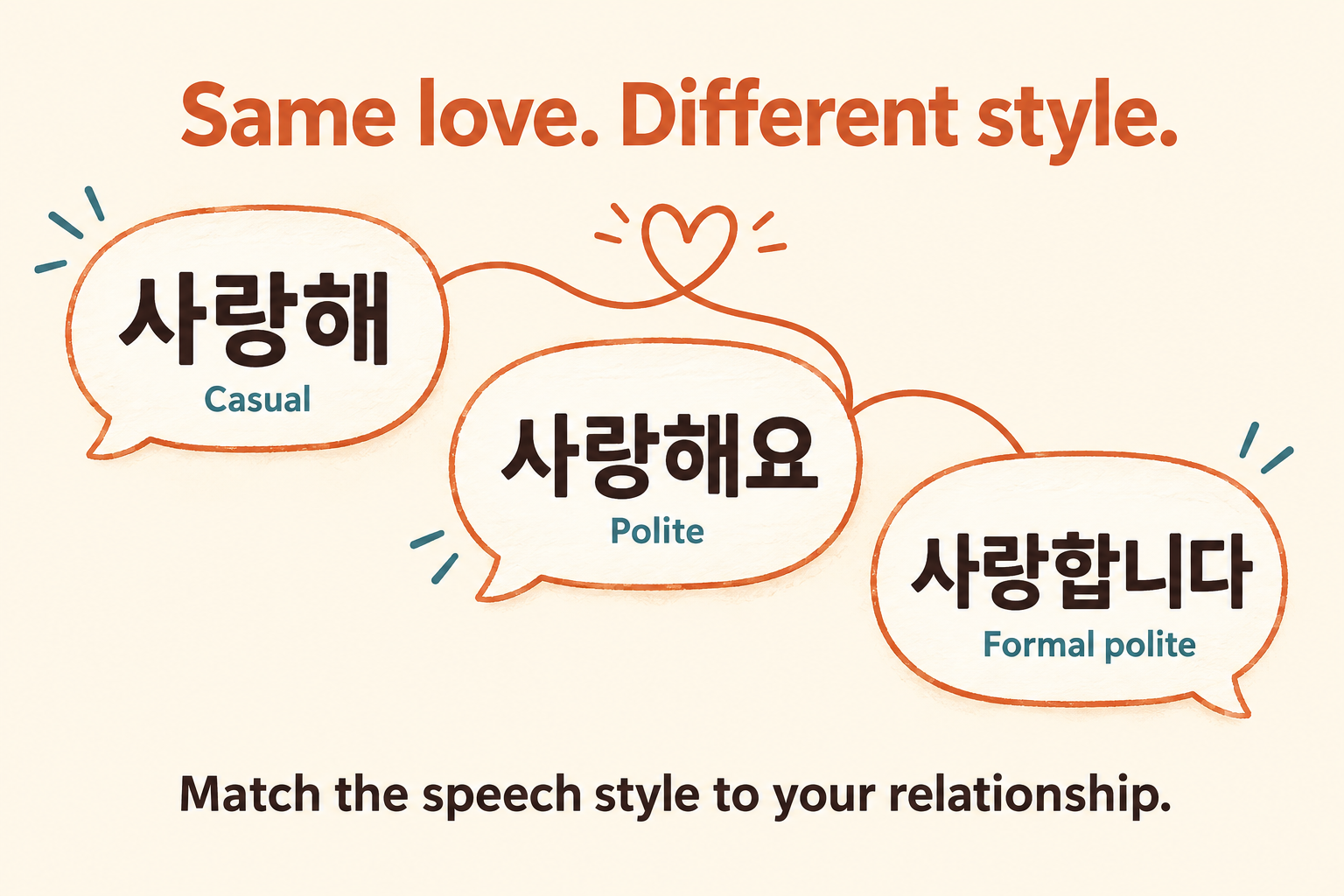
The cable car up Namsan closes at ten, but the fence beside it stays busy until midnight. Pairs of lovers clip a padlock onto the wire, write their names with a marker that barely works in the cold, and throw the key into the dark. If you stand there long enough you will hear one word said in three entirely different ways in the same evening: 사랑해 whispered between two students, 사랑해요 said with a shy laugh over the phone to a mother, 사랑합니다 spoken into a microphone by an actor holding an award. Learners usually memorize one of these and then hesitate, because no one has told them the real rule: Korean love has one verb and many volumes, and the ending you choose tells the room how the two of you speak, not how much you love.
사랑하다 is a verb before it is ever a sentence
The word is built from 사랑, "love" — a Sino-Korean noun written with the character 愛 — plus 하다, the verb "to do." Korean forms a huge family of emotional and action words this way: 공부하다 (to study), 걱정하다 (to worry), 사랑하다 (to love). That matters because 사랑하다 conjugates like any other 하다 verb. The dictionary form 사랑하다 gives 사랑해 in casual speech, 사랑해요 in polite speech, and 사랑합니다 in formal speech. The drama-style plain form 사랑한다 also exists, and you will hear it in films and in older men's speech.
This is the core principle: the ending changes the speech style, not the amount of love. 사랑해 is not a weaker love than 사랑합니다, and 사랑합니다 is not reserved for grander feelings. The three forms answer one question only — what speech level does this relationship run on?
Korean also leaves out the people. 나는 너를 사랑해 ("I love you," word for word) is grammatical but almost nobody says it aloud, because the sentence drops its subject and object when context carries them. 사랑해 by itself means "I love you" when you are the one saying it to the person in front of you. That is why the same two syllables can appear in a parent's voice message and a breakup scene without any change at all.
The same love at three speech levels
With a partner or a close friend, 사랑해 is the form. It is 반말, plain speech, and using it assumes you already have that intimacy. Saying 사랑해 to someone you normally speak to politely breaks the level before it delivers the feeling, which is why it can land as either romantic or presumptuous.
사랑해요 is the polite form and the quiet workhorse of family life. Adult children say 사랑해요 to parents, parents answer in either level depending on the household, and partners who speak politely to each other use it too. In a text to your mother, 엄마 사랑해요 is completely ordinary.
사랑합니다 is the formal polite form, and it belongs to one-to-many settings: award speeches, wedding vows, fan meetings, public letters. An actor ending a speech with 팬 여러분, 사랑합니다 — "Fans, I love you" — is speaking to a crowd in the same register a newsreader uses. Choosing it face to face with one person creates distance or ceremony, which is occasionally the intent and usually a joke.
A useful extra rung is 사랑한다. As a plain declarative it sounds like a confession in a film or a gruff father's single sentence at the door. You will recognize it far more often than you will produce it.
Three conversations you will actually have
Partners, casual (반말)
A: 오늘 하루종일 생각했어. 사랑해. — Oneul harujongil saengkaessaet. Saranghae. — I thought about you all day. I love you. B: 나도 사랑해. — Nado saranghae. — I love you too.
An adult child phoning home (존댓말)
A: 엄마, 건강 챙겨 먹어야 해요. 사랑해요. — Eomma, geongang gyeongyeo meogoya haeyo. Saranghaeyo. — Mom, you have to eat properly. I love you. B: 알았어, 우리 딸. — Arasseo, uri ttal. — Okay, my daughter.
An award speech, formal (격식)
A: 저를 응원해 주시는 분들께 늘 감사합니다. 사랑합니다! — Jeoreul eungwonhae jusineun bundeulkke neul gamsahamnida. Saranghamnida! — Thank you always to everyone cheering for me. I love you! B: (군중) 저희도 사랑합니다! — (Gunjung) Jeohuido saranghamnida! — (Crowd) We love you too!
Notice the crowd answering with 저희도, "we too." The verb frames both directions; only the pronoun moves.
The mistakes that cost the most
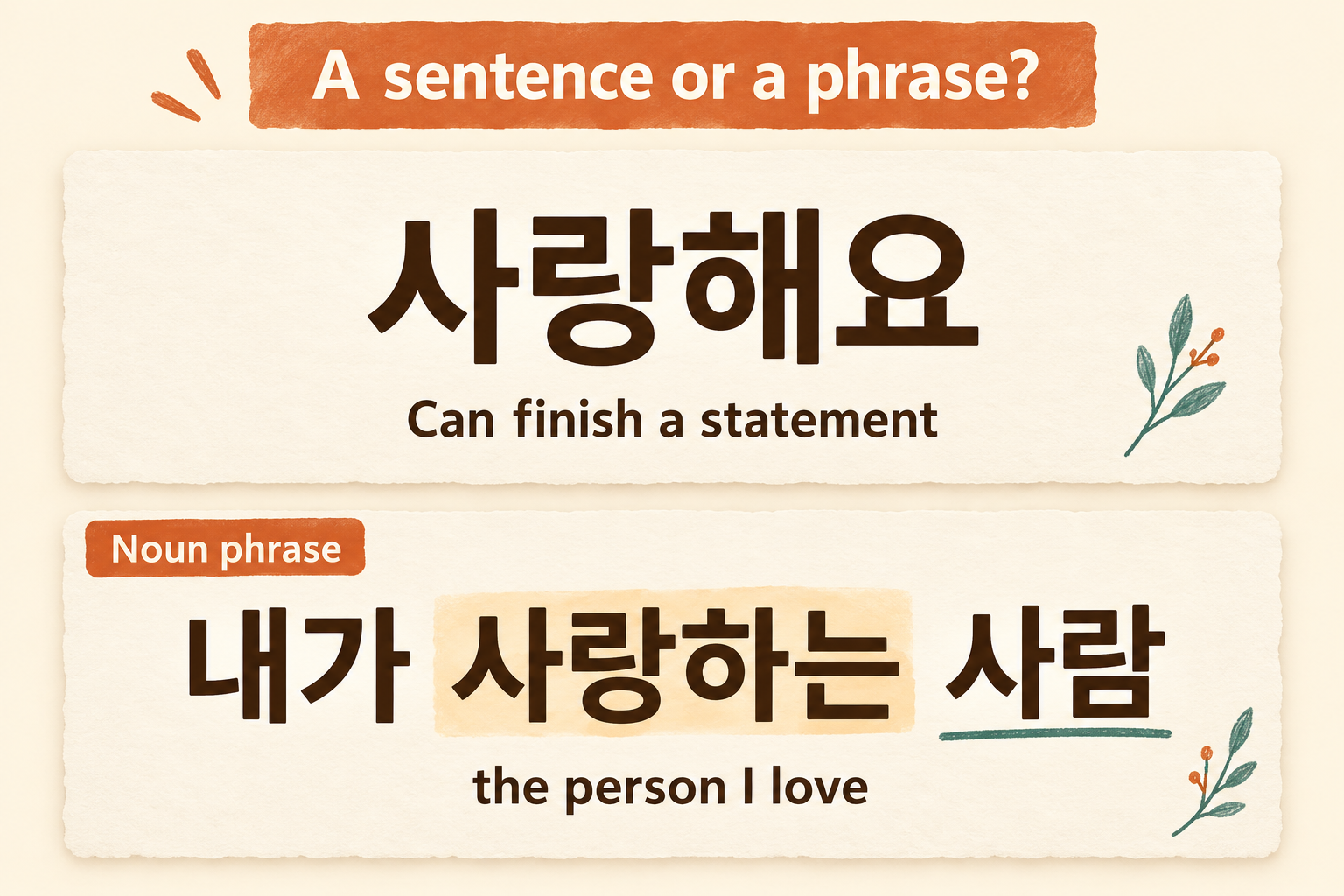
The most expensive one is direction in writing. Korean builds "the person I love" as 내가 사랑하는 사람, where 내가 marks you as the one doing the loving and the verb takes the modifier form 사랑하는. Flip the particle to 나를 사랑하는 사람 and the phrase becomes "the person who loves me." A caption with the wrong particle describes the other person's feelings instead of yours, which is a public mistake in a way spoken Korean is not. The same test applies to any name: 민수가 사랑하는 사람 is the person Minsu loves; 민수를 사랑하는 사람 is the person who loves Minsu. Check 가 or 를 before you post.
Second, pacing. English uses "love" for everything from playlists to lattes, and Korean does too — 음악을 사랑해요 ("I love music") is a normal sentence, and 사랑하다 is not forbidden with things. But between people, 사랑해 carries weight that 좋아해 ("I like you") does not. The polite, standard early step is 좋아해요; leaping to 사랑해 with someone you have just started seeing tends to read as either a confession or a red flag, depending on the listener.
Third, the level break. Telling someone 사랑해 when the relationship runs on 존댓말 does not sound more passionate; it sounds like you have unilaterally rewritten how the two of you speak. If you want warmth within polite speech, 사랑해요 keeps the ending where the relationship already lives.
Fourth, fandom. Shouting 사랑해요 at an idol is normal fan behavior and binds no one. Learners sometimes hear it in concert clips and conclude it is casual; the speech level (요) plus the crowd context is what makes it safe there, not the word.
Fifth, gender. 사랑해 between close female friends, or in a friend group chat signing off, is ordinary affection, not a hidden romance. Reading Korean same-sex friend speech through English romantic expectations causes more confusion than any grammar on this page.
How love gets typed instead of said
KakaoTalk has its own affectionate register. The suffix 행, a cutesy ending, turns short phrases tender: 사랑행 ("love ya"), 조아행 ("like ya"). 행쇼 (행복하쇼, "be happy") and 냉무 (a cutesy 안녕하세요) belong to the same playful family, dated but still recognized. Older still are the pager-era number codes: 486 reads 사랑해 by sound (사-팔-육), and 1004 is 천사, "angel." Nobody texts 486 sincerely today, but knowing it unlocks thirty years of Korean pop lyrics. The one rule the codes obey is the same as speech: the softer the ending, the smaller the circle it is safe in.
Saranghae at a glance
| 사랑해 | saranghae | Casual (반말) | Partners, close friends, family you speak casually with |
| 사랑해요 | saranghaeyo | Polite (해요체) | Parents, politely-spoken partners, everyday warmth |
| 사랑합니다 | saranghamnida | Formal (합쇼체) | Audiences, ceremonies, public statements |
| 사랑한다 | saranghanda | Plain declarative | Drama confessions, self-talk, writing |
| 내가 사랑하는 사람 | naega saranghaneun saram | Modifier form | "The person I love" (I do the loving) |
Frequently asked questions
What does saranghae (사랑해) mean? 사랑해 means "I love you" in casual Korean. It is the 반말 form of the verb 사랑하다, "to love," and the subject and object are dropped because context carries them. Use it with someone you already speak casually with; the polite form is 사랑해요 and the formal form is 사랑합니다.
What is the difference between 사랑해, 사랑해요, and 사랑합니다? Only the speech level differs, not the intensity of the feeling. 사랑해 is for casual relationships, 사랑해요 is the polite everyday form, and 사랑합니다 is for formal one-to-many settings such as speeches and ceremonies. Pick the level your relationship already speaks in.
How do you write "the person I love" in Korean? 내가 사랑하는 사람. The verb takes the modifier ending -는 (사랑하는) and 내가 marks you as the one loving. 내가 사랑하는 사람 is the person you love; 나를 사랑하는 사람 is the person who loves you. The particle decides the direction, so check it before posting.
'Real Korean Language & Everyday Korea' 카테고리의 다른 글
| Hanji: How Korean Paper Takes Shape (0) | 2026.10.31 |
|---|---|
| Friend in Korean: Say Close Friend or Best Friend Clearly (0) | 2026.10.30 |
| Months in Korean: All 12 Names, From Calendar Labels to Dates (0) | 2026.10.29 |
| Hungry in Korean, From Baegopa to a Polite Reply (0) | 2026.10.29 |
| Native Korean Numbers, Build the Count Before You Shorten It (0) | 2026.10.29 |
| Korean Texting Slang, Read the Letters Without Inventing the Missing Words (0) | 2026.10.29 |
| Korean Sentence Structure, Roles and Verb Groups in Korean Word Order (0) | 2026.10.29 |
| Korean Verb Conjugation, A Starter Table and Two Stem Mistakes (0) | 2026.10.29 |


