Sunbae Meaning in Korean, Senior to Whom?

Sunbae (선배, also written seonbae) means a senior in a shared school or field. For school relationships, it refers to someone who entered the same school earlier. It is not another word for an older person.
But which school? Being a senior at high school does not necessarily make someone a senior at university.
Keep the school attached to the relationship
The National Institute of Korean Language's entry for 선배 includes both an earlier participant in the same field and an earlier entrant to the same school. One example has a high-school senior entering university alongside the speaker.
Suppose two students enter school in these years:
- 2021: Jisoo enters a particular high school.
- 2022: Min enters that high school.
- 2026: Both enter the same university.
Jisoo is Min's high-school 선배. At their university, those dates place them in the same entry-year cohort. Starting university together does not erase the earlier high-school relationship.
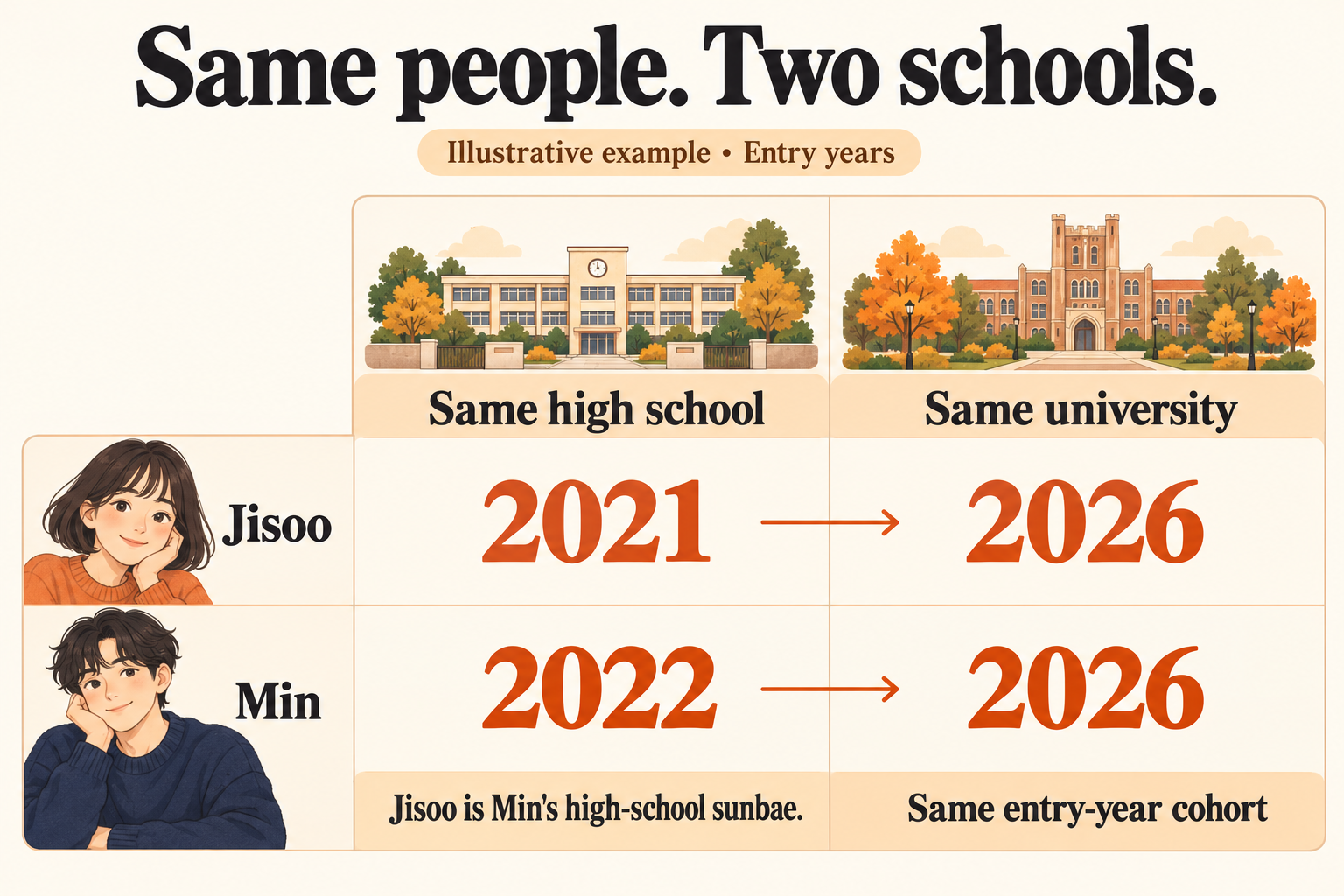
In a conversation, 고등학교 선배 (godeunghakgyo seonbae, high-school senior) keeps that reference visible. Do not change it to “university senior” just because the conversation happens on a university campus.
학번 can be a cohort, not just a student ID
The word 학번 (hakbeon) has two dictionary meanings. The official 학번 entry distinguishes an individual student number from a number identifying the year a group entered university.
학번이 같아요 — hakbeoni gatayo — can mean “We're in the same entry-year cohort.” In a discussion of who is a 선배, that does not mean two people have the same personal student ID. The dictionary gives an exchange in which someone assumes a person must be a senior because he is a year older; the reply explains that their 학번 is the same.
Conversely, an instruction to write 학번 on an assignment asks for a student identifier, not a claim about seniority. Check the task before translating the word: a relationship discussion and a form field can be using different senses.
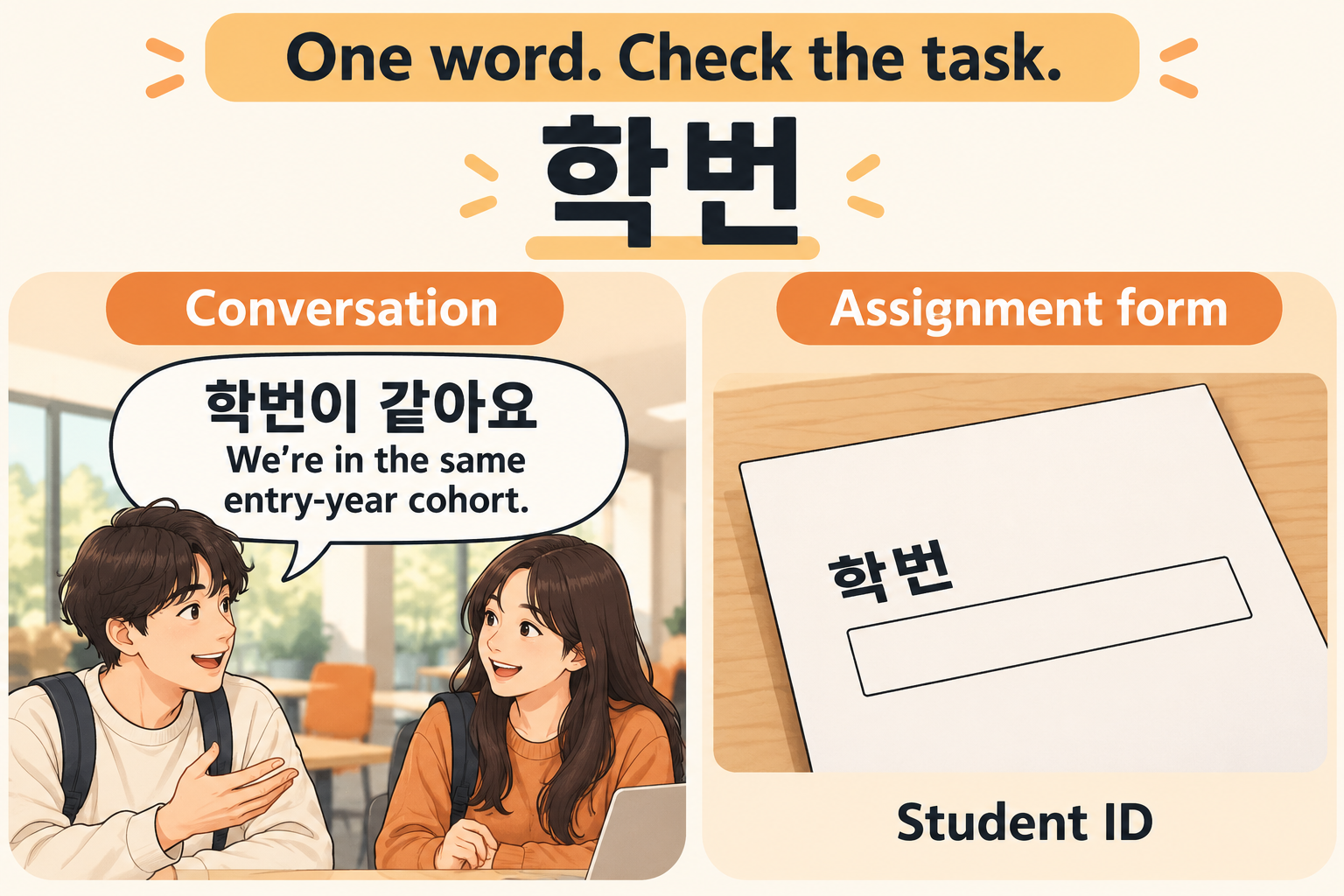
A larger full student-ID number is not, by itself, proof that someone entered later. The number may encode more than the year. Compare confirmed entry years at the same institution rather than treating the whole identifier as a seniority score.
The relationship does not choose every form of address
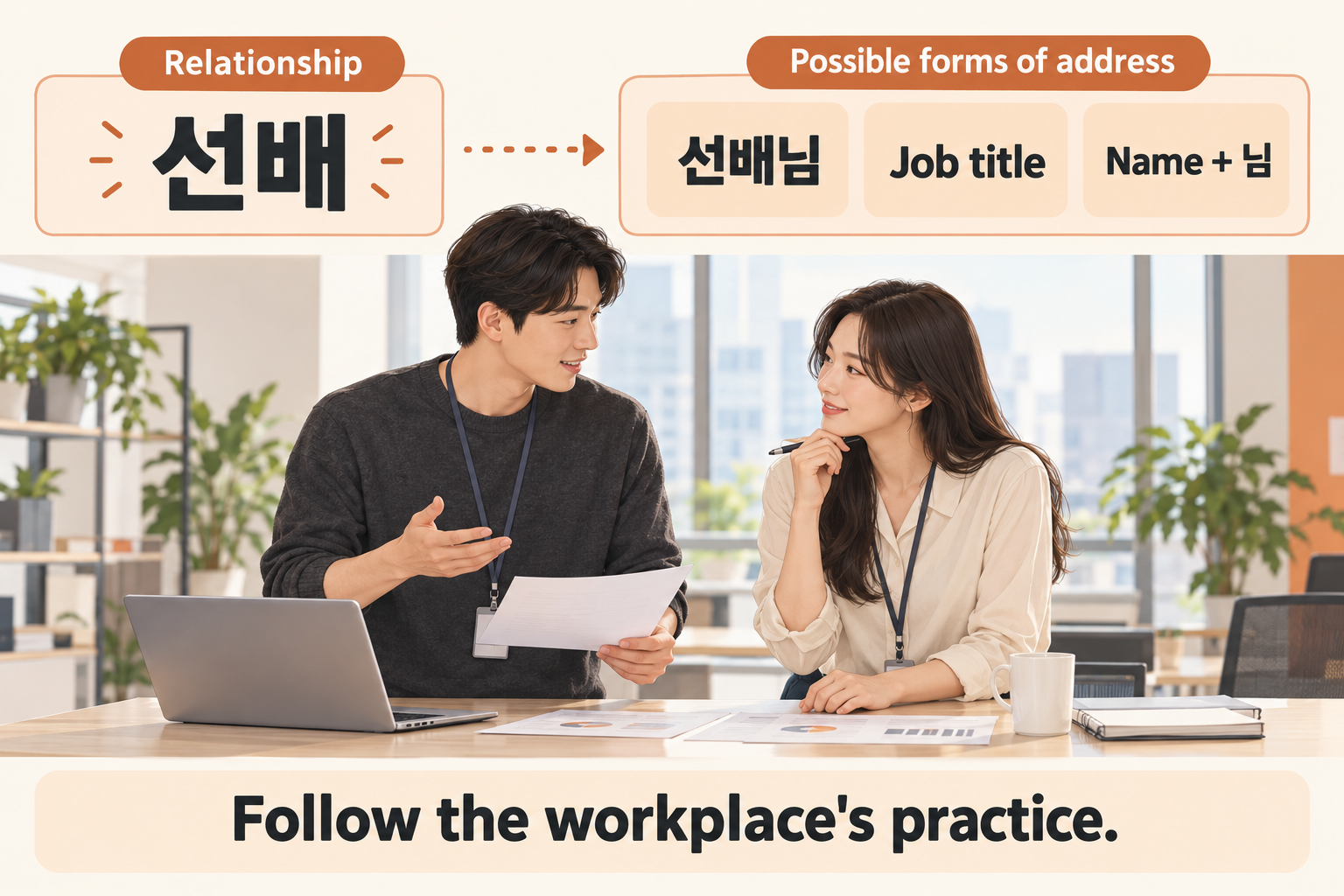
선배님 (seonbaenim) adds the respectful 님 to 선배. But identifying someone as a senior and deciding how to address that person are separate questions.
In a May 2026 answer about workplace address, the National Institute of Korean Language declined to prescribe one universally correct form. It described job-title-based address and workplaces that use names with 님, advising people to follow the workplace's own practice.
So a colleague can be a 선배 in the relevant field while the workplace uses a job title or name with 님.
'Real Korean Language & Everyday Korea' 카테고리의 다른 글
| Arasso Meaning, Choosing Between Got It and I Understand (0) | 2026.10.28 |
|---|---|
| Boyfriend in Korean, Namjachingu Meaning and the Short Form Namchin (0) | 2026.10.28 |
| Sino Korean Numbers in Writing From 1 to 1000 (0) | 2026.10.28 |
| Aigoo Meaning, What 아이고 Adds to a Korean Sentence (0) | 2026.10.28 |
| Korean Keyboard, Find the Keys and Build Your First Words (0) | 2026.10.28 |
| How to Say Delicious in Korean Beyond 맛있어요 (0) | 2026.10.28 |
| Beautiful in Korean: 예쁘다, 아름답다, and What Each One Can Describe (0) | 2026.09.30 |
| Happy Birthday in Korean: Why 생일 Changes to 생신 (0) | 2026.09.26 |


