Aigoo Meaning, What 아이고 Adds to a Korean Sentence

반가워요 means “I’m glad to see you.” Put 아이고 in front of it, and the greeting has an audible reaction before the words of welcome.
아이고, 반가워요!
Aigo, bangawoyo!
“Oh, I’m so glad to see you!”
What does aigoo mean?
아이고 is a Korean exclamation that can express pain, effort, surprise, joy, frustration, or grief. English might use “oh dear,” “ouch,” “oh my,” or “aw,” depending on the moment. Aigo and aigoo are Roman-letter spellings used for 아이고.
It can be a reaction on its own. It can also sit beside a sentence without becoming the word that tells you what happened.
The statement and the reaction do different jobs
Consider these short examples:
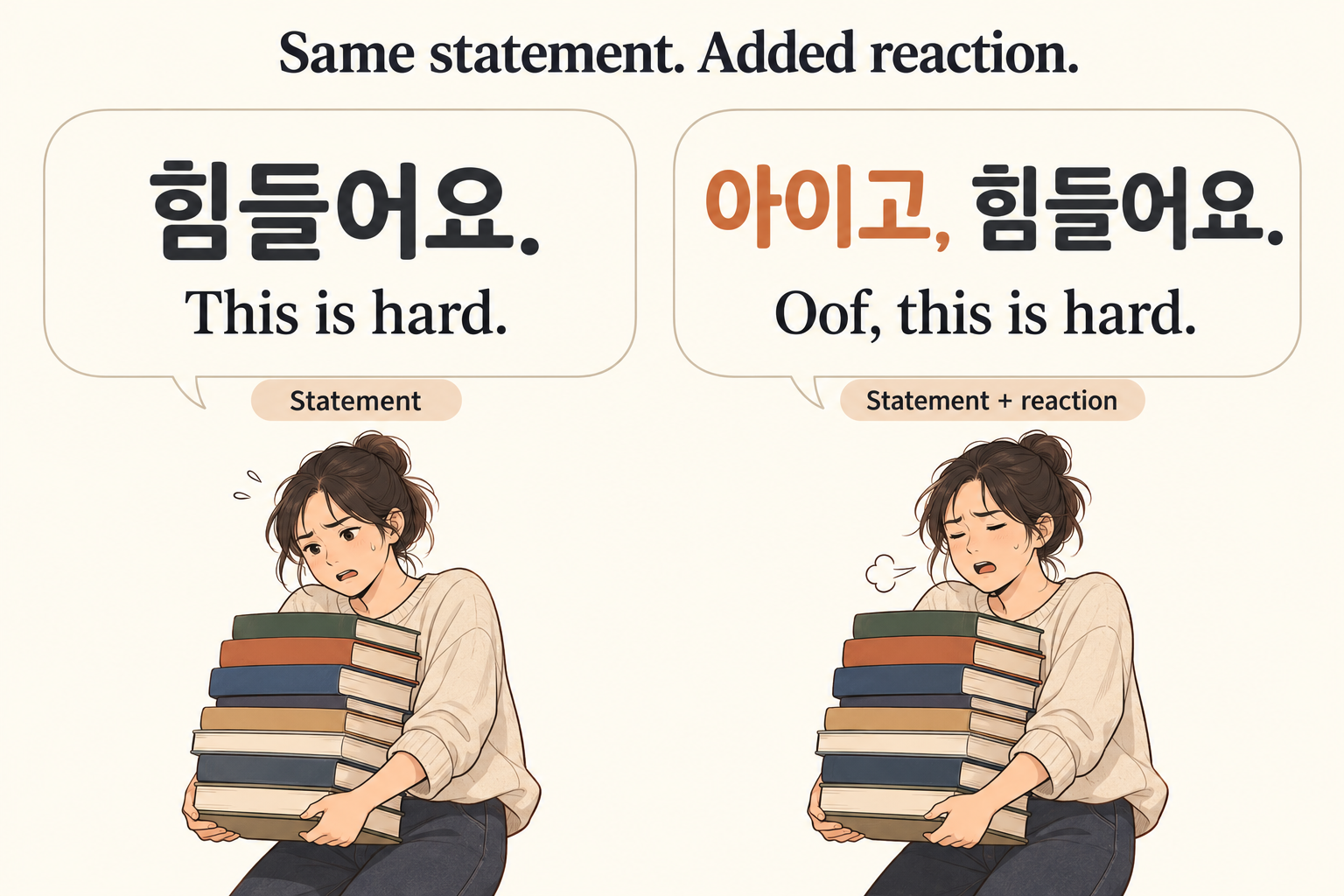
힘들어요.
Himdeureoyo.
“This is hard.”아이고, 힘들어요.
Aigo, himdeureoyo.
“Oof, this is hard.”
힘들어요 already expresses difficulty. 아이고 adds the speaker’s reaction to it.
The same separation works in the greeting above. 반가워요 supplies the gladness at seeing someone. The exclamation lets that feeling burst out before the greeting. It has not turned the welcome into a complaint.
This is why replacing every 아이고 with “ugh” can distort a translation. “Ugh, I’m glad to see you” may suggest reluctance or annoyance that the Korean greeting does not establish. In a warmly delivered welcome, “Oh!” preserves the reaction without importing that negative attitude.

A painful sound is not its only meaning
The official Korean-English dictionary entry includes delighted greetings as well as discomfort. It also includes a frustrated sigh and a cry of grief. The range reaches well beyond mild comic exasperation.
A person reacting to a painful back might be rendered with “Ow.” A joyful welcome may call for “Oh!” A cry after a death needs the surrounding grief to remain visible in the translation. One English label cannot carry all three scenes.
Delivery helps express the feeling, but a stretched spelling such as 아이고~ does not give a complete emotional reading. Duration is only part of a voice. The words on a page do not preserve its pitch, expression, or the scene around it.
When a sentence quotes the sound
If a narrator reports someone crying, the sentence may read:
민수는 “아이고” 하며 울었어요.
Minsuneun “aigo” hamyeo ureosseoyo.
“Minsu cried, saying ‘aigo.’”
There are two things to keep separate. 아이고 is the sound Minsu uttered. 울었어요 tells us that he cried. The narrator reports the exclamation rather than using it as a word meaning “sadly.”
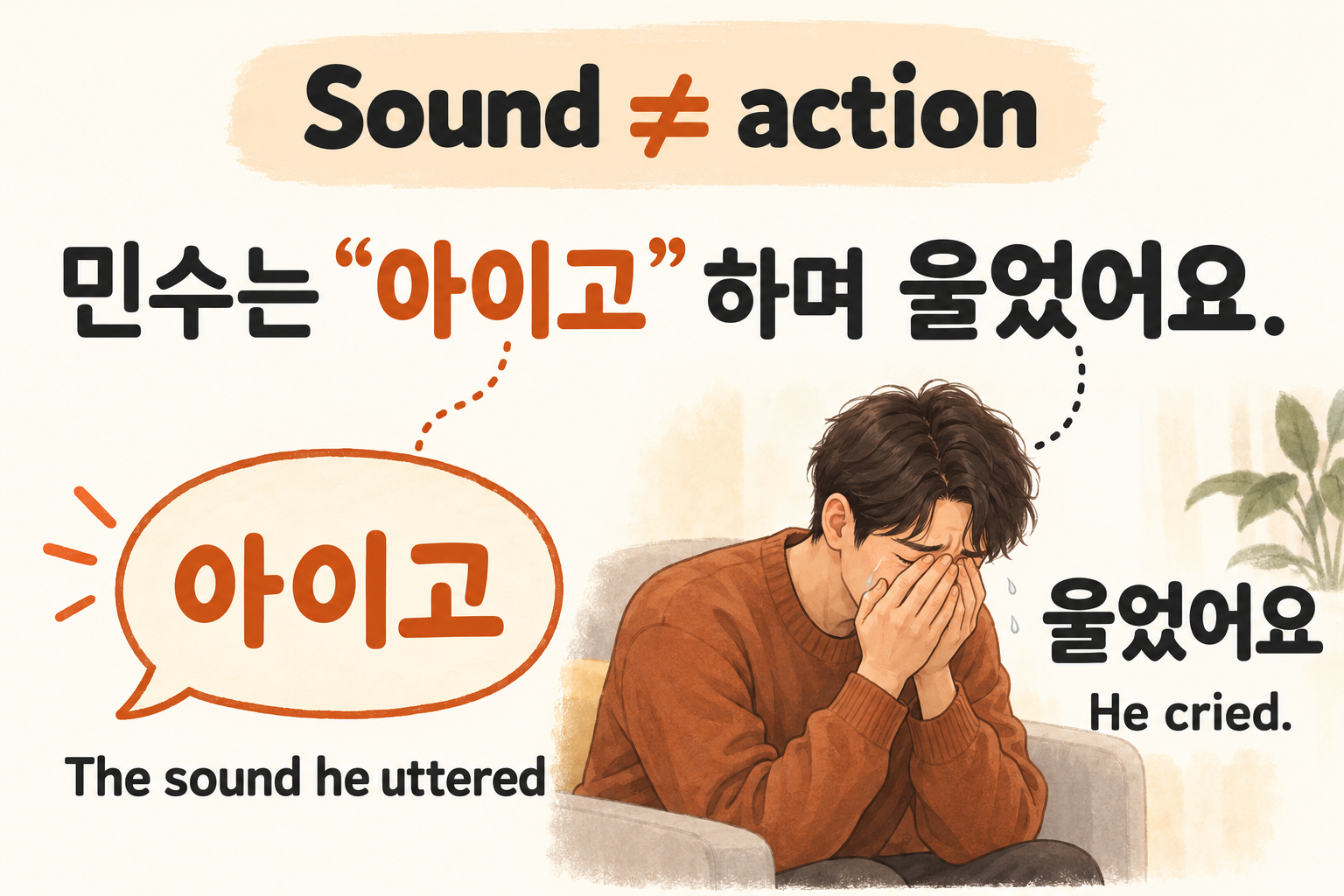
If the quotation marks disappear, that division still matters. In 민수는 아이고 하며 울었어요, 아이고 has not become a new form of the verb “to cry.”
A subtitle might translate the cry as “Oh no,” while a language explanation might keep aigo to show the Korean sound. Those choices serve different purposes. Neither makes “cry,” “sadly,” or “oh no” the one fixed meaning of the exclamation.
'Real Korean Language & Everyday Korea' 카테고리의 다른 글
| Family in Korean, Who Is Related to Whom? (0) | 2026.10.28 |
|---|---|
| Arasso Meaning, Choosing Between Got It and I Understand (0) | 2026.10.28 |
| Boyfriend in Korean, Namjachingu Meaning and the Short Form Namchin (0) | 2026.10.28 |
| Sino Korean Numbers in Writing From 1 to 1000 (0) | 2026.10.28 |
| Sunbae Meaning in Korean, Senior to Whom? (0) | 2026.10.28 |
| Korean Keyboard, Find the Keys and Build Your First Words (0) | 2026.10.28 |
| How to Say Delicious in Korean Beyond 맛있어요 (0) | 2026.10.28 |
| Beautiful in Korean: 예쁘다, 아름답다, and What Each One Can Describe (0) | 2026.09.30 |


