Family in Korean, Who Is Related to Whom?
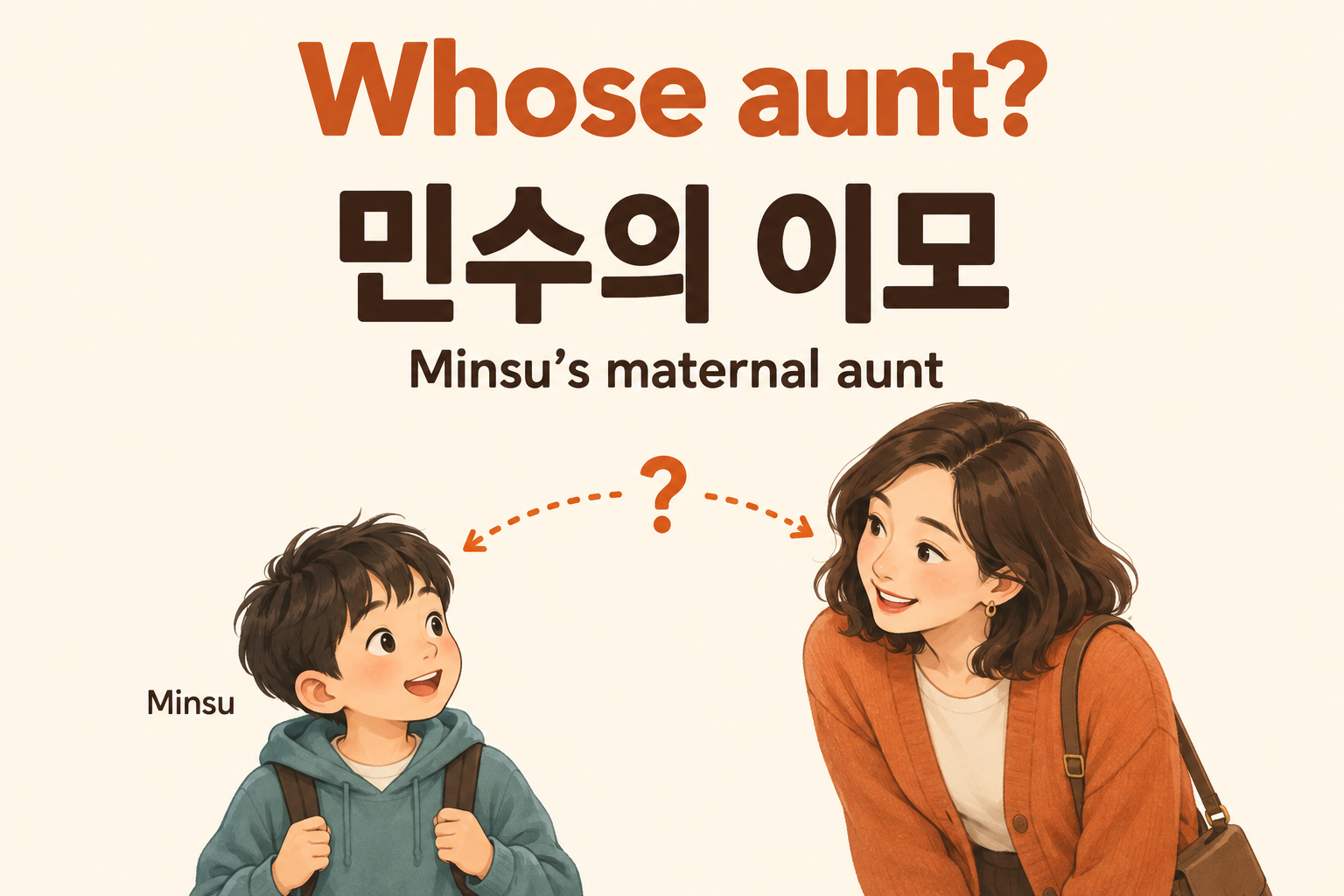
가족 (gajok) means family. Individual relationships have their own terms, but a family word is not a permanent label attached to one person. 민수의 이모 means Minsu’s maternal aunt, not necessarily the speaker’s aunt.
There are two tasks when using these words: identifying the relationship in a description and deciding how to address the person.
Family members in Korean, a starting reference
| Word | Reading cue | Relationship |
|---|---|---|
| 아버지 | abeoji | Father |
| 어머니 | eomeoni | Mother |
| 아들 | adeul | Son |
| 딸 | ttal | Daughter |
| 이모 | imo | Mother’s sister |
| 고모 | gomo | Father’s sister |
| 조카 | joka | Nephew or niece |
The two aunt words identify a different route through the family. Neither 이모 nor 고모 says that the aunt is older than the parent. A mother’s younger sister is still 이모; a father’s older sister is still 고모.
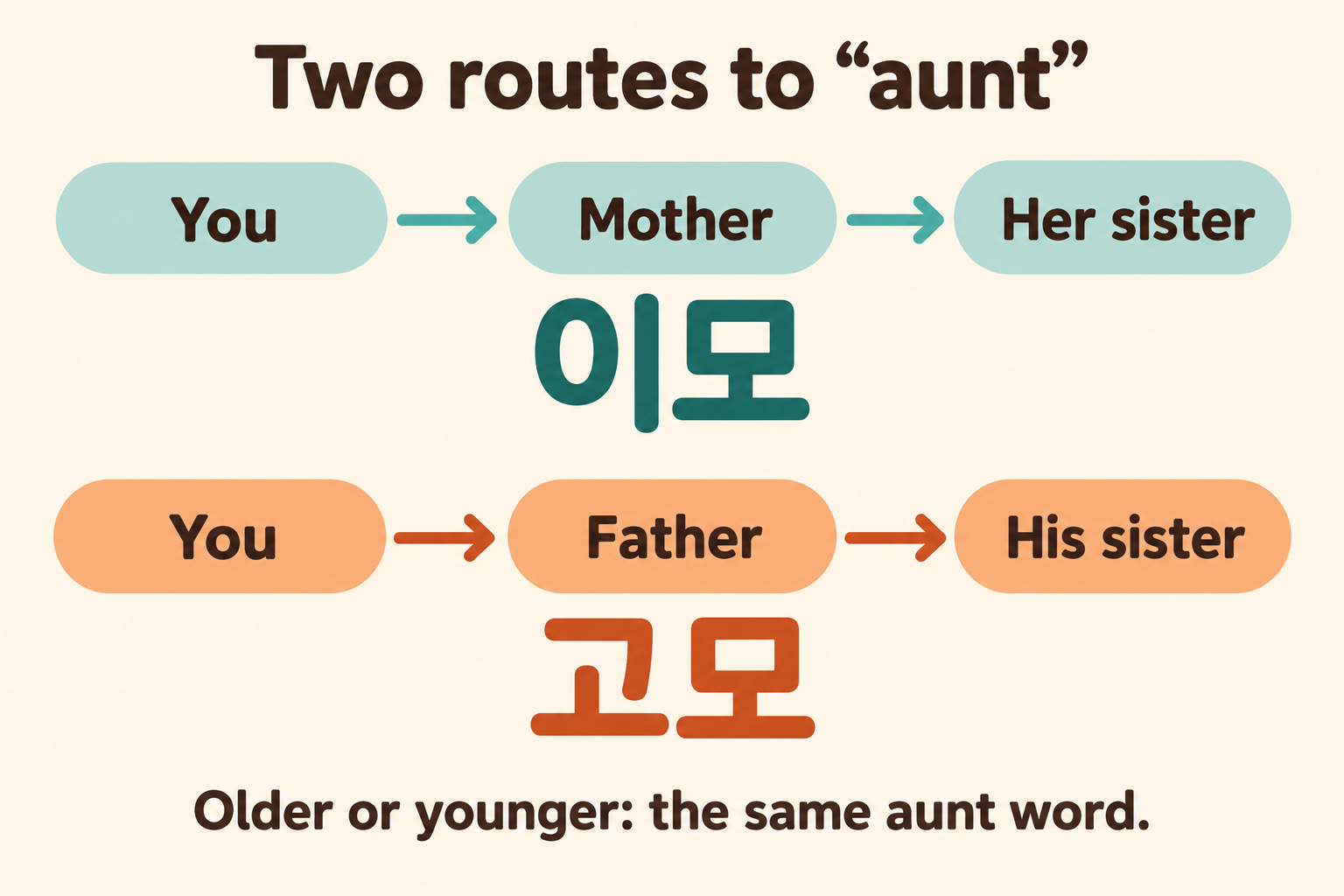
Some family words can describe a relationship or address the person directly. The Korean Basic Dictionary describes 이모 as a word for referring to or addressing a mother’s sister.
Start with the person named before the relationship
Suppose a photo caption reads:
민수의 이모
Minsu’s maternal aunt
Start with Minsu. Move to his mother, then to her sister. The caption does not tell you how the person writing it is related to that woman.
Now compare two descriptions containing the same aunt word:
- 민수의 고모 — Minsu’s father’s sister.
- 민수 어머니의 고모 — Minsu’s mother’s father’s sister.
In the second phrase, the person whose 고모 is being described is 민수 어머니, Minsu’s mother. Starting from Minsu and immediately choosing his father’s sister would skip the word 어머니. The extra relationship changes which generation you reach.
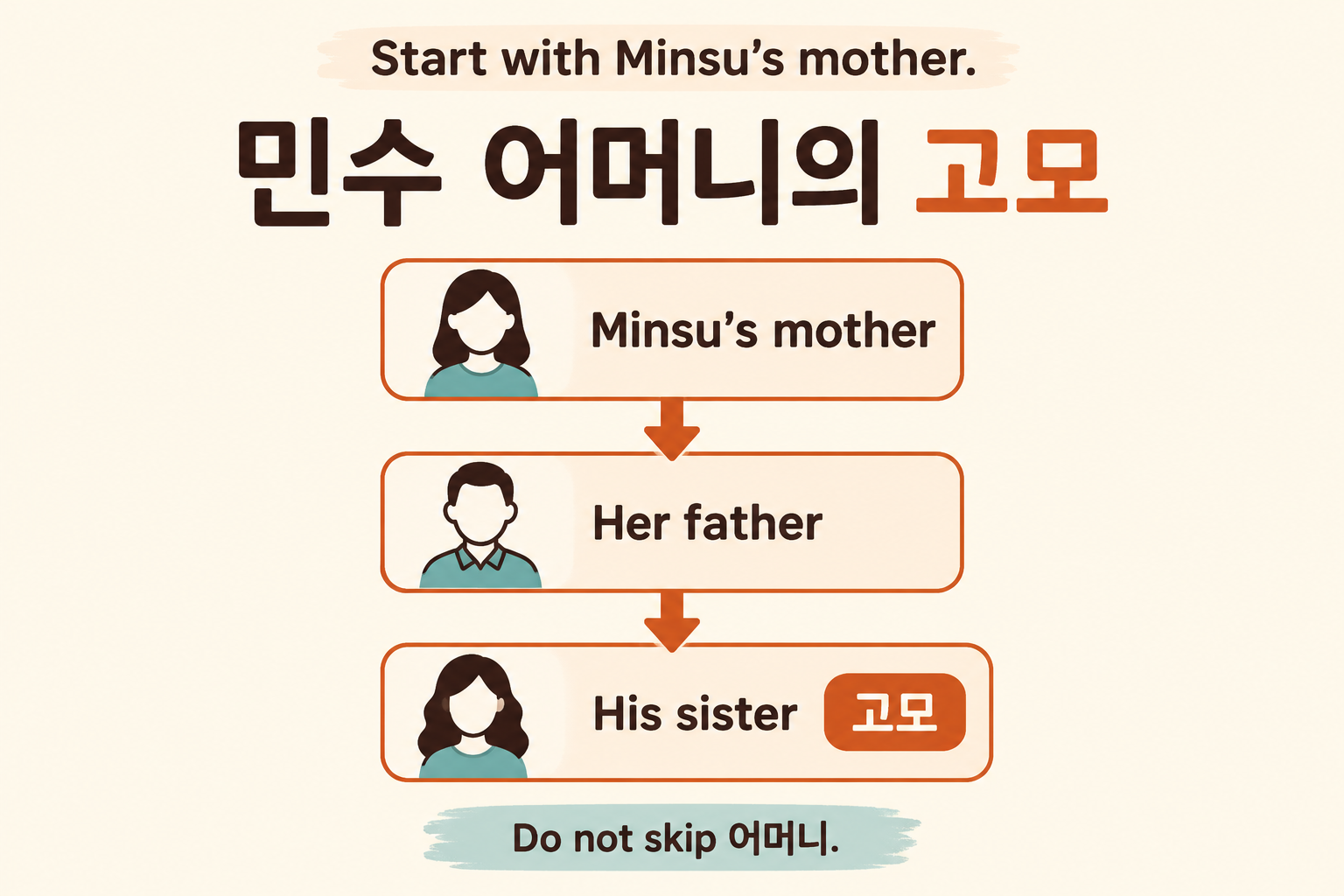
The phrase describes the relationship, but it does not tell you what Minsu normally calls her.
Korean family terms in a description and a direct call
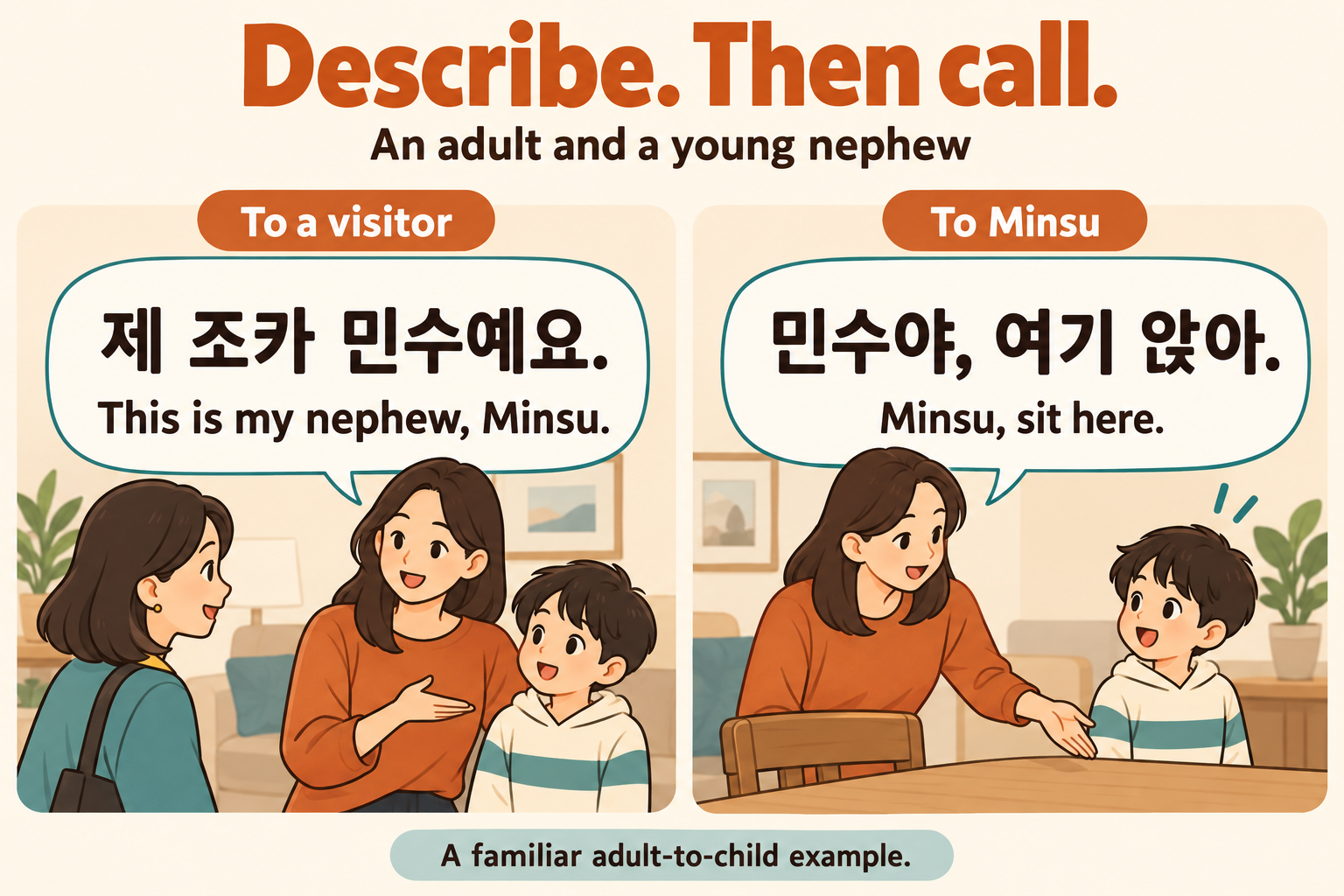
Imagine an adult introducing a young nephew named Minsu to a visitor.
제 조카 민수예요.
This is my nephew, Minsu.
The adult is explaining the relationship to the visitor. Here, 조카 identifies Minsu as a nephew. If the relative were a niece, the same relationship word could still apply.
The adult then turns to the child:
민수야, 여기 앉아.
Minsu, sit here.
The adult now calls Minsu directly by name. The particle 야 follows the vowel-ending name 민수 in this familiar adult-to-child exchange; it is not a form to attach automatically to an unfamiliar adult’s name.
In its 2019 guide to forms of address, the National Institute of Korean Language says nieces and nephews are generally addressed by name. It also allows 조카 or 조카님 when the person is married or is being given particular consideration.
The official 2019 guide, 우리, 뭐라고 부를까요? is in Korean. The section on nieces and nephews spans printed pages 33–34.
Read this caption before choosing a greeting
A new caption says 소라 어머니의 이모. Whose mother’s sister does 이모 identify here? Does the caption alone establish what Sora should say when greeting her?
Check the relationship
Start with Sora’s mother. Her 이모 is her mother’s sister: Sora’s maternal grandmother’s sister. The caption does not specify the family’s chosen greeting. Replacing it with “Sora’s mother’s sister” would remove one generation from the description.
'Real Korean Language & Everyday Korea' 카테고리의 다른 글
| Batchim Rules, Keep Spelling and Final Sounds Apart (0) | 2026.10.29 |
|---|---|
| Hangul Alphabet, Read the Letters Inside a Syllable (0) | 2026.10.29 |
| Korean Counters, What the Counting Word Actually Counts (0) | 2026.10.28 |
| Korean Surnames, Common Names and What Their Labels Mean (0) | 2026.10.28 |
| Arasso Meaning, Choosing Between Got It and I Understand (0) | 2026.10.28 |
| Boyfriend in Korean, Namjachingu Meaning and the Short Form Namchin (0) | 2026.10.28 |
| Sino Korean Numbers in Writing From 1 to 1000 (0) | 2026.10.28 |
| Aigoo Meaning, What 아이고 Adds to a Korean Sentence (0) | 2026.10.28 |


