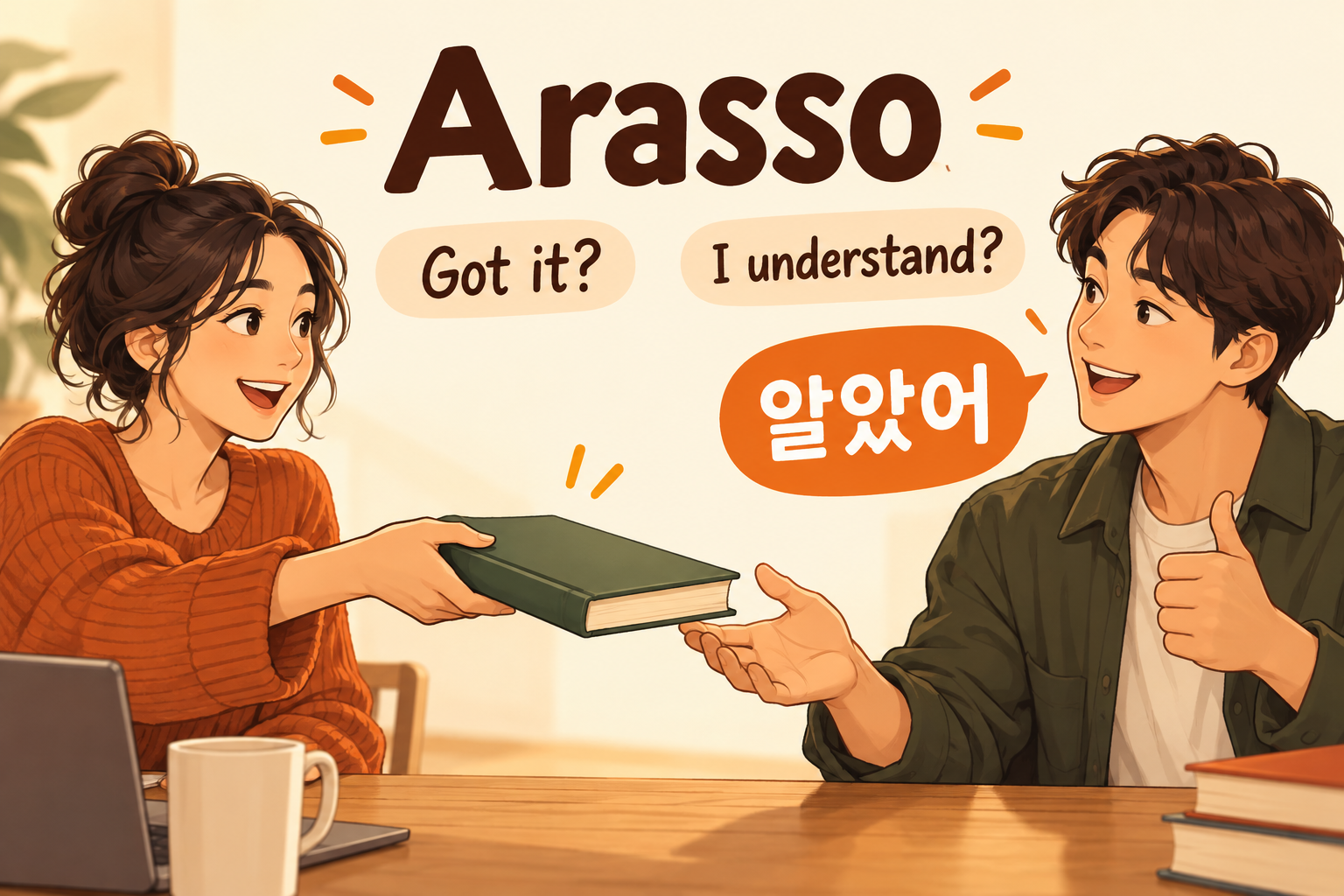
Arasso Meaning: Choosing Between "Got It" and "I Understand"
Your Korean coworker hands you a project file and asks you to review it before 5:00 PM.
You want to say "Got it!" or "Understood."
In English, either phrase works fine. But in Korean, choosing between 알았어 (arasso), 알겠어 (algesseo), and 알겠습니다 (algesseumnida) can mean the difference between sounding like a polished professional or sounding like an annoyed teenager snapping back at their parents.
Why do Korean dictionaries list both words under the same verb—알다 (alda, "to know")—and how can two small syllables change the entire temperature of a conversation?
Here is the complete guide to understanding arasso, when to use it, the critical difference between acknowledging information and accepting a task, and how to avoid the most common social mistakes learners make.
1. The Core Meaning of "알았어" (Arasso)
At its root, 알았어 comes from the verb 알다 (alda), which means "to know" or "to understand." The past-tense infix -았- is attached, creating the literal meaning "I have come to know it" or "I grasped it."
In everyday spoken Korean, it functions as:
- "Got it."
- "Okay / Alright."
- "Understood."
Because it ends without the polite particle -요 (-yo), 알았어 is strictly informal speech (반말). You should only use it with:
- Close friends of the same age
- People younger than you
- Siblings and close family members
If you say "알았어" to a boss, an older colleague, a server at a restaurant, or someone you met recently, it sounds jarringly disrespectful.
Adding Politeness: 알았어요 (arassoyo)
By simply attaching -요, you get 알았어요, the polite form.
- "네, 알았어요." (Yes, I got it / Alright.) It is friendly and polite, suitable for casual conversations with older acquaintances or friendly colleagues outside of strict formal settings.
2. 알았어 vs 알겠어: What’s the Real Difference?
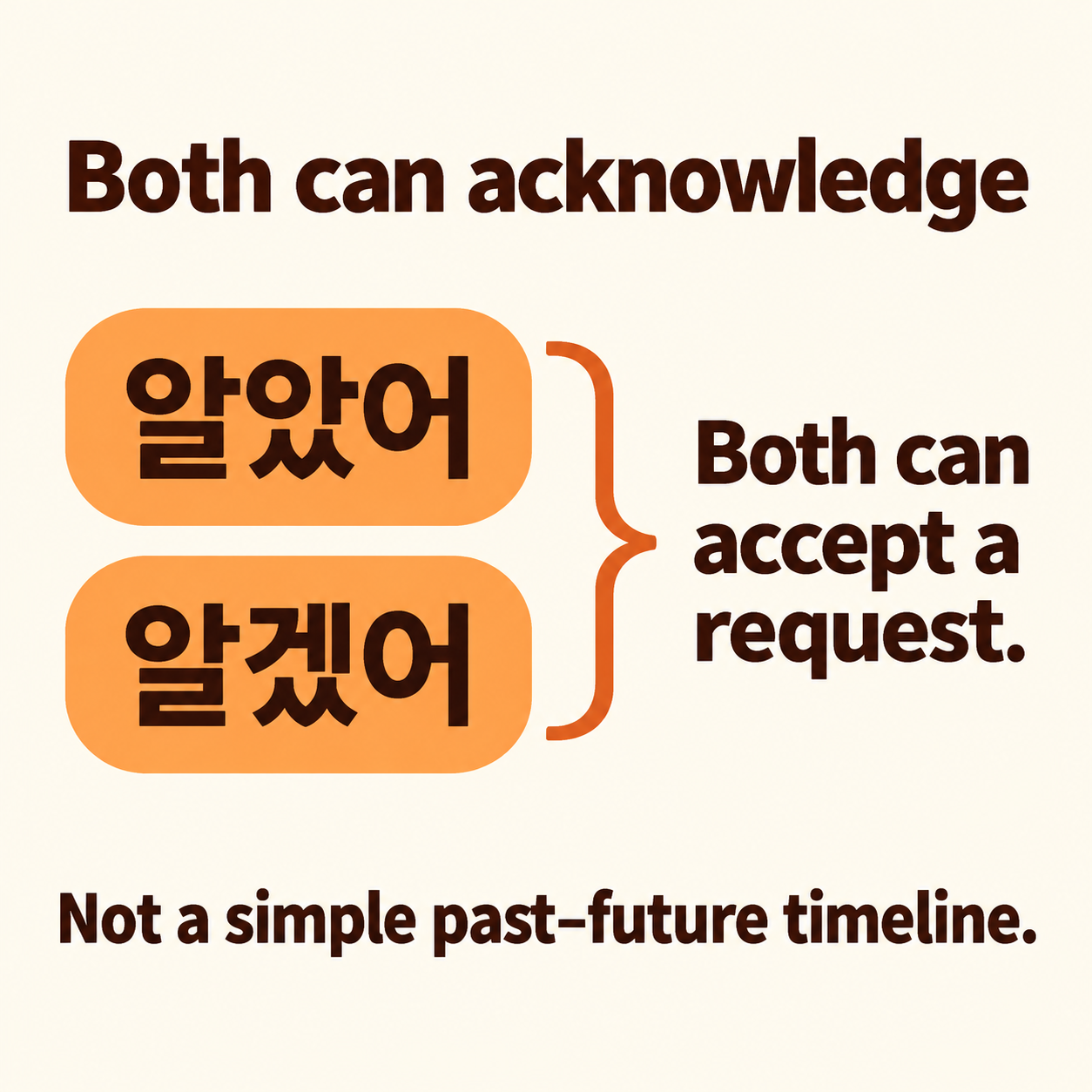
Many learners assume the difference between 알았어 (past tense) and 알겠어 (future/presumptive -겠-) is about time—as if one means "I already understood" and the other means "I will understand."
In reality, in Korean acknowledgment replies, both refer to the present moment. The difference is certainty, tone, and willingness to comply.
The National Institute of Korean Language explains the distinction clearly:
알았어 (Arasso) — Decisive & Direct
- Focuses on the completion of understanding.
- Tone: Direct, firm, and matter-of-fact.
- "I have received the information, and I know what to do."
- Nuance Risk: If said quickly or with a flat intonation, it can sound impatient or dismissive—similar to saying "Yeah, yeah, got it."
알겠어 (Algesseo) — Softer & Accommodating
- The infix -겠- softens the statement, indicating willingness or receptivity.
- Tone: Gentle, compliant, and cooperative.
- "I see your point / I will gladly do so."
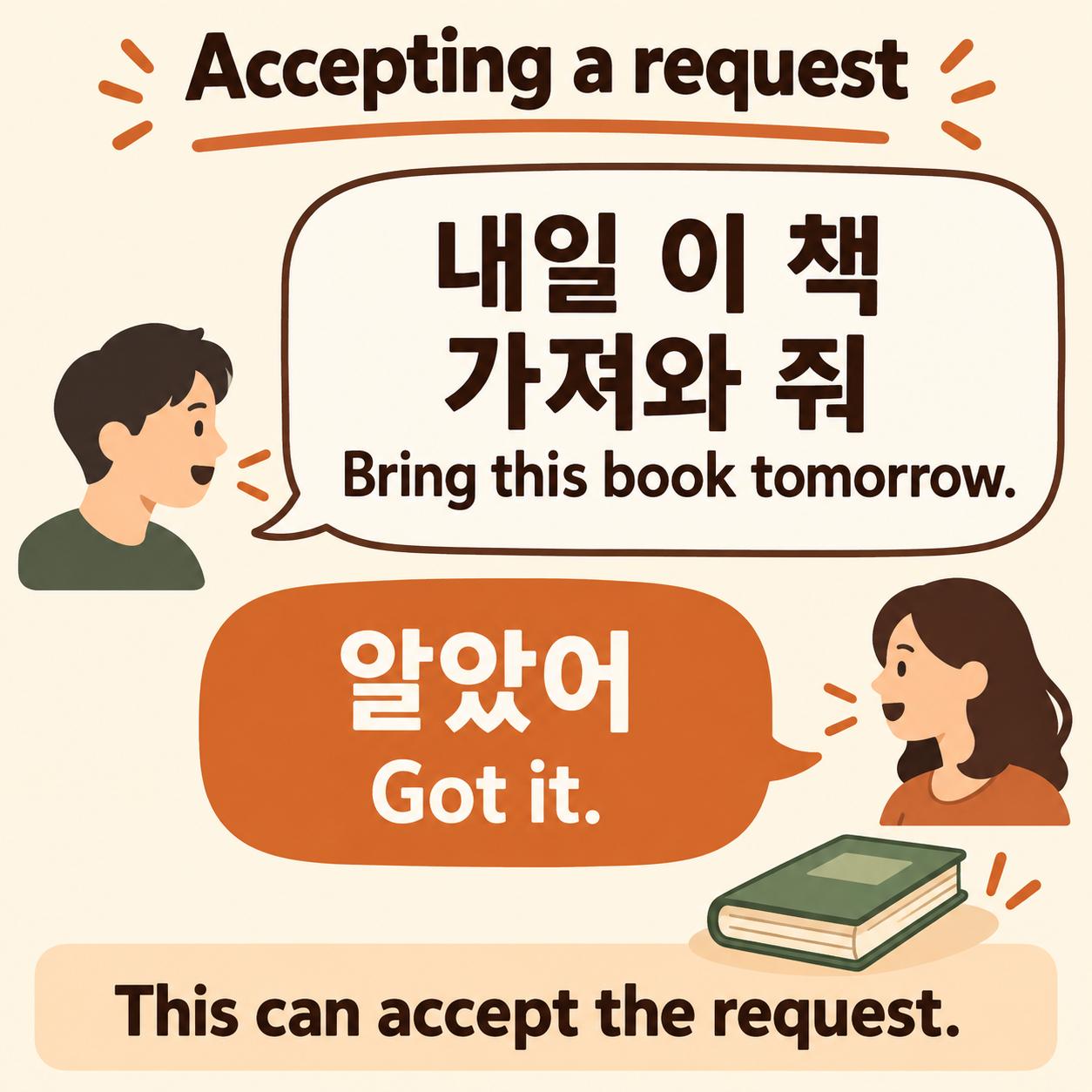
- If a friend says, "Can you bring my notes tomorrow?", replying "응, 알겠어" sounds warmer and more cooperative than a blunt "알았어".
3. Workplace & Formal Korean: 알겠습니다 (Algesseumnida)
In any professional setting—offices, part-time jobs, meetings, or customer service—neither 알았어 nor 알았어요 is the standard.
The gold standard for Korean business etiquette is 알겠습니다 (algesseumnida).
Manager: 김 대리님, 이 보고서 오늘 4시까지 수정해서 보내주세요.
(Deputy Kim, please revise this report and send it by 4:00 PM.)
Employee: 네, 알겠습니다. 바로 진행하겠습니다.
(Yes, understood. I will proceed right away.)
Why 알겠습니다 is the Only Choice at Work
- Confirms Responsibility: It signals not just that your ears heard the words, but that you take full responsibility for carrying out the instruction.
- Shows Professional Hierarchy: Using the formal ending (-습니다) honors the workplace relationship and eliminates any perception of casualness.
4. "I Got It" vs "I Comprehend the Concept": 알았어요 vs 이해했어요
Another major confusion for English speakers is distinguishing between agreeing to do something versus actually understanding a complex idea.
Korean uses two distinct verbs for this:
| Accepting a request / task | 알았어요 / 알겠습니다 | "Got it / Will do." |
| Comprehending a difficult concept | 이해했어요 (ihaehaesseoyo) | "Now I understand / That makes sense." |
Example: In a Classroom or Tutorial
If a teacher explains a tricky grammar rule or a math formula:
- Saying "네, 이제 이해했어요" means: "Yes, I understand the concept now; it makes sense to me." (From 이해하다, to comprehend).
- Saying "네, 알겠어요" means: "Yes, I follow what you're saying."
- Saying "네, 알았어요" can sound slightly like you are just acknowledging their instruction rather than grasping the logic.
5. Real-Life Dialogues: See Them in Action
Situation 1: KakaoTalk Texting with a Close Friend
Minji: 오늘 약속 6시 말고 6시 반으로 미뤄도 돼?
(Can we push our meeting today from 6:00 to 6:30?)
Sujin: 응 알겠어! 천천히 와 ㅋㅋㅋ
(Yeah, got it! Take your time haha)
Situation 2: Workplace Task Acknowledgment
Senior: 현수 씨, 내일 회의 자료 5부 출력해 둬요.
(Hyeonsu, please print 5 copies of tomorrow's meeting materials.)
Hyeonsu: 네, 퇴근 전에 미리 준비해 두겠습니다. 알겠습니다!
(Yes, I will prepare them before leaving. Understood!)
Situation 3: Concept Explanation Between Peers
Colleague A: 이 프로그램 오류는 캐시 데이터를 비우면 해결돼요.
(This software bug gets resolved if you clear the cache data.)
Colleague B: 아, 그렇군요! 이제 확실히 이해했어요. 감사합니다.
(Ah, I see! Now I clearly understand. Thank you.)
6. Tone Warnings & Texting Slang
⚠️ The Dangerous "알았다고!" (Arassdago!)
When someone repeats an instruction or nags you, adding -다고 turns it into an irritated complaint:
- "알았다고!" = "I said I got it! Stop repeating yourself!" Never use this unless you are deliberately expressing frustration with a close sibling or friend.
📱 Texting Abbreviations on Mobile
In mobile messages, Koreans often shorten acknowledgments to save time:
- ㅇㅋ: The Korean letters for "OK" (오케이).
- 알겠음 / 알겠슴다: Informal noun-ending or military-style shorthand widely used in team chats and Slack.
- ㅇㅇ 알써: Super-fast slang for "Yeah, got it" (응 알았어).
7. Summary Comparison Table
| 알았어 | Casual (반말) | I grasped it | Close friends, younger people | Direct, decisive "Got it" |
| 알겠어 | Casual (반말) | I understand/agree | Close friends | Softer, cooperative "Okay, will do" |
| 알았어요 | Polite (존댓말) | I understood | Older acquaintances, peers | Friendly polite acknowledgment |
| 알겠습니다 | Formal (존댓말) | I will carry it out | Boss, clients, elders, public | Professional "Understood / Confirmed" |
| 이해했어요 | Polite (존댓말) | I comprehended | Teachers, speakers, explainers | Focus on grasping meaning/logic |
8. Frequently Asked Questions (FAQ)
Q1. What does "알았지?" mean when someone asks me?
"알았지?" (arassji?) means "Got it, right?" or "You understand, don't you?". It is used by parents, teachers, or close seniors to confirm that you have accepted their instruction or promise. The polite version is "알았죠?" or "아셨죠?".
Q2. Can I say "알겠어요" to my boss at work?
While 알겠어요 is polite, in traditional Korean company culture, answering a direct supervisor with 알겠어요 can sound slightly casual or conversational. Stick with "네, 알겠습니다" for maximum professional courtesy.
Q3. Is "알겠습니다" used when answering a question about facts?
No! If someone asks you a question of fact—like "Do you know where the station is?" (역이 어디인지 아세요?)—you do not say 알겠습니다. You say "네, 알아요" (Yes, I know) or "아니요, 몰라요" (No, I don't know). 알겠습니다 is used specifically to acknowledge orders, explanations, or requests.
'Real Korean Language & Everyday Korea' 카테고리의 다른 글
| Hangul Alphabet, Read the Letters Inside a Syllable (0) | 2026.10.29 |
|---|---|
| Korean Counters, What the Counting Word Actually Counts (0) | 2026.10.28 |
| Korean Surnames, Common Names and What Their Labels Mean (0) | 2026.10.28 |
| Family in Korean, Who Is Related to Whom? (0) | 2026.10.28 |
| Boyfriend in Korean, Namjachingu Meaning and the Short Form Namchin (0) | 2026.10.28 |
| Sino Korean Numbers in Writing From 1 to 1000 (0) | 2026.10.28 |
| Aigoo Meaning, What 아이고 Adds to a Korean Sentence (0) | 2026.10.28 |
| Sunbae Meaning in Korean, Senior to Whom? (0) | 2026.10.28 |


