Boyfriend in Korean, Namjachingu Meaning and the Short Form Namchin
- 친구를 사귀고 싶어요.
- I want to make friends.
- 남자 친구를 사귀고 싶어요.
- I want to find a boyfriend.
A language-exchange café in Sinchon, table for six, the usual rotation of Korean and English. Halfway through the hour the woman across from you asks, politely, without warning: 남자 친구 있어요? — "Do you have a boyfriend?" The question is a landmine for exactly one reason: you learned that 남자 친구 (namja chingu) means boyfriend, so the grammar is fine. The panic is cultural. Is this flirting? Is this a census? Neither. In Korea the question is small talk the way "what do you do" is small talk elsewhere, and the only hard part is the word itself — which turns out to have more structure, and more traps, than any four-syllable relationship label you have met.
남자 친구 is two words doing one job
The expression is built from 남자 (namja), "man," and 친구 (chingu), "friend." The female counterpart is 여자 친구 (yeoja chingu), girlfriend, built the same way. Because Korean uses 친구 loosely for any trusted companion, the sex of the friend has to be supplied somewhere, and when the relationship is romantic, the nouns 남자 and 여자 do the supplying.
The standard spelling, according to a May 2025 answer by the National Institute of Korean Language, is 남자 친구 with a space — and that answer is explicitly about a male partner in a romantic relationship. Published writing also appears with the unspaced 남자친구, and the spacing does not turn a boyfriend into a platonic friend; the relationship meaning lives in the words, not the gap. If you edit Korean text, fix the spacing to 남자 친구 and leave the meaning untouched: 제 남자친구예요 and 제 남자 친구예요 both translate as "He's my boyfriend."
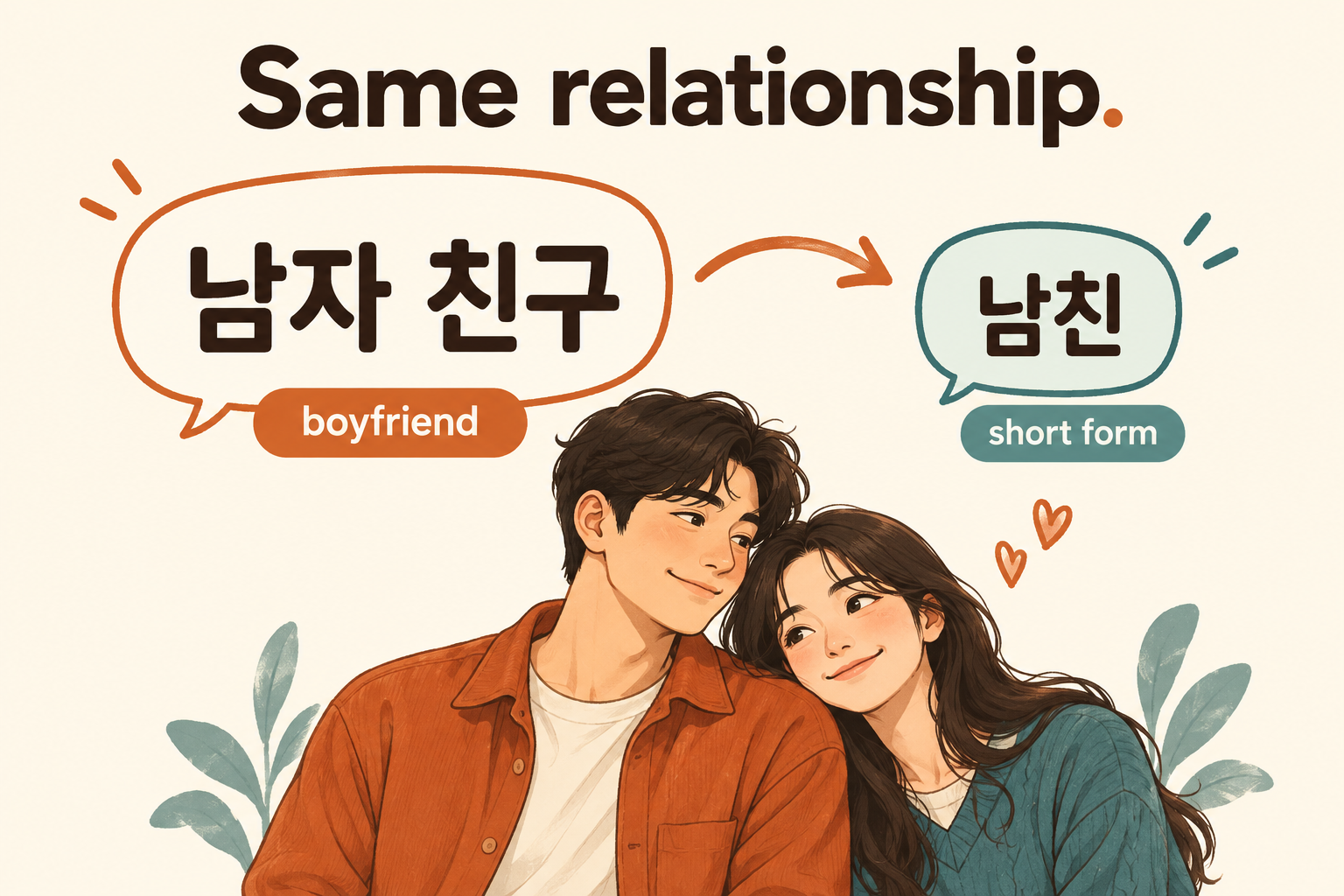
The short form is 남친 (namchin), taking 남 from 남자 and 친 from 친구. It is a contraction for convenience, not a different stage of dating — a Netflix announcement can use 남친 in its headline and 남자친구 in the description of the same character. The parallel contractions 여친 (yeochin, girlfriend) and, importantly, 남사친 (namsachin, a male friend who is just a friend) and 여사친 (yeosachin) complete the set. 남사친 exists precisely because 남자 친구 usually means boyfriend; the extra syllable 사 from 사이 ("relationship") pulls the romance back out.
One label, three registers of use
Introducing him politely — to a stranger, an elder, or your friend's parents — takes 제: 제 남자 친구예요 ("This is my boyfriend"). 제 is the polite possessive; 내 남자 친구 is the casual version for people you speak 반말 with.
Korean adds a quirk English lacks: couples often say 우리 instead of 내. 우리 남친 — "our boyfriend" — sounds strange translated literally, but 우리 is the natural Korean possessive for anything shared-adjacent, from our house to our country, and boyfriends fall in. It reads as affectionate, not polygamous.
Finally, the word you will actually hear inside the relationship is not 남자 친구 at all. Couples address each other as 자기야 (jagiya, roughly "honey"), 여보 (yeobo, for married couples), or 오빠 (oppa, what a woman calls an older man she is close to). 남자 친구 is the label used about him, to other people; 자기야 is what you call him when he leaves his umbrella at your place.
Three conversations you will actually have
Between friends (반말)
A: 야, 너 남친 있어? — Ya, neo namchin isseo? — Hey, do you have a boyfriend? B: 응, 한 지 삼 개월 됐어. — Eung, han ji sam dareul dwaesseo. — Yeah, it's been three months. A: 진짜? 소개팅 해줄까 했는데. — Jinjja? Sogaeting haejulkka haenneunde. — Really? I was going to set you up on a blind date.
Introducing him to an elder (존댓말)
A: 할머니, 이 사람은 제 남자 친구예요. — Halmeoni, i sarameun je namja chinguiyeyo. — Grandmother, this is my boyfriend. B: 잘 생겼네. 앉아요. — Jal saenggyeonne. Anjayo. — He's handsome. Sit down.
The 사귀다 trap, at a language exchange (존댓말)
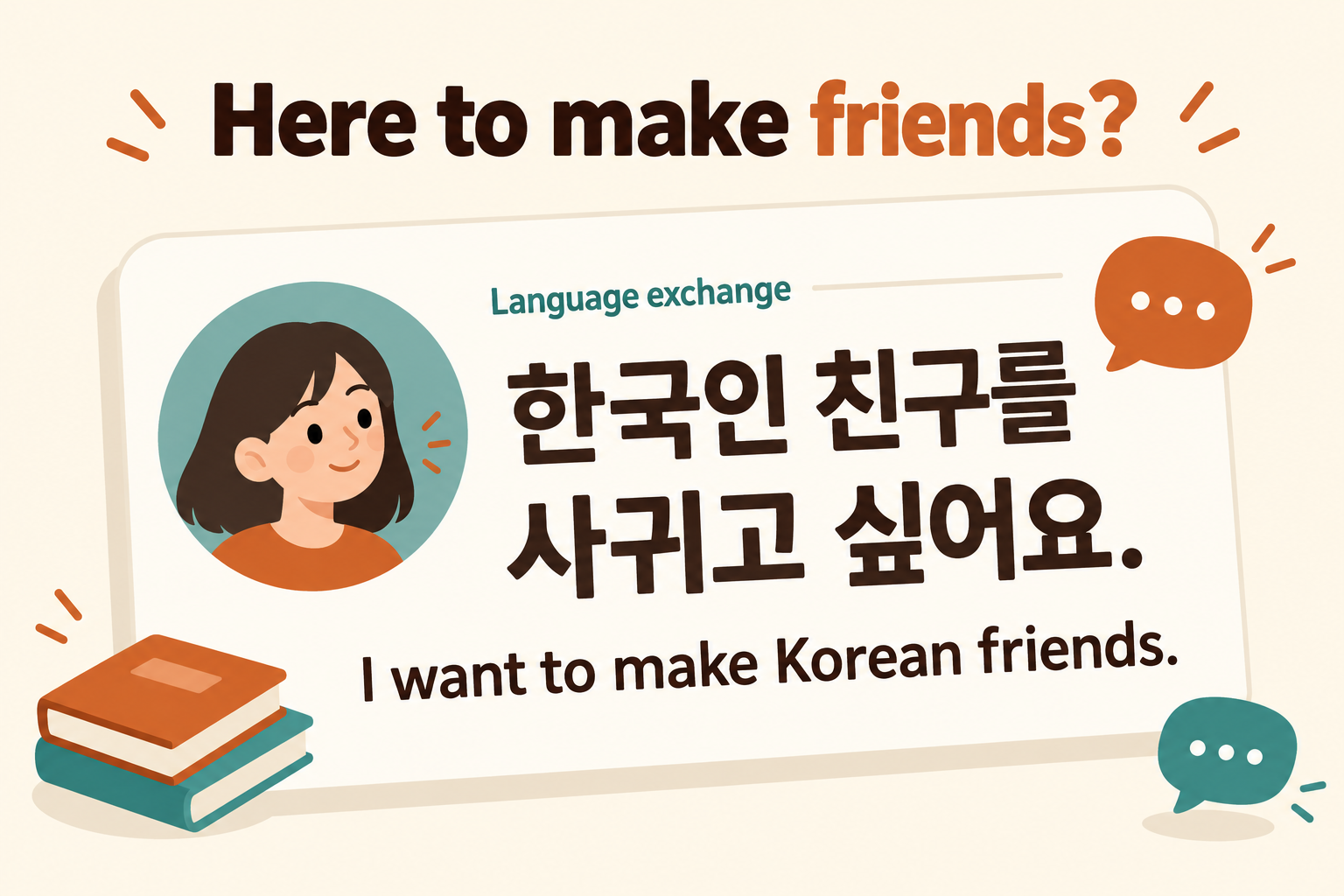
A: 저는 한국인 친구를 사귀고 싶어요. — Jeoneun hangungin chingureul sagwigo sipeoyo. — I want to make Korean friends. B: 좋아요, 그럼 먼저 연락 드릴게요. — Joayo, geureom meonjeon yeollak deurilgeyo. — Great, then I'll contact you first.
Sentence by sentence this is all level-appropriate. The danger is one word away, and it is the next section.
The mistakes that cost the most
The single most damaging error is translating 사귀다 as "to date" every time. The verb means to keep company with, and the National Institute of Korean Language's dictionary gives both 친구를 사귀다, "to make friends," and 애인을 사귀다, "to have a romantic relationship." It also gives 이웃과 사귀다, to be on friendly terms with neighbors — and notice the particle changed from 를 to 과 there, which means the particle is not the switch. The noun decides: 친구를 사귀고 싶어요 is "I want to make friends," and 남자 친구를 사귀고 싶어요 is "I want to find a boyfriend." In a language-exchange introduction, that difference is not stylistic. 한국인 친구를 사귀고 싶어요 says you want Korean friends; 한국인 남자 친구를 사귀고 싶어요 will be read as a very specific goal, and the room will act accordingly.
Second, the spacing panic. Seeing 남자친구 unspaced in a text does not mean the writer is casual or careless about the relationship, and correcting it to "male friend" changes the sentence into something the writer never said. Fix the space when editing formal Korean; never fix the meaning.
Third, using 남친 with people you would not discuss dating with. The contraction is chat register. In a message to a professor, a landlord, or an immigration officer, 제 남자 친구 or simply the person's name is the register that matches.
Fourth, assuming 남자 친구 있어요? is an advance. Doctors ask it for prescription safety, aunts ask it at weddings, and colleagues ask it in the first week. The correct neutral reply — 네, 있어요 or 아뇨, 없어요 — ends the inquiry without drama, because for the asker there was never any drama in it.
Fifth, the title 오빠. It belongs to a specific geometry: a younger woman addressing an older man. Using it for your boyfriend is normal inside a relationship; using it for a stranger your age who happens to be male is a level error, not a term of endearment.
How couples talk in the chat window
KakaoTalk carries a vocabulary stage before the label even exists. 썸 (sseom, from English "some") is the ambiguous zone between meeting and dating, and 썬다 or 썸탄다 (sseomtanda) is what the two people are doing there — "building some." Ask 썸 있어? and you are asking whether there is a maybe-person in the picture. Once feelings land, the chat vocabulary turns physical-symptomatic: 심쿵 ("heart drop," the moment your chest actually reacts) and 설레 (the flutter before you see someone) are both standard romantic texting words. The transition point is explicit and contractual: 커플 (couple) is a status, 고백 (goback) is the confession that changes the status, and until a 고백 happens, Koreans will tell you 사귀는 사이가 아니에요 — "we're not dating" — no matter how it looks from outside. The label 남자 친구, in other words, is not a description. It is an appointment.
Namjachingu at a glance
| 남자 친구 | namja chingu | Boyfriend | Standard spelling has a space; romantic by default |
| 여자 친구 | yeoja chingu | Girlfriend | Same structure, female |
| 남친 / 여친 | namchin / yeochin | Contraction of either | Chat register; avoid in formal writing |
| 남사친 / 여사친 | namsachin / yeosachin | Male / female friend, platonic | 사 from 사이 explicitly removes romance |
| 친구를 사귀다 | chingureul sagwida | To make friends | 사귀다 ≠ "to date" by itself |
| 자기야 / 여보 | jagiya / yeobo | Honey / dear | Address terms inside the couple |
Frequently asked questions
What does namchin (남친) mean? 남친 is the short form of 남자 친구, "boyfriend" — 남 from 남자 and 친 from 친구. It is a convenience contraction, not a different stage of dating, and it belongs in chat and casual speech. The standard full spelling is 남자 친구 with a space.
Is it 남자친구 or 남자 친구? The National Institute of Korean Language specifies 남자 친구, with a space, in a May 2025 answer that is explicitly about a romantic partner. Both spellings appear in published writing, and the spacing does not change the meaning: neither version makes a boyfriend into a platonic friend.
How do I say "I want to make Korean friends" without it sounding like dating? 한국인 친구를 사귀고 싶어요. The verb 사귀다 covers friendship and romance, and the noun decides which one: 친구 gives "make friends," 남자 친구 gives "find a boyfriend." Adding 남자 in the middle of the sentence changes the goal, so keep the noun as 친구 if friendship is what you mean.
'Real Korean Language & Everyday Korea' 카테고리의 다른 글
| Korean Counters, What the Counting Word Actually Counts (0) | 2026.10.28 |
|---|---|
| Korean Surnames, Common Names and What Their Labels Mean (0) | 2026.10.28 |
| Family in Korean, Who Is Related to Whom? (0) | 2026.10.28 |
| Arasso Meaning, Choosing Between Got It and I Understand (0) | 2026.10.28 |
| Sino Korean Numbers in Writing From 1 to 1000 (0) | 2026.10.28 |
| Aigoo Meaning, What 아이고 Adds to a Korean Sentence (0) | 2026.10.28 |
| Sunbae Meaning in Korean, Senior to Whom? (0) | 2026.10.28 |
| Korean Keyboard, Find the Keys and Build Your First Words (0) | 2026.10.28 |


