Why in Korean: The Word 왜 (Wae)
Imagine a friend suddenly cancels dinner. You want to know what happened, so you ask, “Why?” In Korean, one short word can begin that conversation: 왜 (wae).
왜 is the everyday Korean question word for “why.” You can use it to ask about an action, a situation, a decision, or a result. However, knowing the translation is only the beginning. The surrounding sentence tells you what you are asking about, while your tone and relationship with the listener influence how the question comes across.
To ask why in Korean, you usually place 왜 before the part of the sentence you are questioning. For example, 왜 왔어요? means “Why did you come?” and 왜 웃어요? means “Why are you laughing?” The question word itself stays the same even when the action changes.
The wae meaning Korean learners first meet is usually the direct question “why?” But in actual conversation, the same word can express curiosity, surprise, concern, or a request for an explanation. Understanding those differences will help you respond naturally instead of simply repeating a translated phrase.

How 왜 Works in a Korean Sentence
왜 is an interrogative adverb. It asks about the reason or cause behind something. It does not need a separate English-style question structure to work.
왜 + Verb or Adjective
One of the simplest patterns is:
왜 + conjugated verb or adjective?
- 왜 가요? — Why are you going?
- 왜 먹어요? — Why are you eating?
- 왜 울어요? — Why are you crying?
- 왜 바빠요? — Why are you busy?
- 왜 웃어요? — Why are you laughing?
Notice that the verb or adjective remains in its normal question form. You do not need to change the basic structure just because you add 왜.
For example, 가요 is the polite present form of 가다, meaning “to go.” When you add 왜, the result is 왜 가요? The question now asks for the reason behind the action.
Changing the Tense
왜 can also appear with past and future expressions.
- 왜 왔어요? — Why did you come?
- 왜 전화했어요? — Why did you call?
- 왜 안 먹었어요? — Why didn't you eat?
- 왜 갈 거예요? — Why are you going to go?
The tense comes from the verb ending, not from 왜. In 왜 왔어요?, 왔어요 shows that the coming happened in the past. In 왜 갈 거예요?, 갈 거예요 expresses a future plan.
This makes 왜 flexible. You can ask about something happening now, something that already happened, or an action someone intends to take.
Understanding 왜요? and 왜 그래요?
Two expressions that beginners often encounter are 왜요? and 왜 그래요? Both contain 왜, but they are not interchangeable in every situation.
왜요? — Why? / How Come?
왜요? is a short question formed by adding the polite particle 요 to 왜. It can ask for a reason when the context already makes the subject clear.
For example:
A: 오늘은 먼저 갈게요.
“I'll leave early today.”
B: 왜요?
“Why?”
A: 약속이 있어서요.
“Because I have an appointment.”
The listener does not need to repeat the entire question 왜 먼저 가요? because the previous statement already provides the context. 왜요? is enough to ask why the person is leaving.
The wae meaning in a sentence depends partly on what has already been said. A short 왜요? can sound genuinely curious when someone wants to understand a situation. It can also sound challenging if the listener uses a sharp or impatient tone.
왜 그래요? — What's Wrong? / Why Are You Like That?
왜 그래요? combines 왜 with 그래요, the polite form of 그러다. It is commonly used when asking about someone's unusual behavior, emotional state, or a situation that seems different from normal.
For example:
A: 오늘 표정이 안 좋아 보여요.
“You don't look very cheerful today.”
A: 왜 그래요? 무슨 일 있어요?
“What's wrong? Did something happen?”
Here, 왜 그래요? is not simply asking for the reason behind one specific action. It responds to the person's overall appearance or behavior and expresses concern.
Compare the two questions:
- 왜요? — Why? What is the reason?
- 왜 그래요? — What's wrong? Why are you acting or feeling that way?
The second expression can be caring, concerned, or critical depending on the situation. It should not automatically be translated as an accusation.
Does Asking 왜 Sound Rude?
Not automatically. 왜 is a normal question word, and asking for a reason is a common part of conversation. However, a question can feel uncomfortable if it sounds demanding, especially when the listener does not want to explain a personal matter.
Consider these situations:
With a close friend:
왜 안 와?
“Why aren't you coming?”
This casual form can be perfectly natural between close friends. Depending on the tone, it may express curiosity, disappointment, or impatience.
With someone you do not know well:
왜 안 오세요?
“Why aren't you coming?”
This uses a polite ending, but politeness in grammar does not automatically make every question comfortable. If the subject is personal or sensitive, a softer approach may be more appropriate.
For example:
혹시 못 오시는 이유가 있으세요?
“Is there perhaps a reason you cannot come?”
This question uses 이유, meaning reason, and frames the request more gently. 혹시 can soften the approach by making the question less direct.
Therefore, do not judge 왜 as rude or polite by itself. Pay attention to the relationship, the sentence ending, the situation, and the speaker's tone.
Why in Korean: Asking About a Specific Situation
Sometimes you are not asking about an action. You want to understand why something happened or why a person feels a certain way.
In those situations, you can use 왜 with a more complete sentence.
- 왜 그런 일이 생겼어요? — Why did that happen?
- 왜 기분이 안 좋아요? — Why are you in a bad mood?
- 왜 그렇게 생각해요? — Why do you think that?
- 왜 갑자기 바뀌었어요? — Why did it suddenly change?
These questions show how the word 왜 can connect to different kinds of information. You may ask about a cause, a person's opinion, an unexpected event, or a change in circumstances.
The key is to identify the part you want explained. If you are asking why someone made a decision, include the decision in the sentence. If you are asking about an unexpected result, describe that result clearly. The question becomes easier to understand when the listener knows exactly what you are asking about.
How to Give a Reason in Korean
Asking why is only half of the conversation. Once someone asks 왜, you need to explain the reason clearly. Korean has several useful patterns for doing this, and the best choice depends on how the reason connects to the rest of your sentence.
때문에: Because of Something
때문에 expresses a cause or reason. It commonly follows a noun or a noun phrase.
Examples:
- 비 때문에 집에 있었어요. — I stayed home because of the rain.
- 일 때문에 바빠요. — I'm busy because of work.
- 교통 체증 때문에 늦었어요. — I was late because of traffic.
Notice that the noun before 때문에 identifies the reason. You can use this structure when the cause is a person, situation, event, or other noun-based expression.
-(으)니까: Giving a Reason for an Action or Suggestion
-(으)니까 connects a reason to another statement. It is especially useful when explaining why you are making a suggestion, giving an instruction, or choosing to do something.
- 비가 오니까 우산을 가져가세요. — Since it's raining, take an umbrella.
- 시간이 없으니까 빨리 가요. — Since we don't have time, let's go quickly.
- 피곤하니까 오늘은 쉬세요. — Since you're tired, rest today.
The form changes according to the verb or adjective stem:
- 가다 → 가니까
- 먹다 → 먹으니까
- 춥다 → 추우니까
Do not treat -(으)니까 as a word that simply replaces “because” in every English sentence. It connects the reason to the following statement, and its use is particularly natural when the speaker draws a conclusion or makes a suggestion from that reason.
-아/어서: Connecting a Cause to a Result
-아/어서 is another common way to connect a reason with a result. It often presents the first action or situation as the reason for what follows.
- 배가 아파서 병원에 갔어요. — I went to the hospital because my stomach hurt.
- 늦게 일어나서 택시를 탔어요. — I took a taxi because I woke up late.
- 너무 피곤해서 일찍 잤어요. — I went to bed early because I was very tired.
Pay attention to the connection between the two parts. The first describes the cause, and the second gives the resulting action or situation.
For example, 배가 아파서 explains why the person went to the hospital. It is not simply two unrelated events placed next to each other.
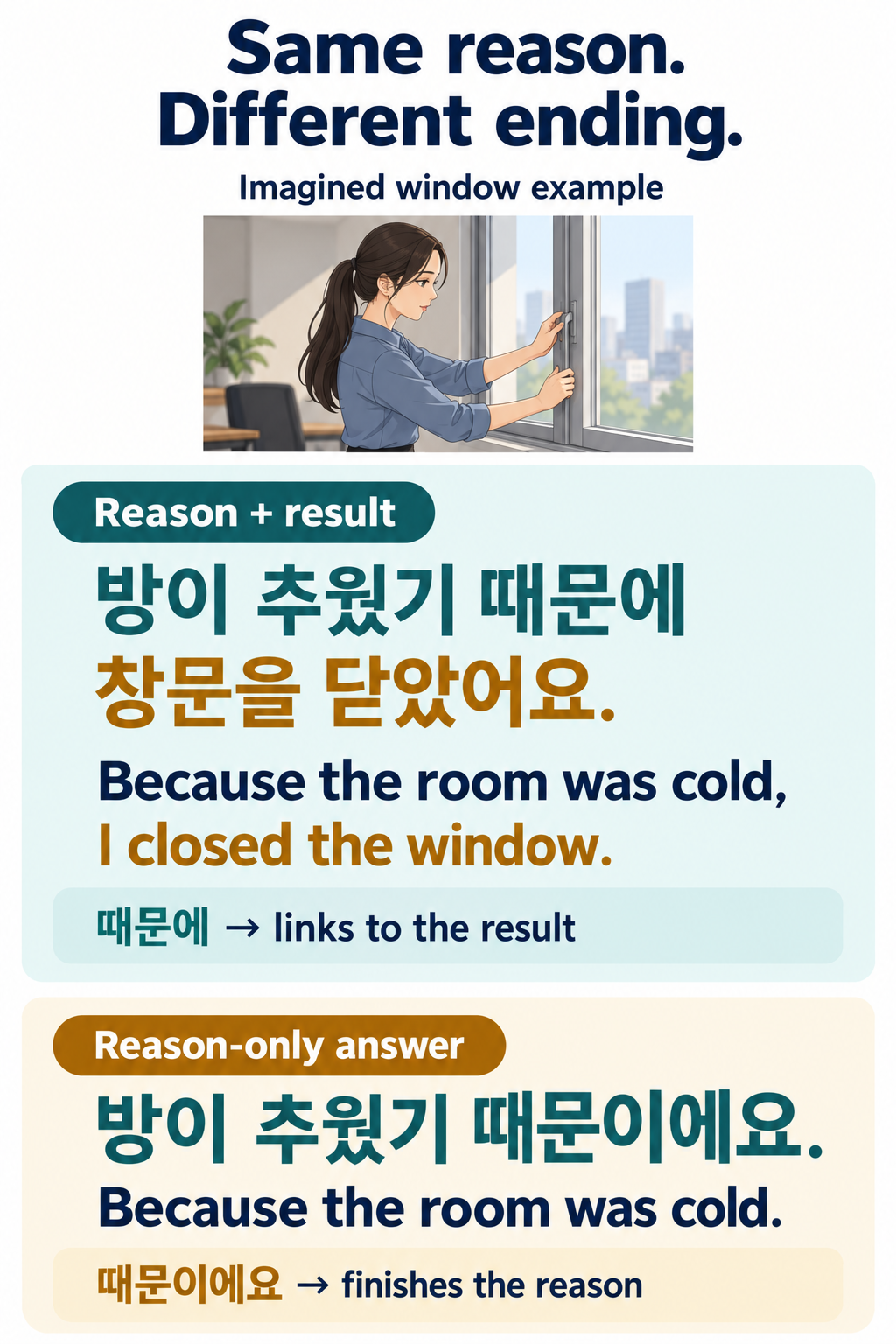
-기 때문이에요: Stating a Reason
When you want to give a more explicit explanation, -기 때문이에요 can state the reason directly.
- 늦은 이유는 길이 막혔기 때문이에요. — The reason I was late is that there was traffic.
- 오늘 못 가는 이유는 일이 있기 때문이에요. — The reason I cannot go today is that I have work.
This form is useful when answering a question that specifically asks for an explanation. It connects the action or situation to the reason with a clear structure.
Compare:
왜 늦었어요?
“Why were you late?”
길이 막혔기 때문이에요.
“Because there was traffic.”
The question asks for the reason, and the answer identifies it directly.
Three Conversations: Asking Why and Explaining the Reason
Conversation 1: A Friend Cancels a Plan
Situation: Two close friends planned to meet for dinner. One friend suddenly says they cannot come.
A: 오늘 저녁에 못 온다고?
“You can't come tonight?”
B: 응, 미안해. 갑자기 일이 생겼어.
“Yes, sorry. Something suddenly came up.”
A: 왜? 무슨 일 있어?
“Why? Did something happen?”
B: 회사에서 급하게 처리할 일이 생겨서 그래.
“It's because something urgent came up at work.”
Why this conversation works: Friends use casual speech with each other. 왜? asks for an explanation, while 무슨 일 있어? adds concern about the situation. The response uses -아/어서 to connect the unexpected work situation with the cancellation.
Conversation 2: Explaining a Late Arrival to a Colleague
Situation: A colleague arrives late to a morning meeting and explains the reason to another coworker.
A: 오늘 회의에 왜 늦으셨어요?
“Why were you late to today's meeting?”
B: 출근길에 교통 체증이 심했어요.
“There was heavy traffic on my way to work.”
A: 아, 그래서 늦으셨군요.
“Oh, so that's why you were late.”
B: 네, 다음에는 조금 더 일찍 출발할게요.
“Yes, next time I'll leave a little earlier.”
Why this conversation works: The colleagues use polite speech. 왜 늦으셨어요? asks for the reason while using an honorific verb form. 그래서 connects the explanation to the result, and 출발할게요 expresses the speaker's intention for next time.
Conversation 3: Asking a Stranger About a Closed Shop
Situation: A visitor arrives at a shop but finds it closed during its usual business hours. They ask someone nearby for information.
A: 실례합니다. 오늘 가게가 왜 문을 닫았나요?
“Excuse me. Why is the shop closed today?”
B: 오늘은 사장님이 개인 사정으로 쉬신다고 들었어요.
“I heard the owner is taking the day off for personal reasons.”
A: 그렇군요. 내일은 다시 여나요?
“I see. Will it open again tomorrow?”
B: 아마 내일은 정상적으로 열 거예요.
“It will probably open normally tomorrow.”
Why this conversation works: The visitor begins with 실례합니다 to approach an unfamiliar person politely. The question uses 왜 to ask for the reason behind the closure. The response uses 개인 사정으로, meaning for personal reasons, while 들었어요 shows that the speaker is reporting information they heard rather than claiming direct knowledge.
Compare Korean Expressions for Asking Why and Giving Reasons
| Expression | Pronunciation | Speech Level | Best Situation | Natural Reply / Nuance |
|---|---|---|---|---|
| 왜? | wae | Casual | Asking a close friend for a reason | 왜냐하면... — Because... |
| 왜요? | waeyo | Polite | Asking why when the context is already clear | 무슨 일이 있어서요 — Because something happened |
| 왜 그래요? | wae geuraeyo | Polite | Asking what is wrong or why someone is acting differently | 조금 피곤해서요 — Because I'm a little tired |
| 때문에 | ttaemune | Neutral connector | Giving a noun-based reason | 비 때문에 늦었어요 — I was late because of the rain |
| -(으)니까 | (eu)nikka | Neutral connector | Giving a reason for a suggestion or action | 시간이 없으니까 빨리 가요 — Since we have no time, let's go |
| -아/어서 | a/eoseo | Neutral connector | Connecting a cause with its result | 아파서 쉬었어요 — I rested because I was sick |
| -기 때문이에요 | gi ttaemunieyo | Polite explanation | Giving an explicit reason | 길이 막혔기 때문이에요 — Because there was traffic |
Frequently Asked Questions
What does 왜 mean in Korean?
왜 means “why” and is used to ask about the reason behind an action, decision, or situation. It can appear with present, past, and future verb forms. The surrounding sentence tells the listener exactly what you want explained.
Is 왜요 rude in Korean?
Not necessarily. 왜요? is a normal polite question, but its impression depends on tone, relationship, and context. It can express curiosity or surprise, while a sharp delivery may sound challenging. When asking about a sensitive personal matter, a softer question may be more considerate.
How do you answer 왜 in Korean?
You can answer with a reason using 때문에, -(으)니까, or -아/어서, depending on the sentence. For example, 비 때문에 늦었어요 means “I was late because of the rain.” 길이 막혔기 때문이에요 gives a more explicit explanation: “It's because there was traffic.”
'Real Korean Language & Everyday Korea' 카테고리의 다른 글
| Korean Chopsticks: A Steady Grip and a Bowl of Bibimbap (0) | 2026.11.05 |
|---|---|
| Dad in Korean: Appa, Abeoji, and Using Them in a Sentence (0) | 2026.11.05 |
| Money in Korean: Using 돈 for Cash, Costs, and Payment (0) | 2026.11.04 |
| Excuse Me in Korean: Getting Attention and Asking Your Question (0) | 2026.11.03 |
| Hul in Korean: The Slang for Shock, Disbelief, and Speechless Moments "헐~" (0) | 2026.11.03 |
| Jinjja in Korean: "Really?" "Seriously?" and the Nuance Behind 진짜 vs 정말 (0) | 2026.11.02 |
| Gwenchana in Korean: "I'm Okay," "Are You Okay?" and That Comforting Little Word (0) | 2026.11.02 |
| Sad in Korean: Feeling Sad, Looking Sad, and 아쉬워요 (0) | 2026.11.01 |


