How Do You Say Dad in Korean?
Imagine introducing your family to a Korean friend. You want to say, “My dad works in Seoul.” You know the word 아빠 (appa), but you have also heard 아버지 (abeoji). Which one should you choose?
I still remember my first dinner at a Korean friend's family home, hovering between 아빠 and 아버지 like the wrong choice might end the meal early. It will not — but picking the right one for the moment does make the room warm up to you a little faster.
Both words refer to a father, but they can create different impressions depending on the relationship and situation. 아빠 is a familiar everyday expression, while 아버지 is commonly used as a more formal or respectful way to refer to or address one's father. So please don't sort them into 'the one adults use' and 'the one kids use' based only on the speaker's age.
If you are learning dad in Korean, three expressions are especially useful:
- 아빠 (appa) — Dad or daddy; a familiar expression.
- 아버지 (abeoji) — Father; a more formal or respectful expression in many family contexts.
- 아버님 (abeonim) — An honorific form used in particular respectful relationships and situations.
Choosing the right word involves more than translating the English word “dad.” You also need to consider whether you are speaking directly to your own father, talking about him to someone else, or referring to another person's father.
아빠 vs. 아버지: Understanding the Difference
아빠 (Appa): A Familiar Way to Say Dad
아빠 is a familiar Korean word for father. It is commonly used when speaking directly to one's father in an informal family setting or when talking about one's father in everyday conversation.
Here is the kind of line you will actually use:
아빠, 오늘 일찍 오세요?
“Dad, are you coming home early today?”
우리 아빠는 요리를 잘해요.
“My dad is good at cooking.”
In the first sentence, 아빠 is the person being addressed directly. In the second, 우리 아빠 refers to the speaker's own father when talking to someone else.
Although 아빠 is familiar, it is not automatically childish or inappropriate for adults. Adults may continue using it when that is the established way they address their father. The choice can depend on family habits and personal preference.
아버지 (Abeoji): Father
아버지 is a widely used word for father that often carries a more formal or respectful tone than 아빠. It can appear in direct address and when referring to one's father in a conversation.
A couple you would hear at any family table:
아버지, 식사하셨어요?
“Father, have you eaten?”
제 아버지는 부산에서 일하세요.
“My father works in Busan.”
Notice that 아버지 can be used both to address someone and to talk about that person. Its meaning does not change simply because the speaker is using a different sentence structure.
When choosing between 아빠 and 아버지, consider how you normally speak to your father and the tone you want to express. Some families use 아빠 throughout adulthood, while others prefer 아버지. There is no need to force one expression onto every family.

아버님 (Abeonim): An Honorific Expression
아버님 is an honorific form related to 아버지. It is used in particular respectful relationships, including when referring to or addressing someone else's father and a spouse's father.
Like this:
아버님, 안녕하세요?
“Hello, Father.”
지수 아버님, 잠시 말씀드려도 될까요?
“Jisoo's father, may I speak with you for a moment?”
One trap to skip: 아버님 is not simply 아빠 with extra politeness sprinkled on. I once built a whole office sentence on that guess, and you could hear the politeness misfire. The word follows the relationship, not the grammar of the sentence.
Talking About Your Own Father: 내 아빠, 제 아버지, and 우리 아버지
After learning the three main words, you need to know how to say “my dad” or “my father.” Korean has several ways to express possession, and the choice can affect how natural a sentence sounds.
내 아빠 and 제 아버지
내 comes from 나의, meaning “my” in a familiar or casual context. 제 comes from 저의, a more humble or polite form of “my.”
- 내 아빠 — My dad, using a familiar first-person form.
- 제 아버지 — My father, using a humble first-person form.
Some real-life ones:
내 아빠는 축구를 좋아해.
“My dad likes soccer.”
제 아버지는 음악을 좋아하세요.
“My father likes music.”
The second sentence uses 제 to present the speaker modestly. The ending -세요 also shows respect toward the father as the subject of the sentence.
Why Do Koreans Say 우리 아빠?
One expression that may surprise English speakers is 우리 아빠, which literally contains the word “our” but often means “my dad” in ordinary Korean conversation.
Korean commonly uses 우리 when referring to one's own family, home, school, or workplace. This is a familiar way of describing something connected to one's group or family rather than emphasizing individual ownership.
Examples include:
- 우리 아빠 — My dad.
- 우리 아버지 — My father.
- 우리 엄마 — My mom.
- 우리 가족 — My family.
- 우리 집 — My home or our house.
In practice:
우리 아버지는 주말마다 산책하세요.
“My father goes for a walk every weekend.”
This is natural Korean even though the English translation uses “my.” The use of 우리 does not mean that the speaker is describing a father shared with unrelated people.
Choosing Between 내, 제, and 우리
| Expression | Meaning | Typical Context | Example |
|---|---|---|---|
| 내 아빠 | My dad | Familiar or casual speech | 내 아빠는 친절해. |
| 제 아버지 | My father | Polite or humble self-reference | 제 아버지는 선생님이세요. |
| 우리 아빠 | My dad | Everyday reference to one's family | 우리 아빠는 요리를 잘해요. |
| 우리 아버지 | My father | Everyday or polite family reference | 우리 아버지는 부산에 계세요. |
Please don't read that table as a ranking where one row wins and the rest are wrong — Koreans slide between these forms all day long, and nobody at the dinner table is keeping score. 내 and 제 reflect the speaker's choice of first-person form, while 우리 presents the family relationship collectively. The sentence ending and the listener's relationship also influence the overall tone.
Talking About Someone Else's Father
When you talk about another person's father, the relationship between you and that person matters. Korean has expressions that identify whose father you mean, and the appropriate choice can depend on whether you are speaking to a friend, a colleague, or someone you need to address respectfully.
Using Someone's Name with 아버지
You can put a person's name before 아버지 to identify their father. For example:
민수 아버지
“Minsu's father.”
지수 아버지는 어떤 일을 하세요?
“What kind of work does Jisoo's father do?”
The name 민수 or 지수 identifies the family relationship being discussed. This is useful when several people are talking about different families and you need to make the reference clear.
A small confession from a taxi ride I still think about: I spent the whole trip saying 아버지 when every cell in my body wanted 아버님, because my friend's father kept telling me not to be so formal. Follow his lead in the moment — but until someone tells you to relax, err on the respectful side.
When 아버님 Is More Appropriate
아버님 is often suitable when speaking respectfully about someone else's father or addressing a spouse's father. It is also used in certain family relationships where an honorific form is customary.
Picture this:
아버님께서 오늘 오신다고 들었어요.
“I heard that your father is coming today.”
장인어른께서 주말에 방문하세요.
“My wife's father is visiting this weekend.”
장인어른 is a specific respectful term for one's wife's father. The appropriate family term depends on the relationship, so it is better to learn the relationship-specific expression rather than replacing every reference with 아버님.
When speaking to a friend about their father, you may hear expressions such as 친구 아버지 or 친구 아버님. The choice depends on the sentence and the level of respect being expressed. In a direct conversation with an older person, using their name or relationship term with an appropriate honorific can also matter.
How to Use Dad and Father in Complete Sentences
Knowing the vocabulary is only the beginning. To use these words naturally, pay attention to whether you are calling your father, describing him, or asking someone about their father.
Speaking Directly to Your Own Father
When speaking directly to your father, the expression can be short and conversational.
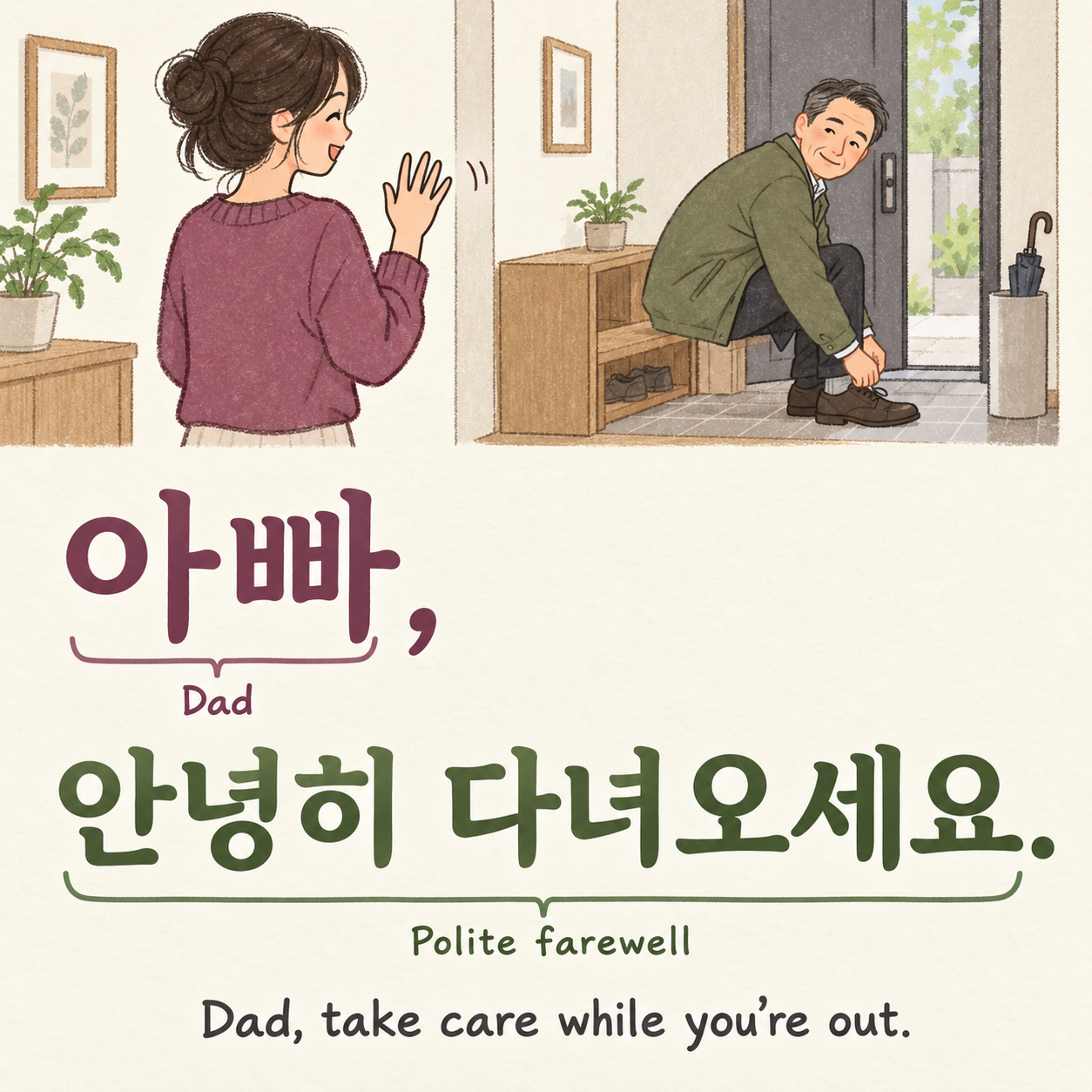
- 아빠, 이거 봐 주세요. — Dad, please look at this.
- 아버지, 잠깐 말씀드릴 게 있어요. — Father, I have something to tell you.
The first uses a familiar expression and a polite request. The second uses a more respectful form of address and a polite way to introduce something you want to say. The choice depends on established family habits and the tone of the conversation.
Describing Your Father to Someone Else
When talking about your father to another person, you can use 우리 아빠, 우리 아버지, or 제 아버지 according to the context.
- 우리 아빠는 음악을 좋아해요. — My dad likes music.
- 우리 아버지는 부산에 사세요. — My father lives in Busan.
- 제 아버지는 회사에서 일하세요. — My father works at a company.
These sentences all describe the speaker's father. 우리 is common in family references, while 제 presents the speaker's self-reference more humbly. The verb ending can also show respect toward the person being discussed.
Three Conversations About Fathers
Conversation 1: Talking with a Close Friend
Situation: Two close friends are talking about their families. They normally use casual speech.
A: 너희 아빠는 주말에 뭐 하셔?
“What does your dad do on weekends?”
B: 우리 아빠는 주로 등산하셔.
“My dad usually goes hiking.”
A: 와, 운동을 좋아하시나 보다.
“Wow, he must enjoy exercising.”
Why this conversation works: The friends use casual speech with each other, but they use respectful verb endings when referring to the friend's father. 뭐 하셔? and 좋아하시나 보다 show that the speaker can maintain an informal relationship with a friend while expressing respect toward the person being discussed.
Conversation 2: Introducing Your Father at Work
Situation: Two colleagues are talking during a break. One colleague asks about the other's family.
A: 아버님은 어떤 일을 하세요?
“What kind of work does your father do?”
B: 저희 아버지는 작은 가게를 운영하세요.
“My father runs a small shop.”
A: 그러시군요. 오래 운영하셨어요?
“I see. Has he run it for a long time?”
B: 네, 십 년 정도 되셨어요.
“Yes, it's been about ten years.”
Why this conversation works: The colleagues use polite speech with each other. 아버님 is a respectful way to refer to the other person's father in the question, while 저희 아버지 identifies the speaker's own father. 운영하세요 and 되셨어요 use respectful verb forms in reference to him.
Conversation 3: Speaking to Your Father-in-Law
Situation: A married adult visits their spouse's father and speaks to him respectfully.
A: 아버님, 주말에 시간 괜찮으세요?
“Father, are you available this weekend?”
B: 네, 무슨 일이니?
“Yes, what is it?”
A: 가족들과 함께 식사하고 싶습니다.
“I would like to have a meal with the family.”
B: 그래요. 그럼 토요일에 만납시다.
“Sure. Then let's meet on Saturday.”
Why this conversation works: The speaker uses 아버님 as a respectful form of address for their spouse's father. 괜찮으세요? politely asks about his availability, while 식사하고 싶습니다 expresses a wish in a more formal style. The exact speech level can vary between families, but the relationship makes the respectful form appropriate here.
Compare the Expressions for Dad and Father
| Expression (한국어) | Pronunciation | Speech Level | Best Situation | Natural Reply / Nuance |
|---|---|---|---|---|
| 아빠 | appa | Familiar | Addressing or referring to one's dad in everyday family conversation | 아빠, 고마워요 — Dad, thank you |
| 아버지 | abeoji | Polite / Respectful | Addressing or referring to one's father with a more formal tone | 아버지, 식사하셨어요? — Father, have you eaten? |
| 아버님 | abeonim | Honorific | Referring to or addressing another person's father in an appropriate respectful relationship | 아버님, 안녕하세요? — Hello, Father |
| 우리 아빠 | uri appa | Familiar | Talking about one's own dad in everyday conversation | 우리 아빠는 요리를 잘해요 — My dad cooks well |
| 우리 아버지 | uri abeoji | Polite / Respectful | Referring to one's father in a family context | 우리 아버지는 부산에 계세요 — My father is in Busan |
| 제 아버지 | je abeoji | Humble self-reference | Introducing one's father in a polite conversation | 제 아버지는 선생님이세요 — My father is a teacher |
Frequently Asked Questions
What is the difference between 아빠 and 아버지?
Both words mean father, but 아빠 is more familiar and commonly used in everyday family conversation. 아버지 often sounds more formal or respectful. The choice depends on family habits and the situation rather than the speaker's age alone.
Does 우리 아빠 mean “our dad” or “my dad”?
우리 아빠 often means “my dad” in natural Korean conversation. Korean commonly uses 우리 when referring to one's own family or things connected to it. The English translation may therefore use “my” even though the Korean expression literally contains “our.”
When should I use 아버님?
아버님 is an honorific form used in appropriate respectful relationships, including references to another person's father and a spouse's father. It is not simply a more polite replacement for 아빠 in every sentence. Consider who the father belongs to and your relationship with that person before choosing the expression.
'Real Korean Language & Everyday Korea' 카테고리의 다른 글
| Korean Chopsticks: A Steady Grip and a Bowl of Bibimbap (0) | 2026.11.05 |
|---|---|
| Money in Korean: Using 돈 for Cash, Costs, and Payment (0) | 2026.11.04 |
| Excuse Me in Korean: Getting Attention and Asking Your Question (0) | 2026.11.03 |
| Why in Korean: Asking for a Reason and Giving One (0) | 2026.11.03 |
| Hul in Korean: The Slang for Shock, Disbelief, and Speechless Moments "헐~" (0) | 2026.11.03 |
| Jinjja in Korean: "Really?" "Seriously?" and the Nuance Behind 진짜 vs 정말 (0) | 2026.11.02 |
| Gwenchana in Korean: "I'm Okay," "Are You Okay?" and That Comforting Little Word (0) | 2026.11.02 |
| Sad in Korean: Feeling Sad, Looking Sad, and 아쉬워요 (0) | 2026.11.01 |


