Why Do Korean Chopsticks Feel Different?
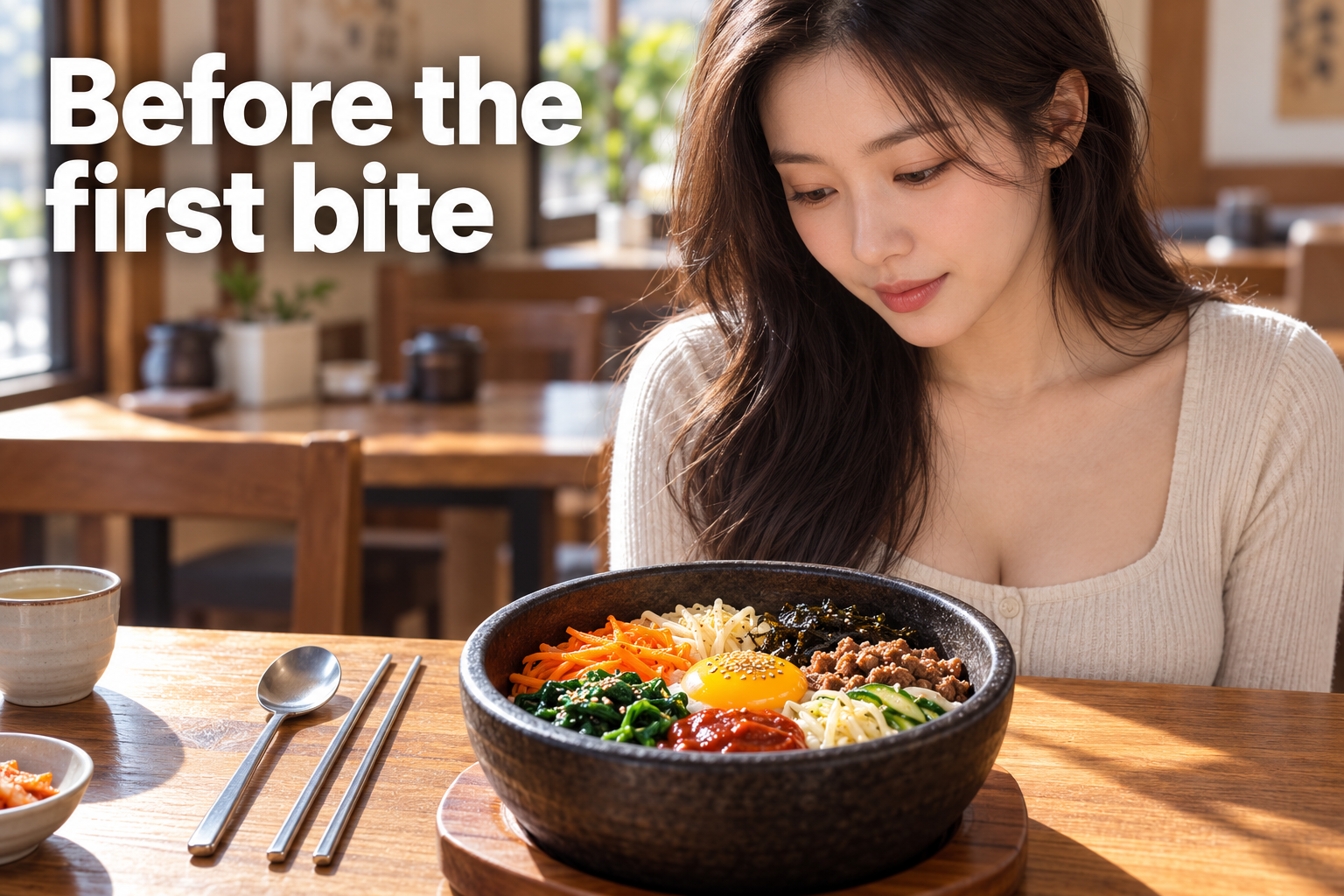
Imagine sitting down at a Korean restaurant. In front of you is a bowl of bibimbap, a metal spoon, and a pair of flat stainless-steel chopsticks. You pick up the chopsticks, but the smooth surfaces slide against each other. A piece of vegetable moves just as you try to lift it.
This is a common first impression of Korean metal chopsticks. They can feel different from thicker wooden or bamboo versions, partly because many Korean examples are relatively flat, slender, and smooth. Their shape changes how your fingers control the two sticks.
Learning to use Korean chopsticks is not simply about squeezing harder. A steadier grip comes from keeping one stick relatively stable while controlling the movement of the other. Once you understand that movement, picking up vegetables, noodles, and other small pieces becomes easier to manage.
Korean meals also commonly use a spoon alongside chopsticks. This matters when eating bibimbap: the spoon is useful for rice and mixed bites, while chopsticks help handle individual toppings or side dishes. Knowing which utensil to choose is part of understanding the meal, not just learning a hand technique.
What Makes Korean Metal Chopsticks Different?
Korean metal chopsticks are often made from stainless steel. Other materials, including traditional bronze alloys, have also been used. The exact material and shape vary by product, restaurant, and household, so not every pair has identical weight, thickness, or surface texture.
Many familiar Korean examples have a flat or slightly rectangular profile rather than the rounded shape common in some other chopstick designs. The relatively smooth surface can make them feel slippery at first, especially when picking up a small piece of food.
The Korea.net culture article by an Honorary Reporter, “What Makes Korean Chopsticks Unique?”, describes the flat and smooth shape of Korean metal chopsticks and notes that controlling them can require practice. It also discusses the use of a metal spoon together with metal chopsticks. These are useful descriptions of a recognizable Korean dining style, not a claim that every household uses exactly the same utensils.
Why Do Koreans Use Metal Chopsticks?
Metal chopsticks have a long history in Korea. Museum collections preserve examples of bronze utensils from the Goryeo period, and historical objects show that metal was used for eating long before modern stainless-steel tableware became common.
However, the history should not be reduced to one simple story about royalty or a single invention. The surviving objects show that metal chopsticks existed in different historical settings, but an individual artifact cannot establish one universal reason for their adoption or prove that every social group used the same material.
Modern stainless-steel chopsticks are reusable and durable. Their smooth metal surface is also different from wood or bamboo, which can have more texture and a different amount of friction. These material differences affect how the utensil feels in your hand and how easily food stays between the tips.
How to Hold Korean Chopsticks with Better Control
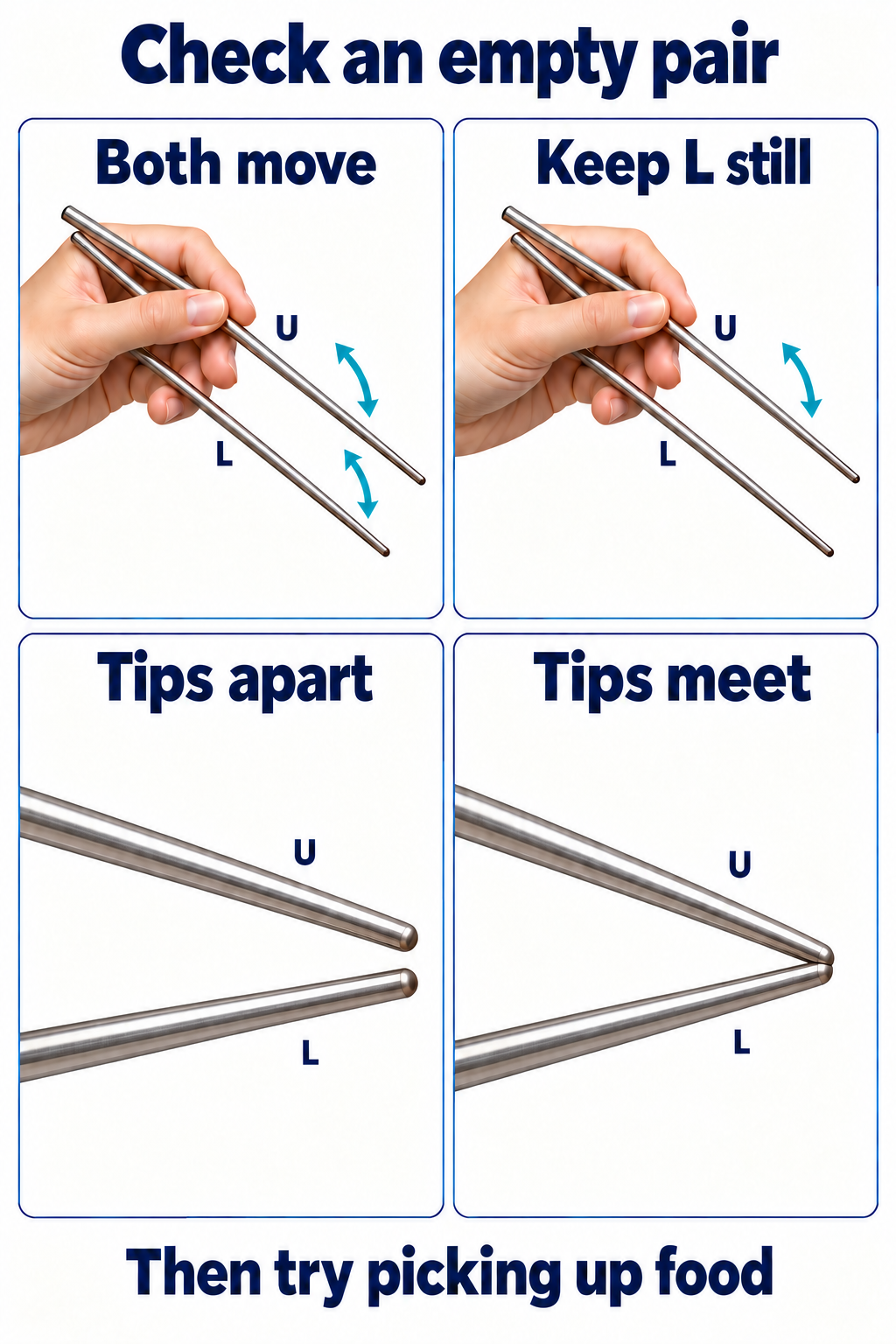
The most useful starting point is to give each stick a separate job. One stick acts as the support, while the other moves to open and close the tips around food.
Step 1: Set the Lower Chopstick in Place
Place the lower chopstick between the base of your thumb and the side of your ring finger. Let it rest against the ring finger rather than gripping it tightly with every finger.
This lower stick should remain mostly steady while you eat. If it moves around whenever you try to pick something up, the two tips will be harder to control.
Step 2: Hold the Upper Chopstick Separately
Hold the upper stick between your thumb, index finger, and middle finger. The index and middle fingers help guide its movement, while the thumb provides support.
Do not press both sticks together with your whole hand. The aim is to control the upper stick while the lower one provides a stable base.
Step 3: Practice Opening and Closing the Tips
Keep the lower stick steady and move the upper stick gently. Open the tips, bring them together, and repeat the motion without picking up food at first.
Watch the two ends rather than focusing only on the fingers near the top. The tips should meet in a controlled way. If the tips do not line up, the food may slip out when you lift it.
Step 4: Start with Larger, Easier Pieces
Once the opening and closing movement feels more consistent, practice with a larger piece of food that is easy to grip. A small piece of vegetable or a firm side dish can be a useful starting point.
Try to pick it up without crushing it or tightening your fingers excessively. When you can lift and place it steadily, move on to smaller pieces.
Flat metal chopsticks may take some adjustment if you are used to rounded wooden ones. Avoid assuming that a stronger squeeze will solve every problem. Controlled movement, aligned tips, and a relaxed grip are more useful starting points.
What Is a Korean Spoon and Chopstick Set?
A traditional Korean place setting commonly includes a spoon and chopsticks. The pair is often called sujeo (수저), a word associated with the spoon-and-chopsticks set.
The two utensils have different jobs. A spoon is convenient for eating rice, soup, and foods that are difficult to lift securely with chopsticks. Chopsticks are useful for picking up individual pieces of vegetables, meat, noodles, and side dishes.
For this reason, Korean dining is not simply a chopstick-only system. The spoon is an important part of the meal, and choosing between the two utensils depends on the food in front of you.
How the Two Utensils Work Together
Consider a meal with rice, soup, and several side dishes. You might use a spoon to eat the rice and take a spoonful of soup. You can then use chopsticks to pick up a piece of kimchi or a vegetable side dish.
This division of tasks is practical rather than absolute. Some foods can be eaten with either utensil, and personal habits vary. The useful point is to recognize that the spoon and chopsticks are complementary tools on the same table.
How to Eat Bibimbap with a Spoon and Chopsticks
Bibimbap is a useful dish for understanding how Korean utensils work together. It usually consists of rice topped with vegetables and other ingredients, often accompanied by gochujang (고추장), a red chili paste. The toppings are arranged over the rice before the ingredients are mixed together.
Step 1: Look at the Ingredients Before Mixing
When your bibimbap arrives, you may see rice at the bottom with vegetables, meat, egg, and sauce arranged on top. Ingredients differ according to the restaurant and regional style, so the bowl does not always contain the same toppings.
Take a moment to see where the sauce is placed and whether it has already been added. If the restaurant serves gochujang separately, you can decide how much to add rather than mixing all of it in immediately.
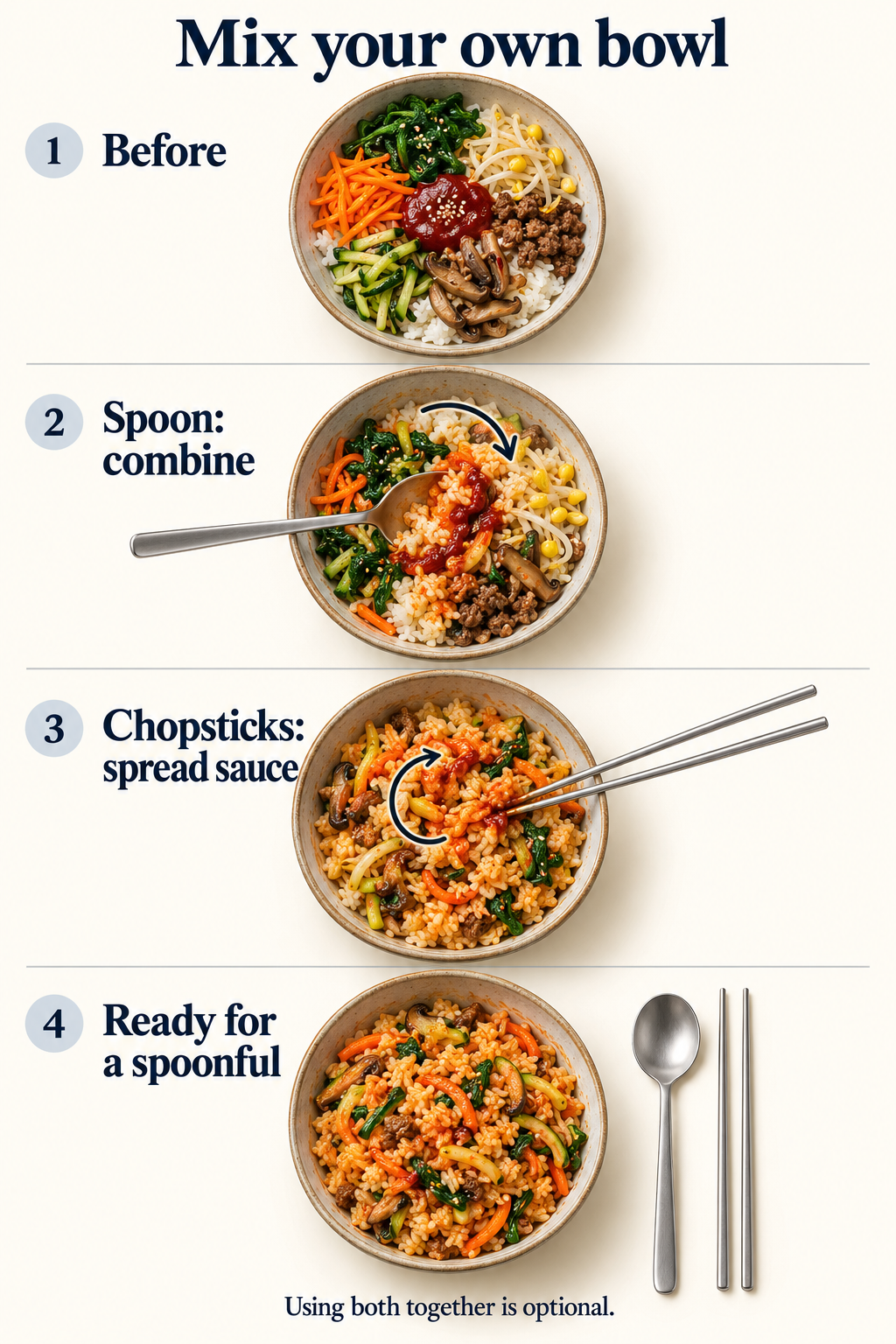
Step 2: Use the Spoon to Combine the Ingredients
A spoon is useful for reaching the rice at the bottom and bringing it together with the toppings. Move the ingredients around the bowl, lifting rice from underneath so that the vegetables and sauce become distributed throughout the mixture.
The Korea Tourism Organization's guide to Jeonju bibimbap describes using a spoon to press and combine the ingredients. It also explains that chopsticks can help distribute the sauce more evenly. This is a practical method for the dish described in that guide, rather than a strict rule that every person must follow.
Step 3: Use Chopsticks to Separate and Handle Individual Ingredients
Chopsticks can help separate vegetables that have clumped together, reposition a larger topping, or pick up a particular ingredient. If a piece of vegetable is difficult to lift, adjust the angle of the tips instead of squeezing harder.
You can also use a spoon in one hand and chopsticks in the other when mixing, if that feels comfortable. The important point is to coordinate the utensils rather than assuming that only one tool is appropriate for the entire meal.
Step 4: Choose the Utensil for Each Bite
Once the ingredients are mixed, a spoon is convenient for picking up rice and several ingredients together. Chopsticks remain useful for individual toppings or pieces that are easier to grasp separately.
There is no need to force every bite into one fixed method. The texture of the food and the size of each portion can guide your choice. If a spoonful contains rice, vegetables, and sauce together, the spoon may be the easier option. If you want to pick up one piece of seasoned vegetable, chopsticks may offer more control.
When Should You Use a Spoon Instead of Chopsticks?
The best utensil depends on what you are eating. Korean meals commonly place rice and soup in front of the diner with a spoon and chopsticks available together. This arrangement makes it natural to switch tools during the same meal.
| Food or Task | Useful Utensil | Why It Helps | Korean Expression | Meaning |
|---|---|---|---|---|
| Rice | Spoon | Easy to collect rice in one scoop | 밥을 먹다 | To eat rice |
| Soup | Spoon | Holds liquid and small ingredients | 국을 먹다 | To eat soup |
| Seasoned vegetables | Chopsticks | Useful for picking up individual pieces | 나물을 집다 | To pick up seasoned vegetables |
| Kimchi | Chopsticks | Helps grip a slice or small portion | 김치를 집다 | To pick up kimchi |
| Mixed bibimbap | Spoon, with chopsticks as needed | Convenient for combining and eating rice with toppings | 비빔밥을 비비다 | To mix bibimbap |
| A separate topping | Chopsticks | Allows you to select one ingredient | 고명을 집다 | To pick up a garnish |
These are practical suggestions, not strict utensil laws. Some people prefer chopsticks for certain foods, while others use a spoon more often. The texture, serving style, and individual preference all influence the choice.
Three Conversations About Korean Chopsticks and Bibimbap
Conversation 1: Practicing with a Friend
Situation: Two friends are eating together. One friend is having difficulty controlling a pair of metal chopsticks.
A: 한국 젓가락은 왜 이렇게 미끄러워?
“Why are Korean chopsticks so slippery?”
B: 금속이라서 처음에는 익숙하지 않을 수 있어.
“Because they're metal, they might feel unfamiliar at first.”
A: 어떻게 잡으면 더 편해?
“How can I hold them more comfortably?”
B: 아래쪽 젓가락은 고정하고 위쪽만 움직여 봐.
“Keep the lower chopstick steady and try moving only the upper one.”
A: 아, 이제 조금 더 잘 잡히는 것 같아.
“Oh, I think I can grip things a little better now.”
Why this conversation works: The question 어떻게 잡으면 더 편해? asks how to hold something more comfortably. The response uses 고정하다, meaning to keep something in a fixed position, and 움직이다, meaning to move. The explanation focuses on controlling the two sticks separately instead of squeezing them together.
Conversation 2: Ordering and Eating Bibimbap
Situation: Two coworkers are having lunch at a Korean restaurant. One has ordered bibimbap for the first time.
A: 비빔밥은 어떻게 먹으면 돼요?
“How should I eat bibimbap?”
B: 먼저 밥이랑 나물을 잘 섞으면 돼요.
“First, you can mix the rice and vegetables well.”
A: 숟가락으로 비비면 되나요?
“Should I mix it with a spoon?”
B: 네. 젓가락으로도 재료를 골고루 섞을 수 있어요.
“Yes. You can also use chopsticks to distribute the ingredients evenly.”
A: 그럼 숟가락으로 먹어 볼게요.
“Then I'll try eating it with a spoon.”
Why this conversation works: 어떻게 먹으면 돼요? asks for a practical way to eat something. The expression -(으)면 돼요 gives a suggestion about what the person can do. The final sentence uses 먹어 볼게요 to express the speaker's intention to try that method.
Conversation 3: Choosing Between the Two Utensils
Situation: A visitor is eating with a Korean colleague and wants to know which utensil is easier for different foods.
A: 밥은 젓가락으로 먹어도 돼요?
“Is it okay to eat rice with chopsticks?”
B: 먹을 수는 있지만 숟가락을 쓰면 더 편해요.
“You can, but using a spoon is more convenient.”
A: 그럼 김치는 젓가락으로 먹을까요?
“Then should I eat kimchi with chopsticks?”
B: 네, 김치처럼 작은 반찬은 젓가락으로 집기 좋아요.
“Yes, chopsticks are useful for picking up small side dishes such as kimchi.”
A: 이제 어떤 도구를 써야 할지 알겠어요.
“Now I understand which utensil to use.”
Why this conversation works: 먹어도 돼요? asks whether an action is acceptable or possible. The answer 먹을 수는 있지만 uses -(으)ㄹ 수 있다 to acknowledge that eating rice with chopsticks is possible, while 더 편해요 explains why the spoon may be more convenient. The response gives a preference without presenting it as an absolute rule.
Useful Korean Expressions for Chopsticks and Bibimbap
These expressions help you ask for utensils, describe how you use them, and talk about the food during a meal.
| Korean Expression | Romanization | Meaning | Example Situation |
|---|---|---|---|
| 젓가락 | jeotgarak | Chopsticks | Asking for chopsticks |
| 숟가락 | sutgarak | Spoon | Eating rice or soup |
| 수저 | sujeo | Spoon-and-chopsticks set | Referring to the dining utensils together |
| 젓가락을 잡다 | jeotgarageul japda | To hold chopsticks | Describing your grip |
| 젓가락으로 집다 | jeotgarageuro jipda | To pick something up with chopsticks | Picking up a vegetable |
| 밥을 뜨다 | babeul tteuda | To scoop rice | Using a spoon |
| 비비다 | bibida | To mix or rub together | Mixing bibimbap |
| 골고루 | golgoru | Evenly; throughout | Mixing sauce with ingredients |
Frequently Asked Questions
Are Korean chopsticks always made of metal?
No. Stainless steel is familiar in modern Korean dining, but historical and other examples include wood, bronze alloys, and different materials. The exact material depends on the utensil and its maker. Korean chopsticks should not be treated as one identical design.
Why are Korean metal chopsticks often flat?
Many commonly encountered Korean metal chopsticks have a flat or slightly rectangular shape. This profile can feel different from rounded wooden chopsticks and may require more careful finger control. However, shapes vary, so not every Korean pair has exactly the same profile.
Should I use a spoon or chopsticks for bibimbap?
A spoon is convenient for combining rice, sauce, and toppings and for eating the mixed portions. Chopsticks can help separate vegetables or handle individual ingredients. You can use both according to the texture of the food and what feels comfortable.
'Real Korean Language & Everyday Korea' 카테고리의 다른 글
| Dad in Korean: Appa, Abeoji, and Using Them in a Sentence (0) | 2026.11.05 |
|---|---|
| Money in Korean: Using 돈 for Cash, Costs, and Payment (0) | 2026.11.04 |
| Excuse Me in Korean: Getting Attention and Asking Your Question (0) | 2026.11.03 |
| Why in Korean: Asking for a Reason and Giving One (0) | 2026.11.03 |
| Hul in Korean: The Slang for Shock, Disbelief, and Speechless Moments "헐~" (0) | 2026.11.03 |
| Jinjja in Korean: "Really?" "Seriously?" and the Nuance Behind 진짜 vs 정말 (0) | 2026.11.02 |
| Gwenchana in Korean: "I'm Okay," "Are You Okay?" and That Comforting Little Word (0) | 2026.11.02 |
| Sad in Korean: Feeling Sad, Looking Sad, and 아쉬워요 (0) | 2026.11.01 |


