돈 and 원: Money Is Not the Same as a Currency Unit
A café menu shows 7,000원. A friend asks whether you have 돈. At the counter, a cashier asks how you would like to pay. English can connect these moments with money, but Korean uses different expressions to show what the speaker means.
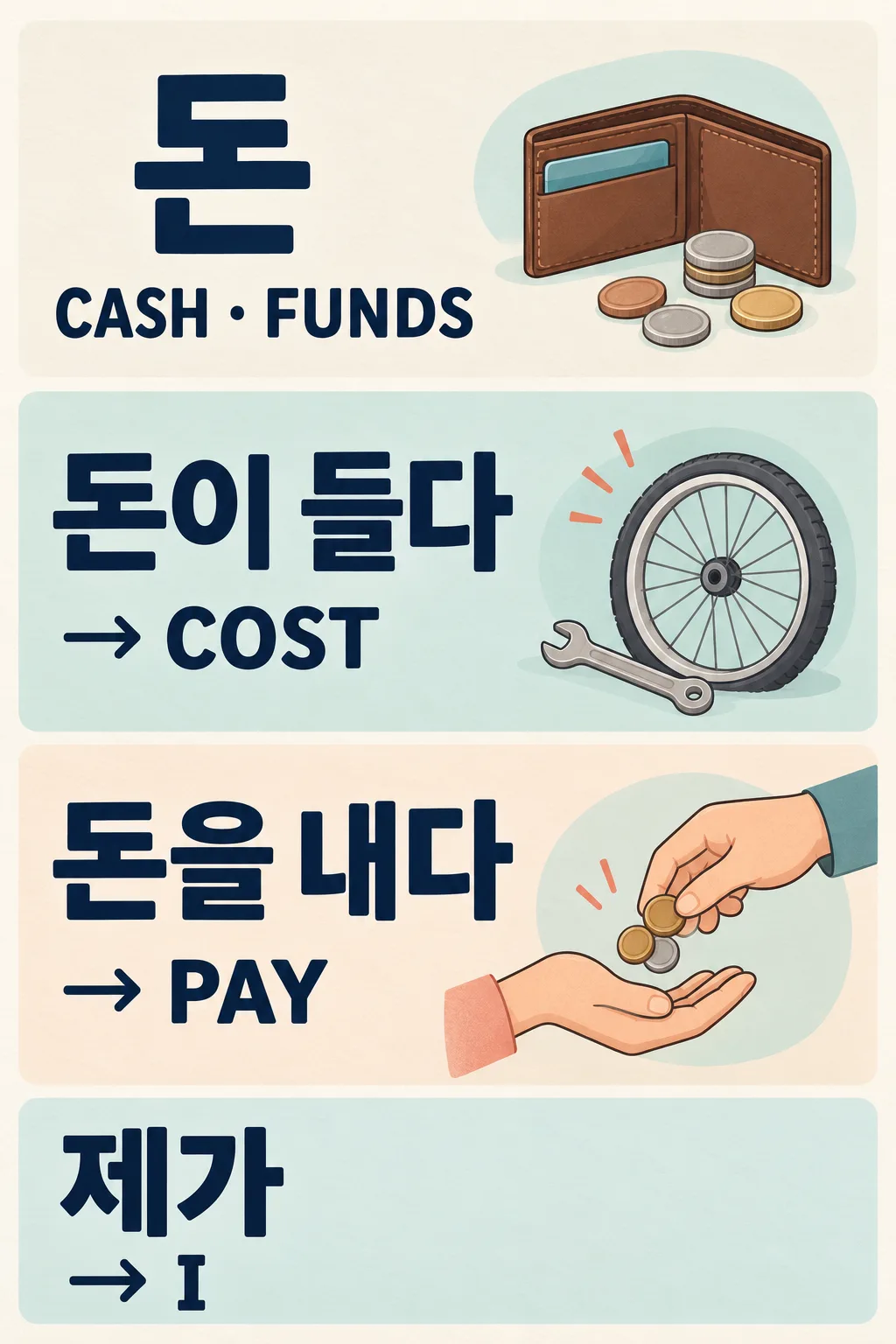
돈 (don) means money in a broad sense. It can refer to funds, cash, or an amount involved in a cost. 원 (won) names the Korean currency unit, written ₩ or KRW. Compare money and dollars in English: money describes the resource, while the currency name identifies the unit used to count it.
한국 돈 means Korean money. 천 원 means one thousand won. 현금 (hyeongeum) means cash: physical notes and coins. A person can have 돈 in a bank account without carrying 현금 in a wallet. 돈 있어요? can ask whether someone has money, while 현금 있어요? asks more specifically whether they have cash available.

Read a Korean Price by Building It
Korean prices commonly use Sino-Korean number words. Start with the pieces needed for a menu price: 칠 (chil) is seven, 천 (cheon) is one thousand, and 원 (won) is the currency unit. The number 7,000 is formed by joining 칠 and 천, then adding 원.
Here is the number knowledge needed for the examples:
- 일 (il) = one; 이 (i) = two; 삼 (sam) = three.
- 오 (o) = five; 칠 (chil) = seven; 구 (gu) = nine.
- 십 (sip) = ten; 백 (baek) = one hundred.
- 천 (cheon) = one thousand; 만 (man) = ten thousand.
For 7,000원, combine 칠 + 천 + 원. Say 칠천 원 (chil-cheon won). In ordinary writing, you may see 7,000원 with Arabic numerals or 칠천 원 with Hangul number words. When speaking, the number is read as one amount, not digit by digit.
Now build another price. A notebook costing 3,000원 is 삼천 원 (sam-cheon won). For 12,000원, 만 and 이천 combine as 만 이천 원 (man i-cheon won). Korean groups large amounts around ten thousand, so the structure differs from an uninterrupted English-style “twelve thousand.”
Useful questions include 얼마예요? (eolmayeyo?) — “How much is it?” and 이거 얼마예요? — “How much is this?” A cashier may answer 칠천 원이에요. (chil-cheon won-ieyo.) — “It’s 7,000 won.” The KBS currency lesson teaches 돈, 원, 칠, 천, and 만 together. Its old exchange-rate example is historical and should not be treated as a current rate.
돈, 값, 가격, and 비용 Describe Different Parts of a Transaction
These nouns overlap, but each directs attention to a different part of the situation.
돈 is the broad resource. 돈이 있어요 means “I have money.” 돈이 많이 들었어요 means “It cost a lot of money.” The verb 들다 in this construction describes money being required or spent.
값 (gap) is the value or price of something. 책값 means the price of a book. 값이 비싸요 means “The price is high,” or naturally, “It’s expensive.” 값 can also refer to what is paid or received in an exchange, so the surrounding sentence matters.
가격 (gagyeok) is the stated price. 메뉴 가격을 확인했어요 means “I checked the menu price.” It suits labels, comparisons, product listings, and discussions about how much an item is priced at.
비용 (biyong) is a cost or expense connected with an activity or service. 배송 비용 is a delivery cost. 여행 비용 means travel expenses. It often points to the money required to complete something rather than the tag attached to one item.
Compare a meal. 음식 가격은 12,000원이에요 describes the listed price of a dish. 식사 비용은 15,000원 들었어요 reports the amount spent on the meal overall. The first sentence focuses on the item; the second describes an expense.
The same offer at three levels
With a close friend, 내가 낼게 (naega naelge) is casual: “I’ll pay.” With someone you address politely, 제가 낼게요 (jega naelgeyo) is a natural offer. In a formal business statement, 제가 지불하겠습니다 (jega jibulhagetseumnida) sounds more deliberate and official. The choice reflects the relationship and setting; the amount itself does not decide the speech level. The verb 내다 is common in everyday payment talk, while 지불하다 often appears in formal explanations and administrative contexts.
Who Pays? Three Conversations in Context
With a close friend: offering to pay
Situation: Two friends finish coffee. One reaches for the card reader.
A: 내가 낼게. (naega naelge.) — I’ll pay.
B: 진짜? 다음에는 내가 살게. (jinjja? daeum-eneun naega salge.) — Really? I’ll treat you next time.
A: 좋아. 오늘은 내가 낼게. (joa. oneureun naega naelge.) — Sounds good. I’ll cover it today.
낼게 comes from 내다, to pay or put up money. 살게 literally uses 사다, “to buy,” and in this setting means “I’ll treat you.” 내가 identifies the person taking responsibility. These casual endings fit friends who already speak informally.
At work: identifying the expense and payer
Situation: Colleagues arrange a meeting-room rental and check the reimbursement process.
A: 회의실 대여 비용은 누가 내나요? (hoeuisil daeyeo biyong-eun nuga naenayo?) — Who pays the meeting-room rental cost?
B: 회사에서 지불해요. (hoesae-seo jibulhaeyo.) — The company pays.
A: 영수증은 제가 제출할게요. (yeongsujeung-eun jega jechulhalgeyo.) — I’ll submit the receipt.
비용 names the expense, and 회사에서 identifies the company as payer. 지불하다 is a clear verb for making a payment, often suitable for administrative or business explanations. 제가 marks the speaker politely as the person submitting the receipt; it does not mean that the speaker personally pays the bill.
In a shop: asking about price and payment method
Situation: A customer wants a small item and asks its price before choosing a payment method.
A: 이거 얼마예요? (igeo eolmayeyo?) — How much is this?
B: 오천 원이에요. 현금이나 카드로 결제하실 수 있어요. (ocheon won-ieyo. hyeongeum-ina kadeuro gyeoljehasil su isseoyo.) — It’s 5,000 won. You can pay by cash or card.
A: 카드로 계산할게요. (kadeuro gyesanhalgeyo.) — I’ll pay by card.
결제하다 refers to making a payment through a method or system. 계산하다 can mean calculating, settling an account, or paying at a shop or restaurant. The cashier’s wording and the customer’s response fit a service interaction. 현금 and 카드 name the method; 원 states the amount.
Short Messages About Money
In a chat, friends may write 돈 보내 줄래? when asking someone to send money, or 내가 보낼게 when promising to transfer it. A more polite message is 돈 보내 주실 수 있어요? (don bonae jusil su isseoyo?) — “Could you send me the money?” The request is direct, so the relationship and reason for the transfer matter.
돈 없어 can mean “I don’t have money.” It does not automatically mean “I’m broke” in every situation. At a cash-only shop, 돈 없어요 may be understood as not having money available to pay, but 현금이 없어요 more precisely says “I don’t have cash.” Someone with a bank card may have funds while carrying no notes or coins.
For a clear statement about the payer, use 제가 낼게요 (jega naelgeyo) — “I’ll pay.” To say everyone will pay separately, 각자 낼게요 (gakja naelgeyo) means “We’ll each pay.” To say the speaker paid already, 제가 돈을 냈어요 (jega doneul naesseoyo) means “I paid the money.” 제가 identifies the payer, while 내다 expresses the act of paying.
Other everyday verbs make a budget conversation more precise. 돈을 벌다 means to earn money; 돈을 모으다 means to save or collect it; 돈을 아끼다 means to spend carefully; 돈을 쓰다 means to spend it. 월급 is salary, 용돈 is allowance or pocket money, and 잔돈 is change. These words describe where funds come from, how someone keeps them, and what remains after a purchase. They are useful when talking about personal spending rather than a shop’s displayed price.
Choose the Expression That Matches the Situation
| Expression (한국어) | Pronunciation | Speech Level | Best Situation | Natural Reply / Nuance |
|---|---|---|---|---|
| 돈이 있어요 | don-i isseoyo | Polite | Talking about money or funds | Broad meaning; not necessarily cash in hand |
| 현금이 없어요 | hyeongeum-i eopseoyo | Polite | No physical cash available | A card or bank balance may still be available |
| 가격이 얼마예요? | gagyeok-i eolmayeyo | Polite | Asking an item’s listed price | 칠천 원이에요 — It is 7,000 won |
| 비용이 들었어요 | biyong-i deureosseoyo | Polite | Reporting an expense | Names the cost required for an activity |
| 제가 낼게요 | jega naelgeyo | Polite | Offering to pay | The speaker takes responsibility |
| 카드로 결제할게요 | kadeuro gyeoljehalgeyo | Polite | Choosing card payment | Names the payment method |
Frequently Asked Questions
Is 돈 the same as 원?
No. 돈 means money in a broad sense, while 원 is the name of the Korean currency unit. You can say 돈이 필요해요 when you need money, and 삼천 원 when stating an amount of 3,000 won. Use 현금 when you specifically mean physical cash.
How do I read 7,000 won in Korean?
Read it as 칠천 원 (chil-cheon won). 칠 means seven and 천 means one thousand, so the amount is built from the number parts before adding 원. The same pattern helps with other prices, such as 삼천 원 for 3,000 won.
How do I say “I’ll pay” in Korean?
제가 낼게요 (jega naelgeyo) is a natural polite way to say “I’ll pay.” With a close friend, 내가 낼게 (naega naelge) is casual. 계산할게요 can also mean “I’ll pay” when settling a bill at a shop or restaurant; the verb depends on the payment scene.
'Real Korean Language & Everyday Korea' 카테고리의 다른 글
| Korean Chopsticks: A Steady Grip and a Bowl of Bibimbap (0) | 2026.11.05 |
|---|---|
| Dad in Korean: Appa, Abeoji, and Using Them in a Sentence (0) | 2026.11.05 |
| Excuse Me in Korean: Getting Attention and Asking Your Question (0) | 2026.11.03 |
| Why in Korean: Asking for a Reason and Giving One (0) | 2026.11.03 |
| Hul in Korean: The Slang for Shock, Disbelief, and Speechless Moments "헐~" (0) | 2026.11.03 |
| Jinjja in Korean: "Really?" "Seriously?" and the Nuance Behind 진짜 vs 정말 (0) | 2026.11.02 |
| Gwenchana in Korean: "I'm Okay," "Are You Okay?" and That Comforting Little Word (0) | 2026.11.02 |
| Sad in Korean: Feeling Sad, Looking Sad, and 아쉬워요 (0) | 2026.11.01 |


