Ottoke Meaning, When to Write 어떡해 and When to Correct It
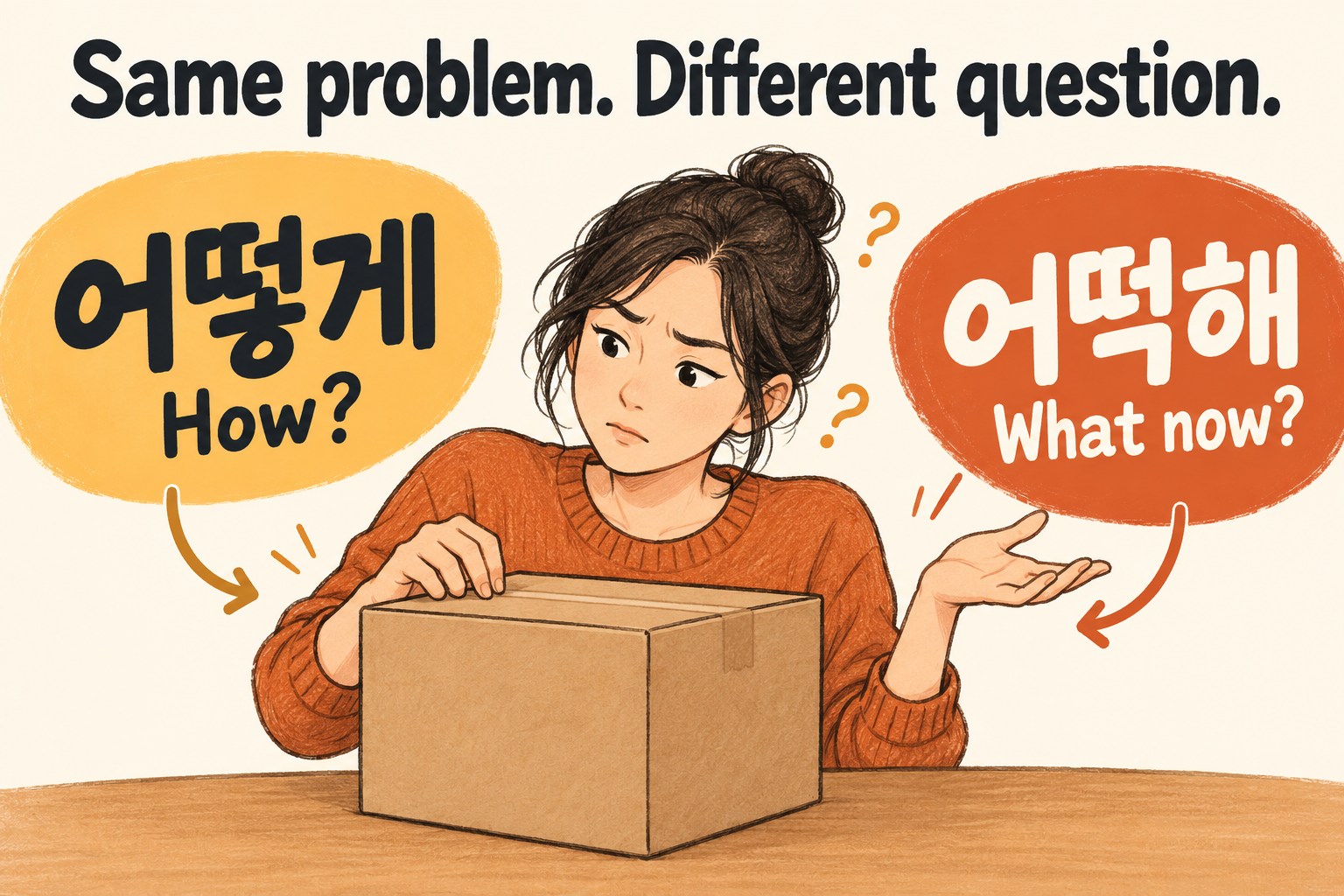
It is Saturday night at Seoul Station and the ticket machine has rejected your card three times. The line behind you is growing, the KTX departure board has started flashing, and you text your Korean friend the only word panic has left you: "ottoke??" The reply comes in eight seconds: 어떡해 is 어떻게 해, and if you're asking how to use the machine, write 어떻게. One letter of spelling has just split your situation into two different questions — what should I do about this, and how does this machine work — and Korean refuses to blur them. That refusal is the entire lesson of ottoke, and it is learnable in one sitting.
어떡해 and 어떻게 differ by one letter and one job
The longer form comes first. 어떻게 (eotteoke) means "how" and asks about the manner of an action. It needs another verb in the sentence to ask about: 이 상자 어떻게 열어요? — "How do I open this box?" The verb 열어요 ("open") supplies the action, and 어떻게 supplies the question about method.
어떡해 (eotteokae) is a contraction of 어떻게 해, literally "how does it become / how does one do," which collapsed into a single word and took the panic with it. Because the verb 해 ("do") is already fused inside it, 어떡해 does not ask how something is done. It asks what to do about the situation — "What should I do?" "Oh no, now what?" That is why it arrives in sentences like 상자가 안 열려. 이제 어떡해? — "The box won't open. What do we do now?" The opening action belongs to the previous sentence; 어떡해 reacts to the mess.
So the rule is not really about spelling at all. If the sentence already has its action verb, you want 어떻게. If the word stands alone facing a problem with no verb in sight, you want 어떡해.
The National Institute of Korean Language was asked directly whether 이럴 땐 어떻게 해? ("What does one do in a situation like this?") can be shortened to 이럴 땐 어떡해? Its answer allows the contraction grammatically in that context, while judging from its own examples that the contracted form is not much used for asking about a method. In practice: 이럴 땐 어떡해? is not an error, but if you specifically want the method, 어떻게 해? says so without ambiguity.
One panic, five levels of politeness
The root verb is 어떠하다, and it conjugates down the usual ladder.
어떡해 is 반말, for friends, siblings, and the voice inside your own head. 어떡해요 is the polite form and the safe default for strangers, colleagues, and anyone older you are on good terms with. 어떡하죠 turns the question outward with the honorific -죠, softening it into "what should we do, then?" — the version you use to a shop clerk, a professor, or a taxi driver whose meter is climbing. 어떡합니다 exists in very formal speech but is rare; formal settings prefer restating the problem and asking for guidance. Finally, 어떡하지 is the musing form, said to nobody in particular when something goes wrong and there is no one to ask.
English translates all of them as "what should I do," but the Korean subject is still unstated. Depending on the situation, 어떡해요 can mean "what should I do," "what should we do," or "what is to be done" — context supplies the sufferer, which is why it sounds natural in a workplace email as well as a group chat.
Three conversations you will actually have
Between friends (반말)
A: 내 폰이 물에 빠졌어. 어떡해? — Nae poni mure ppajyeosseo. Eotteokae? — My phone fell in the water. What do I do? B: 일단 꺼. 나중에 켜지 말고. — Ildan kkeo. Najunge kyeoji malgo. — Turn it off first. Don't turn it on again later.
At work, polite (존댓말)
A: 보고서를 잘못 보냈어요. 이제 어떡해요? — Bogoseoreul jalmot bonaesseoyo. Ije eotteokhaeyo? — I sent the report to the wrong person. What should I do now? B: 회수 요청부터 하세요. — Hoesu yocheongbuteo haseyo. — Request a recall first, before anything else.
With an elder or a stranger (존댓말, softened)
A: 차가 막혀서 늦을 것 같은데 어떡하죠? — Chaga makyeoseo neujeul geot gateunde eotteokajyo? — Traffic is bad and I'll probably be late. What should I do? B: 괜찮아요, 천천히 오세요. — Gwaenchanayo, cheoncheonhi oseyo. — It's fine, come slowly.
The -죠 version is the one foreigners underuse and Koreans notice. It asks for guidance without demanding an answer, which is exactly the register service situations run on.
The mistakes that make the sentence mean the opposite
The classic correction: a learner who wants to ask "How do I open this box?" writes 이 상자 어떡해 열어요? The form is wrong because 어떡해 already contains 해, so expanding it puts 어떻게 해 in front of another action verb — "how does one do open this box." The fix is the spelling swap to 이 상자 어떻게 열어요? The crossed-out version is not a politer variant; it is a different question.
Second, the typo 어떡게. Both correct forms start with 어떠- or 어떻-, and the string 어떡게 is not a standard spelling of either. If you can say the phrase out loud — 어떡해 has a hard k sound ending the second syllable — the spelling follows.
Third, correcting a word that was never wrong. A friend points at a broken umbrella and writes 이걸 어떻게 고쳐? — "How do I fix this?" The verb 고쳐 supplies the action, so 어떻게 is correct and any change to 어떡해 would break the sentence. The same discipline applies to you as a reader: if all you have is the romanization "ottoke," ask for the Korean. Without the spelling or the rest of the message you cannot tell whether anything needs correcting, because both words are pronounced close enough to share the romanization.
Fourth, tone mismatch at work. 어떡해요! with exclamation marks reads as helpless panic in a professional thread, even when the grammar is polite. Korean workplace writing prefers naming the problem and asking for a specific: 문제가 발생해서 공유드립니다 ("a problem has come up; sharing for your awareness"). Save the drama for the group chat.
Fifth, assuming ottoke always translates as "what should I do." In 이럴 땐 어떻게 해? the question is "what does one do in this situation," close to "how is this handled" — a request for a method, not a cry of distress. Context and the surrounding verbs decide, which is why the spelling matters more than the sound.
When the panic goes into the group chat
Korean internet culture built an entire meme family on this word. Reply to any 어떡해 with 어쩔티비 and you have answered distress with a nonsensical rhyme — it abbreviates 어쩔 수 없지, 티비 ("can't be helped, TV"), a 2022 meme whose variant 저쩔티비 answers 어떡하지. It is dismissive by design, funny inside a friend group and rude to anyone older, and it marks exactly the line the serious grammar draws: 어떡해 is a real question, 어쩔 is a shrug. Alongside them, everyday chat keeps ㅇㅋ for "OK" and ㅇㅇ for a casual "yeah, yeah," both of which pair naturally with a plan that replaces the panic.
Ottoke at a glance
| 어떻게 | Asks how an action is done | 이거 어떻게 열어요? | Neutral, needs a verb |
| 어떡해 | Reacts: what to do now | 상자가 안 열려. 어떡해? | 반말 |
| 어떡해요 | Same question, polite | 이제 어떡해요? | 존댓말 |
| 어떡하죠 | Asks for guidance, softened | 늦을 것 같은데 어떡하죠? | 존댓말, service situations |
| 어떡하지 | Musing to oneself | 이제 어떡하지? | Self-directed |
Frequently asked questions
What does ottoke (어떡해) mean? 어떡해 means "What should I do?" It is the contraction of 어떻게 해, with the verb 해 ("do") fused inside it, and it reacts to a problem rather than asking about a method. The similar-looking 어떻게 means "how."
어떡해 or 어떻게 — which spelling do I use? If your sentence already has its action verb, use 어떻게: 이 상자 어떻게 열어요? ("How do I open this box?"). If the word stands alone facing a problem, use 어떡해: 상자가 안 열려. 이제 어떡해? ("The box won't open. Now what?"). 어떡해 already contains "do," so it never takes another action verb after it.
Is 어떡해 informal? How do I say it politely? 어떡해 by itself is 반말, casual speech. The polite form is 어떡해요, and the softened version asking for guidance is 어떡하죠, which suits strangers, elders, and service situations. The spelling changes with the level: 어떡해, 어떡해요, 어떡하죠.
'Real Korean Language & Everyday Korea' 카테고리의 다른 글
| Korean Texting Slang, Read the Letters Without Inventing the Missing Words (0) | 2026.10.29 |
|---|---|
| Korean Sentence Structure, Roles and Verb Groups in Korean Word Order (0) | 2026.10.29 |
| Korean Verb Conjugation, A Starter Table and Two Stem Mistakes (0) | 2026.10.29 |
| Cute in Korean, Who the Sentence Is Describing (0) | 2026.10.29 |
| Yeoboseyo Meaning, A Phone Hello and the Replies It Allows (0) | 2026.10.29 |
| Daebak Meaning Beyond Awesome (0) | 2026.10.29 |
| Hajima Meaning and What Someone Is Telling You Not to Do (0) | 2026.10.29 |
| Batchim Rules, Keep Spelling and Final Sounds Apart (0) | 2026.10.29 |


