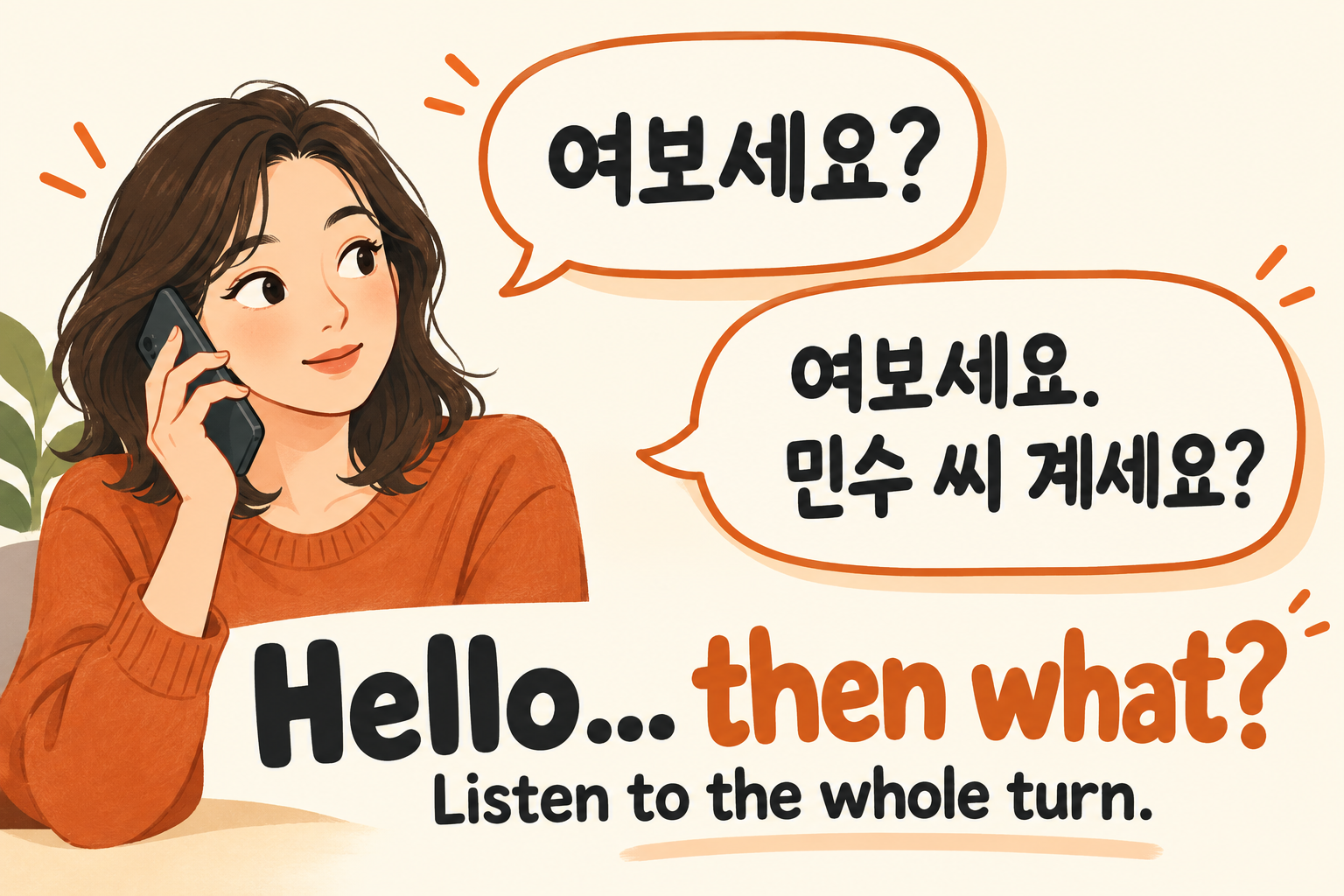
여보세요? Your phone rings on a crowded Line 2 train. The screen shows a number you do not know, the car is loud, and every second the caller waits feels longer to them than to you. You press accept and say the one Korean word that half the world already knows from television: 여보세요 (yeoboseyo). The voice on the other end starts talking immediately, as if that single word had unlocked the line. In a way, it did. Korean does not actually open a phone call with a greeting at all. 여보세요 is something older and stranger: a request to be looked at. Once you see what the word is really asking for, the replies it allows stop feeling random, and the first ten seconds of a Korean phone call become predictable.
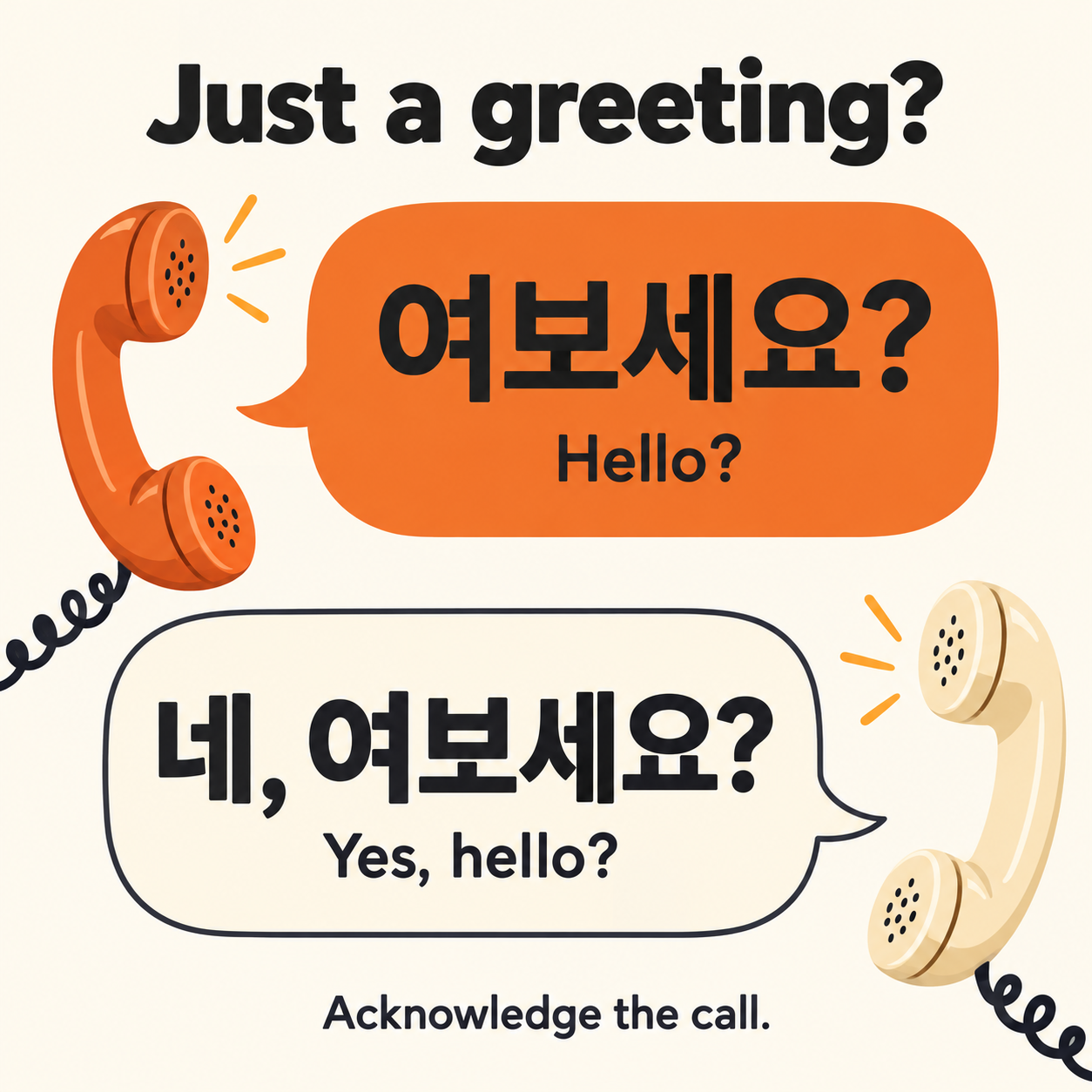
여보세요 comes from a request to look, not from a greeting
Take the word apart and it is not a hello. The ending -세요 is the honorific form of 보다, the verb "to see" or "to look," so 보세요 means "please look." The syllable 여- is a leftover of 여보, an old way of calling out to catch someone's attention. The same 여보 still stands alone today between married couples, where it means something like "honey" or "dear." Put the pieces together and 여보세요 began life as roughly "look here, please look this way."
That origin explains exactly where the word is allowed to live. One place is the telephone: two people who cannot see each other need to call for attention before any information can travel, so each side can open with 여보세요 and the conversation starts from zero. The other place is real space. You can say 여보세요! to pull the attention of someone nearby, the way English uses "hey, over here," though in modern Seoul you will hear it less often than a shouted 죄송한데요 or a wave of the hand.
Because the word already contains the honorific -세요, it carries its own politeness toward the listener. You do not upgrade it or downgrade it. What changes from situation to situation is whether Koreans reach for it at all, and that is the part most learners never get told.
The word is fixed, but the choice to use it changes with the listener
여보세요 never changes its own ending, so the speech-level work happens around it. Three openings cover almost every call you will ever make.
To a stranger or an elder, 여보세요 is the default and the safe choice. It is already respectful, and the National Institute of Korean Language confirmed in a March 20, 2025 answer about customer-service calls that telephone 여보세요 is not readily classified as banmal, or informal speech: it can address someone above you or below you in status. The institute also left room for each workplace to prefer its own opening rather than prescribing a replacement.
Between close friends, the full form often disappears. The casual contraction 여어 (yeoeo) survives in speech, and many younger speakers skip the greeting entirely and open with a name, an 야, or even a plain 응? The intimacy is shown by dropping the ceremony, not by adding a ruder word.
At work, many organizations replace the greeting with identification: (회사명)입니다, "This is (company name)," or a department and then the speaker's name. If you answer phones in a Korean office, ask a colleague what the house opening is on your first day, because the script varies by company.
Three conversations you will actually have
The fastest way to make the opening yours is to hear where each register sits.
Between friends (반말)
A: 여어, 나야. — Yeoeo, naya. — Hey, it's me. B: 응, 무슨 일 있어? — Eung, museun il isseo? — Yeah, what's up? A: 오늘 저녁에 시간 있어? — Oneul jeonyeoge sigan isseo? — Do you have time this evening?
Nobody says 여보세요. The contraction and the drop into 반말 signal closeness before the first real sentence.
A polite call to a classmate's mother (존댓말)
A: 여보세요. — Yeoboseyo. — Hello? B: 여보세요, 선생님 뵈려고요. 저는 지수의 친구예요. — Yeoboseyo, seonsaengnim bworyeogoyo. Jeoneun Jisoui chinguiyeyo. — Hello, I'm calling to see the teacher. I'm Jisu's friend. A: 아, 네. 잠시만 기다려 주세요. — A, ne. Jamsiman gidaryeo juseyo. — Oh, yes. One moment, please.
Here the caller answers 여보세요 and then moves into polite speech at once. The greeting opens the line; the honorific endings do the respect.
Calling a restaurant (격식)
A: 여보세요, 내일 저녁 여섯 시에 두 명 예약 가능한가요? — Yeoboseyo, naeil jeonyeok yeoseot sie du myeong yeyak ganeunhangayo? — Hello, could we book a table for two at six tomorrow evening? B: 네, 가능합니다. — Ne, ganeunghamnida. — Yes, that's possible.
The restaurant answers with the formal -습니다 style. Notice that the caller used 여보세요 only once; the rest of the turn carried the request.
The mistakes that make callers panic
The most common error is carrying the word into person. Greeting someone face to face with 여보세요 sounds theatrical, because the word exists for people who cannot see each other. In person, 안녕하세요 is the greeting; 여보세요 is for the phone, for catching attention across a room, and almost nothing else.
Second, do not confuse 여보세요 with 여보. The longer form is the phone word. The shorter 여보 is what married couples call each other, and using it toward a stranger, a colleague, or someone you have just met is a serious misstep, not a cute one.
Third, calling a waiter or a shop clerk with 여보세요 will turn heads. The word for summoning staff is 저기요, and the polite attention-getter for a stranger is 죄송한데요. Reserve 여보세요 for the phone.
Fourth, learners often believe both sides must say the word, because that is what movies show. In real calls, the receiver usually says it and the caller moves straight into business, as in the restaurant exchange above. Mirroring it back is allowed but not required, and replying 네, 여보세요? to a silent caller simply invites them to state their business.
Fifth, when you cannot hear the caller, Koreans rarely repeat 여보세요 mid-conversation. 네? or 죄송한데, 잘 안 들려요 — "Sorry, I can't hear you well" — is the natural repair, and 여보세요, 제 말 들리세요? ("Can you hear me?") is for checking whether your own voice is coming through, for example in a tunnel or on a bad connection.
When the call becomes a text thread
Phone culture spills into KakaoTalk, and a few codes surround the call itself. To say hello in text, Koreans write ㅎㅇ, the initials of 하이 (hai, "hi"), or simply 안녕. The borrowed word 콜 (kol, from "call") has drifted from the phone into agreement: replying 콜! to a plan means "deal, it's on." If you are asking someone to hold on, ㄱㄷ stands for 기다려 (gidaryeo, "wait"). And when a call goes unanswered, one short ring and a hang-up often means "call me back when you see this" — texting 전화 왜 못 받아? ("why didn't you pick up?") after two ignored calls is a mild reproach, which is why Koreans count the rings.
Yeoboseyo at a glance
| Answering a call, polite default | 여보세요 | 여보세요? | Works for strangers and elders |
| Answering a close friend | 여어 / a name | 여어, 나야 | Ceremony dropped, not downgraded |
| Answering at work | (회사명)입니다 | OOO입니다입니다 | Ask for the house script |
| Greeting in person | 안녕하세요 | 안녕하세요! | 여보세요 is not a face-to-face hello |
| Calling staff | 저기요 | 저기요, 주문할게요 | Never 여보세요 in a café |
| Spouse, calling across a room | 여보 | 여보, 이것 좀 봐 | Separate word, not a short form |
Frequently asked questions
What does yeoboseyo (여보세요) mean in Korean? 여보세요 means "hello?" on the phone. Literally it is a polite request to look this way, built on 보다, "to see," which is why it also works for calling attention to someone nearby. It opens the line; it does not carry a meaning of greeting the way 안녕하세요 does.
Is 여보세요 polite or informal? It is neutral to polite and safe with strangers and elders, because the honorific -세요 is built into the word. The National Institute of Korean Language says it is not readily classified as banmal on the phone, since it can address anyone in either direction.
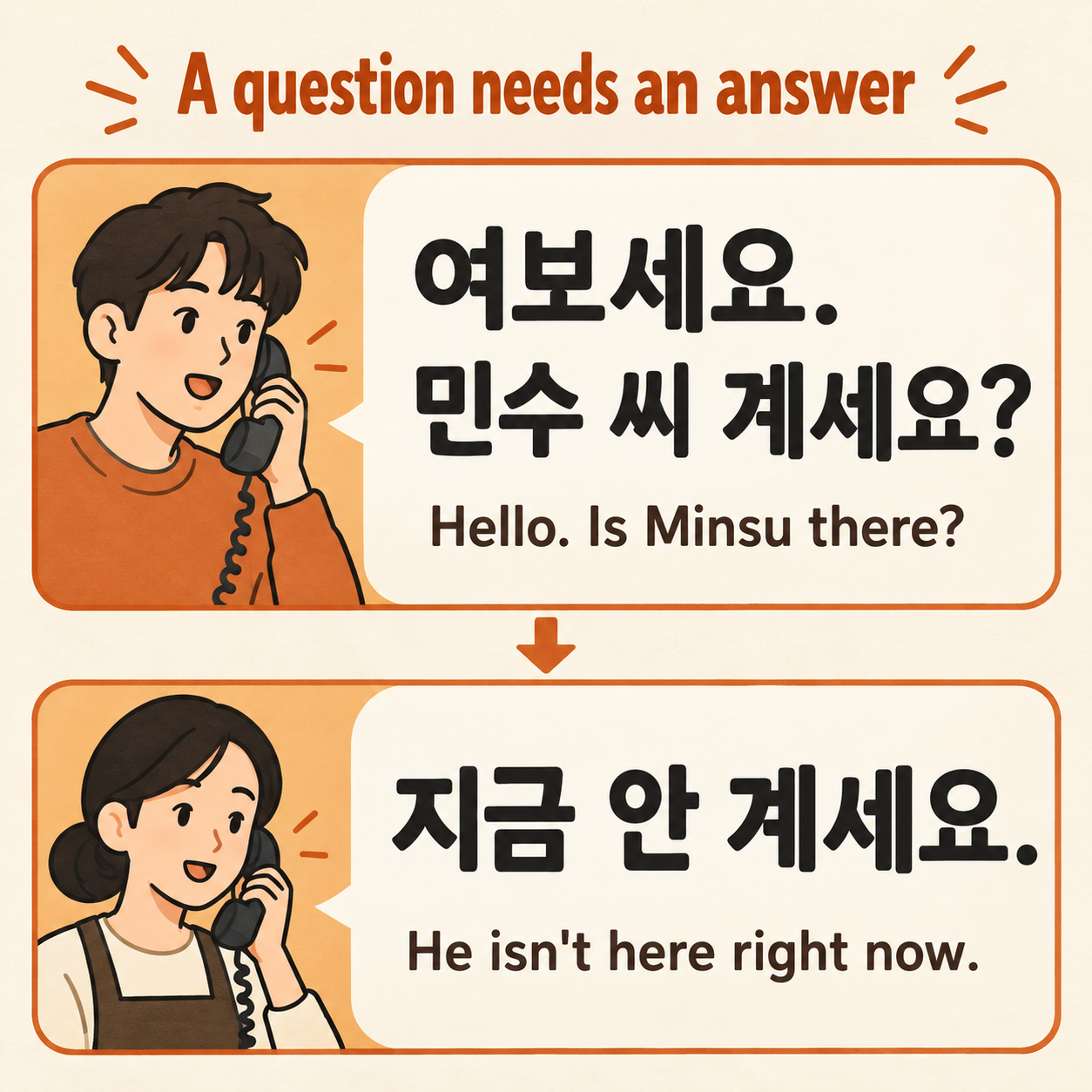
What do you reply when someone says 여보세요? If the caller says only 여보세요?, you can answer 네, 여보세요? or simply 네?, inviting them to speak. If they asked a question in the same breath, such as 여보세요, 지연 씨 계세요? ("Hello, is Jiyeon there?"), skip the greeting and answer the question directly: 네, 잠시만요 ("Yes, one moment").
'Real Korean Language & Everyday Korea' 카테고리의 다른 글
| Korean Sentence Structure, Roles and Verb Groups in Korean Word Order (0) | 2026.10.29 |
|---|---|
| Korean Verb Conjugation, A Starter Table and Two Stem Mistakes (0) | 2026.10.29 |
| Cute in Korean, Who the Sentence Is Describing (0) | 2026.10.29 |
| Ottoke Meaning, When to Write 어떡해 and When to Correct It (0) | 2026.10.29 |
| Daebak Meaning Beyond Awesome (0) | 2026.10.29 |
| Hajima Meaning and What Someone Is Telling You Not to Do (0) | 2026.10.29 |
| Batchim Rules, Keep Spelling and Final Sounds Apart (0) | 2026.10.29 |
| Hangul Alphabet, Read the Letters Inside a Syllable (0) | 2026.10.29 |


