Daebak Meaning Beyond Awesome

대박 (daebak) can mean a big success, or serve as a reaction such as “Wow!” Translating every occurrence as “awesome” loses an important difference: a sentence may report that something became a hit, while a short reaction may only show that the speaker is surprised.
The words around it help you decide which reading fits. A verb such as 나다 supplies information that the standalone word does not.
What does daebak mean in a sentence about success?
The National Institute of Korean Language's learner dictionary lists 대박 as a noun meaning a great success. It records combinations including 대박이 나다 and 대박이 터지다. Neither expression requires a lottery or a gambling scene: the dictionary also illustrates success in entertainment.
If you want to describe a film as a hit, compare these sentences:
- 그 영화가 대박이 났어요.
“That film became a big hit.” - 그 영화는 대박이에요.
“That film is a big hit.”
Both assess the film positively. The first uses 났어요, a past form of 나다, to report the success as something that happened. The second identifies the film as a hit with 이에요. An English translation can sound similar, but the Korean sentences are not built from the same ending. Both end in polite 요; a bare 대박! has no polite ending.

Do not take the English adjective “awesome” and assume that 대박 itself conjugates like a Korean adjective. In these examples it remains a noun. The verb 나다 or the following 이다 form does the grammatical work.
Daebak in Korean can show surprise without approval
Study Korean's lesson on 대박 explains a wider range of uses, including surprise at something unexpected or newly learned. That makes “That's great!” a risky automatic translation when the surrounding event is not good news.
If you caption 대박! in these two situations, the same reaction can call for different English wording.
| What the speaker has just learned | Reaction | A possible English caption |
|---|---|---|
| A friend's film won an award. | 대박! | “Wow!” or “That's amazing!” |
| A ticket unexpectedly costs ten times the price the speaker had expected. | 대박! | “Wow!” or “No way!” |
In the first situation, an approving reading fits the good news. In the second, the reaction could express astonishment at the price; it is not evidence that the speaker likes the price. Delivery and the rest of the conversation can change the interpretation.

If all you have is an isolated text message saying 대박, leave the speaker's exact attitude unresolved. “Wow” may preserve that uncertainty better than a translation that adds praise. Likewise, the standalone word does not prove that a business made money or a film sold many tickets. For that claim, look for the sentence or situation being described.
A noun label and an exclamatory use are not a contradiction
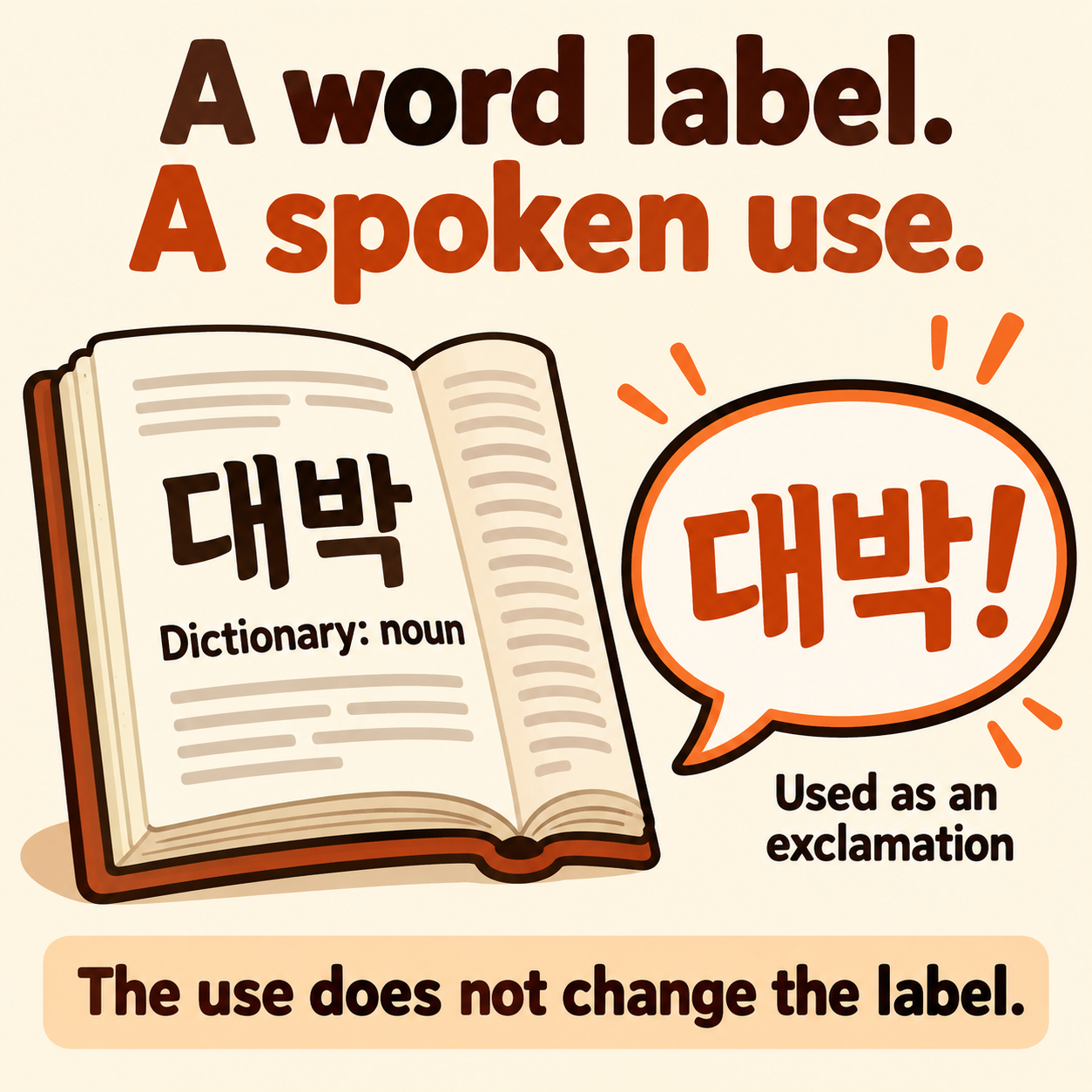
A dictionary's part-of-speech label and a description of how someone uses a word answer different questions. The National Institute of Korean Language notes that the Standard Korean Language Dictionary does not classify 대박 as an interjection. Calling its standalone use an exclamation describes its conversational role; it need not change the dictionary classification.
The learner dictionary marks 대 as the Sino-Korean element 大 and 박 as a native Korean element. It does not support a claim that the word consists of two Chinese characters. A translation such as “jackpot” is not, by itself, proof of a gambling origin.
'Real Korean Language & Everyday Korea' 카테고리의 다른 글
| Korean Verb Conjugation, A Starter Table and Two Stem Mistakes (0) | 2026.10.29 |
|---|---|
| Cute in Korean, Who the Sentence Is Describing (0) | 2026.10.29 |
| Ottoke Meaning, When to Write 어떡해 and When to Correct It (0) | 2026.10.29 |
| Yeoboseyo Meaning, A Phone Hello and the Replies It Allows (0) | 2026.10.29 |
| Hajima Meaning and What Someone Is Telling You Not to Do (0) | 2026.10.29 |
| Batchim Rules, Keep Spelling and Final Sounds Apart (0) | 2026.10.29 |
| Hangul Alphabet, Read the Letters Inside a Syllable (0) | 2026.10.29 |
| Korean Counters, What the Counting Word Actually Counts (0) | 2026.10.28 |


