Batchim Rules, Keep Spelling and Final Sounds Apart
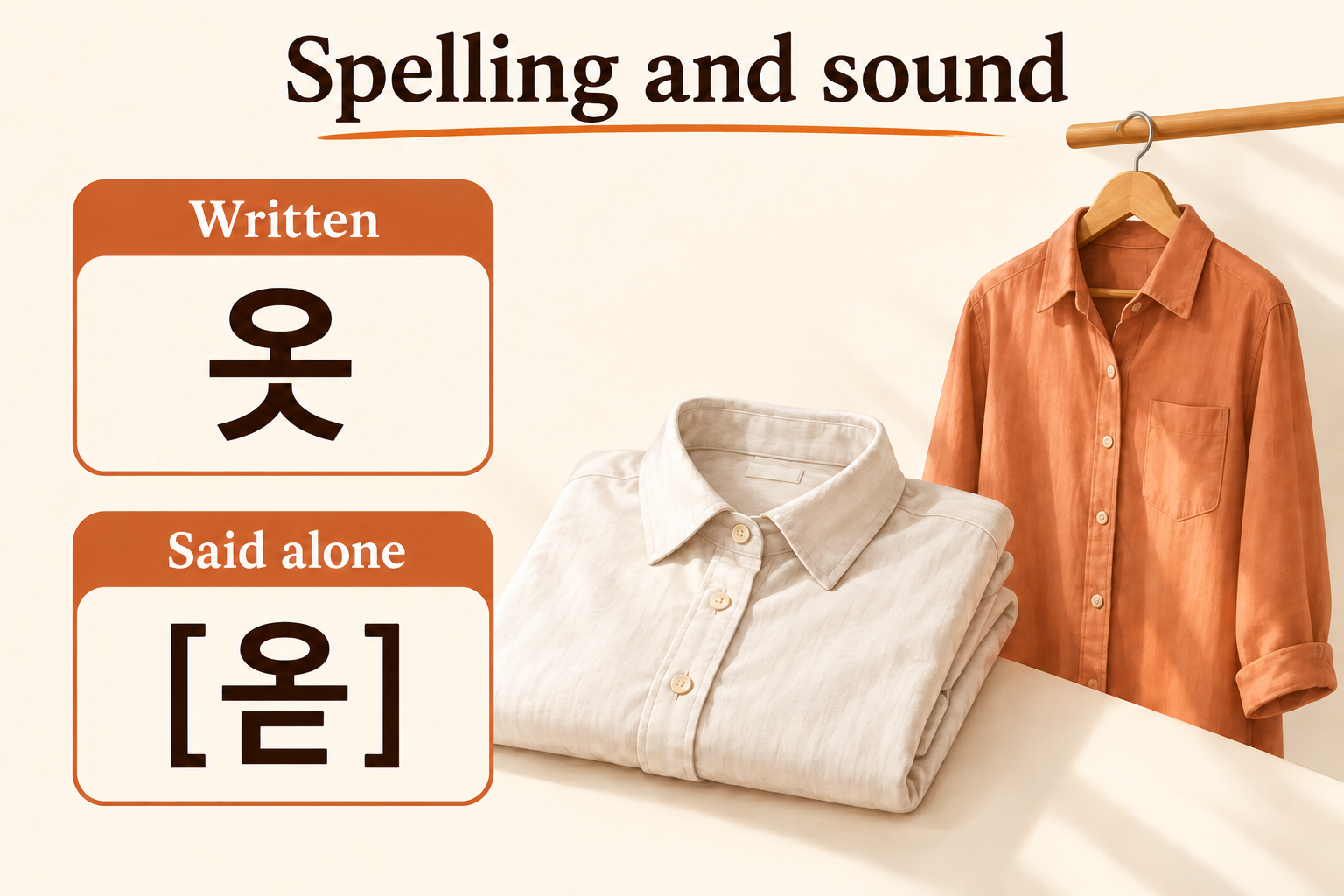
The ㅅ in 옷, “clothes,” is written at the bottom of the syllable block. Read the word on its own and its pronunciation is [옫]. Add the subject particle 이 and the written form becomes 옷이, pronounced [오시]. The spelling has kept ㅅ; the pronunciation has changed with its surroundings.
받침 (batchim) refers to the final consonant position in a written syllable. A pronunciation written in square brackets is not an instruction to replace the word's spelling.
Seven final sounds do not mean seven possible spellings
Standard Korean restricts syllable-final consonant sounds to seven categories, represented as ㄱ, ㄴ, ㄷ, ㄹ, ㅁ, ㅂ, ㅇ. More written consonants can occupy the final position. For example, ㅅ and ㅈ can both be pronounced as final [ㄷ]. This is a many-to-one sound relationship, not a spelling correction.
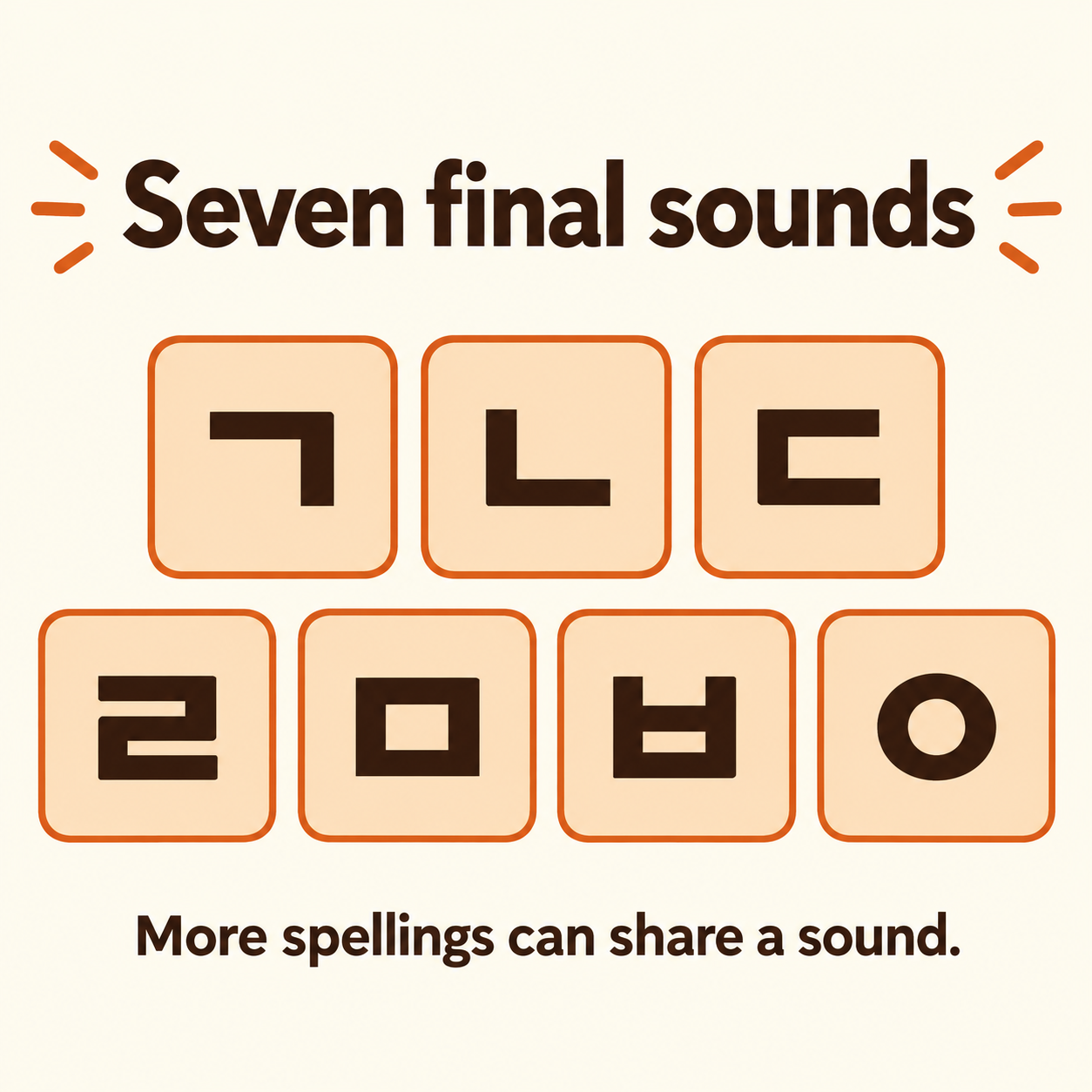
These final-sound categories apply at the end of a spoken syllable. What follows can trigger further changes, so the seven symbols alone cannot predict every word’s pronunciation. In [옫], the brackets show one spoken syllable, not the names of its letters.
To read the examples below, first identify the written final letter. Then check what follows. Do not decide the sound from the letter alone.
Follow one written word into a new environment
| Written form | Environment | Standard pronunciation |
|---|---|---|
| 옷 | The word read alone | [옫] |
| 옷이 | The vowel-initial particle 이 is attached | [오시] |
These forms come from the official learner dictionary's entry for 옷. In the second row, ㅅ is pronounced at the start of the following spoken syllable. It is not first turned into [ㄷ] and then carried over. That incorrect two-step reading would miss the [시] in the dictionary pronunciation.
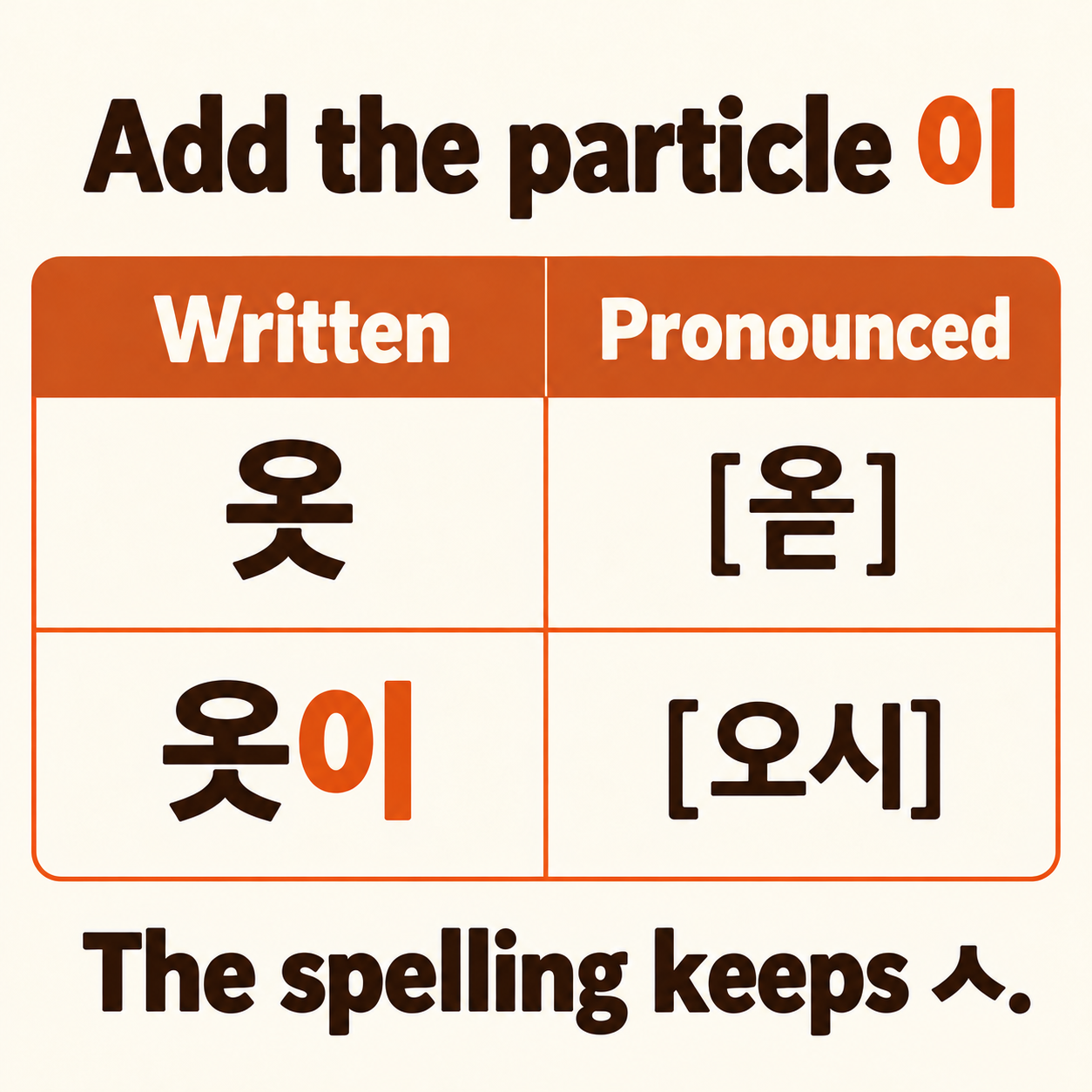
The linking rule covers a single or doubled final consonant before a vowel-initial grammatical particle, ending, or suffix. A particle is a short grammatical marker attached to a word, such as the subject marker 이 in 옷이. It is not a blanket instruction to move every final consonant whenever the next written block starts with ㅇ. Clusters, ㅎ, compound words, and other sound changes need their own treatment. This lesson uses a single ㅅ before a particle, not an unrestricted rule for all of them.
When taking notes, copy the ordinary word into a spelling column and put the sound in brackets beside it. Keep the particle visible in both columns. Writing only “ㅅ sounds like ㄷ” would discard the environment that explains why the second row differs.
Korean batchim sounds cannot always identify the word
The same distinction works in reverse. 낮, “daytime,” and 낫, “sickle,” are both pronounced [낟] when read alone. Hearing that isolated sound does not tell you which of the two words was intended.
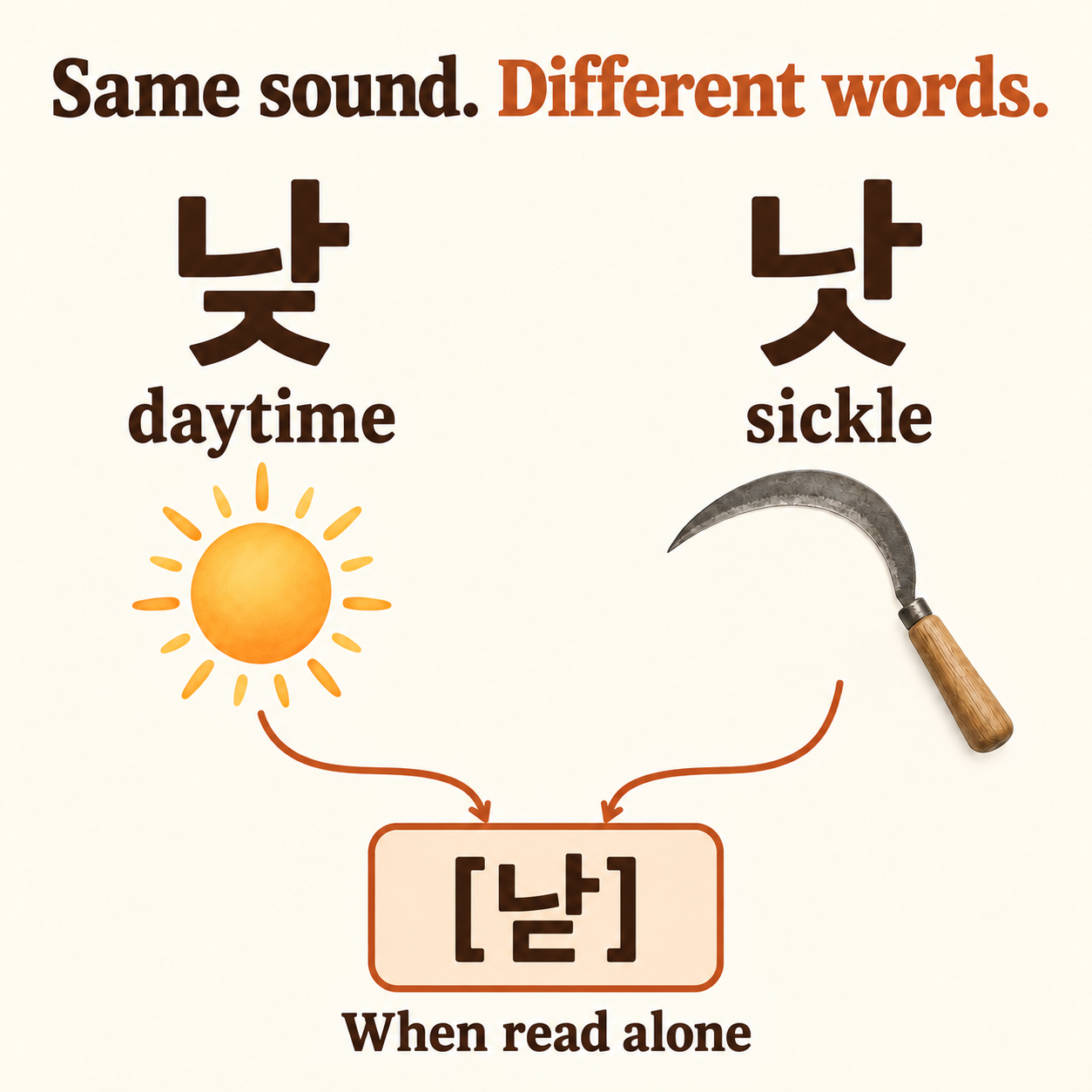
With the particle 이 attached, their pronunciations differ: 낮이 [나지] and 낫이 [나시]. The contrast is also shown in the National Institute of Korean Language’s explanation. The different written consonants have not become the same letter just because their standalone sounds coincide.
Imagine a vocabulary recording containing only [낟], without a picture, sentence, or definition. Choosing either spelling as the unique answer would add information the recording did not provide. Ask for the meaning or a fuller sentence. Do not convert every final [ㄷ] you hear into written ㄷ.
Apply the distinction to a new word
밭 means “field.” Attach the particle 에. Write the combined form, then predict its pronunciation in brackets. Should the written ㅌ change?
Check your answer
Keep the spelling 밭에. Its standard pronunciation is [바테]. The ㅌ remains in the written first block even though its sound starts the next spoken syllable.
'Real Korean Language & Everyday Korea' 카테고리의 다른 글
| Ottoke Meaning, When to Write 어떡해 and When to Correct It (0) | 2026.10.29 |
|---|---|
| Yeoboseyo Meaning, A Phone Hello and the Replies It Allows (0) | 2026.10.29 |
| Daebak Meaning Beyond Awesome (0) | 2026.10.29 |
| Hajima Meaning and What Someone Is Telling You Not to Do (0) | 2026.10.29 |
| Hangul Alphabet, Read the Letters Inside a Syllable (0) | 2026.10.29 |
| Korean Counters, What the Counting Word Actually Counts (0) | 2026.10.28 |
| Korean Surnames, Common Names and What Their Labels Mean (0) | 2026.10.28 |
| Family in Korean, Who Is Related to Whom? (0) | 2026.10.28 |


