Hajima Meaning and What Someone Is Telling You Not to Do
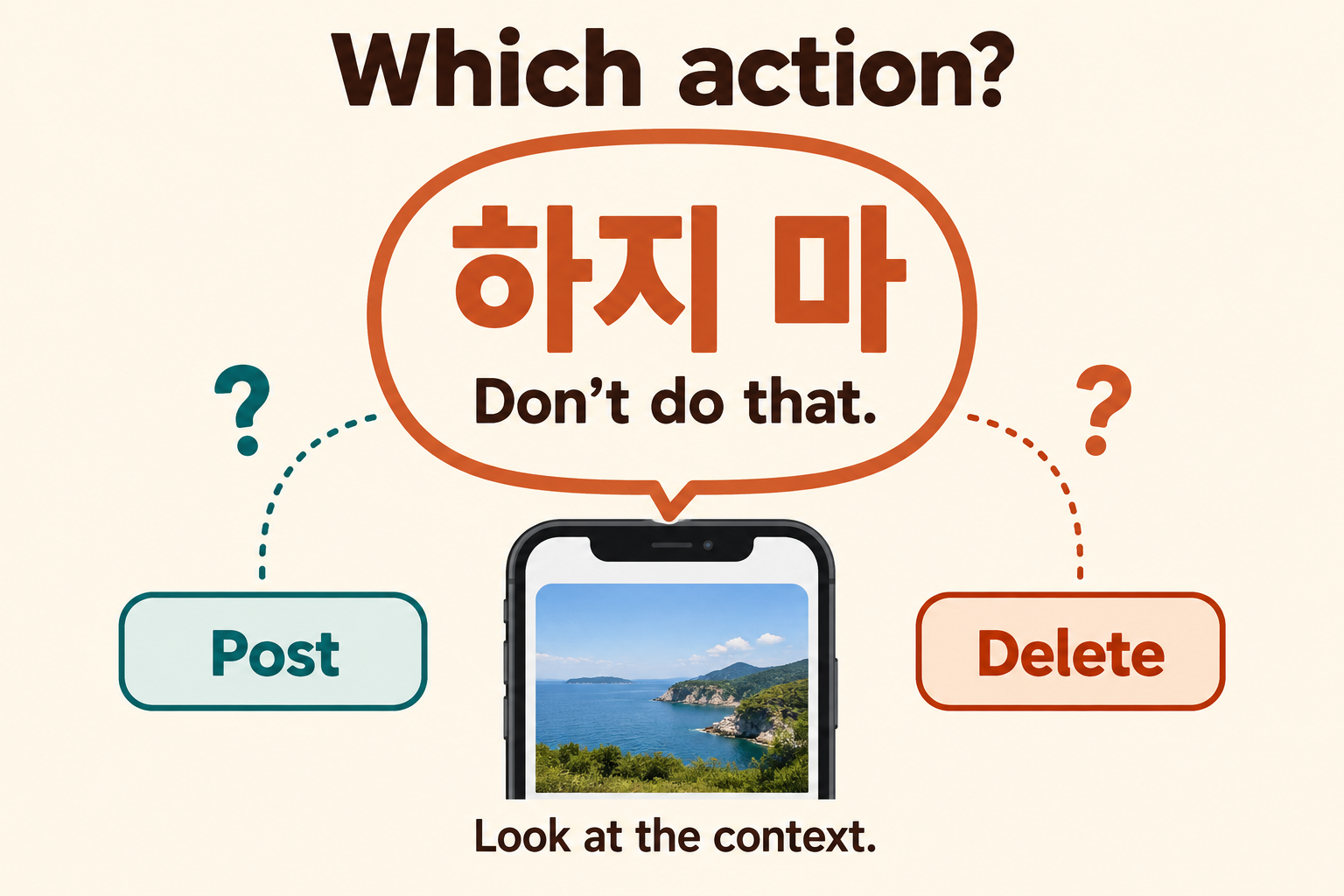
하지 마 (hajima) means don’t do that or stop it. It is a casual negative command. It can tell someone not to begin an action or to stop an action already happening.
The short phrase does not name the action. A raised camera, a hand reaching for a button or the previous sentence may supply that information. The same two words can therefore tell someone to keep a photo—or not to post it at all.
What does hajima mean after a question?
Suppose two friends who already use casual speech are discussing the same photo. Compare these two exchanges.
| First speaker | Reply | What the reply tells them not to do |
|---|---|---|
| 이 사진 올릴까? Shall I post this photo? |
하지 마. | Don’t post it. |
| 이 사진 지울까? Shall I delete this photo? |
하지 마. | Don’t delete it. |
The first exchange blocks posting. The second blocks deleting. Translating both replies as “Stop it!” would hide that difference, especially because neither question says the action has started.
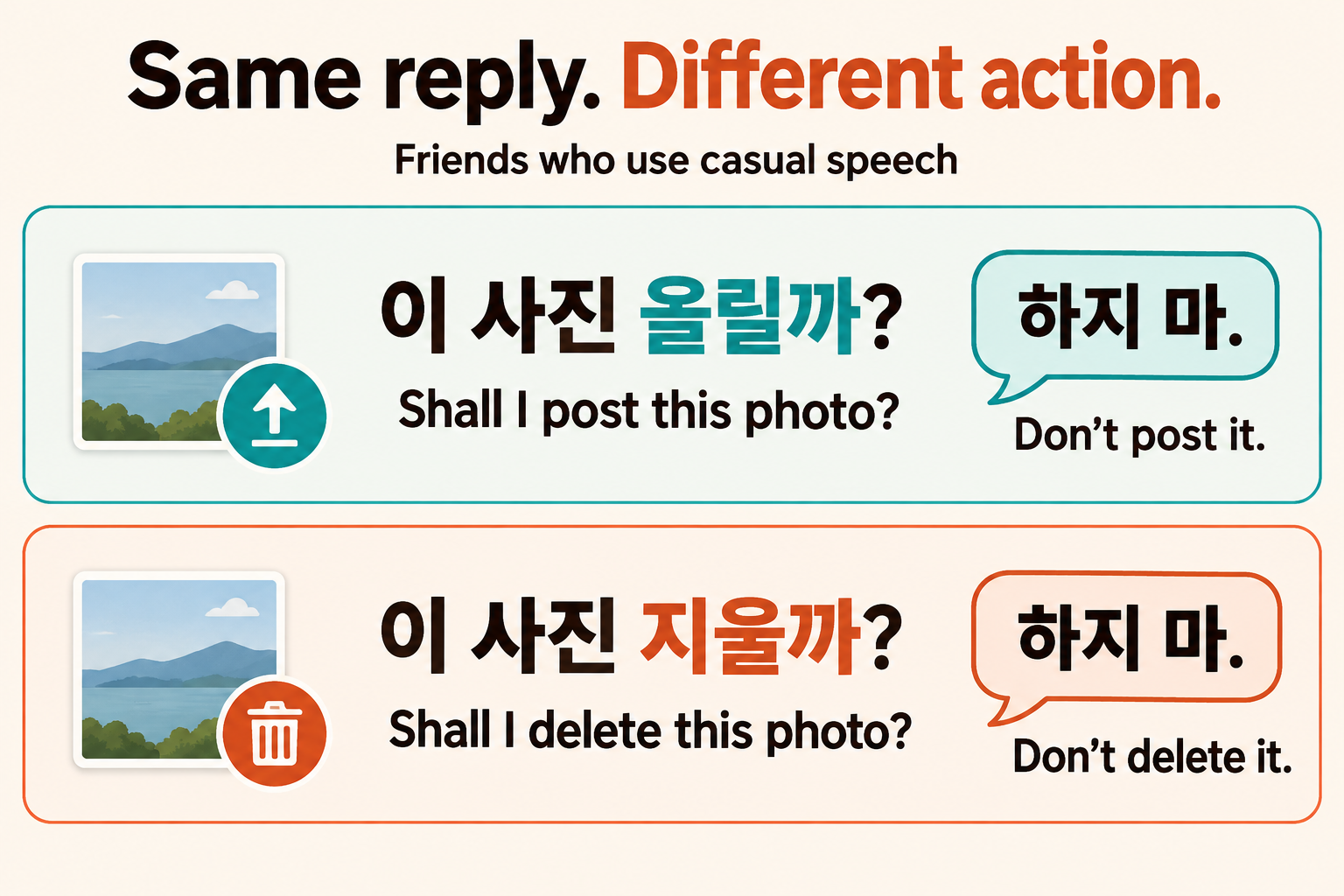
If you have only the reply, you cannot recover a specific action from the word hajima alone. Look back at what was proposed or what is happening in the scene. When two actions are possible, a subtitle that confidently names one needs more context.
How 하다 becomes 하지 마
The dictionary form 하다 means to do. Its stem 하- combines with -지 and the command form 마 of 말다. In this construction, 말다 tells someone not to carry out the action before it.
하- + -지 + 마 → 하지 마
The National Institute of Korean Language specifies the spacing as 하지 마. The joined spelling 하지마 does not represent a different meaning, but it is not the standard spacing.
A more specific verb can name the action directly. Remove the dictionary ending -다 and attach -지 마 to the stem:
- 찍다, to take a photo → 찍지 마, don’t take a photo.
- 올리다, to post or upload → 올리지 마, don’t post it.
- 지우다, to delete or erase → 지우지 마, don’t delete it.
These translations follow the photo context above. The verbs can have other uses, so their objects still matter. There is no extra 하 in these forms: 올리지 마 already contains the verb for posting.
The whole sentence tells you the boundary
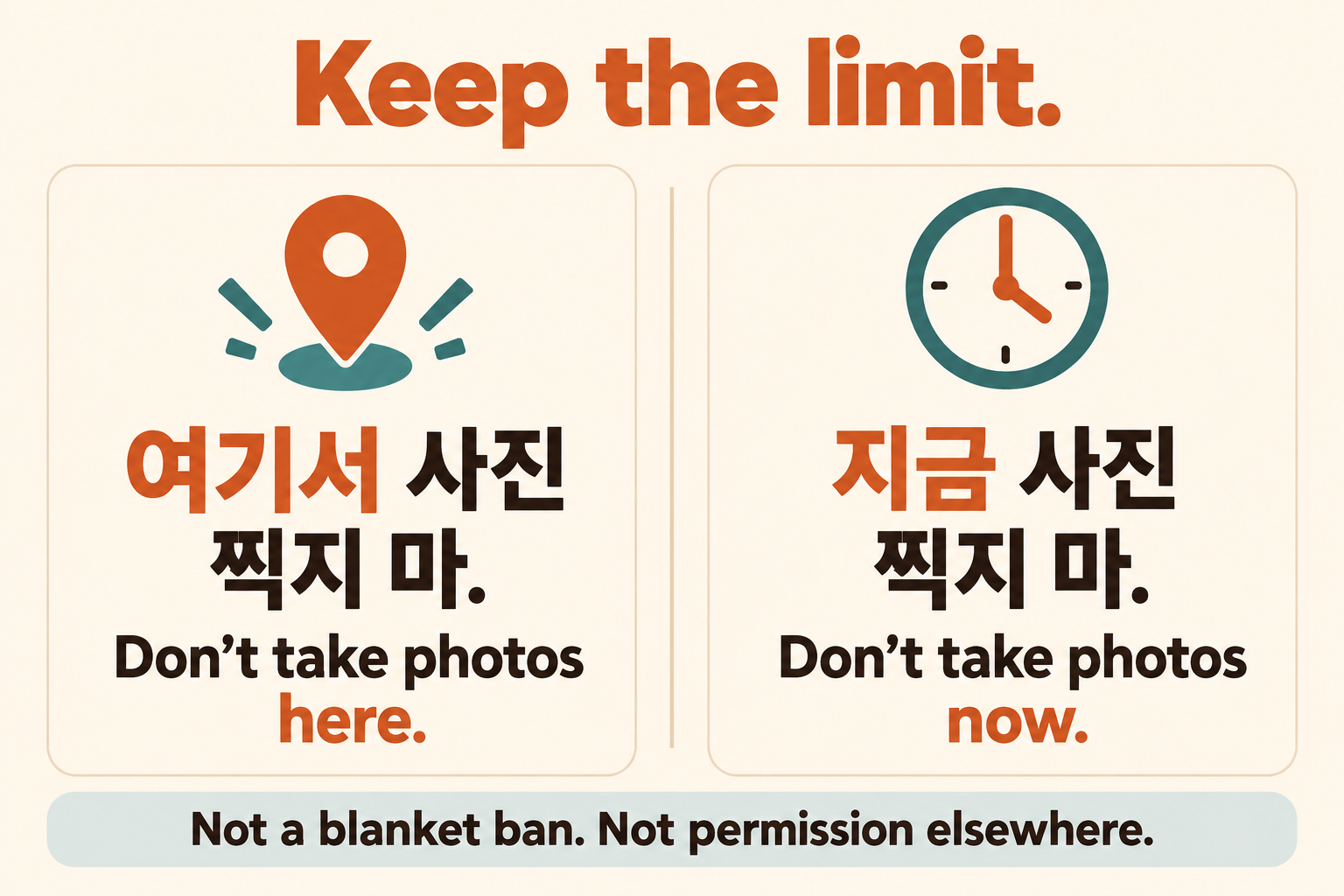
A longer prohibition may restrict a place, a time or a particular object. Keep those details when translating. Compare these learning examples:
| Korean | Translation | Detail to preserve |
|---|---|---|
| 여기서 사진 찍지 마. | Don’t take photos here. | 여기서 limits the stated prohibition to this place. |
| 지금 사진 찍지 마. | Don’t take photos now. | 지금 specifies the present time. |
| 내 사진 올리지 마. | Don’t post my photo. | 내 사진 names the speaker’s photo as the object. |
None of these sentences says “Never take any photos.” The first two concern taking photos; the third concerns posting one. Treating all three as a general ban on photography would change both the action and its scope.
A stated limit also does not grant permission outside that limit. “Don’t take photos here” does not tell you whether another place allows photography.
Changing the ending changes how you address the listener
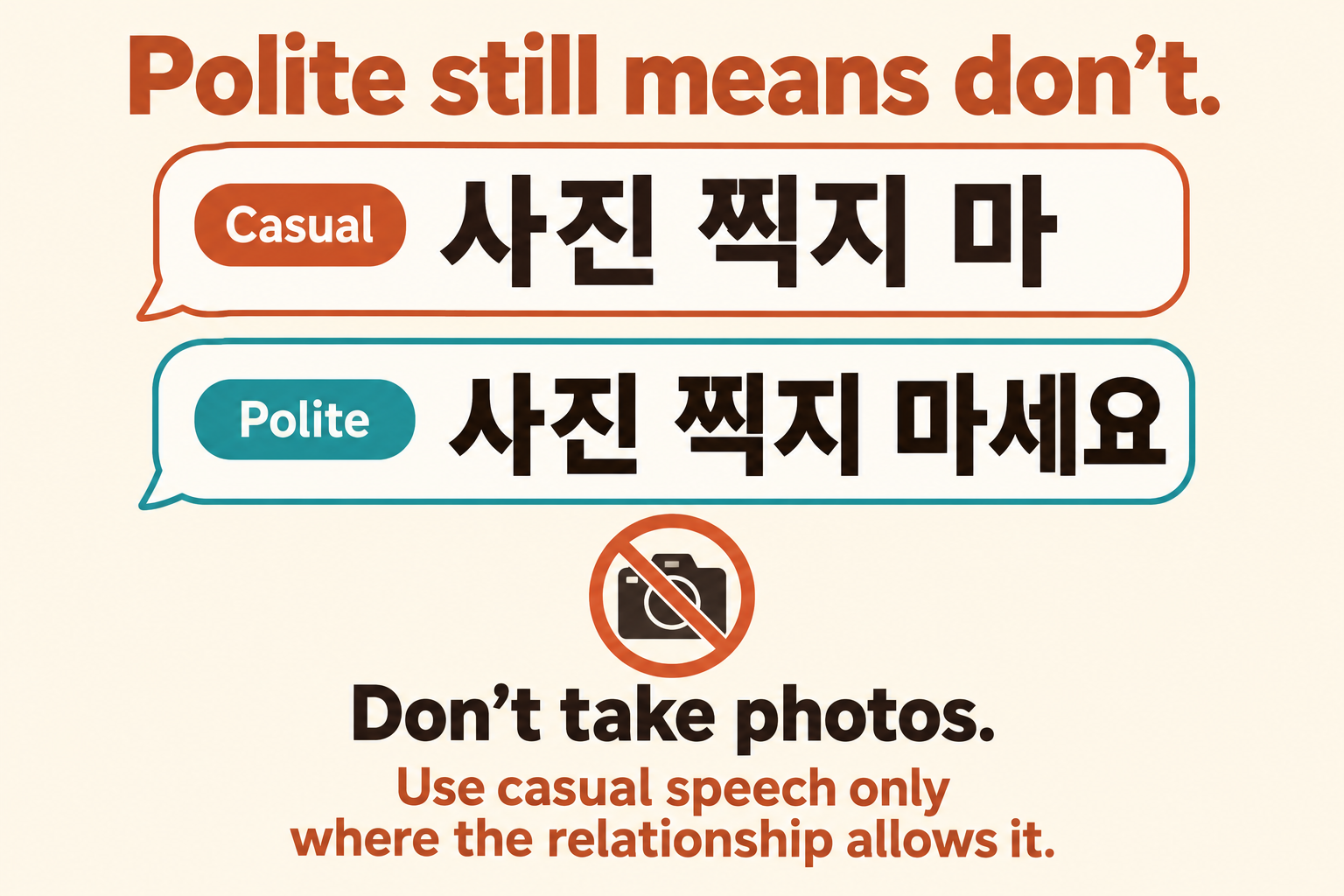
하지 마 is the casual form. 하지 마요 adds polite 요, while 하지 마세요 uses the honorific-polite form of the command. The action remains prohibited in all three.
Use the casual version within a relationship where casual speech is appropriate. For an ordinary polite request not to do something, 하지 마세요 is a useful form. Age alone does not establish that you and another person use casual speech together.
Compare 사진 찍지 마 and 사진 찍지 마세요. Both tell the listener not to take photos. The second addresses the listener politely; it does not mean the speaker only mildly objects or that taking the photo is optional.
Volume, facial expression and the surrounding conversation affect how a line sounds. A drawn-out vowel or playful delivery does not, by itself, establish permission.
Read a new instruction without broadening it
Read this practice sentence:
밤에는 전화하지 마.
밤 means night, and 전화하다 means to call by phone. Which action is prohibited, and when?
Show the reading
Don’t call at night. The verb is 전화하다, so its stem 전화하- takes -지 before 마. 밤에는 supplies the time restriction. The sentence does not say “Never contact me again,” and it does not name who would receive the call. A fuller conversation may identify the recipient.
'Real Korean Language & Everyday Korea' 카테고리의 다른 글
| Cute in Korean, Who the Sentence Is Describing (0) | 2026.10.29 |
|---|---|
| Ottoke Meaning, When to Write 어떡해 and When to Correct It (0) | 2026.10.29 |
| Yeoboseyo Meaning, A Phone Hello and the Replies It Allows (0) | 2026.10.29 |
| Daebak Meaning Beyond Awesome (0) | 2026.10.29 |
| Batchim Rules, Keep Spelling and Final Sounds Apart (0) | 2026.10.29 |
| Hangul Alphabet, Read the Letters Inside a Syllable (0) | 2026.10.29 |
| Korean Counters, What the Counting Word Actually Counts (0) | 2026.10.28 |
| Korean Surnames, Common Names and What Their Labels Mean (0) | 2026.10.28 |


