Korean Adjectives?
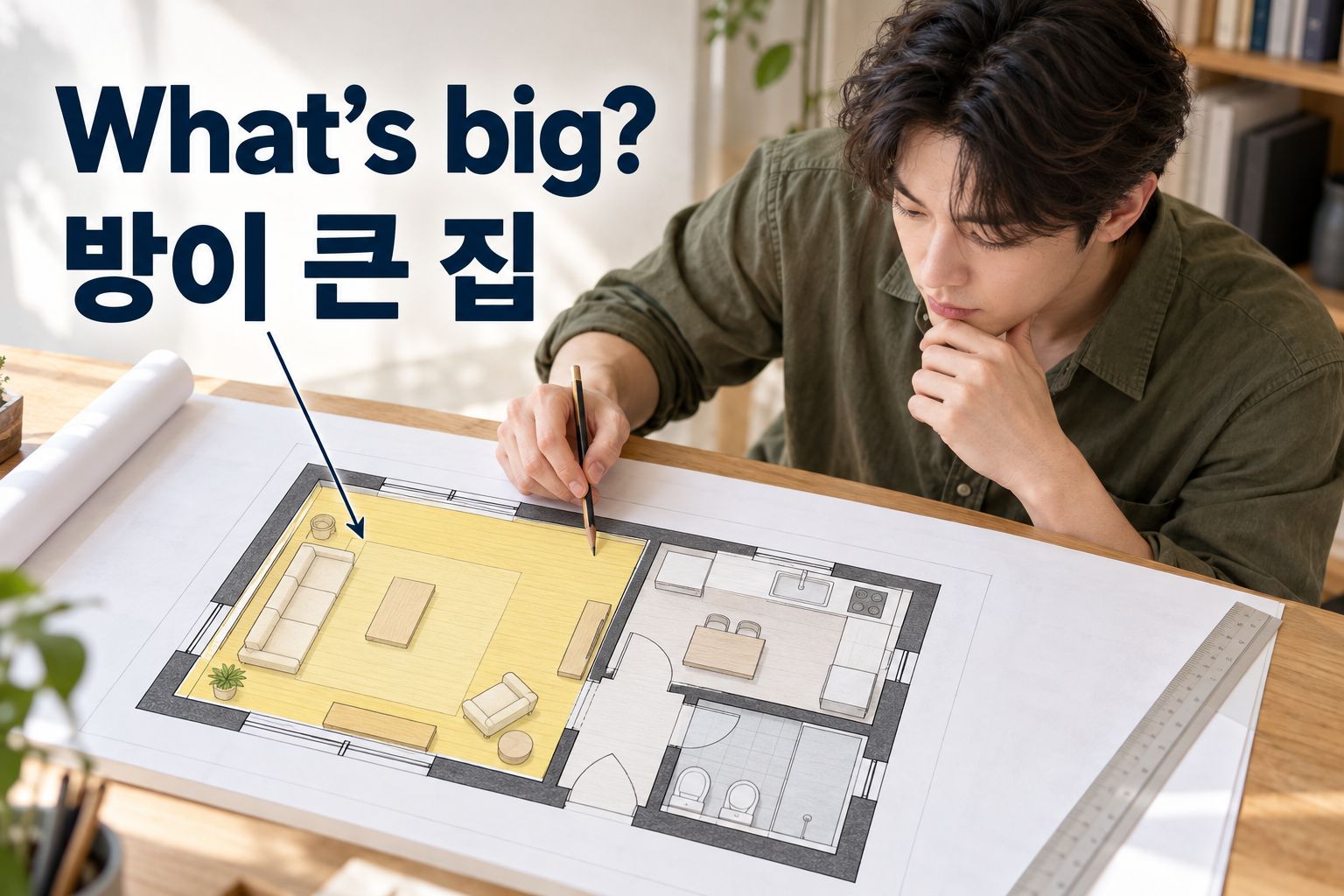
Imagine a modest house with one unusually spacious room. Calling the whole house big would lose the detail you wanted to describe. Korean adjectives can keep that distinction, but their forms change as you build the description.
Start with big, small, and a few useful descriptions
Big in Korean is 크다; small in Korean is 작다. These are dictionary forms. In a polite statement, they become 커요 and 작아요. Before a noun, use 큰 and 작은.
For example, 방 means room. 방이 작아요 means the room is small; 작은 방 means a small room.
Korean adjectives describe qualities or states, including size, length, difficulty, and interest. They change their endings and can finish a statement without a separate word for English is. Here are seven starting points. Each line gives the dictionary form, a polite statement form, then the form used before a noun.
- 크다 — big: 커요 → 큰
- 작다 — small: 작아요 → 작은
- 좋다 — good: 좋아요 → 좋은
- 길다 — long: 길어요 → 긴
- 조용하다 — quiet: 조용해요 → 조용한
- 어렵다 — difficult: 어려워요 → 어려운
- 재미있다 — interesting or enjoyable: 재미있어요 → 재미있는
For many adjectives, remove 다 and add ㄴ after a vowel or 은 after a consonant: 크다 becomes 큰, while 작다 becomes 작은. Some forms also change within the word. 길다 loses its final ㄹ in 긴; 어렵다 changes to 어려운.
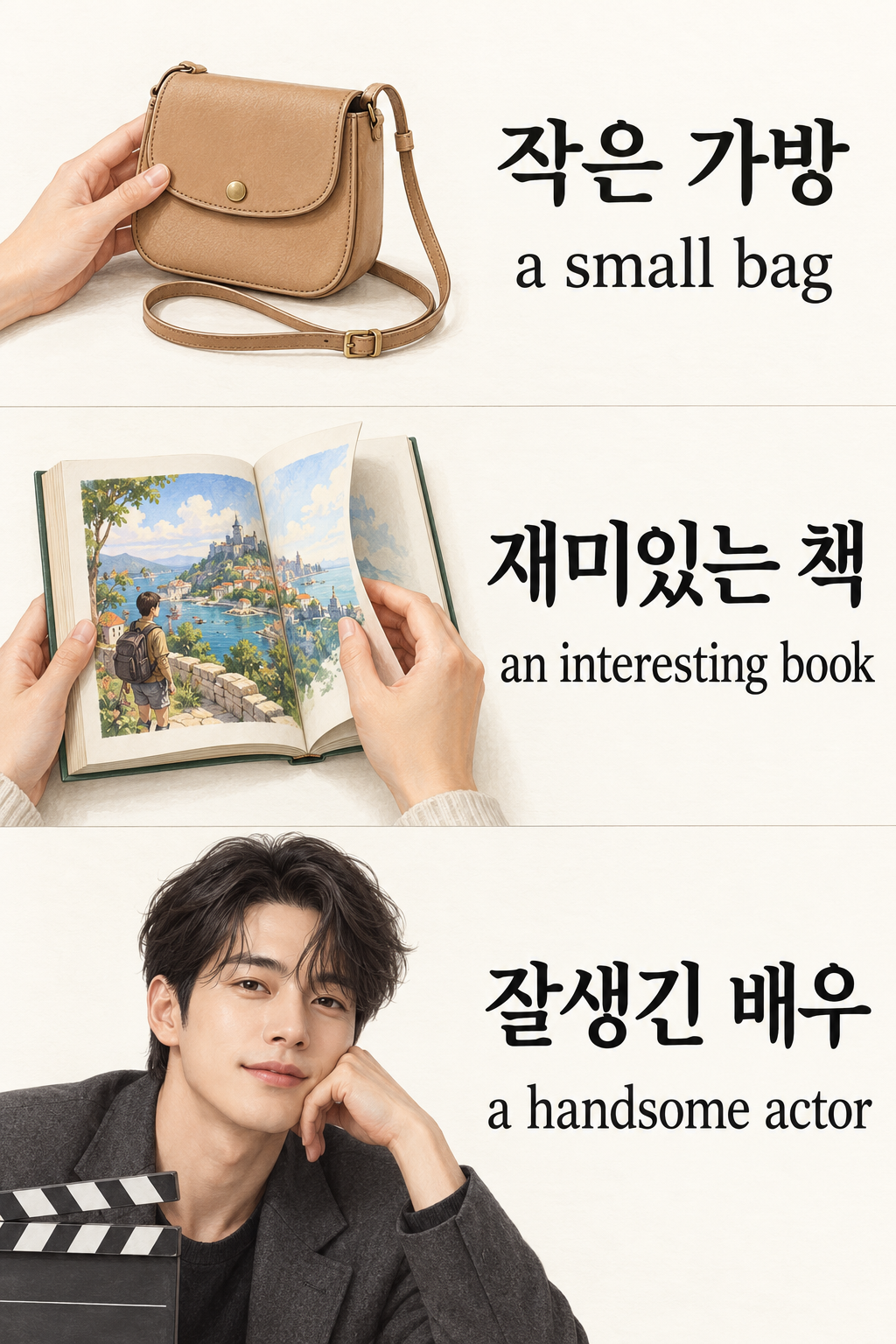
A small bag, an interesting book, a handsome actor
Suppose you are writing three short captions: a small bag, an interesting book, and a handsome actor. The nouns are 가방 for bag, 책 for book, and 배우 for actor. Small already has a form you can use: 작은 가방.
For the book, use 재미있는 책. The ending here is 는. Adjectives ending in 있다 or 없다 use this pattern in these descriptions, so 재미있다 does not take the same ending as 작다. The Korean Basic Dictionary lists 재미있다 as an adjective; the different ending does not turn it into an action word.
The actor's caption is 잘생긴 배우. 잘생기다 means handsome or good-looking, and that same dictionary lists it as a verb. Its noun-modifying form here is 잘생긴.
If you are describing how the actor looks in a photograph taken today, 잘생긴 배우 can describe his appearance now. It does not inherently mean an actor who used to be handsome. A larger sentence can supply a past setting, so the visible ending alone does not settle the time.
When adding another word to a caption, check its before-noun form and an example with the meaning you intend. An English translation such as interesting or handsome cannot supply that Korean form for you.
Say what is big, not just which thing you mean
Return to the imagined floor plan. 집 means house. Focus on one particular room that occupies a large share of a modest house. You want your note to identify the house by that room.
큰 방 gives you a big room. Change 방 to 집 and you get 큰 집, a big house. Neither phrase preserves the detail you wanted: the room is spacious, while the overall house may be modest.
Start with what is true of the room: 방이 커요, the room is big. To place that description before 집, change 커요 to 큰 and keep 방이:
방이 큰 집 — a house with a big room
Read it as [방이 큰] 집. Inside the brackets, 방이 tells us what is big: the room. Outside, 집 tells us which thing the whole phrase identifies: the house. The particle 이 keeps 방 in its role within that description. Dropping 방이 would leave 큰 집 and shift the size claim to the house itself.
Try changing the room's size instead. 방이 작은 집 describes a house with a small room; 작은 집 describes the house itself as small.
A small book with large print
Now imagine choosing a compact book whose print is comfortably large. 책 is book; 글씨 refers to the lettering or writing, and here it means the print on the page.
Start with 글씨가 커요, the print is large. Keeping 글씨가 in the description gives 글씨가 큰 책, a book with large print. Here 가 marks the print as the thing whose size you are describing.
큰 책 would describe a physically large book. For your compact large-print choice, [글씨가 큰] 책 keeps the size claim on the letters—even when the book fits easily into a small bag.
'Real Korean Language & Everyday Korea' 카테고리의 다른 글
| No in Korean: 아니요, 아니에요, and 안 돼요 in Full Sentences (0) | 2026.11.07 |
|---|---|
| Korean Table Manners: When to Start and How to Share (0) | 2026.11.06 |
| Jjimjilbang: Where to Change, Meet Up, and Pay for Extras (0) | 2026.11.06 |
| Korean Chopsticks: A Steady Grip and a Bowl of Bibimbap (0) | 2026.11.05 |
| Dad in Korean: Appa, Abeoji, and Using Them in a Sentence (0) | 2026.11.05 |
| Money in Korean: Using 돈 for Cash, Costs, and Payment (0) | 2026.11.04 |
| Excuse Me in Korean: Getting Attention and Asking Your Question (0) | 2026.11.03 |
| Why in Korean: Asking for a Reason and Giving One (0) | 2026.11.03 |


