No in Korean: 아니요, 아니에요, and 안 돼요 in Full Sentences
아니요 (aniyo) is a polite way to answer no in Korean. You can use it on its own or follow it with a correction. The shorter 아뇨 (anyo) is also polite. For a casual negative reply to someone you already speak casually with, use 아니 (ani). If the three forms blur together when you hear them spoken — they genuinely did for me during my first months in Seoul — working through the full sentences below will finally make the differences stick.

Answer the question and name the book
사전 (sajeon) means dictionary; 소설 (soseol) means novel. Imagine someone pointing to a novel and asking:
사전이에요?
Is it a dictionary?
A short answer is 아니요. To tell the person what the book is, add 소설이에요, It's a novel:
아니요, 소설이에요.
No, it's a novel.
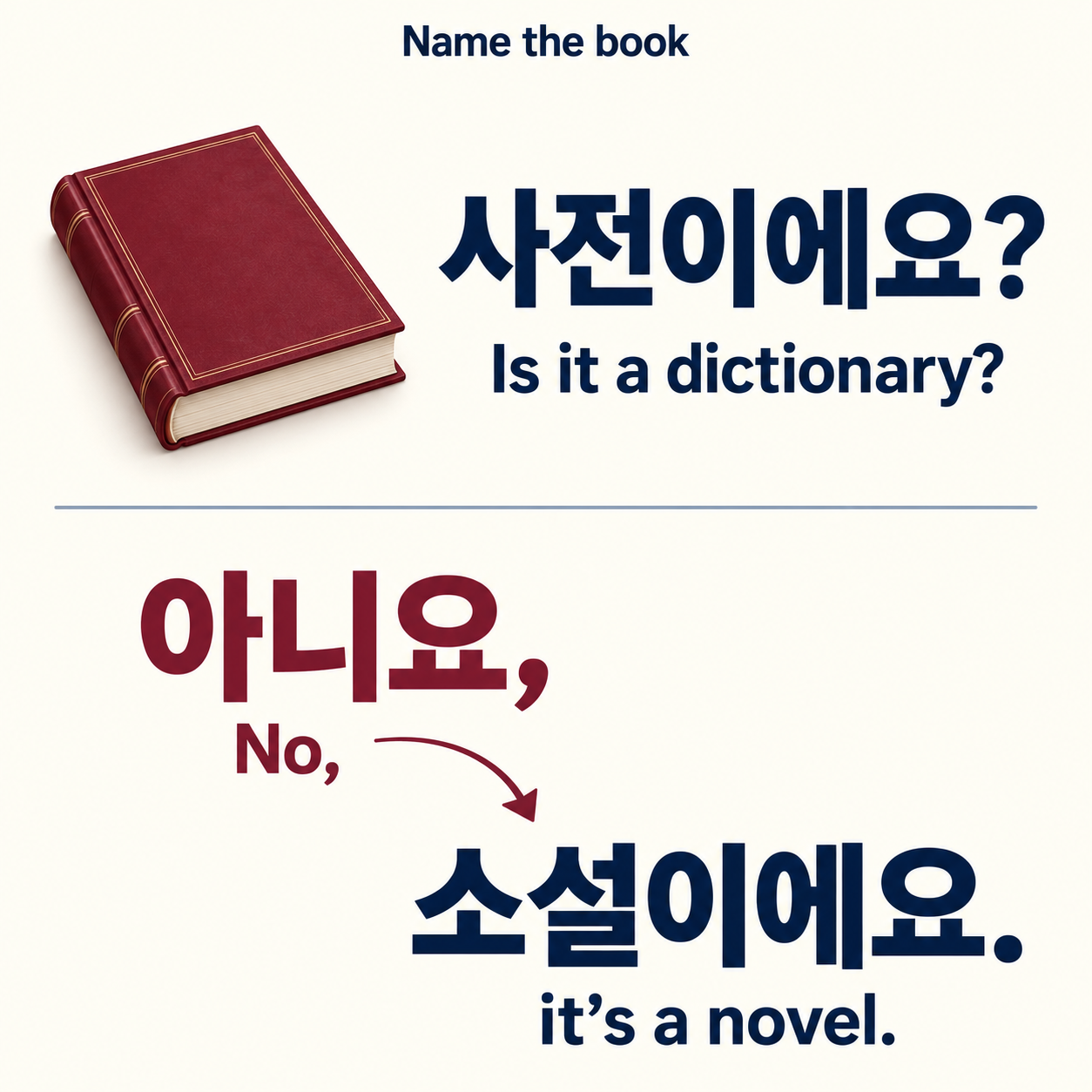
아니요 answers the question about whether the book is a dictionary. The next part gives the replacement: 소설이에요 is an affirmative statement. Here, the ending 이에요 follows the noun 소설 to say what the book is.
You can also state directly what the book is not. 아니에요 (anieyo) is the polite form used in this sentence:
사전이 아니에요.
It isn't a dictionary.
The 이 after 사전 marks the noun being denied. It is the form used after a noun ending in a consonant, as 사전 does. This answer rules out dictionary but does not name the book as a novel. If you want to supply that information too, the full reply can be 사전이 아니에요. 소설이에요.—It isn't a dictionary. It's a novel.
In the same conversation, 아니에요. can also stand alone: the question has already supplied a dictionary. Both 아니요 and 아니에요 can answer here.
A connection problem or “Don't connect now”?
안 돼 (andwae) can mean That's not allowed; 안 돼요 (andwaeyo) uses a polite ending. A similar-sounding expression can also describe something that is not working.
연결 (yeongyeol) means connection, and 연결하다 means to connect. Suppose someone has tried to make a connection but the attempt is not succeeding. They can report:
연결이 안돼요.
The connection isn't working.
Here, 안돼요 comes from 안되다, which describes something not going properly. The sentence reports a connection problem without identifying its cause — the kind of thing a friend mutters at a cafe when the wifi drops, seconds before you both instinctively check your phones.
In a separate example, someone asks you to wait before connecting. 지금 (jigeum) means now. 연결하면 means if you connect.
Putting 안 돼요 after that gives the pattern -면 안 되다, which restricts the action. It is written with a space in this construction — and yes, this space is the kind of spelling detail that makes a native speaker do a double take when it goes missing. An instruction like this can be given before anyone tries the connection:
지금 연결하면 안 돼요.
You must not connect now.
Choose the Right Negative at a Glance
| Expression | Pronunciation | What It Does | Typical Situation |
|---|---|---|---|
| 아니요 | aniyo | Polite standalone "no" to a question | Answering a shop clerk, a colleague, or an elder |
| 아뇨 | anyo | Softer, shorter polite "no" | Casual-polite conversation, often spoken |
| 아니 | ani | Casual "no" | Close friends who already speak informally |
| 아니에요 | anieyo | Denies a noun: "It is not X" | Correcting what something is, politely |
| 안 돼요 | andwaeyo | "You must not" or "it is not allowed" | Restricting an action politely |
| 연결이 안돼요 | yeongyeol-i andwaeyo | "The connection is not working" | Reporting a device or system problem |
Frequently Asked Questions
Is 아니요 the same as 아니에요?
No. 아니요 is a standalone polite answer, like "No" on its own. 아니에요 is the polite form of 아니다 and needs a noun before it, as in 사전이 아니에요 — "It is not a dictionary." One answers, the other denies.
Why is it written 안 돼요 with a space in 지금 연결하면 안 돼요?
In the -면 안 되다 pattern, 안 is an adverb modifying 돼요, and the construction is spelled with a space. In 연결이 안돼요 the same idea is written attached. Check the spelling in a dictionary when you write it; the space itself carries no extra meaning.
Can I say 아뇨 to an elder?
아뇨 is a polite contraction of 아니요 and works well in most polite situations. When you want the most standard, unambiguous form — answering a question from an elder or in formal settings — 아니요 is the safer choice.
'Real Korean Language & Everyday Korea' 카테고리의 다른 글
| Korean Adjectives: From Big and Small to Clear Descriptions (0) | 2026.11.07 |
|---|---|
| Korean Table Manners: When to Start and How to Share (0) | 2026.11.06 |
| Jjimjilbang: Where to Change, Meet Up, and Pay for Extras (0) | 2026.11.06 |
| Korean Chopsticks: A Steady Grip and a Bowl of Bibimbap (0) | 2026.11.05 |
| Dad in Korean: Appa, Abeoji, and Using Them in a Sentence (0) | 2026.11.05 |
| Money in Korean: Using 돈 for Cash, Costs, and Payment (0) | 2026.11.04 |
| Excuse Me in Korean: Getting Attention and Asking Your Question (0) | 2026.11.03 |
| Why in Korean: Asking for a Reason and Giving One (0) | 2026.11.03 |


