Why Does a Korean Room Feel Warm from the Floor Up?
Imagine entering a Korean home on a cold winter morning. You take off your shoes, step onto the floor, and notice that the surface itself feels warm. There may be no fireplace in the room and no visible heater beside the wall. Yet the warmth spreads through the space from below. My own first winter morning in a Korean apartment had me freezing mid-step, checking whether I had walked over something I shouldn't have — no, the floor was simply doing its job.
This experience is closely connected to ondol (온돌), Korea's traditional underfloor heating system. The word is often associated with warm floors, but the technology involves more than simply heating a surface. Traditional ondol uses a fire source, passages beneath the floor, and a chimney. Heat travels through this structure, warms the floor materials, and remains there after the fire has weakened.
Today, the word ondol is also used when discussing modern Korean floor heating. However, a traditional fire-based system and a modern water-pipe system do not move heat in the same way. Understanding that difference makes it easier to see how Korean floors carry heat and hold it.
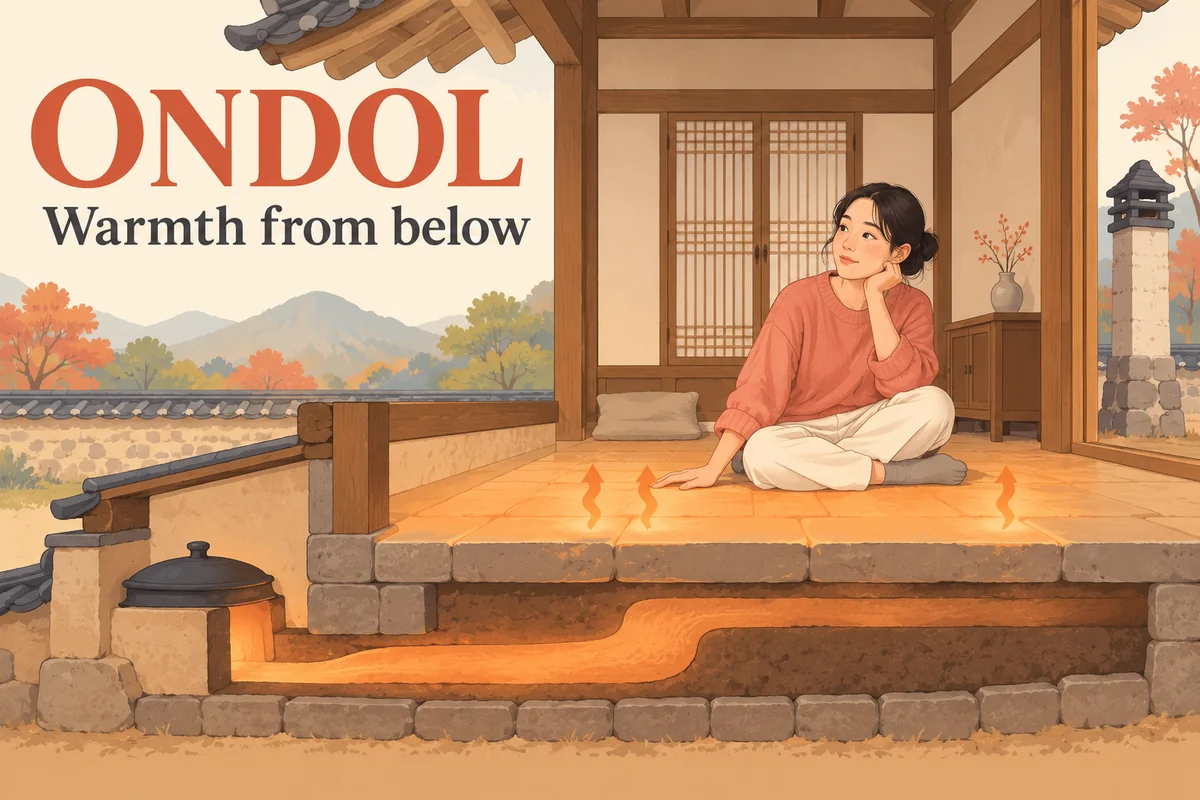
Traditional Ondol: From the Firebox to the Chimney
A traditional ondol system has four important parts: the agungi (아궁이), the gorae (고래), the gudeul (구들), and the chimney (굴뚝). Each has a different role in moving heat through the building.
1. Agungi: Where the Fire Begins
The agungi is the firebox or furnace where fuel, traditionally wood, is burned. It is commonly positioned beside or below the kitchen area, near the beginning of the underfloor heating structure.
When the fire burns, it produces hot combustion gases. These gases carry heat into the passages beneath the room. The fire itself is not placed in the living area where people sit or sleep. Instead, the heating structure connects the firebox to the space beneath the floor.
2. Gorae: The Passages Beneath the Floor
The gorae are channels beneath the floor through which hot gases and smoke travel toward the chimney. They form the route connecting the firebox to the exhaust outlet.
As the hot gases move through the passages, heat transfers to the materials surrounding them. The stone floor structure becomes warm, while the smoke continues toward the chimney. The arrangement and shape of these channels can differ between buildings, so traditional ondol did not have one identical internal layout everywhere.
3. Gudeul: The Floor That Receives and Stores Heat
The gudeul (구들) refers to the traditional heated floor structure, including the broad stone plates laid above the underfloor passages. These stones receive heat from the gases moving through the gorae.
Stone and the surrounding floor materials have thermal mass: they can absorb and retain heat rather than becoming cold immediately when the fire weakens. After warming up, the floor gradually releases that stored energy into the room.
4. The Chimney: Where Smoke Leaves
The chimney provides the exhaust route for smoke and combustion gases. The firebox, underfloor passages, and chimney work as connected parts of one system.
This distinction matters. Smoke does not need to enter the living room to warm it. In a properly functioning traditional ondol, combustion gases travel through the designated underfloor passages and leave through the chimney. Heat crosses the floor structure, while the exhaust follows its own route.
How Traditional Ondol Transfers Heat
To understand the heating process, separate the movement of hot gases from the movement of heat into the room. They are related, but they are not the same thing.
The process can be followed in four stages:
- Combustion: Fuel burns in the agungi and produces hot gases.
- Heat transport: Those gases move through the gorae beneath the floor toward the chimney.
- Heat transfer and storage: Heat passes into the stone plates and surrounding floor materials, warming the gudeul.
- Heat release: The warmed floor gradually transfers heat to the room, including through radiation from its surface.
In other words, the hot gases are the heat-carrying medium inside the traditional passages. The stone floor is the material that receives and stores much of that heat. The room is warmed by the heated floor, not by smoke circulating through the living space.
This is the central idea behind traditional ondol heating: the fire does not have to remain strong every moment for the floor to continue releasing warmth. The floor itself becomes part of the heating system.
Why Does the Floor Stay Warm After the Fire Dies Down?
A stone floor does not respond to heat in exactly the same way as the air in a room. Air temperature can change relatively quickly, while a substantial floor structure takes time to warm and also takes time to cool.
This behavior is called thermal storage. When the fire heats the stone plates and surrounding materials, some of the incoming energy is stored within them. Once the fire becomes weaker or stops, the warmed materials continue releasing energy to their cooler surroundings.
Think of a stone that has been warmed by sunlight. Even after the sunlight disappears, the stone does not instantly return to its original temperature. It gradually loses the heat it has absorbed. The same basic idea helps explain why a heated ondol floor can remain warm after the fire has gone out.
The length of time that warmth remains depends on several conditions, including the floor's construction, the amount of material being heated, the quality of the structure, and heat loss from the room. So if one grandmother's floor stays warm all night and another's cools by midnight, that is the construction talking, not a broken promise.
Modern Ondol: How Hot-Water Pipes Heat the Floor
Modern Korean floor heating keeps the basic idea of warming a room from below, but its heat source and delivery system are different. Instead of sending hot combustion gases through channels beneath stone plates, many modern systems circulate heated water through pipes installed under the floor.
1. The Boiler Heats the Water
A boiler or other heat source raises the temperature of water. The heated water then enters a network of pipes installed beneath the floor surface.
The water stays inside the pipes. It does not flow across the floor or enter the room. The pipe walls transfer heat to the surrounding floor layers, which gradually become warmer.
2. Pipes Distribute Heat Beneath the Room
The pipes are usually arranged in loops or connected circuits beneath the floor. Heated water travels through these pipes, transferring energy to the surrounding construction materials.
As the floor warms, it releases heat toward the room. This is the basic principle of ondol heating in its modern water-based form: water carries energy through pipes, and the floor distributes that energy into the living space.
3. The Floor Becomes the Heating Surface
Once the floor materials receive enough heat, their surface temperature rises. The warmed surface transfers energy to people, furniture, and other objects, while also warming the surrounding air.
The modern system therefore preserves an important feature of traditional ondol: the floor itself acts as a large heating surface. What changes is how energy reaches that surface.
Traditional Ondol vs. Modern Water-Pipe Heating
Both systems heat a room through its floor, but their internal structures are different.
| Feature | Traditional Ondol | Modern Water-Based System |
|---|---|---|
| Heat source | Fire in the agungi | Boiler or other water-heating source |
| Heat-carrying medium | Hot combustion gases | Heated water |
| Underfloor structure | Gorae passages beneath stone plates | Pipes installed beneath the floor |
| Heat storage | Stone plates and surrounding floor materials | Floor layers surrounding the pipes |
| Exhaust | Smoke travels through the passages toward a chimney | There are no smoke passages beneath the heated floor |
| Heat control | Primarily managed through the fire and fuel | Often controlled through heating equipment and room or floor controls |
The key difference is the heat-carrying medium. Traditional ondol uses hot gases from a fire, while modern hydronic heating uses circulating water. Both transfer heat into floor materials, but the paths are not interchangeable.
It is also important not to treat every modern floor-heating system as a water-pipe system. Some buildings use electric heating panels or other arrangements. The Korean National Encyclopedia of Korean Culture describes the transition from traditional flues to modern hot-water pipes and electric panels, showing that modern floor heating includes more than one technical approach.
How a Heated Floor Changes the Feel of a Room
Understanding the floor structure explains a small mystery every foreigner eventually meets in a Korean apartment: you press the heating button and nothing feels different for an hour, yet hours after switching it off the floor is still toasty. My first winter, I kept switching the boiler on and off like a fidgety thermostat until a neighbor laughed and told me to just set it and go about my day — the floor takes its time both ways.
First, heat must reach the floor materials. Those materials then need time to warm before their surface can transfer substantial heat into the room. A room with a heavy floor structure may respond more slowly than one with a lighter construction.
The same process works in reverse. When heating is reduced or switched off, the floor may continue releasing stored warmth. The room can therefore remain warm for some time even though the heat source is no longer actively supplying energy.
Why One Part of a Room May Feel Warmer
Floor temperature does not always remain perfectly uniform. Several factors can influence how warmth spreads:
- Pipe or flue arrangement: The path through which heat travels can affect how different floor areas receive energy.
- Floor construction: Material thickness and the way layers are assembled influence how quickly heat moves and how much is stored.
- Floor coverings: Thick rugs and other coverings can change how easily heat moves from the floor surface into the room.
- Heat loss: Windows, exterior walls, insulation, and air leakage can affect how quickly different parts of a room lose warmth.
- Furniture placement: Large objects covering parts of the floor can change how heat is released into the surrounding space.
These details help explain why a traditional ondol room should not be treated as an ordinary room with a heater placed underneath it. The floor is an active part of the heating structure, and its materials influence how warmth spreads and how long it remains.
Modern Ondol: Heating the Floor with Hot Water
Most modern Korean homes use a different arrangement from the traditional fire-based system. Instead of burning wood in an agungi and directing hot combustion gases through underfloor passages, modern hydronic floor heating circulates heated water through pipes installed beneath the floor.
The basic process is straightforward:
- A boiler or other heat source warms the water.
- A circulation system moves the heated water through pipes beneath the floor.
- Heat passes from the pipes into the surrounding floor materials.
- The warmed floor transfers heat into the room.
- The cooler water returns through the circulation system to be heated again.
The important difference is what carries the heat. Traditional ondol uses hot combustion gases moving through underfloor flues. Modern water-based ondol uses circulating water inside sealed pipes. The water carries thermal energy, while the pipes and floor materials transfer that energy into the room.
There is no need for a wood fire, smoke passage, or traditional chimney in an ordinary modern hydronic floor-heating installation. The boiler may use gas or another energy source, but that fuel heats the water rather than sending combustion gases through the room's floor channels.
Traditional and Modern Ondol: What Has Changed?
| Feature | Traditional Ondol | Modern Hydronic Ondol |
|---|---|---|
| Heat source | Fire in an agungi | Boiler or another water-heating source |
| Heat carrier | Hot combustion gases | Circulating hot water |
| Underfloor structure | Gorae passages and stone floor plates | Water pipes embedded beneath the floor |
| Exhaust | Smoke and combustion gases leave through a chimney | Combustion exhaust, if produced by the boiler, follows its separate exhaust system |
| Heat storage | Stone plates and surrounding floor materials | Floor screed, concrete, and other floor materials |
| Heat control | Fire intensity and duration | Heating controls, water circulation, and boiler operation |
Although the two systems share the idea of warming a room through its floor, their internal structures are different. Modern hydronic heating preserves the central concept of underfloor warmth while replacing the traditional fire-and-flue arrangement with a water circulation network.
Why Does a Modern Ondol Floor Take Time to Warm Up?
Modern water-based floor heating also relies on the ability of floor materials to absorb and release heat. When warm water circulates through the pipes, the surrounding floor gradually becomes warmer.
This means that the room does not necessarily become warm immediately after the heating system starts. The pipes first transfer heat to the floor structure, and the warmed floor then releases energy into the room. The response depends on factors such as pipe layout, floor thickness, water temperature, insulation, and the room's heat loss.
The same process works in reverse when heating is reduced or switched off. The water may stop circulating or become cooler, but the floor does not instantly lose all its stored warmth. It gradually releases the remaining heat into the surrounding space.
This is why floor temperature and room air temperature do not always change at exactly the same speed. A room may continue feeling warm for some time after the heating setting has been lowered, depending on the construction and operating conditions.
How Ondol Changes the Way a Room Feels
Because the floor itself becomes warm, ondol influences how people use the room. This is one reason the heating system became closely connected with Korean domestic life — and honestly, once you have eaten a tangerine sitting on a warm floor in winter, regular chairs start losing some of their appeal.
In traditional Korean homes, people commonly sat, ate, rested, and slept on the heated floor. Low tables and floor cushions suited this arrangement. The floor was not simply a surface to walk across; it was also an important place for everyday activities.
Modern homes may use beds, sofas, dining tables, and chairs, but the heated floor remains an important part of indoor comfort. People may still sit on floor cushions, spread a blanket on the floor, or stretch out on the warm living-room floor with a drama playing — the classic winter weekend in a Korean home.
Several factors influence how warmth is experienced:
- Floor temperature: A warm floor can make direct contact with the surface feel comfortable even when the room air has not reached the same temperature.
- Room layout: Furniture, rugs, and other objects affect how people interact with the heated surface and how freely the room can be used.
- Floor construction: Different materials and floor thicknesses affect how quickly heat moves through the structure and how long it is retained.
- Heating settings: The operating schedule and temperature settings influence when the floor begins to warm and how it behaves after heating is reduced.
These are general principles, of course — building design, insulation, heating equipment, and each household's settings all shape the experience, so no two floors feel exactly alike.
Ondol Is More Than a Warm Floor
Traditional ondol demonstrates how a heating system can combine the movement of hot gases, heat transfer through stone, and thermal storage in a single architectural structure. The firebox produces heat, the underfloor passages guide the hot gases toward the chimney, and the floor materials absorb and gradually release warmth.
Modern water-based ondol keeps the idea of heating a room from beneath the floor but uses a different heat-transfer arrangement. Heated water circulates through embedded pipes, transferring energy to the floor without sending combustion gases through the traditional underfloor passages.
Understanding these two systems separately helps explain why ondol is both a historical Korean building technology and a familiar feature of modern Korean homes.
Frequently Asked Questions
Does traditional ondol send smoke into the room?
No. In the traditional system described here, smoke and combustion gases travel through the underfloor passages toward the chimney. The heated stone floor separates the exhaust route from the living space. The system is designed to transfer heat through the floor rather than use indoor smoke to warm the room.
Does modern Korean ondol use water or gas?
Modern hydronic ondol uses circulating heated water inside pipes beneath the floor. A boiler or another heat source warms that water. If the boiler uses gas, the gas is its energy source; it is not the water circulating through the floor pipes.
Are traditional ondol and modern floor heating the same system?
They share the principle of heating a room through the floor, but their internal structures differ. Traditional ondol uses a firebox, underfloor flues, stone plates, and a chimney. Modern hydronic heating uses a heat source, circulating water, and embedded pipes.
Why can an ondol room stay warm after the heating stops?
The floor materials absorb heat while the system is operating. They release that stored energy gradually after the heat source is reduced or stopped. How long the warmth remains depends on the floor structure, insulation, room conditions, and the amount of heat previously stored.
Does every Korean home have the same ondol structure?
No. Traditional systems differed in their layout and construction, and modern homes also use different heating equipment, pipe arrangements, and floor materials. So treat ondol as the name of a tradition that keeps adapting, not one identical design stamped into every building.
'Real Korean Language & Everyday Korea' 카테고리의 다른 글
| How to Say Cheers in Korean and Make a Short Toast (0) | 2026.11.09 |
|---|---|
| Maknae Meaning: Who Is Youngest and What the Label Says (0) | 2026.11.09 |
| No in Korean: 아니요, 아니에요, and 안 돼요 in Full Sentences (0) | 2026.11.07 |
| Korean Table Manners: When to Start and How to Share (0) | 2026.11.06 |
| Jjimjilbang: Where to Change, Meet Up, and Pay for Extras (0) | 2026.11.06 |
| Dad in Korean: Appa, Abeoji, and Using Them in a Sentence (0) | 2026.11.05 |
| Money in Korean: Using 돈 for Cash, Costs, and Payment (0) | 2026.11.04 |
| Excuse Me in Korean: Getting Attention and Asking Your Question (0) | 2026.11.03 |


