Breakfast in Korean: Meal Names in Messages and Labels
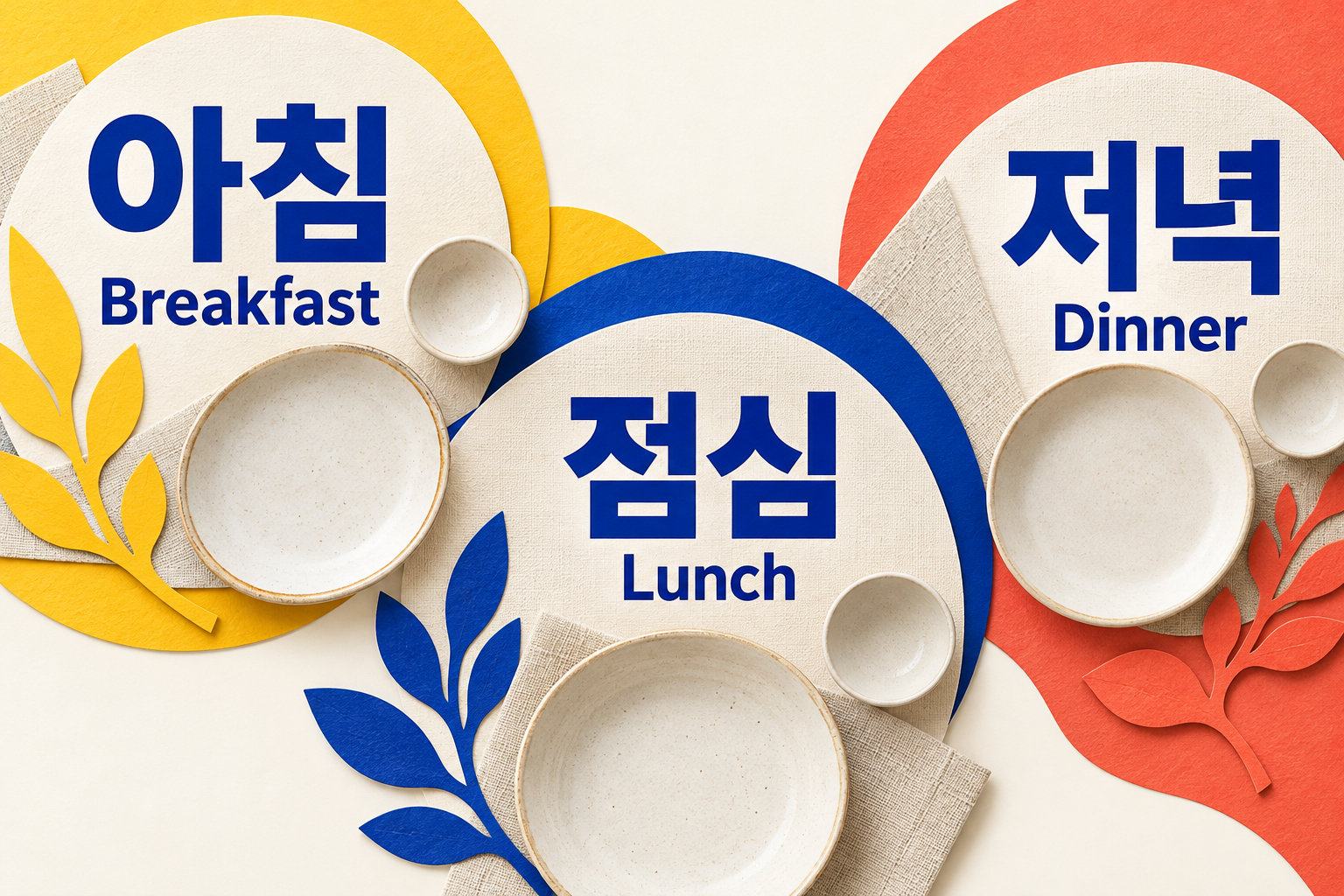
Breakfast in Korean is 아침 (achim), lunch is 점심 (jeomsim), and dinner is 저녁 (jeonyeok). But 아침 inside a message may mean the morning rather than the meal. A few words around it can change what a meeting plan asks you to do.
My own classic misunderstanding: a Korean friend texted 아침에 봐! — see you in the morning — and I showed up at her door with a bag of groceries for breakfast. She meant eight a.m. for a hike, not toast. The words around 아침 decide the meal, exactly as this page shows.

Name the meal you mean.
식사 means a meal. The combinations 아침 식사, 점심 식사, and 저녁 식사 make the meal meaning explicit.
The shorter words also name parts of the day: 아침 can mean morning, 점심 can refer to midday or lunchtime, and 저녁 can mean evening. An eating verb makes the meal sense clear in 아침을 먹어요—“I eat breakfast.” Here, 먹어요 means “eat,” and 을 marks what is eaten.
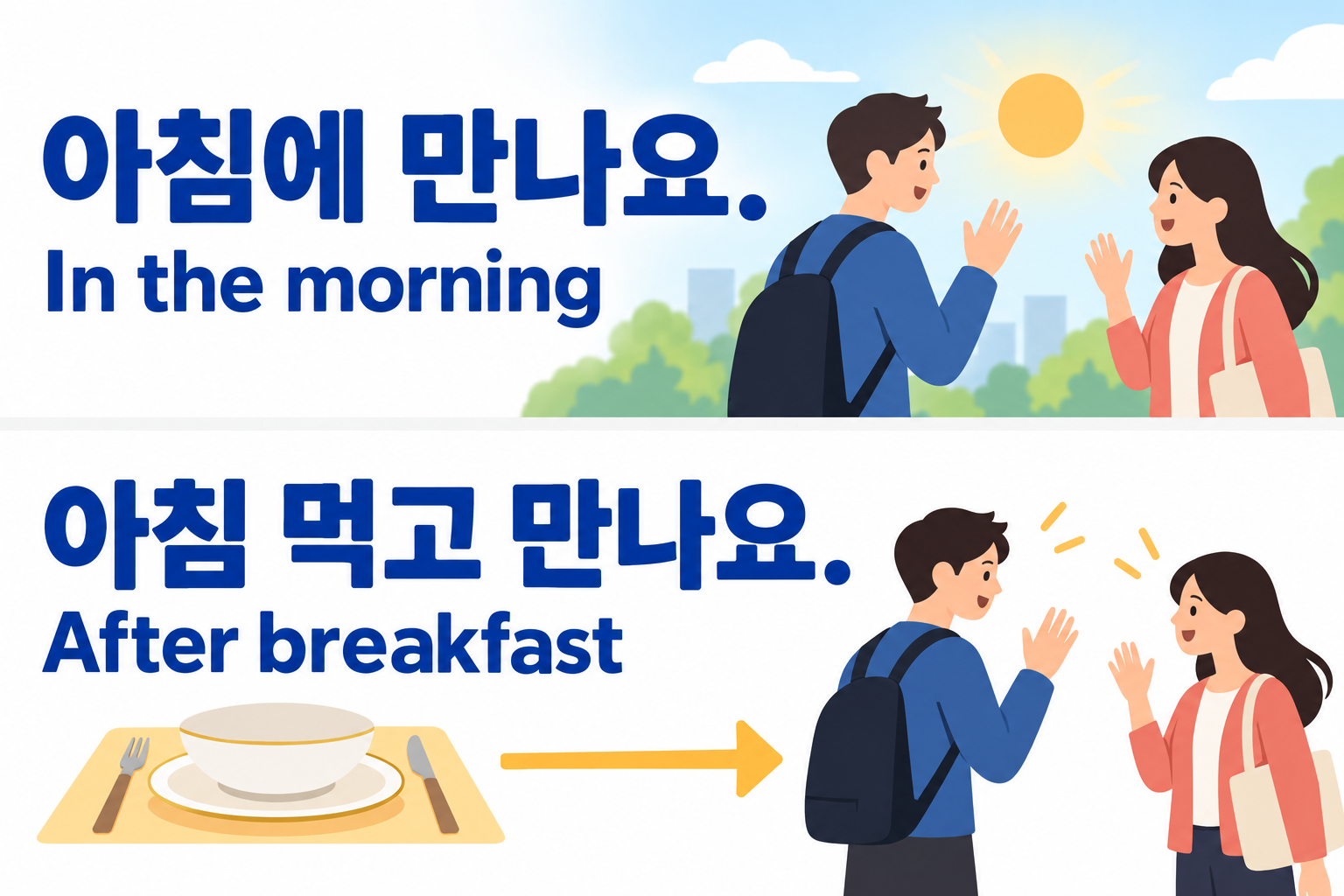
Meeting in the morning or after breakfast
Imagine arranging a meeting. Compare these two messages:
아침에 만나요.
Let’s meet in the morning.
아침 먹고 만나요.
Let’s meet after breakfast.
The first message puts the meeting within the morning. The particle 에 marks when the meeting happens. Nothing in that sentence requires eating first.
In the second, 먹고 connects eating with meeting. The verb 먹다 means “eat”; its ending -고 links the actions in sequence here.
Meeting before eating can fit the first message, as long as it is morning. It reverses the order in the second.
Neither message gives an exact clock time. The second also leaves the gap between the two actions unstated: “after” does not mean “immediately after.”
Read 중식 under its heading.
The meal labels 조식, 중식, and 석식 offer another way to name the three meals. Read them in these sample labels:
Meals: 조식 · 중식 · 석식
Breakfast · Lunch · Dinner
Cuisine: 중식
Chinese food
In the first label, the heading and neighboring words organize the day’s meals. 중식 fills the lunch slot between the other two. In the second, the heading asks what kind of food it is, so the same written word means Chinese food.
The lunch label does not tell you the cuisine. The cuisine label does not tell you which meal of the day it is.
Meal Names at a Glance
| Korean | Meaning | Typical place you meet it |
|---|---|---|
| 아침 / 점심 / 저녁 | morning (or breakfast) / midday (or lunch) / evening (or dinner) | Everyday conversation and messages |
| 아침 식사 / 점심 식사 / 저녁 식사 | The meal meaning, made explicit | Written plans, polite invitations |
| 조식 / 중식 / 석식 | Breakfast / lunch / dinner, label style | Hotel signs, event schedules, cafeterias |
| 중식 (in a cuisine tag) | Chinese food | Restaurant listings |
Frequently Asked Questions
Is 아침 breakfast or morning?
Both, until the sentence narrows it. 아침에 만나요 puts a meeting inside the morning; 아침을 먹어요 puts food inside it. When the ambiguity could actually matter, 아침 식사 removes the doubt in two syllables.
Why does 중식 mean lunch in one place and Chinese food in another?
The heading does the deciding. Under a 조식 · 중식 · 석식 schedule it fills the lunch slot; beside Korean food and Japanese food it names a cuisine. Read the sign around the word, not just the word.
Does 아침 먹고 만나요 mean we meet right after eating?
It sets the order — breakfast, then meet — without promising the gap. If the exact timing matters, add a time like 9시에 and let the sequence do the rest.
That is the whole trick of meal words in Korean: the day's three meals ride on short words that lean on their neighbors for meaning. Learn the 식사 forms and the 조식·중식·석식 labels, and no hotel buffet schedule or morning text will catch you out again.
'Real Korean Language & Everyday Korea' 카테고리의 다른 글
| Ondol: How Korean Floors Carry Heat and Hold It (0) | 2026.11.10 |
|---|---|
| How to Say Cheers in Korean and Make a Short Toast (0) | 2026.11.09 |
| Maknae Meaning: Who Is Youngest and What the Label Says (0) | 2026.11.09 |
| No in Korean: 아니요, 아니에요, and 안 돼요 in Full Sentences (0) | 2026.11.07 |
| Korean Table Manners: When to Start and How to Share (0) | 2026.11.06 |
| Jjimjilbang: Where to Change, Meet Up, and Pay for Extras (0) | 2026.11.06 |
| Dad in Korean: Appa, Abeoji, and Using Them in a Sentence (0) | 2026.11.05 |
| Money in Korean: Using 돈 for Cash, Costs, and Payment (0) | 2026.11.04 |


