Korean Reading Practice: Two Short Stories With Answers Explained
Reading a Korean sentence is one thing. Understanding who did what, where it happened, and why something happened is another. You might recognize every word in a sentence and still misunderstand the story because of a small particle or verb ending.
This Korean reading practice uses two original short stories set in familiar everyday situations. The first follows a student visiting a café before class. The second takes place during a weekend trip to a traditional market. Both stories use beginner-friendly vocabulary and sentence structures, with a gradual increase in reading difficulty.
Each passage includes comprehension questions and explanations that show how to find the answer in the Korean text. Instead of relying only on English translations, you will learn to recognize subjects, objects, locations, time expressions, and the clues that connect one sentence to the next.
Before You Start: Four Things to Recognize
You do not need advanced grammar to understand these stories. A few basic patterns will help you follow the sentences.
1. 은/는 and 이/가: What Is the Sentence About?
Korean often marks nouns with particles. Two common pairs are 은/는 and 이/가.
- 은/는 introduces or emphasizes the topic of a sentence.
- 이/가 marks the grammatical subject.
For example:
- 민지는 학생이에요. — Minji is a student.
- 날씨가 좋아요. — The weather is nice.
In the first sentence, 민지는 identifies Minji as the topic. In the second, 날씨가 marks the weather as the subject of the description.
2. 을/를: What Receives the Action?
The particles 을 and 를 commonly mark the object of an action.
- 책을 읽어요. — I read a book.
- 커피를 마셔요. — I drink coffee.
책을 and 커피를 identify what is being read and drunk. This can help you distinguish the person performing an action from the thing involved in it.
3. 에 and 에서: Destination or Place of Action?
These particles can both appear with place names, but they serve different purposes.
- 학교에 가요. — I go to school.
- 학교에서 공부해요. — I study at school.
에 marks the destination in the first example. 에서 marks the place where the studying happens in the second.
4. Basic Verb Endings
Look for the ending of a verb to understand when an action happens.
| Ending | Example | Meaning |
|---|---|---|
| -아요 / -어요 | 먹어요 | Eat / am eating |
| -았어요 / -었어요 | 먹었어요 | Ate |
| -(으)ㄹ 거예요 | 먹을 거예요 | Will eat |
These endings help you place events in time. When reading a story, notice whether a sentence describes something happening now, something that already happened, or a plan for later.
Story 1: A Morning at the Café
Difficulty: Beginner
민지는 아침에 일찍 일어났어요. 오늘은 친구 수진이와 함께 학교에 가기로 했어요. 민지는 집에서 나가기 전에 가방을 확인했어요. 책과 공책은 있었지만 지갑이 없었어요.
민지는 방으로 돌아가 책상 위를 살펴봤어요. 지갑은 책 옆에 있었어요. 민지는 지갑을 가방에 넣고 집을 나왔어요.
학교에 가는 길에 민지는 작은 카페에 들렀어요. 민지는 따뜻한 라테 한 잔을 주문했어요. 카페에는 손님이 많지 않았어요. 민지는 창가에 앉아서 커피를 마셨어요.
잠시 후 친구 수진이에게 전화가 왔어요.
수진: 민지야, 지금 어디야?
민지: 카페에 있어. 커피를 마시고 있어.
수진: 학교 앞에서 기다릴게. 천천히 와!
민지: 알겠어. 조금 있다가 갈게.
민지는 커피를 다 마신 후 카페에서 나왔어요. 그리고 학교 앞에서 수진이를 만났어요. 두 사람은 함께 교실로 갔어요.
Story 1 Vocabulary
| Korean | Pronunciation | English |
|---|---|---|
| 아침 | achim | Morning |
| 일찍 | iljjik | Early |
| 일어나다 | ireonada | To get up |
| 함께 | hamkke | Together |
| 확인하다 | hwaginhada | To check |
| 지갑 | jigap | Wallet |
| 책상 | chaeksang | Desk |
| 옆 | yeop | Beside |
| 주문하다 | jumunhada | To order |
| 창가 | changga | By the window |
| 기다리다 | gidarida | To wait |
| 조금 있다가 | jogeum itdaga | In a little while |
| 만나다 | mannada | To meet |
Story 1: Comprehension Questions
Try answering the questions using the Korean passage. Pay attention to the particles and verb endings rather than looking only for familiar vocabulary.
Question 1. Why did Minji return to her room?
- She forgot her books.
- She could not find her wallet.
- She wanted to drink coffee.
- She wanted to call Sujin.
Question 2. Where was the wallet?
- Inside her bag.
- Beside her notebook.
- On the desk beside the book.
- At the café.
Question 3. What did Minji order?
- A cup of warm latte.
- An iced Americano.
- A sandwich.
- A cup of tea.
Question 4. Where did Sujin say she would wait?
- Inside the café.
- At Minji's house.
- In the classroom.
- In front of the school.
Question 5. What did Minji do after finishing her coffee?
- She went home.
- She called Sujin.
- She left the café and met Sujin.
- She returned to her room.
Story 1: Answers and Explanations
1. B — She could not find her wallet.
The important sentence is:
책과 공책은 있었지만 지갑이 없었어요.
This means that she had her book and notebook, but her wallet was missing. The word 있었지만 connects two contrasting situations: the books were there, but the wallet was not. The next sentence confirms the reason for returning to the room: 민지는 방으로 돌아가 책상 위를 살펴봤어요.
2. C — On the desk beside the book.
Look at this sentence:
지갑은 책 옆에 있었어요.
책 means book, 옆 means beside, and 에 marks the location. The sentence places the wallet beside the book. It does not say that the wallet was already inside her bag; she puts it there afterward.
3. A — A cup of warm latte.
The passage says:
민지는 따뜻한 라테 한 잔을 주문했어요.
따뜻한 means warm, 라테 means latte, and 한 잔 is a counter phrase for one cup or glass. The object marker 을 connects the ordered item to 주문했어요, meaning ordered. Together, these words identify her drink.
4. D — In front of the school.
Sujin says:
학교 앞에서 기다릴게.
학교 앞 means in front of the school. The particle 에서 marks the place where the waiting will happen. The verb 기다릴게 expresses Sujin's intention to wait there.
5. C — She left the café and met Sujin.
The final part of the story says:
민지는 커피를 다 마신 후 카페에서 나왔어요. 그리고 학교 앞에서 수진이를 만났어요.
다 마신 후 means after finishing the drink. 카페에서 나왔어요 means she came out of the café, and 학교 앞에서 수진이를 만났어요 tells us where she met Sujin. The two sentences establish the order of events.
Look Closer: What the Particles Tell You
There are several useful clues in this story.
- 지갑이 없었어요 identifies the missing item with 이.
- 책 옆에 있었어요 identifies where the wallet was.
- 라테 한 잔을 주문했어요 identifies what Minji ordered.
- 학교 앞에서 기다릴게 identifies where Sujin plans to wait.
- 수진이를 만났어요 identifies the person Minji met.
Notice that the location particle changes with the action. The wallet is located beside a book, Minji drinks coffee at a café, and Sujin waits in front of the school. Reading the noun and its particle together helps you follow each event.
Story 2: A Weekend Visit to the Market
Difficulty: Beginner to lower-intermediate
지난 토요일에 준호는 어머니와 함께 전통시장에 갔어요. 두 사람은 집에서 아침을 먹은 후 버스를 타고 시장으로 갔어요. 시장에는 과일과 채소를 파는 가게가 많았어요. 사람들도 많아서 조금 복잡했어요.
준호의 어머니는 사과와 바나나를 사고 싶었어요. 먼저 과일 가게에 갔어요. 사과는 한 봉지에 오천 원이었고 바나나는 한 송이에 삼천 원이었어요.
어머니는 사과 한 봉지와 바나나 한 송이를 샀어요. 준호는 어머니가 물건을 고르는 동안 옆 가게를 구경했어요. 그 가게에서는 작은 빵과 떡을 팔았어요.
준호는 떡을 좋아해서 떡 한 상자를 샀어요. 어머니는 준호에게 집에 가서 가족과 함께 먹자고 했어요. 두 사람은 시장에서 필요한 물건을 모두 산 후 버스 정류장으로 갔어요.
집에 도착했을 때는 오후였어요. 어머니는 과일을 씻었고 준호는 떡을 접시에 담았어요. 가족은 함께 앉아서 과일과 떡을 먹었어요.
Story 2 Vocabulary
| Korean | Pronunciation | English |
|---|---|---|
| 지난 | jinan | Last / previous |
| 토요일 | toyoil | Saturday |
| 전통시장 | jeontongsijang | Traditional market |
| 버스 | beoseu | Bus |
| 채소 | chaeso | Vegetables |
| 복잡하다 | bokjaphada | To be crowded / complicated |
| 사과 | sagwa | Apple |
| 바나나 | banana | Banana |
| 한 봉지 | han bongji | One bag |
| 한 송이 | han songi | One bunch |
| 고르다 | goreuda | To choose |
| 구경하다 | gugyeonghada | To look around / browse |
| 떡 | tteok | Korean rice cake |
| 상자 | sangja | Box |
| 정류장 | jeongnyujang | Bus stop |
| 도착하다 | dochakhada | To arrive |
| 씻다 | ssitda | To wash |
| 담다 | damda | To put / place into |
Story 2: Comprehension Questions
Read the story again and use the details about time, location, and actions to choose your answers.
Question 1. When did Junho visit the traditional market?
- Last Friday.
- Last Saturday.
- Sunday morning.
- Saturday evening.
Question 2. How did Junho and his mother travel to the market?
- By taxi.
- By subway.
- By bus.
- On foot.
Question 3. How much did one bag of apples cost?
- Three thousand won.
- Four thousand won.
- Five thousand won.
- Eight thousand won.
Question 4. What did Junho do while his mother chose the fruit?
- He looked around the neighboring shop.
- He went to the bus stop.
- He bought some vegetables.
- He waited at home.
Question 5. What did Junho buy?
- A bag of apples.
- A bunch of bananas.
- A box of rice cakes.
- A box of bread.
Question 6. What did the family do after arriving home?
- They went back to the market.
- They ate fruit and rice cakes together.
- They cooked dinner on the bus.
- They put all the food away without eating.
Story 2: Answers and Explanations
1. B — Last Saturday.
The opening sentence says:
지난 토요일에 준호는 어머니와 함께 전통시장에 갔어요.
지난 means last or previous, and 토요일 means Saturday. The particle 에 marks the time when the event happened. The verb 갔어요 is the past form of 가다, meaning went. These clues establish that the visit took place last Saturday.
2. C — By bus.
Look at the sentence:
두 사람은 집에서 아침을 먹은 후 버스를 타고 시장으로 갔어요.
버스를 타다 means to take or ride a bus. The object particle 를 marks the bus as the object of 타다, meaning “to ride.” The phrase 시장으로 갔어요 tells us that they went toward the market.
3. C — Five thousand won.
The passage gives two prices:
사과는 한 봉지에 오천 원이었고 바나나는 한 송이에 삼천 원이었어요.
오천 원 means 5,000 won, while 삼천 원 means 3,000 won. The important distinction is between 한 봉지, one bag, and 한 송이, one bunch. The first price belongs to the bag of apples.
4. A — He looked around the neighboring shop.
The relevant sentence is:
준호는 어머니가 물건을 고르는 동안 옆 가게를 구경했어요.
동안 means while or during. The phrase 어머니가 물건을 고르는 동안 describes the time when his mother was choosing the items. 옆 가게 means the neighboring shop, and 구경했어요 means he looked around or browsed.
The sentence describes two actions happening at the same time: his mother chose the fruit while Junho looked around another shop.
5. C — A box of rice cakes.
The passage says:
준호는 떡을 좋아해서 떡 한 상자를 샀어요.
떡 means Korean rice cake. 한 상자 means one box, and 샀어요 is the past form of 사다, meaning bought. The sentence directly identifies what Junho purchased and how much he bought.
6. B — They ate fruit and rice cakes together.
Read the final sentence:
가족은 함께 앉아서 과일과 떡을 먹었어요.
가족 means family, 함께 means together, and 과일과 떡 means fruit and rice cakes. The verb 먹었어요 means ate. The earlier sentences explain how the food was prepared: his mother washed the fruit and Junho placed the rice cakes on a plate.
Look Closer: Following Actions and Time
Story 2 contains several expressions that connect events in sequence or describe actions happening at the same time.
- 먹은 후 — After eating. 후 indicates that another event follows.
- 고르는 동안 — While choosing. 동안 describes the period in which an action takes place.
- 산 후 — After buying. This connects shopping with the next activity.
- 집에 도착했을 때 — When they arrived home. 때 identifies the time of an event.
- 씻었고 — Washed, and. The ending -고 connects this action to the next one.
These expressions help you follow the order of events without treating every sentence as an isolated statement. In particular, 동안 connects two activities that overlap, while 후 places one activity after another.
How to Improve Your Korean Reading Skills
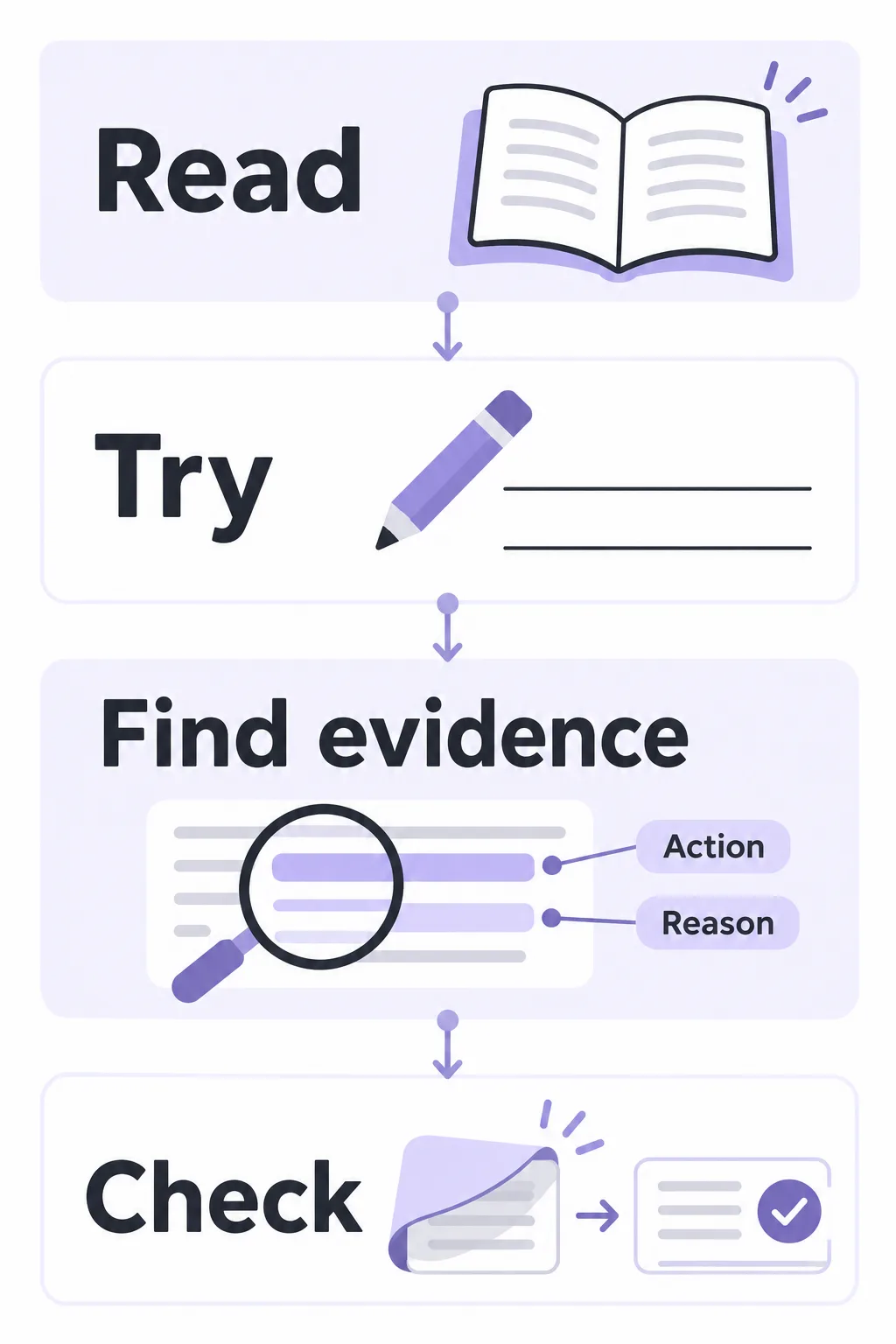
When you read a short Korean passage, translating every word immediately can make it harder to understand the whole situation. Try following the sentence structure first.
1. Find the Main People and Things
Look for names and nouns that appear repeatedly. In the first story, 민지, 수진이, 지갑, and 카페 help establish who is involved and what the story is about. In the second, 준호, 어머니, 시장, and 떡 provide the main characters and objects.
2. Pay Attention to Particles
Particles help identify the roles of nouns. When you see 을/를, look for the action and the object involved. When you see 에 or 에서, check whether the sentence describes a destination, a time, or the place where an action happens.
3. Notice Verb Endings
Verb endings often tell you whether an event has already happened or is planned. For example, 갔어요 describes a completed visit, while 기다릴게 expresses an intention to wait. Recognizing these forms makes the timeline easier to follow.
4. Connect Sentences Instead of Reading Them Separately
A sentence may introduce an object that becomes important in the next sentence. In Story 1, the missing wallet explains why Minji returns to her room. In Story 2, the fruit and rice cakes bought at the market appear again when the family eats together at home.
Look for these connections. They often explain why a character does something, even when the reason is not repeated in every sentence.
Frequently Asked Questions
Is this Korean reading practice suitable for complete beginners?
Yes. The stories use common everyday vocabulary and basic grammar patterns. If you are new to Korean, start with the vocabulary tables and the explanations of particles before reading each passage. You can gradually work toward understanding the sentences without translating every word.
Should I read the Korean story before looking at the English explanations?
Yes. Try reading the Korean passage first and identify the people, places, actions, and time expressions. Then answer the questions before checking the explanations. This helps you see which details you understood and which sentence clues you overlooked.
How can I use short stories to improve Korean reading?
Read a passage more than once, but give each reading a purpose. First, understand the general situation. Next, examine unfamiliar vocabulary and particles. Finally, return to the questions and locate the Korean sentences that support each answer. This connects vocabulary recognition with actual reading comprehension.
What should I do if I understand the vocabulary but cannot understand the sentence?
Start by identifying the main verb. Then look at the particles attached to the nouns to determine who performs the action and what is involved. Check time expressions such as 후 and 동안 to understand how events connect. A sentence often becomes clearer when you identify these relationships rather than translating its words one by one.
'Real Korean Language & Everyday Korea' 카테고리의 다른 글
| Korean Colors: Names and Simple Ways to Describe What You See (0) | 2026.11.08 |
|---|---|
| Korean Adjectives: From Big and Small to Clear Descriptions (0) | 2026.11.07 |
| No in Korean: 아니요, 아니에요, and 안 돼요 in Full Sentences (0) | 2026.11.07 |
| Korean Table Manners: When to Start and How to Share (0) | 2026.11.06 |
| Jjimjilbang: Where to Change, Meet Up, and Pay for Extras (0) | 2026.11.06 |
| Korean Chopsticks: A Steady Grip and a Bowl of Bibimbap (0) | 2026.11.05 |
| Dad in Korean: Appa, Abeoji, and Using Them in a Sentence (0) | 2026.11.05 |
| Money in Korean: Using 돈 for Cash, Costs, and Payment (0) | 2026.11.04 |


